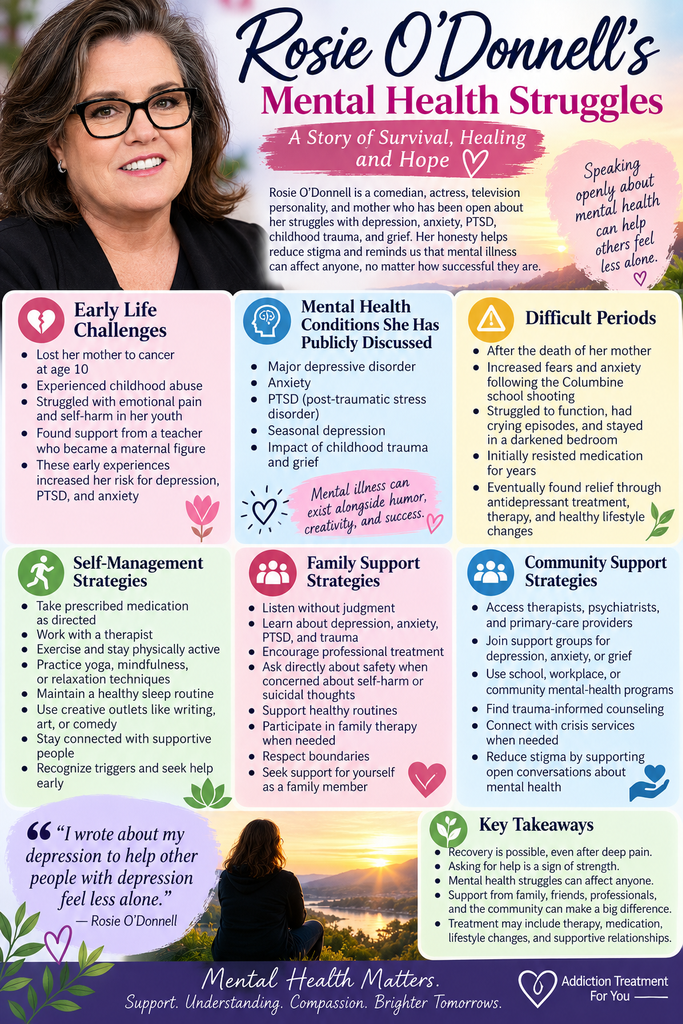
Rosie O’Donnell is a comedian, actress, television personality, and mother who has spoken unusually openly about her mental health. Unlike many celebrity stories that rely on speculation, O’Donnell has publicly identified her struggles with major depressive disorder, PTSD, anxiety, childhood trauma, and seasonal depression. In a 2026 interview, she again described herself as having major depressive disorder and explained that episodes can significantly affect her life and ability to parent.
Her experiences demonstrate an important truth about mental illness: a person can appear funny, successful, confident, and energetic while privately experiencing significant emotional pain.
Childhood Trauma, Grief, and Emotional Pain
One of the most significant events in O’Donnell’s childhood was the death of her mother from cancer when Rosie was only 10. She has described losing her mother as a defining event in her life. O’Donnell has also publicly discussed childhood abuse and recalled deliberately physically hurting herself when emotional pain became overwhelming.
Childhood trauma and bereavement can have effects that continue into adulthood. They do not determine a person’s future, but unresolved trauma can influence emotional regulation, relationships, self-esteem, anxiety, and responses to stressful situations.
O’Donnell has also described the importance of a teacher who became a maternal figure during her adolescence. She has said this relationship provided affection and support that she desperately needed after losing her mother.
Her experience illustrates how one supportive adult can make a meaningful difference in a young person’s life.
Living With Depression
O’Donnell has discussed experiencing depression for many years. She previously explained that she spent approximately a decade seeing different therapists while resisting their recommendations that she consider medication. She eventually began antidepressant treatment and publicly described medication as transformative.
A particularly difficult period occurred following the 1999 Columbine school shooting. O’Donnell described becoming consumed by fears about her children’s safety, waking repeatedly during the night, struggling to function, crying, remaining in a darkened bedroom, and eventually beginning medication.
Her experience illustrates why depression should not be confused with ordinary sadness. Clinical depression can affect sleep, energy, concentration, motivation, relationships, parenting, and a person’s ability to complete everyday activities.
Self-Management Strategies
O’Donnell has discussed combining professional treatment with activities that helped her manage her emotional health. She has spoken about medication, therapy, movement, and yoga. She has particularly emphasized the importance of getting physically active when depression makes everything seem emotionally “gray.”
For people managing depression, trauma, or anxiety, self-management strategies may include:
- Establishing consistent sleeping and waking schedules.
- Exercising regularly, even when motivation is low.
- Recognizing situations that intensify depression or anxiety.
- Maintaining contact with supportive people rather than completely isolating.
- Using creative outlets such as writing, art, music, comedy, or journaling.
- Practicing relaxation, mindfulness, or other healthy stress-management techniques.
- Limiting alcohol or other substances that can worsen mental-health symptoms.
- Continuing prescribed medication rather than stopping it without discussing the change with a healthcare professional.
- Working with a therapist to develop coping strategies for trauma, grief, depression, or anxiety.
- Seeking additional help when symptoms begin interfering with work, parenting, relationships, sleep, or personal safety.
Self-management is not the same as treating serious depression alone. Healthy habits can complement professional care, but severe or persistent symptoms deserve clinical evaluation.
The Importance of Family Support
Mental illness can affect an entire family. O’Donnell has spoken about how her depression has sometimes affected her ability to parent. She has also discussed attending therapy with her son during a difficult stage in their relationship.
Families supporting someone with depression can help by:
- Listening without immediately criticizing or trying to fix everything.
- Learning about depression, anxiety, PTSD, and trauma.
- Recognizing that withdrawal or low motivation may be symptoms rather than rejection.
- Encouraging treatment without shaming the person for needing help.
- Asking directly about safety when there are concerns about self-harm or suicide.
- Supporting healthy routines and social connection.
- Respecting appropriate boundaries.
- Participating in family therapy when relationship difficulties are affecting recovery.
- Seeking their own counseling or support when caregiving becomes emotionally exhausting.
Family support does not mean taking responsibility for another person’s recovery. Healthy support combines compassion with boundaries and professional assistance when necessary.
Community Support Strategies
O’Donnell’s childhood story demonstrates how support can come from outside the immediate family. She has credited teachers and other adults with providing important emotional connections after her mother’s death.
Community support for someone experiencing mental-health difficulties may include:
- Primary-care and behavioral-health professionals.
- Psychiatrists and therapists.
- Trauma-informed counseling programs.
- Depression and grief support groups.
- School counselors and trusted teachers.
- Workplace mental-health programs.
- Peer-support organizations.
- Community mental-health centers.
- Crisis-intervention services.
Communities can also help by reducing the stigma surrounding therapy and psychiatric medication. O’Donnell has specifically spoken publicly about overcoming her own reluctance to use antidepressants and about how important medication became in her treatment.
Turning Pain Into Connection
One striking aspect of O’Donnell’s journey is her willingness to discuss experiences that many people hide. When she first publicly wrote about depression, she explained that part of her motivation was helping other people with depression feel less alone.
Speaking openly cannot replace treatment, but reducing secrecy can reduce stigma. When public figures discuss mental illness responsibly, they can remind people that depression does not discriminate according to wealth, fame, career success, or personality.
Someone who makes other people laugh can still experience depression. A devoted parent can still struggle emotionally. A successful person can still need medication or therapy.
Lessons From Rosie O’Donnell’s Journey
O’Donnell’s experiences provide several broader lessons about mental health. Childhood trauma can continue influencing emotional well-being decades later, and grief does not necessarily disappear simply because many years have passed. Depression can also recur, making continued awareness and treatment important.
Her story additionally shows that finding the right approach may take time. O’Donnell initially resisted medication despite years of therapy before eventually accepting it as part of her treatment.
Recovery therefore does not have to follow a perfect or straight path. Treatment may involve therapy, medication, lifestyle changes, supportive relationships, community resources, or a combination of approaches tailored to the individual.
Conclusion
Rosie O’Donnell’s mental-health journey includes childhood grief and trauma, depression, anxiety, PTSD, treatment, parenting challenges, and years of learning how to manage her emotional health. Her openness demonstrates that mental illness can exist alongside humor, creativity, professional achievement, and strong relationships.
Self-management strategies can help people recognize triggers and maintain healthier routines. Families can provide compassion, stability, and encouragement while maintaining appropriate boundaries. Communities can provide professional treatment, peer connection, education, and crisis resources.
Perhaps the most important lesson is that asking for help is not a failure of strength. Mental-health recovery often involves recognizing when personal coping strategies are no longer enough and allowing other people—family members, friends, therapists, physicians, teachers, and community organizations—to become part of the support system.
Safety note: Anyone experiencing thoughts of suicide or self-harm should seek immediate assistance. In the United States, call or text 988 to reach the Suicide & Crisis Lifeline.
Frequently Asked Questions
Here are some common questions:
1. Has Rosie O’Donnell publicly discussed mental health struggles?
Yes. Rosie O’Donnell has spoken publicly about depression, anxiety, PTSD, childhood trauma, grief, and periods when her symptoms made everyday functioning difficult. Her openness has helped bring attention to the reality that mental illness can affect people regardless of success, humor, or public image.
2. Has Rosie O’Donnell experienced depression?
Yes. O’Donnell has publicly described living with major depressive disorder. She has discussed periods of intense sadness, crying, withdrawal, difficulty functioning, and feeling as though the world had lost its emotional color.
3. What childhood experiences affected Rosie O’Donnell?
O’Donnell lost her mother to cancer when she was 10 years old. She has also publicly discussed childhood abuse and emotional difficulties during her youth. Losing a parent and experiencing childhood trauma can have long-lasting effects on emotional well-being.
4. Has Rosie O’Donnell talked about self-harm?
Yes. O’Donnell has described deliberately hurting herself when she was younger as a way of dealing with overwhelming emotional pain. Self-harm should always be taken seriously because it can indicate significant emotional distress.
5. Has Rosie O’Donnell experienced PTSD?
O’Donnell has publicly identified PTSD among her mental-health struggles. PTSD can develop after exposure to traumatic experiences and may involve intrusive memories, avoidance, emotional distress, sleep problems, heightened alertness, and changes in mood.
6. Did Rosie O’Donnell initially resist taking medication for depression?
Yes. O’Donnell has said that therapists recommended medication for years before she was willing to try it. She later described antidepressant treatment as an important part of managing her depression. Medication decisions should always be individualized and discussed with a qualified healthcare professional.
7. What self-management strategies can help with depression and trauma?
Helpful strategies may include regular exercise, adequate sleep, structured routines, mindfulness, yoga, creative activities, maintaining supportive relationships, recognizing emotional triggers, and limiting isolation. These strategies can complement professional treatment rather than replace it.
8. Why is professional treatment important?
Depression, PTSD, anxiety, and trauma can significantly interfere with relationships, parenting, employment, sleep, and everyday functioning. Psychotherapy, medication when appropriate, and other evidence-based treatments can help people understand symptoms and develop healthier coping strategies.
9. How can family members support someone experiencing depression?
Family members can listen without judgment, learn about the condition, encourage treatment, support healthy routines, and maintain appropriate boundaries. They should also take statements about suicide or self-harm seriously rather than dismissing them.
10. How can childhood trauma continue affecting someone in adulthood?
Childhood trauma can influence emotional regulation, relationships, self-esteem, responses to stress, and feelings of safety. However, trauma does not determine a person’s future. Therapy, supportive relationships, healthy coping strategies, and safe environments can promote recovery.
11. How did losing her mother influence Rosie O’Donnell?
O’Donnell has repeatedly described losing her mother at a young age as an important event in her life. Childhood bereavement can affect a person’s understanding of attachment, security, family, and grief for many years.
12. Did supportive adults help Rosie O’Donnell when she was young?
O’Donnell has spoken about a teacher who became an important maternal figure during her adolescence. Her experience shows how teachers, relatives, mentors, counselors, and other trusted adults can support children experiencing grief or difficult family circumstances.
13. How can community resources support mental-health recovery?
Community support may include therapists, psychiatrists, primary-care professionals, trauma-informed programs, grief counseling, peer-support groups, school counselors, workplace programs, community mental-health centers, and crisis services.
14. Can someone be successful and still have serious depression?
Absolutely. Professional success does not protect someone from mental illness. A person can be productive, funny, creative, wealthy, or famous while privately experiencing significant depression, anxiety, grief, or trauma-related symptoms.
15. What can we learn from Rosie O’Donnell’s mental-health journey?
Her experiences demonstrate the importance of acknowledging emotional pain rather than hiding it. They also highlight how recovery may involve several forms of support, including therapy, medication when clinically appropriate, physical activity, meaningful relationships, family support, and community resources.
16. Is recovery from depression and trauma possible?
Many people experience substantial improvement with appropriate treatment and support. Recovery does not necessarily mean never experiencing another difficult period. It can mean recognizing symptoms earlier, developing healthier coping skills, staying in treatment when needed, and knowing when to ask for additional help.
17. Why does Rosie O’Donnell speaking publicly about mental health matter?
Public conversations can challenge the misconception that mental illness represents weakness. When people openly discuss treatment and recovery, others may feel less ashamed about seeking professional help.
18. What should someone do if depression becomes overwhelming?
Persistent depression, inability to function, severe hopelessness, self-harming behavior, or suicidal thoughts require professional attention. A mental-health professional or healthcare provider can evaluate symptoms and recommend appropriate treatment.
Safety note: If someone is in immediate danger or experiencing suicidal or self-harming thoughts in the United States, call or text 988 to reach the Suicide & Crisis Lifeline.
Video: