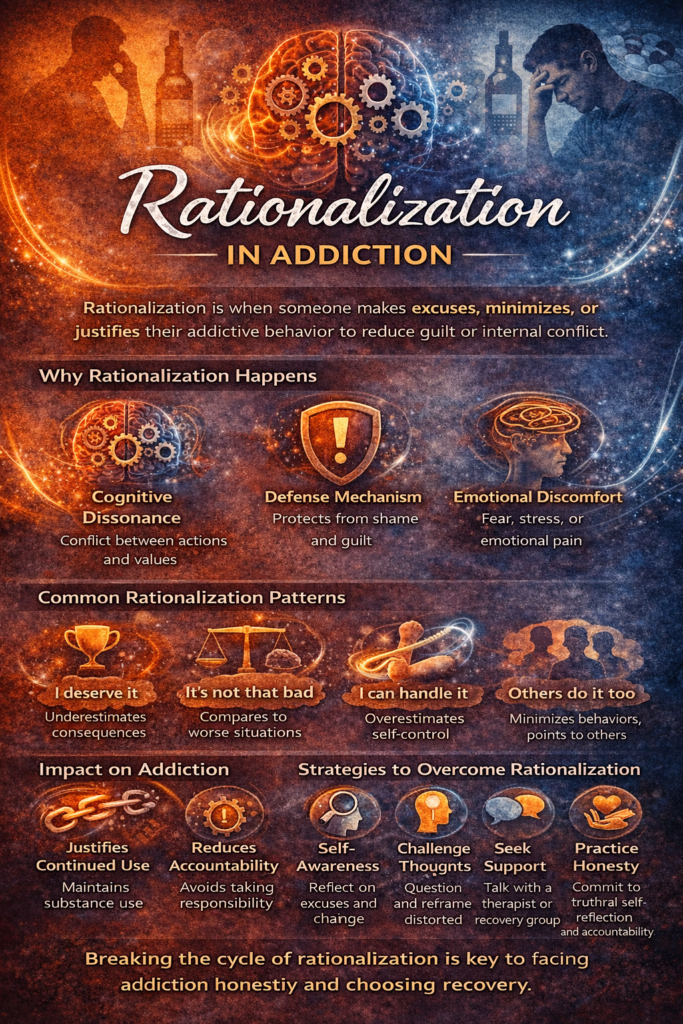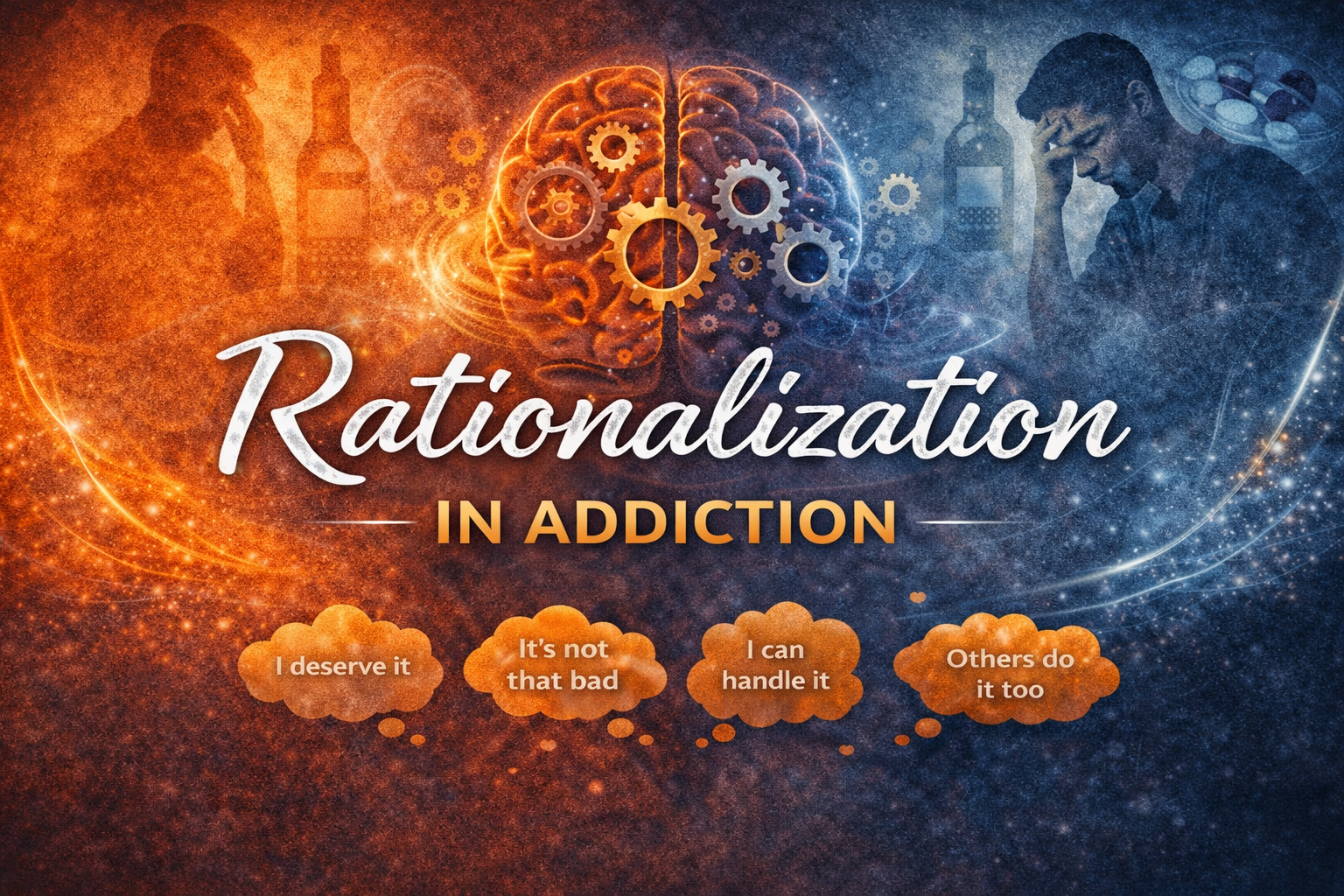
Rationalization plays a key role in addiction by enabling individuals to justify actions that go against their values, goals, or overall well-being. It works by generating explanations that seem logical on the surface, helping to ease feelings of guilt, shame, or inner conflict—often without full awareness. In this context, rationalization supports continued substance use by downplaying its effects or framing it as acceptable or deserved. Recognizing this process is important because it highlights how patterns of thinking can sustain harmful behavior, making it harder to fully acknowledge the problem and take steps toward meaningful change.
“The Rationalization Trap: Understanding Justification in Addiction”
Rationalization is one of the most powerful and often invisible psychological processes in addiction. It involves creating seemingly logical explanations to justify behaviors that may be harmful or self-destructive. In the context of addiction, rationalization allows individuals to continue substance use while minimizing internal conflict, guilt, or awareness of the problem. What makes it particularly challenging is that these justifications often feel believable, even convincing.
At a psychological level, rationalization is closely tied to cognitive dissonance—the discomfort that arises when behavior conflicts with personal values or beliefs. For example, someone may value health and responsibility but continue using substances. To reduce this tension, the mind generates explanations such as “I can stop anytime” or “I’m not as bad as others.” These thoughts temporarily relieve discomfort but ultimately reinforce the behavior.
Rationalization also functions as a defense mechanism, protecting individuals from feelings of shame, fear, or vulnerability. Instead of confronting the reality of addiction, the mind reframes it in a way that feels more manageable. While this may provide short-term emotional relief, it delays recognition of the problem and can prevent meaningful change.
Another important aspect is that rationalization is not always obvious. It can appear as subtle distortions in thinking, such as comparing oneself to others (“At least I’m not like them”), minimizing consequences (“It’s not affecting my life that much”), or justifying use based on circumstances (“I’ve had a stressful day—I deserve this”). Over time, these patterns become automatic, shaping how situations are interpreted and decisions are made.
In recovery, breaking the cycle of rationalization requires awareness and honesty. Individuals begin to recognize these thought patterns and question their validity. This process can be uncomfortable, as it involves confronting realities that were previously avoided. However, it is also a critical step toward regaining control and making more intentional choices.
Developing alternative thinking patterns is equally important. Instead of justifying behavior, individuals learn to tolerate discomfort, accept responsibility, and seek healthier ways to cope. This shift transforms the role of thinking—from protecting the addiction to supporting recovery.
Ultimately, understanding rationalization is about recognizing how the mind can work both for and against us. In addiction, it often serves to maintain harmful patterns. In recovery, it becomes an opportunity to develop greater self-awareness, clarity, and alignment between values and actions.
Key Points
- From short-term relief → long-term growth
What is Rationalization?
- Creating logical-sounding explanations for harmful behavior
- Reduces guilt and internal conflict
Connection to Cognitive Dissonance
- Conflict between values and actions
- Rationalization reduces psychological discomfort
Common Rationalization Patterns
- “I can stop anytime.”
- “It’s not that bad.”
- “I deserve this.”
- “Others have it worse.”
Role as a Defense Mechanism
- Protects against shame, fear, and vulnerability
- Avoids confronting the full impact of addiction
Why It’s Hard to Recognize
- Feels logical and believable
- Becomes automatic over time
Impact on Addiction
- Maintains substance use
- Delays recognition and change
Breaking the Cycle
- Increase self-awareness
- Question automatic thoughts
- Practice honesty and accountability
Healthy Alternatives
- Accept discomfort without justification
- Develop coping strategies
- Align actions with values
Core Mindset Shift
- From justifying → questioning
- From avoidance → awareness
“From Justification to Awareness: Self-Management Strategies for Rationalization in Addiction”
Rationalization in addiction can be one of the most difficult patterns to recognize and change because it often feels logical, justified, and even protective. It allows individuals to continue behaviors while reducing feelings of guilt, shame, or internal conflict. In recovery, however, addressing rationalization is essential—and this is where self-management strategies play a critical role. These strategies help individuals move from automatic thinking to intentional awareness and control.
The first step in self-management is developing self-awareness. Rationalization often operates beneath conscious awareness, showing up as quick thoughts like “It’s not that bad” or “I can handle it.” Learning to pause and examine these thoughts is key. Asking questions such as “Is this completely true?” or “What am I avoiding right now?” helps bring these patterns into awareness. This shift interrupts automatic thinking and creates space for more honest reflection.
Another important strategy is cognitive monitoring and reframing. Once rationalizations are identified, they can be challenged and replaced with more accurate, balanced thoughts. For example, replacing “I deserve this” with “This might feel good now, but it could set me back” helps align thinking with long-term goals. This process, often used in cognitive-behavioral approaches, strengthens the ability to think critically rather than reactively.
Emotional regulation is also central to managing rationalization. Many justifications are driven by discomfort—stress, anxiety, boredom, or emotional pain. Instead of addressing the emotion directly, the mind creates a reason to avoid it. Self-management involves learning to tolerate these feelings without acting on them. Techniques such as deep breathing, mindfulness, or talking to a support person can help process emotions without needing to justify behavior.
Another key component is accountability and honesty. Rationalization thrives in isolation and secrecy. Sharing thoughts with a trusted person—such as a sponsor, therapist, or peer—can help expose distorted thinking. Others can often recognize rationalizations more easily and provide a perspective that challenges them.
Delay and pause strategies are also effective. When a rationalizing thought appears, committing to wait before acting—whether for minutes, hours, or longer—reduces impulsivity. This pause allows the emotional intensity to decrease and gives space for more rational decision-making.
Self-management also includes tracking patterns and triggers. Certain situations—like stress, social pressure, or specific environments—may increase the likelihood of rationalization. Identifying these triggers helps individuals prepare and respond differently, rather than falling into automatic patterns.
Importantly, this process requires self-compassion and consistency. Rationalization is a learned behavior that takes time to change. There may be moments of slipping back into old thinking patterns, especially under stress. The goal is not perfection, but progress—gradually increasing awareness and choosing more honest, intentional responses.
Ultimately, self-management in this context is about reclaiming control over one’s thinking. Instead of allowing the mind to justify harmful behavior, individuals learn to question, reflect, and choose actions that align with their values. This shift transforms thinking from a tool that sustains addiction into one that supports recovery.
Key Self-Management Strategies
- Learn from setbacks without self-judgment
Self-Awareness
- Identify common rationalizing thoughts
- Ask reflective questions about honesty and intent
Cognitive Monitoring
- Notice automatic thoughts in real time
- Interrupt justification patterns
Cognitive Reframing
- Challenge distorted thinking
- Replace with balanced, reality-based thoughts
Emotional Regulation
- Recognize emotions driving rationalization
- Use healthy coping strategies (mindfulness, breathing)
Accountability
- Share thoughts with a trusted person
- Gain outside perspective to challenge rationalizations
Pause and Delay
- Wait before acting on urges
- Allow time for clarity and reduced emotional intensity
Trigger Identification
- Recognize situations that increase rationalization
- Prepare alternative responses
Honesty Practice
- Commit to truthful self-reflection
- Accept responsibility without minimizing
Consistency and Self-Compassion
- Expect gradual progress
“From Excuses to Insight: Family Strategies for Addressing Rationalization in Addiction”
Rationalization is a powerful psychological process in addiction, allowing individuals to justify behaviors that may be harmful while reducing feelings of guilt or internal conflict. For families, this can be especially frustrating—conversations may feel circular, accountability may seem avoided, and progress can feel stalled. However, understanding rationalization as a defense mechanism rather than intentional defiance is key to responding effectively. Family support strategies play an important role in helping shift these patterns toward greater honesty and awareness.
One of the most important strategies is recognizing rationalization without engaging in arguments. When a loved one minimizes or justifies their behavior, it can be tempting to correct, confront, or debate their reasoning. However, direct confrontation often leads to defensiveness and deeper entrenchment in the rationalization. Instead, calmly acknowledging the statement without agreeing helps prevent the cycle from escalating.
Maintaining clear and consistent boundaries is another critical approach. Rationalization often thrives when there are unclear limits or when consequences are inconsistent. Families can support recovery by defining acceptable behaviors and the actions they will take if boundaries are crossed. This shifts the focus away from debating the justification and toward consistent, reality-based responses.
Encouraging reflection rather than forcing insight is also effective. Instead of telling the individual that their thinking is wrong, families can ask open-ended questions like “How do you see this affecting you long-term?” or “What do you think might happen if this continues?” These questions promote self-awareness and allow the individual to begin challenging their own rationalizations.
Another key strategy is avoiding enabling behaviors. Rationalization often goes hand in hand with minimizing consequences. If family members step in to protect the individual from those consequences, it reinforces the belief that the behavior is manageable or justified. Allowing natural consequences—while still offering emotional support—helps align perception with reality.
Modeling honesty and accountability is equally important. Families can demonstrate direct communication and responsibility in their own behavior, creating an environment where honesty is normalized. This modeling can influence the individual over time, making it easier to shift away from patterns of justification.
Families should also focus on managing their own emotional responses. Feelings of frustration, anger, or helplessness are common, but reacting to these emotions can intensify conflict. Practicing calm, consistent responses helps reduce defensiveness and creates a more stable environment for change.
Encouraging external support is another valuable strategy. Therapy, counseling, or peer support groups provide structured settings in which rationalization can be addressed under professional guidance. In these environments, individuals are often more open to examining their thinking patterns.
Finally, it’s important for families to practice patience and realistic expectations. Rationalization is a deeply ingrained cognitive habit that does not change overnight. Progress may be gradual, with periods of resistance or relapse into old thinking patterns. Supporting long-term change requires consistency, understanding, and persistence.
Ultimately, family support in addressing rationalization is not about winning arguments—it’s about creating conditions where insight can develop. By focusing on boundaries, communication, and emotional regulation, families can help shift the dynamic from justification to awareness, supporting both recovery and healthier relationships.
Family Support Strategies
- Focus on long-term progress, not quick fixes
Recognize Rationalization Patterns
- Identify minimizing, denying, or justifying statements
- Avoid taking them personally
Avoid Arguing or Debating
- Do not try to “prove them wrong.”
- Stay calm and avoid escalating conflict
Set Clear Boundaries
- Define acceptable behaviors
- Follow through consistently with consequences
Encourage Reflection
- Ask open-ended, thought-provoking questions
- Support self-awareness rather than forcing insight
Avoid Enabling
- Do not shield from natural consequences
- Reinforce accountability
Model Honesty and Accountability
- Demonstrate direct, truthful communication
- Normalize taking responsibility
Manage Emotional Reactions
- Stay calm and consistent
- Avoid reacting from anger or frustration
Support External Help
- Encourage therapy or support groups
- Use structured environments for deeper insight
Practice Patience
- Understand that change takes time
“From Isolation to Insight: Community Resource Strategies for Addressing Rationalization in Addiction”
Rationalization in addiction can be difficult to recognize and even harder to challenge, especially when individuals rely on their own thinking to justify behaviors. Because these thought patterns often feel logical and convincing, breaking the cycle requires more than internal effort alone. This is where community resources become essential. They provide external perspective, structured guidance, and accountability—key elements in shifting from justification to awareness.
One of the most effective strategies is engaging with peer support groups, such as Alcoholics Anonymous or Narcotics Anonymous. These environments encourage honesty and self-reflection, often through shared experiences. Hearing others openly discuss their own rationalizations can help individuals recognize similar patterns in themselves. This process reduces denial and normalizes the challenge of distorted thinking, making it easier to confront.
Another critical resource is professional therapy, particularly approaches like Cognitive Behavioral Therapy. Therapy helps individuals identify and challenge irrational or distorted thoughts that support addiction. Through structured techniques, individuals learn to replace rationalizations with more accurate and constructive thinking patterns. This not only supports recovery but also strengthens long-term decision-making skills.
Community-based recovery programs and treatment centers also play an important role. These structured environments provide routines, expectations, and accountability, which limit the space for rationalization to thrive. In these settings, individuals are encouraged to take responsibility for their actions and engage in honest self-assessment, often with the support of trained professionals.
Educational workshops and recovery education programs are another valuable strategy. Learning about concepts like cognitive dissonance, defense mechanisms, and behavioral patterns helps individuals understand why rationalization occurs. This knowledge reduces confusion and empowers individuals to approach their thinking more critically.
Accountability networks, such as sponsors or recovery mentors, are especially powerful. These relationships create opportunities to process thoughts before acting on them. A sponsor or mentor can often identify rationalizations quickly and provide direct, honest feedback—something that is difficult to achieve in isolation.
Community resources also include family support groups, such as Al-Anon Family Groups. These groups help families understand rationalization from a systems perspective and learn how to respond without reinforcing it. This creates a more consistent and supportive environment for change.
Additionally, community mental health and social services can address underlying stressors—such as financial strain, housing instability, or mental health conditions—that often contribute to rationalization. By reducing these pressures, individuals are less likely to rely on justification as a coping mechanism.
Ultimately, community resources shift the process from internal justification to external reflection. They provide diverse perspectives, structured feedback, and consistent accountability—elements that are essential for breaking deeply ingrained thinking patterns. Recovery becomes not just an individual effort, but a shared process supported by connection, knowledge, and guidance.
Community Resource Strategies (Bullet Points)
- Stay consistent with support and resources
Engage in Peer Support Groups
- Join Alcoholics Anonymous or Narcotics Anonymous
- Learn from shared experiences and recognize similar thinking patterns
Seek Professional Therapy
- Use approaches like Cognitive Behavioral Therapy
- Identify and challenge rationalizing thoughts
Utilize Structured Recovery Programs
- Participate in outpatient or inpatient treatment
- Follow routines that promote accountability and honesty
Access Educational Resources
- Learn about cognitive dissonance and defense mechanisms
- Build awareness of how rationalization works
Develop Accountability Networks
- Connect with sponsors or mentors
- Process thoughts before acting on them
Support Family Involvement
- Encourage participation in Al-Anon Family Groups
- Help families respond effectively to rationalization
Use Community Support Services
- Access mental health care, housing, or financial assistance
- Reduce external stressors that reinforce justification
Promote Honest Reflection
- Shift from internal justification → external feedback
- Encourage openness and self-awareness
Focus on Long-Term Change
- Understand that changing thinking patterns takes time
Frequently Asked Questions
Here are some common questions:
1. What is rationalization in addiction?
Rationalization is the process of creating logical-sounding excuses to justify substance use or related behaviors. It helps reduce guilt or internal conflict, even if the reasoning is not fully accurate.
2. Why do people rationalize their substance use?
Rationalization helps manage:
- Shame or guilt
- Fear of consequences
- Internal conflict (wanting to stop but continuing)
It acts as a psychological “buffer” to avoid discomfort.
3. Is rationalization intentional or unconscious?
Often, it is unconscious. People usually believe their own justifications, which is why it can be difficult to recognize and challenge.
4. What are common examples of rationalization?
- “I can stop anytime.”
- “It’s not that bad.”
- “I deserve this after a hard day.”
- “Others are worse than me.”
5. How is rationalization related to cognitive dissonance?
Rationalization reduces cognitive dissonance, the discomfort felt when actions conflict with one’s values. It helps align thinking with behavior—without changing the behavior.
6. Why is rationalization dangerous in addiction?
It:
- Keeps the addiction going
- Prevents recognition of the problem
- Reduces accountability
- Delays recovery
7. How can someone tell if they are rationalizing?
Ask:
- Am I minimizing the impact?
- Am I comparing myself to others?
- Am I avoiding responsibility?
If the answer is yes, rationalization may be present.
8. Can rationalization exist in recovery, too?
Yes. It can show up as:
- Justifying risky situations
- Minimizing triggers
- Overestimating control
Recovery involves continuing to challenge these thoughts.
9. What is the difference between rationalization and denial?
- Denial = refusing to accept reality
- Rationalization = explaining or justifying reality
Both protect against addiction but operate differently.
10. How do you break the cycle of rationalization?
- Increase self-awareness
- Question automatic thoughts
- Practice honesty
- Seek outside perspective (therapy, support groups)
11. Why is outside feedback important?
Rationalizations often sound convincing internally. Others can:
- Spot distortions more easily
- Provide an objective perspective
- Challenge thinking patterns
12. What role does accountability play?
Accountability helps:
- Counter excuses
- Reinforce responsibility
- Build trust
It shifts focus from justification to action.
13. Why does rationalization feel so believable?
Because it is:
- Based on partial truth
- Emotionally driven
- Designed to reduce discomfort
This makes it feel logical, even when it’s misleading.
14. Can rationalization be replaced with healthier thinking?
Yes. Through practice, individuals can:
- Recognize distorted thoughts
- Replace them with balanced thinking
- Align actions with values
15. What is the biggest mindset shift in overcoming rationalization?
Moving from:
- “This is okay.” → “This has consequences.”
- “I’m justified.” → “I’m responsible.”
- “I’ll deal with it later.” → “I need to face this now.”
16. What’s the main takeaway about rationalization in addiction?
Rationalization is not just “making excuses”—it is a powerful thinking pattern that maintains addiction. Recognizing and challenging it is a key step toward honest, lasting recovery.
Conclusion
Addressing rationalization in addiction is a crucial part of the recovery process, as it involves shifting from automatic justification to conscious awareness and honesty. By learning to recognize and challenge these thought patterns, individuals can begin to align their actions more closely with their values and long-term goals. This transition requires patience, self-reflection, and often external support, but it opens the door to greater accountability and personal growth. Ultimately, overcoming rationalization is not just about changing thoughts—it is about creating a more truthful and intentional way of living that supports lasting recovery.
Video: How Rationalization Protects Your Addiction #AddictionTruth #Awareness