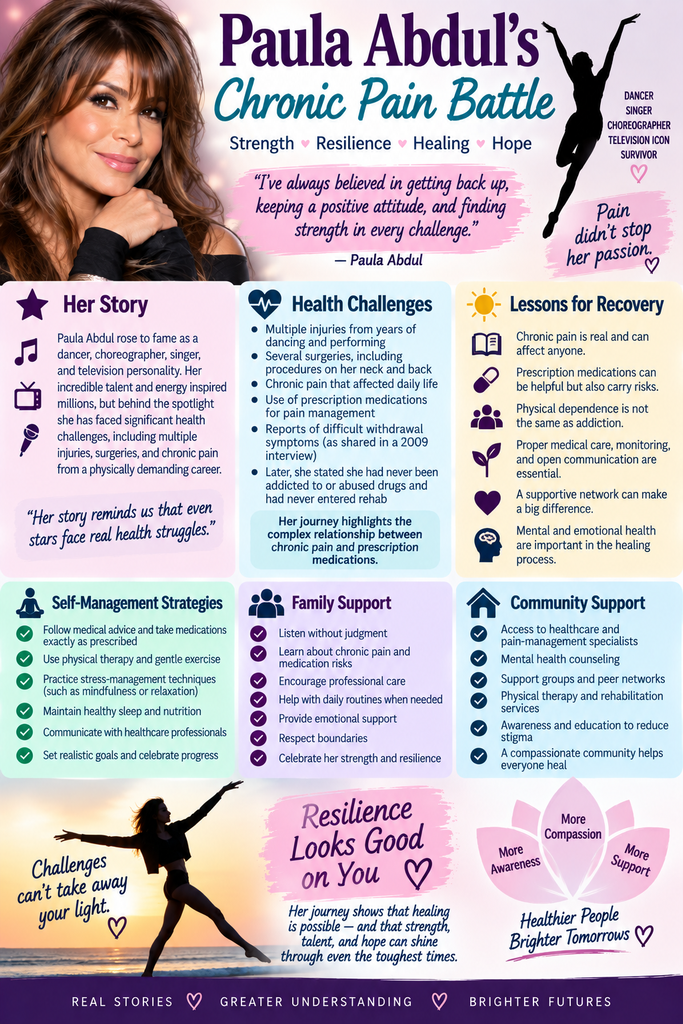
Paula Abdul became internationally known as a singer, dancer, choreographer, and television personality. Behind her energetic performances, however, she has publicly discussed years of injuries, surgeries, chronic pain, and sleep difficulties. Her experience offers an opportunity to discuss an important issue in addiction medicine: the complicated relationship between chronic pain, prescription medications, physical dependence, and substance use disorder.
It is important to describe Abdul’s story accurately. In 2009, Ladies’ Home Journal reported that she had experienced dependence on prescription pain medication and difficult withdrawal. News organizations repeated the account. Abdul later disputed how the interview had been characterized, saying she had never been addicted to or abused drugs and had never checked into rehabilitation.
Her story therefore should not be presented simply as a confirmed “painkiller addiction.” Instead, it can help families understand why chronic pain and medication use require careful, individualized medical care.
Chronic Pain Can Complicate Medication Use
Abdul has described a long history of injuries and chronic pain associated with her physically demanding career. In a 2009 interview, she said she had undergone numerous surgeries following a neck injury and described using nerve medication and anti-inflammatory medications while denying use of drugs such as OxyContin or Vicodin.
Chronic pain can affect nearly every part of someone’s life. Persistent pain may contribute to:
- Sleep problems
- Reduced physical activity
- Anxiety and emotional distress
- Difficulty concentrating
- Social isolation
- Problems working
- Reduced quality of life
- Increased reliance on medications for symptom relief
For some patients, prescription medications are appropriate components of pain treatment. The goal is not to stigmatize medication but to use it safely and monitor benefits and risks.
Dependence and Addiction Are Not the Same Thing
This distinction is particularly important when discussing stories like Abdul’s.
Physical dependence means the body has adapted to a medication, and withdrawal symptoms may occur when it is reduced or stopped. Physical dependence can develop even when someone takes certain medications as prescribed.
Substance use disorder, by contrast, involves a problematic pattern of substance use associated with impaired control, continued use despite consequences, and other clinical criteria.
Withdrawal alone does not prove that someone has an addiction.
Self-Management Strategies
People managing chronic pain or recovering from problematic substance use can benefit from developing a comprehensive plan with healthcare professionals.
Helpful strategies include:
- Take medications exactly as prescribed.
- Keep an updated list of prescription medications, over-the-counter products, and supplements.
- Discuss any increase in pain or medication concerns rather than changing doses independently.
- Learn personal triggers for substance use or medication misuse.
- Maintain consistent sleep and wake times.
- Incorporate appropriate physical activity when medically cleared.
- Use relaxation, mindfulness, or other stress-management techniques.
- Attend medical, pain management, or behavioral health appointments consistently.
- Develop a plan for responding to cravings or high-risk situations.
- Seek help early when medication use begins feeling difficult to control.
For people taking opioids regularly, suddenly stopping can produce significant withdrawal. Medication changes should be discussed with an appropriate healthcare professional.
Managing Pain Without Ignoring Recovery
People with a history of substance use disorder still deserve adequate pain treatment. Recovery should not mean that someone must silently endure severe pain.
Depending on the condition, comprehensive pain management may include physical therapy, exercise, behavioral approaches, non-opioid medications, interventional treatments, sleep management, and treatment of accompanying depression or anxiety.
The appropriate combination depends on the individual.
The goal is safe pain control and improved functioning, not simply eliminating every medication.
Family Support Strategies
Families can become important partners when someone is coping with chronic pain, medication concerns, or addiction recovery.
Family members can:
- Listen without immediately judging medication use
- Learn the difference between dependence, tolerance, withdrawal, and addiction
- Encourage professional evaluation when concerns arise
- Help maintain healthy daily routines
- Provide transportation to appointments when needed
- Encourage physical therapy or other recommended treatments
- Watch for significant changes in behavior or functioning
- Maintain reasonable boundaries
- Avoid taking control of medications unless this is part of an agreed treatment plan
- Participate in family counseling when appropriate
Statements such as “You’re addicted to those pills” can shut down communication.
A more productive approach is: “I’ve noticed some changes, and I’m concerned. Can we talk with your healthcare professional about whether your treatment is still working safely?”
Community Support Strategies
Recovery does not occur only inside a doctor’s office. Communities can reduce harm by providing accessible treatment and reducing stigma toward both chronic pain and addiction.
Helpful community resources include:
- Primary healthcare
- Addiction medicine services
- Pain-management specialists
- Physical therapy
- Mental health counseling
- Peer recovery programs
- Recovery community centers
- Support groups
- Pharmacy counseling
- Transportation services
- Overdose education and naloxone access
Integrated care is especially valuable because pain, mental health, sleep, and substance use can interact.
Avoiding Stigma Around Prescription Medication
A prescription does not automatically make a medication harmless, but taking a potentially dependence-producing medication does not automatically make someone “an addict.”
Healthcare professionals and families should look at the entire clinical picture.
Important questions include:
- Is the medication improving function?
- Is it being taken as prescribed?
- Are side effects becoming problematic?
- Is the person losing control over use?
- Are they experiencing cravings?
- Is medication use continuing despite significant harm?
- Are safer or more effective alternatives available?
These questions provide much more useful information than labels.
What Paula Abdul’s Story Can Teach Us
Abdul’s public history demonstrates another important lesson: celebrity health stories are often reduced to dramatic headlines.
The available reports about her medication history conflict. Some accounts characterized her experience as painkiller dependence or addiction and described withdrawal, while Abdul publicly rejected those characterizations.
We should respect that uncertainty rather than diagnose a public figure from media reports.
What is well worth discussing is the larger health issue her experience highlights: chronic pain can be exhausting, medication management can become complicated, withdrawal and addiction are not synonymous, and people deserve compassionate medical care for both pain and substance-related problems.
Recovery Is About the Whole Person
Someone struggling with chronic pain and problematic medication use may need more than instructions to “stop taking pills.” Effective care may require treating the pain, addressing mental health, improving sleep, strengthening relationships, evaluating medications, and providing addiction treatment when a substance use disorder is actually present.
Self-management builds safer routines. Family support provides encouragement without shame. Community support connects people with appropriate healthcare and recovery resources.
Paula Abdul’s experience should not be reduced to an unverified addiction label. Instead, it can remind us of a broader principle:
Treat the pain. Monitor the medication. Recognize addiction when it is present. Support recovery without stigma—and always treat the person, not the label.
Frequently Asked Questions
Here are some common questions:
1. Did Paula Abdul struggle with addiction?
It is disputed. In 2009, Ladies’ Home Journal published an account describing Abdul as having experienced dependence on prescription pain medications and difficult withdrawal. Abdul subsequently denied that characterization, saying she had never been addicted to or abused drugs and had never entered rehabilitation. Contemporary reporting documented both versions.
2. Why was Paula Abdul taking prescription medication?
Abdul has publicly discussed significant chronic pain associated with injuries and surgeries during her physically demanding career as a dancer and performer. Pain management became part of the public discussion surrounding her medication use.
3. Did Paula Abdul go to rehabilitation for drug addiction?
Abdul publicly denied entering a rehabilitation facility for drug addiction. This distinction is important because some media coverage at the time created conflicting impressions about her experience.
4. What is the difference between physical dependence and addiction?
Physical dependence occurs when the body adapts to a medication and withdrawal symptoms can develop when the medication is stopped or reduced. Addiction, clinically diagnosed as a substance use disorder, involves patterns such as impaired control and continued use despite significant harm. A person can develop physical dependence on certain prescribed medications without having a substance use disorder.
5. Does experiencing withdrawal mean someone is addicted?
No. Withdrawal can occur because of physical dependence, including when certain medications have been taken appropriately. Withdrawal symptoms alone are not enough to diagnose addiction.
6. How can chronic pain increase the risk of problematic medication use?
Persistent pain can affect sleep, mood, mobility, work, and quality of life. Some medications used for pain also carry risks of tolerance, dependence, or misuse. Regular medical monitoring can help balance adequate pain relief with medication safety.
7. What can Paula Abdul’s experience teach us about addiction and chronic pain?
Her story illustrates why chronic pain, medication dependence, withdrawal, and addiction should not automatically be treated as interchangeable concepts. It also demonstrates how celebrity health stories can become simplified when conflicting accounts are reduced to dramatic headlines.
8. What self-management strategies can help someone dealing with chronic pain and medication concerns?
Helpful strategies include taking medication exactly as prescribed, discussing worsening pain with a healthcare professional, maintaining regular medical appointments, identifying emotional and environmental triggers, protecting sleep, using appropriate physical activity, and incorporating non-medication pain-management strategies when recommended.
9. Should someone abruptly stop prescription pain medication if they are concerned about dependence?
Not necessarily. Abruptly stopping some medications can cause significant withdrawal or other complications. A healthcare professional can determine whether gradual dose reduction, medication adjustment, or another treatment approach is appropriate.
10. How can families support someone experiencing chronic pain or problematic medication use?
Families can listen without judgment, learn about chronic pain and substance use disorders, encourage professional treatment, support healthy routines, and establish appropriate boundaries. Accusations such as “You’re addicted to your medication” may make honest communication more difficult.
11. What role does mental health play in chronic pain and recovery?
Chronic pain can interact with stress, anxiety, depression, sleep difficulties, and social isolation. Addressing emotional health alongside physical pain can therefore be an important component of comprehensive treatment.
12. What community resources can support recovery?
Resources may include primary care, addiction medicine, pain-management services, physical therapy, behavioral healthcare, peer recovery programs, support groups, pharmacy counseling, and community recovery organizations.
13. Can someone with a history of addiction still receive appropriate pain treatment?
Yes. A history of substance use disorder does not mean a person should be denied adequate pain treatment. Clinicians can develop individualized plans that consider both effective pain management and substance-related risks.
14. Why should celebrity addiction stories be discussed carefully?
Substance use disorder is a medical diagnosis, and outside observers usually do not have access to a celebrity’s complete medical history. When a public figure disputes an addiction claim, responsible health education should acknowledge that uncertainty rather than present the diagnosis as established fact.
15. What is the main lesson from Paula Abdul’s story?
The strongest lesson is not that Paula Abdul represents a confirmed celebrity addiction-and-recovery story. Rather, her experience provides an opportunity to understand the complicated relationship between chronic pain, prescription medications, physical dependence, withdrawal, and addiction.
Video: What you didn’t know about Paula Abdul’s health struggles #celebritynews #health