Stephen King is known worldwide for novels such as Carrie, The Shining, Cujo, and It, but behind his extraordinary literary success was a serious struggle with alcohol and drugs. His experience demonstrates an important reality about substance use disorders: professional success does not protect someone from addiction. King has spoken publicly about heavy drinking, cocaine use, the effects addiction had on his family, and the difficult process of becoming sober.
Addiction Behind the Success
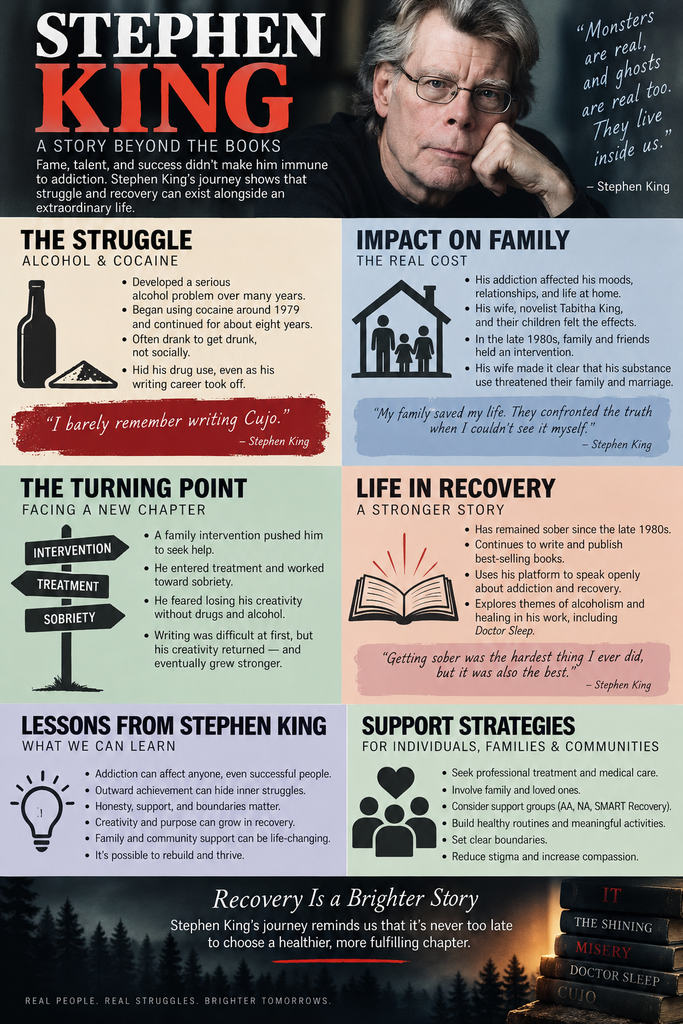
King’s problems with alcohol developed over many years. He has described drinking with the goal of becoming intoxicated rather than drinking socially. Cocaine later became another major problem; King said he began using it around 1979 and continued for approximately eight years. He also acknowledged hiding his drug use because he recognized that it had become problematic.
Despite his addiction, King continued producing successful books. That outward productivity could disguise what was happening privately. He later wrote that he barely remembered writing Cujo, illustrating how severe substance use can coexist with professional accomplishment.
This part of King’s story challenges a common stereotype: addiction does not always look like unemployment, financial collapse, or obvious dysfunction. A person can remain highly productive while experiencing significant substance-related harm.
When Addiction Began Affecting the Family
Addiction rarely affects only the person using substances. King later described how alcohol affected his moods and interactions at home. His wife, novelist Tabitha King, and their children experienced the consequences even while his writing career continued to flourish.
Eventually, his family could no longer ignore the problem. In the late 1980s, family members and friends confronted King through an intervention. His wife made it clear that his substance use threatened their family relationship. King has acknowledged that those memories remained painful, but the intervention became an important turning point.
His experience shows why families sometimes need to combine compassion with firm boundaries. Supporting someone with addiction does not require pretending that destructive behavior is acceptable.
The Fear of Becoming Sober
One of King’s significant concerns was whether sobriety would destroy his creativity. Alcohol and drugs had become intertwined with his life as a writer, creating fear that giving them up might also mean losing his ability to tell stories.
After stopping alcohol and drugs, King went through a period when writing was difficult. Eventually, however, his creativity returned. He later explained that he discovered writing itself provided the satisfaction he had feared losing.
This is an important recovery lesson. When substances have been connected with creativity, socializing, relaxation, or coping for years, recovery involves more than removing the substance. People may need to rediscover who they are and what gives their lives meaning without intoxication.
Self-Management Strategies Inspired by King’s Journey
King’s experience cannot provide a treatment formula for everyone, but several broader recovery principles can be drawn from his story.
Self-management may include:
- Recognizing that being successful does not mean substance use is under control.
- Identifying situations, emotions, routines, and environments associated with cravings.
- Developing daily routines that support stability and purpose.
- Finding meaningful substance-free activities.
- Being honest about the consequences of substance use.
- Seeking professional treatment rather than relying exclusively on willpower.
- Participating in recovery or peer-support programs when appropriate.
- Protecting recovery during stressful or emotionally difficult periods.
- Building an identity that is larger than addiction.
King has discussed recovery and Alcoholics Anonymous in interviews and has incorporated themes of alcoholism and recovery into his fiction, particularly Doctor Sleep.
Family Support Strategies
King’s story especially illustrates the potential importance of family involvement. His family’s intervention did not immediately erase addiction, but it confronted the reality that something needed to change.
Families supporting someone with addiction can:
- Express concern using specific examples rather than insults or accusations.
- Avoid covering up serious consequences caused by substance use.
- Establish clear and reasonable boundaries.
- Encourage evaluation by addiction-treatment professionals.
- Learn about substance use disorders and evidence-based treatment.
- Recognize that recovery may take time.
- Seek counseling or family support for themselves.
- Avoid assuming they can personally control another person’s recovery.
An intervention should not simply be an emotional confrontation. When addiction is severe, families can benefit from professional guidance to determine the safest and most appropriate approach.
Community Support Strategies
Recovery becomes more sustainable when people do not have to manage it alone. Community resources can provide accountability, treatment, education, and connection.
Helpful community supports may include:
- Addiction medicine and behavioral-health professionals.
- Outpatient or residential treatment when clinically appropriate.
- Alcoholics Anonymous, Narcotics Anonymous, SMART Recovery, or other peer-support options.
- Individual and family counseling.
- Recovery community organizations.
- Workplace recovery resources and employee assistance programs.
- Substance-free recreational and social activities.
- Community education designed to reduce addiction stigma.
Different people need different combinations of treatment and support. Mutual-help programs can be valuable for many individuals, but they are not substitutes for medical or psychiatric treatment when those services are needed.
What Families Can Learn From Stephen King
Perhaps one of the most useful lessons from King’s experience is that outward achievement can hide significant addiction. Someone may continue working, earning money, raising children, or achieving professional recognition while their substance use becomes increasingly destructive.
Families should therefore look beyond appearances. Warning signs such as escalating consumption, secrecy, intoxication, mood changes, relationship problems, inability to reduce use, cravings, or continued use despite consequences deserve attention even when the individual appears successful in other areas.
King’s experience also demonstrates that recovery does not necessarily require abandoning the identity, career, or talents someone values. Sobriety ultimately did not end his writing career. He continued producing books for decades after becoming sober.
Recovery Is More Than Stopping a Substance
Recovery involves rebuilding daily life. It can require repairing relationships, learning healthier coping mechanisms, accepting support, managing cravings, and rediscovering meaningful activities without alcohol or drugs.
Stephen King’s journey illustrates how addiction can exist alongside extraordinary talent and achievement. It also demonstrates the importance of family members who are willing to speak up, boundaries that make the seriousness of addiction harder to ignore, and a recovery process that allows someone to rediscover purpose without substances. His experience should not be treated as a universal recovery blueprint, but it offers a powerful reminder: addiction can affect anyone, and a meaningful life can continue after substance use ends.
Frequently Asked Questions
Here are some common questions:
1. Did Stephen King struggle with addiction?
Yes. Stephen King has publicly discussed serious problems with alcohol and drugs during part of his writing career. His experiences show that substance use disorders can affect people regardless of intelligence, creativity, wealth, or professional success.
2. What substances did Stephen King struggle with?
King has spoken about heavy alcohol use as well as cocaine use. He has described a period when substance use became deeply embedded in his everyday life while he continued writing successful novels.
3. When did Stephen King’s substance use become serious?
King’s alcohol problems developed over time, while cocaine became a significant part of his substance use during the late 1970s and 1980s. By the 1980s, his family had become increasingly concerned about the severity of the problem.
4. Was Stephen King still writing while struggling with addiction?
Yes. King remained remarkably productive during this period. He has famously said that he barely remembers writing Cujo. His experience demonstrates why professional success should never automatically be interpreted as evidence that someone does not have a substance use problem.
5. Did Stephen King hide his addiction?
King has described hiding aspects of his cocaine use and recognizing that it had become problematic. Secrecy is common in substance use disorders because people may experience denial, fear, shame, or concern about how others will react.
6. How did addiction affect Stephen King’s family?
King has acknowledged that his substance use affected his behavior and family life. His wife, novelist Tabitha King, and other family members eventually confronted him about what was happening.
7. Did Stephen King’s family stage an intervention?
Yes. In the late 1980s, King’s family and friends confronted him about his alcohol and drug use. His wife made clear that the situation could not continue. The intervention became an important turning point in his recovery journey.
8. Did Stephen King immediately become sober after the intervention?
Recovery was a process rather than a single event. King had to confront his substance use and learn how to live and work without relying on alcohol and drugs. His experience illustrates why recovery often involves significant behavioral and emotional adjustment.
9. Was Stephen King afraid sobriety would affect his writing?
Yes. King has discussed worrying that stopping alcohol and drugs might interfere with his creativity. Writing initially became more difficult, but his ability and productivity returned. He went on to publish extensively during decades of sobriety.
10. Did Stephen King participate in Alcoholics Anonymous?
King has publicly discussed Alcoholics Anonymous and recovery. Recovery themes also became particularly visible in his writing, including in Doctor Sleep, where alcoholism and recovery play important roles.
11. How long has Stephen King been sober?
King has described becoming sober in the late 1980s and has continued to speak publicly about recovery in the decades since. When discussing a public figure’s recovery, it is best to rely on the person’s own public statements rather than speculate about their current private health.
12. What self-management strategies can someone learn from his experience?
King’s story highlights the importance of recognizing a problem, accepting help, developing substance-free routines, finding meaningful activities, and separating creativity or identity from substance use. Professional addiction treatment and peer support may also be important depending on the individual’s needs.
13. What can families learn from Stephen King’s experience?
Families can learn that compassion and boundaries can exist together. Helpful strategies may include:
- Learning about substance use disorders.
- Communicating concerns without humiliation or name-calling.
- Establishing healthy boundaries.
- Refusing to repeatedly conceal harmful consequences.
- Encouraging professional assessment and treatment.
- Getting counseling or peer support for family members.
- Understanding that relatives can support recovery but cannot control it.
14. How can communities support people struggling with addiction?
Communities can make recovery more accessible by reducing stigma and providing evidence-based treatment, mental health services, recovery organizations, peer-support groups, family education, and substance-free social opportunities.
15. Does being highly successful protect someone from addiction?
No. Stephen King’s experience is a strong example of why addiction should not be judged by someone’s career or outward appearance. A person can remain productive while experiencing significant problems with alcohol or drugs.
16. Is addiction simply a lack of willpower?
No. Substance use disorders are treatable medical conditions involving complex interactions among biological, psychological, behavioral, and environmental factors. Recovery often requires more than simply deciding to stop.
17. Can creativity continue after sobriety?
Absolutely. King’s career provides a notable example. He feared that sobriety might interfere with his writing, yet he continued creating successful novels and other works for decades afterward. Recovery does not require someone to surrender the talents and passions that give life meaning.
18. What is the biggest lesson from Stephen King’s recovery story?
One important lesson is that addiction can exist behind extraordinary achievement. Another is that accepting help can become a turning point rather than the end of someone’s identity or career. Family involvement, professional treatment, peer support, meaningful activities, and personal commitment can all contribute to recovery.
19. What should someone do if they recognize similar addiction signs in themselves?
They should consider speaking with a healthcare or addiction-treatment professional for an assessment. Treatment can include counseling, medications for certain substance use disorders, peer support, behavioral therapies, and different levels of outpatient or residential care depending on individual needs.
20. What message does Stephen King’s journey offer people in recovery?
His experience offers a hopeful message: addiction does not have to become the final chapter of someone’s life. Recovery can involve rebuilding relationships, rediscovering creativity, developing healthier coping skills, and creating a meaningful life without alcohol or drugs.
Video: He thought he couldn’t write without drugs #stephenking #writingtips #sobriety