When people are struggling with addiction, one of the most important questions they may ask is, “What are my chances of recovering?” Families may also search for statistics hoping to understand whether their loved one can overcome alcohol or drug addiction.
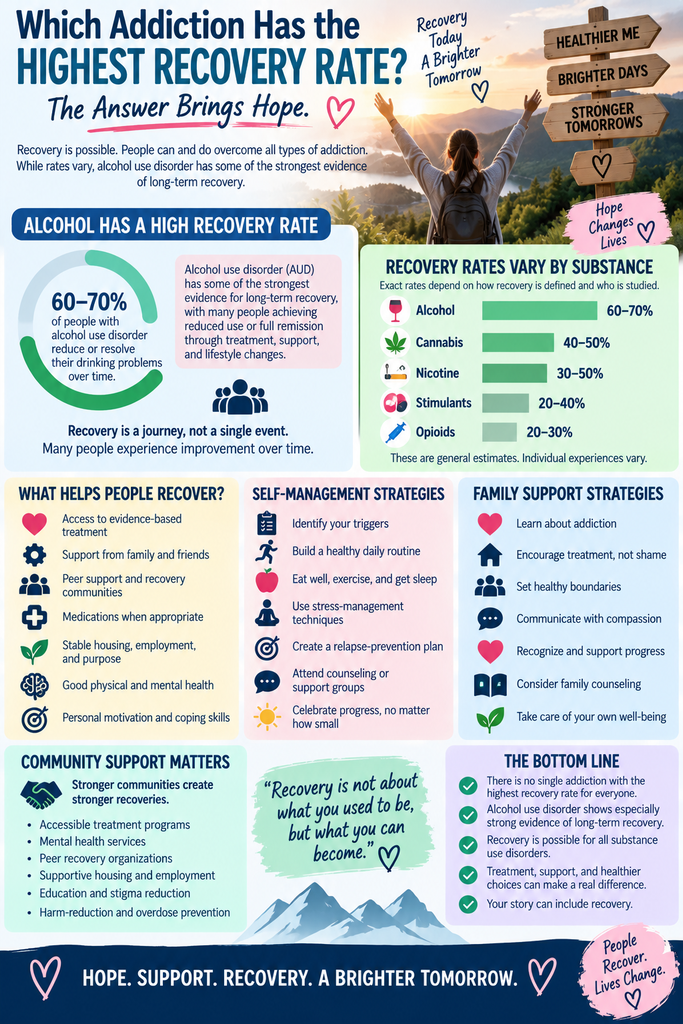
The encouraging answer is that recovery is possible. However, there is no universally accepted ranking identifying one addiction as having the single highest recovery rate. Recovery can mean abstinence, remission from a substance use disorder, reduced harmful use, improved functioning, or a person’s own identification as being in recovery. Because researchers measure these outcomes differently, simple comparisons between substances can be misleading.
Alcohol use disorder provides an especially important example of why recovery statistics can offer hope. Research summarized by the National Institute on Alcohol Abuse and Alcoholism indicates that the majority of people with AUD reduce or resolve their drinking problems over time.
Alcohol Use Disorder and Recovery
Alcohol addiction can be severe and potentially life-threatening, but it is also treatable.
Recovery does not necessarily happen immediately. Some people experience periods of improvement followed by setbacks before achieving sustained change. Others recover through professional treatment, medications, mutual-help groups, family support, lifestyle changes, or combinations of these approaches.
The important message is that addiction does not automatically mean a lifetime of uncontrolled substance use.
National survey data reinforce this broader message. Millions of American adults who previously perceived themselves as having a drug or alcohol problem currently consider themselves recovered or in recovery.
What Does “Recovery” Actually Mean?
Recovery is larger than simply counting the number of days since someone last used a substance.
For alcohol use disorder, clinical recovery involves remission from AUD and cessation of heavy drinking maintained over time. Improvements in physical health, mental health, relationships, quality of life, and social functioning may accompany recovery.
A person’s journey may involve:
- Reducing or stopping substance use
- Managing cravings and triggers
- Rebuilding relationships
- Improving physical and mental health
- Developing stable routines
- Returning to employment or education
- Establishing safe housing
- Finding meaningful activities
- Developing supportive relationships
Recovery therefore represents a process rather than a single event.
Why Do Some People Recover More Successfully?
Recovery rates are influenced by much more than the substance itself.
Factors can include:
- Severity and duration of the addiction
- Access to evidence-based treatment
- Co-occurring mental health conditions
- Physical health
- Housing stability
- Family and social support
- Exposure to substances and triggers
- Availability of effective medications
- Financial and transportation barriers
- Motivation and readiness for change
- Continued recovery support
Two people using the same substance can therefore have very different recovery journeys.
Self-Management Strategies
Recovery becomes more manageable when someone develops daily behaviors that support change.
Identify Personal Triggers
Learn which situations increase cravings. Triggers might include stress, conflict, loneliness, boredom, certain people, particular locations, celebrations, or easy access to substances.
Understanding a trigger creates an opportunity to develop a plan before the craving occurs.
Develop a Daily Routine
Structure can reduce periods of boredom and uncertainty.
A recovery routine might include:
- Regular sleep and wake times
- Balanced meals
- Physical activity
- Counseling or treatment appointments
- Prescribed medications
- Recovery meetings
- Work or education
- Hobbies
- Time with supportive people
- Relaxation or mindfulness
Use Evidence-Based Treatment
Determination alone does not have to carry the entire burden of recovery.
Depending on the substance use disorder, treatment may involve behavioral therapies, counseling, medications, medical management, peer support, or combinations of these interventions.
Make a Craving Plan
Decide what to do before a strong craving occurs.
A plan could include calling a supportive person, leaving a triggering environment, attending a meeting, using coping techniques learned in therapy, or contacting a treatment professional.
Treat a Setback as Information
A return to substance use should be taken seriously, particularly because reduced tolerance can increase overdose risk with opioids and other substances.
However, a setback can also reveal weaknesses in the current recovery plan.
Ask:
What happened? What triggered me? What support was missing? What needs to change now?
Family Support Strategies
Addiction affects families, but families can also become powerful sources of recovery support.
Family members can:
- Learn about substance use disorders
- Encourage professional treatment
- Avoid shame and humiliating language
- Recognize progress
- Establish healthy boundaries
- Avoid providing money or resources that facilitate substance use
- Learn how to respond to relapse or overdose risk
- Participate in family counseling when appropriate
- Support medication-based treatment
- Protect their own emotional health
Support does not mean ignoring harmful behavior. Compassion and boundaries can exist together.
Instead of saying, “Why can’t you just stop?” a family member might ask, “What would help you stay connected to your recovery plan today?”
Community Support Strategies
Recovery becomes harder when people return from treatment to environments filled with instability, isolation, substance exposure, or inadequate healthcare.
Communities can improve recovery opportunities by expanding:
- Affordable addiction treatment
- Mental health services
- Peer recovery programs
- Recovery community centers
- Mutual-help groups
- Primary healthcare
- Recovery-supportive housing
- Employment and educational opportunities
- Transportation to treatment
- Family education
- Harm-reduction and overdose-prevention services
Recovery is strengthened when people have not only treatment but also health, a safe home, a sense of purpose, and a sense of community.
What About Opioid Addiction?
Opioid use disorder deserves special attention because overdose can be fatal. Fortunately, effective medications—including buprenorphine and methadone—can substantially improve treatment outcomes and reduce important risks.
Someone with opioid use disorder should not interpret comparisons of “recovery rates” as evidence that recovery is unlikely.
The appropriate question is not:
“Which addiction is easiest to recover from?”
A better question is:
“Which treatments give this particular person the best chance of recovery?”
Recovery Is Possible Across Addictions
Statistics describe populations, not individual destinies.
Some people recover relatively quickly. Others need several treatment episodes or years of continued support. Recovery can also change over time as relationships, health, housing, employment, and mental health improve.
The latest national U.S. survey provides an encouraging perspective: among adults who said they had ever experienced a problem with drugs or alcohol, a substantial majority described themselves as being in recovery or having recovered.
The Most Important Recovery Rate Is Your Own
Trying to identify the addiction with the “highest recovery rate” can unintentionally create the impression that some people have hope while others do not.
That is the wrong message.
Alcohol use disorder demonstrates particularly well that substantial recovery can occur over time, but people also recover from opioid, stimulant, cannabis, nicotine, and other substance use disorders.
Self-management builds healthier daily behaviors. Family support provides connection and accountability. Community support provides treatment, resources, a sense of belonging, and opportunities to rebuild life.
Recovery is not determined by a statistic alone.
The most important recovery rate is one person choosing treatment, support, and another opportunity for change—and continuing to build from there.
Frequently Asked Questions
Here are some common questions:
1. Which addiction has the highest recovery rate?
There is no scientifically established single addiction with the “highest recovery rate.” Studies use different definitions of recovery, follow people for different lengths of time, and examine different populations. Alcohol use disorder (AUD), however, has substantial long-term research showing that many people eventually reduce or resolve problematic drinking.
2. Does alcohol addiction have a high recovery rate?
Many people with alcohol use disorder improve significantly over time. The National Institute on Alcohol Abuse and Alcoholism (NIAAA) reports that most people with AUD reduce or resolve their drinking problems over time. Recovery can occur with professional treatment, medication, mutual-help programs, behavioral changes, or combinations of these approaches.
3. What does “recovery rate” actually mean?
It depends on the study. Researchers may measure complete abstinence, remission from diagnostic criteria, reduced harmful use, improved health and functioning, or self-identified recovery. These different definitions are one reason recovery percentages should not be compared as though they measure exactly the same thing.
4. Can people recover from severe addiction?
Yes. Severe substance use disorder can be difficult to treat, but severity does not make recovery impossible. Some people require repeated or long-term treatment and continuing recovery support.
5. Which factors increase the likelihood of successful recovery?
Access to evidence-based treatment, appropriate medications, supportive relationships, stable housing, mental healthcare, healthy routines, employment or meaningful activities, and continued recovery support can all contribute to better outcomes.
6. Can someone recover without going to rehabilitation?
Yes. Residential rehabilitation is only one treatment setting. Depending on individual needs and medical risks, treatment can occur through outpatient programs, primary care, addiction specialists, counseling, medications, mutual-help groups, and community recovery services.
7. Does relapse mean recovery has failed?
No. A return to substance use indicates that the recovery plan needs reassessment, but it does not erase previous progress. It should also be taken seriously because relapse can carry substantial medical risks, particularly after tolerance has decreased.
8. Which addiction is the hardest to recover from?
There is no universal answer. Opioids, alcohol, nicotine, stimulants, cannabis, and other substances present different challenges. Severity, duration of use, mental and physical health, environment, treatment access, and individual circumstances can matter as much as the particular substance.
9. Can medications improve recovery outcomes?
Yes, for several substance use disorders. For opioid use disorder, medications such as buprenorphine and methadone are evidence-based treatments. Medications are also available for alcohol and tobacco use disorders. Medication is treatment—not a failure to achieve “real” recovery.
10. What can someone do to improve their own recovery chances?
Develop a structured recovery plan that includes professional treatment when appropriate, identifying triggers, managing cravings, taking prescribed medications consistently, maintaining adequate sleep and nutrition, building supportive relationships, and developing a plan for high-risk situations.
11. How can families improve the chances of recovery?
Families can learn about addiction, encourage treatment, communicate without humiliation or shame, establish appropriate boundaries, recognize progress, participate in family therapy when useful, and learn how to respond to emergencies such as an opioid overdose.
12. How does community support affect recovery?
Recovery is easier to sustain when people have access to healthcare, behavioral health treatment, peer recovery programs, transportation, stable housing, education, employment, and supportive social networks. Communities can also reduce barriers by addressing stigma toward people receiving addiction treatment.
13. Can someone recover after many years of substance use?
Yes. There is no point at which a person’s history automatically makes recovery impossible. Longer or more severe substance use may require more intensive or prolonged support, but meaningful recovery can still occur.
14. How long does addiction recovery take?
There is no standard timeline. Some improvements can occur quickly, while rebuilding health, relationships, employment, finances, and emotional stability can take considerably longer. Recovery is often better understood as an ongoing process rather than a finish line.
15. What is the most important thing to understand about recovery statistics?
Population statistics cannot predict an individual’s future. A lower recovery percentage in a particular study does not mean a person cannot recover, just as a higher percentage does not guarantee success.
Video: Why addiction recovery rates are a lie #recovery #addiction #mentalhealth