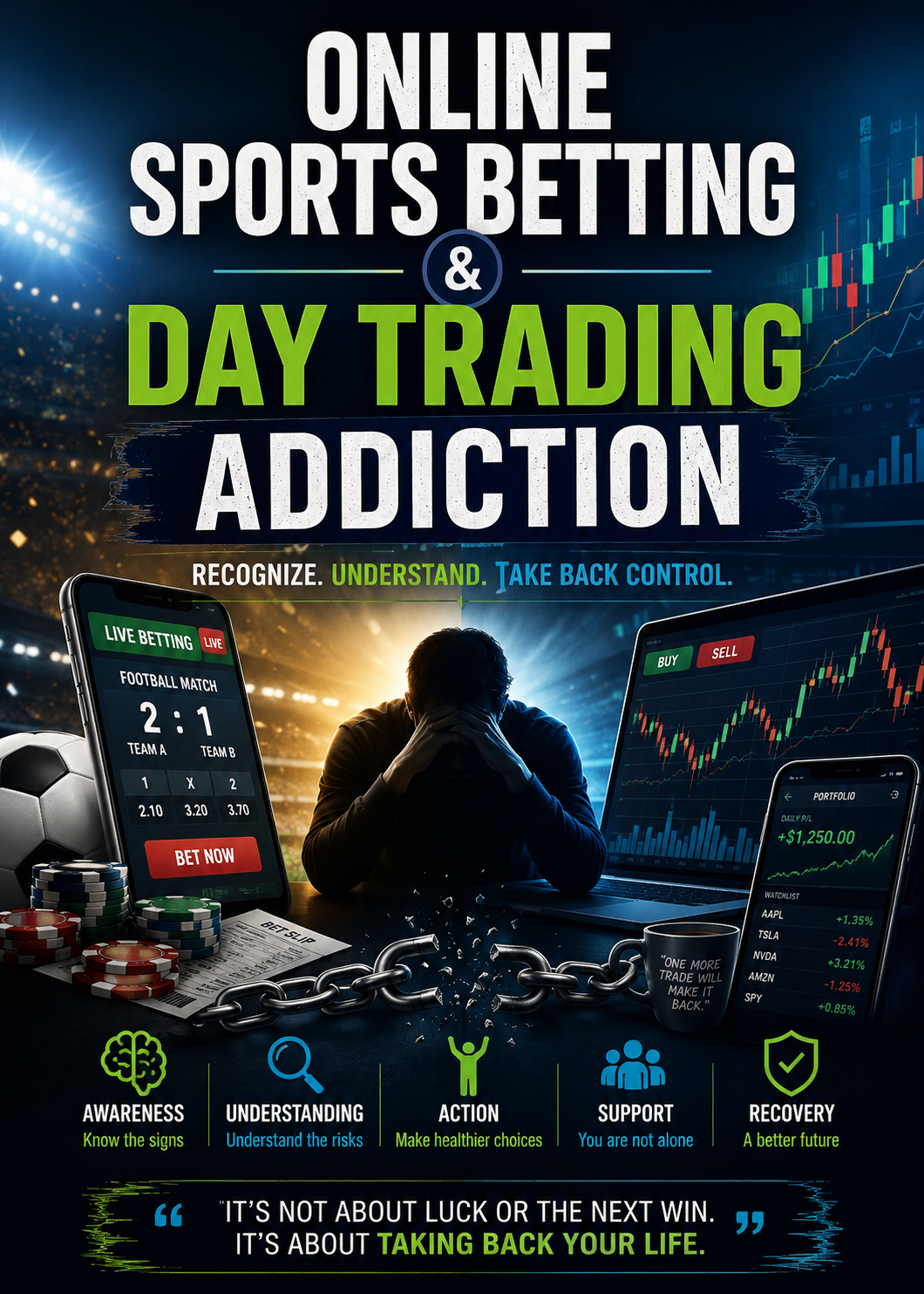
Online sports betting and day trading have become increasingly accessible via smartphones, apps, and digital platforms, allowing people to place wagers or execute trades within seconds. Although sports betting and day trading are different activities—and day trading itself is not considered a behavioral addiction—both can become problematic when excitement, risk-taking, and the pursuit of financial rewards lead to compulsive behavior. Rapid outcomes and unpredictable rewards may encourage repeated participation, while losses can trigger the dangerous urge to “win it back.” Warning signs may include chasing losses, taking on greater financial risks, hiding activities from family members, borrowing money, neglecting responsibilities, and repeatedly failing to cut back. Understanding these patterns can help individuals and families recognize when an activity has shifted from controlled participation to harmful behavior.
Online Sports Betting & Day Trading Addiction
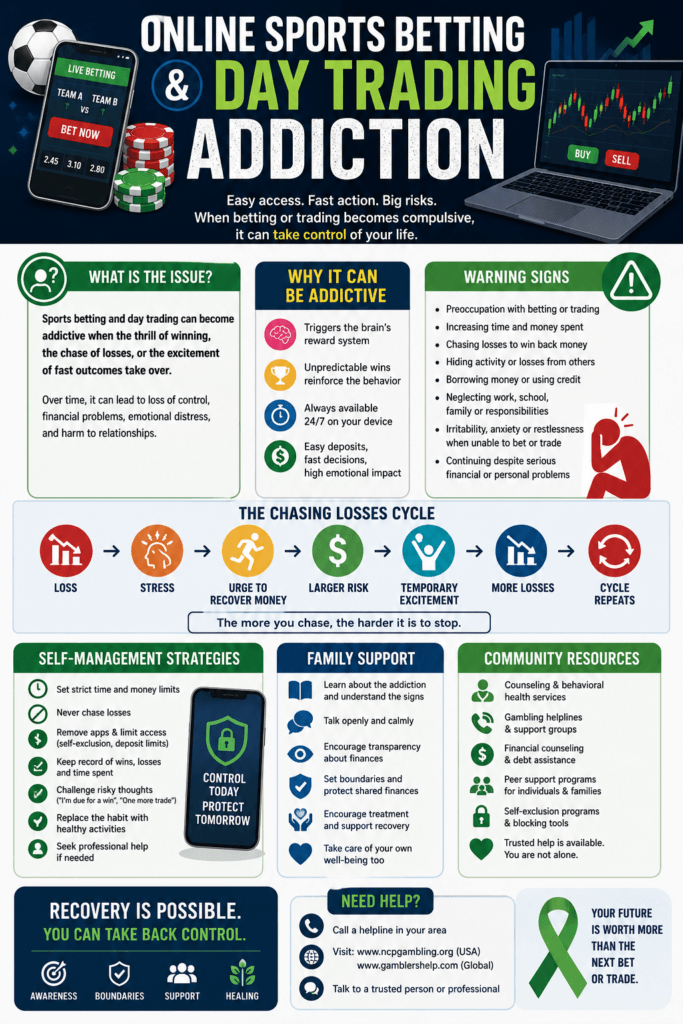
Online sports betting and high-frequency day trading can become addictive when they shift from occasional financial activities into repetitive behaviors driven by excitement, emotional escape, and the urge to recover losses. Although day trading is not inherently gambling, certain patterns—especially highly speculative, rapid trading—can resemble gambling behavior because both involve uncertainty, risk, immediate feedback, and potentially large financial gains or losses.
Why These Behaviors Can Become Addictive
Both activities can strongly engage the brain’s reward and reinforcement systems. Anticipating a winning bet or profitable trade can produce excitement and reinforce the desire to repeat the behavior. Importantly, uncertainty itself can be powerful: an unpredictable win after several losses may encourage someone to keep trying.
Sports-betting apps make wagering available almost continuously, including live and in-game betting. Similarly, trading platforms provide rapid access to stocks, options, cryptocurrency, and other volatile assets. Constant availability can make it difficult for vulnerable individuals to disengage.
The “Chasing Losses” Cycle
One of the most concerning patterns is chasing losses. A person may think, “One more bet will get my money back” or “The next trade will recover today’s losses.” Instead of stopping after losing money, the person increases the frequency or size of bets or trades.
This can create a cycle:
Loss → Stress → Urge to Recover Money → Larger Risk → Temporary Excitement → More Losses → More Stress
Eventually, decisions may become driven more by emotion than financial reasoning.
Warning Signs
Potential signs of problematic sports betting or speculative trading include:
- Spending more and more money or time on betting or trading.
- Constantly checking scores, odds, markets, or investment apps.
- Feeling restless, irritable, anxious, or depressed when unable to participate.
- Repeatedly attempting to win back previous losses.
- Borrowing money or using money needed for bills.
- Hiding financial losses from family members.
- Neglecting sleep, work, school, relationships, or responsibilities.
- Continuing despite serious financial or interpersonal consequences.
- Believing a major win is always “just one bet” or “one trade” away.
Sports Betting vs. Day Trading
There is an important clinical distinction. Gambling disorder is a recognized behavioral addiction, while day trading itself is not a psychiatric diagnosis. A person can trade frequently without having an addiction. However, speculative trading can become gambling-like when someone repeatedly takes excessive risks primarily for excitement, uses money they cannot afford to lose, loses control over the behavior, or compulsively attempts to recover losses.
Mental and Physical Consequences
Compulsive betting or trading can contribute to severe financial stress, debt, relationship conflict, sleep deprivation, impaired concentration, anxiety, depression, and social isolation. Financial losses can also intensify shame and secrecy, making people less willing to seek assistance.
Treatment should therefore address more than money. Cognitive behavioral therapy can help individuals recognize distorted beliefs about probability, luck, control, and “winning back” losses. Practical strategies may include removing betting applications, using gambling self-exclusion programs, establishing financial safeguards, restricting access to speculative trading platforms, allowing a trusted person to assist with finances, and developing healthier ways of managing stress and excitement.
The Key Message
Online sports betting and speculative day trading become particularly dangerous when making money is no longer the primary objective and the pursuit of the next win becomes the psychological reward. Recognizing loss of control early can prevent significant financial, emotional, and relationship consequences.
Recovery involves breaking the cycle of risk → anticipation → reward/loss → chasing → more risk and replacing it with healthier sources of reward, structure, emotional regulation, and financial stability.
Self-Management Strategies for Online Sports Betting & Day Trading Addiction
Self-management can help a person recognize when online sports betting or speculative day trading is shifting from a controlled activity into a compulsive pattern. Because both can involve rapid decisions, uncertain rewards, financial risk, and chasing losses, effective strategies should address behavior, emotions, access to money, and distorted thinking.
- Track the behavior. Keep a record of time spent, money deposited, wins, losses, and emotional state before and after betting or trading. Looking at net results rather than individual wins can reveal patterns that excitement may hide.
- Identify personal triggers. Stress, boredom, loneliness, sporting events, market volatility, financial pressure, alcohol use, and seeing other people’s wins online can trigger urges. Understanding triggers makes it easier to develop alternatives.
- Stop chasing losses. Treat money already lost as gone rather than something that must be recovered. Trying to “break even” can lead to increasingly risky bets or trades.
- Create firm financial boundaries. Protect money needed for housing, food, transportation, healthcare, savings, and debt payments. Avoid borrowing money, using credit, or dipping into emergency funds to continue betting or speculative trading.
- Reduce immediate access. Delete betting or trading apps, turn off promotional notifications, unsubscribe from betting advertisements, remove saved payment information, and consider gambling self-exclusion or platform restrictions when appropriate.
- Use a cooling-off period. When an urge appears, delay acting on it. Even a predetermined pause can create distance between an emotional impulse and a financial decision.
- Challenge thinking errors. Thoughts such as “I’m due for a win,” “I have a system,” or “One big trade will recover everything” can encourage risky behavior. Previous losses do not guarantee that the next outcome will be profitable.
- Separate investing from excitement-seeking. Day trading itself is not automatically an addiction. However, repeatedly making highly speculative trades for excitement, emotional relief, or to recover losses deserves attention. Longer-term financial goals and predetermined investment rules can reduce impulsive decisions.
- Replace the reward. Exercise, hobbies, social activities, learning, volunteering, and other meaningful activities can provide stimulation without risking finances.
- Practice emotional regulation. Stress management, mindfulness, adequate sleep, regular meals, exercise, and relaxation techniques can reduce impulsive decision-making, particularly during emotionally intense periods.
- Increase accountability. Share the problem with a trusted family member, counselor, financial professional, or support person. Financial transparency can make secretive betting or trading more difficult.
- Know when self-management is not enough. Continuing despite debt, relationship problems, repeated failed attempts to stop, significant distress, or loss of control can indicate that professional assessment is appropriate. Gambling-focused counseling and cognitive behavioral therapy can help address compulsive behaviors and distorted beliefs about risk and probability.
The goal is not simply to develop more willpower. Effective self-management creates barriers between an urge and the ability to act on it. Recognizing triggers, protecting finances, reducing access, challenging the urge to chase losses, and seeking support early can help restore control before the behavior produces greater financial and emotional harm.
Family Support Strategies for Online Sports Betting & Day Trading Addiction
Families can play an important role when online sports betting or highly speculative day trading becomes compulsive. While gambling disorder is a recognized behavioral addiction, day trading itself is not a psychiatric disorder. The concern arises when trading becomes gambling-like—characterized by loss of control, chasing losses, secrecy, escalating financial risks, and continued behavior despite serious consequences.
- Learn how behavioral addiction works. Families should understand how anticipation, uncertain rewards, excitement, and occasional wins can reinforce repetitive behavior. This can help shift conversations away from simply viewing the problem as poor financial judgment.
- Recognize warning signs. Watch for secretive transactions, unexplained debt, frequent deposits into betting or trading accounts, borrowing money, constantly checking odds or markets, sleep disruption, irritability when unable to participate, and repeated attempts to recover losses.
- Communicate without attacking. Use specific observations rather than accusations. Focusing on behaviors and consequences can make productive conversations more likely than arguing about whether the person “has a problem.”
- Avoid financing the behavior. Repeatedly paying gambling or speculative-trading debts without safeguards can unintentionally allow the cycle to continue. Families can provide emotional support without supplying additional money for betting or risky trades.
- Protect household finances. When appropriate and mutually agreed upon, establish spending limits, separate essential household funds, review shared accounts, restrict access to credit, and protect money needed for housing, food, healthcare, and other necessities.
- Encourage transparency. Hidden losses can allow financial problems to grow. Encourage honest discussions about debts, loans, credit cards, betting accounts, brokerage accounts, and the actual amount gained or lost.
- Help reduce triggers and access. Support the person in deleting betting apps, disabling promotional notifications, using gambling self-exclusion programs, removing stored payment methods, or creating safeguards around highly speculative trading.
- Do not help chase losses. Families should avoid giving someone additional money because they promise that one more bet or trade will recover previous losses. Chasing losses is a major warning sign of problematic gambling behavior.
- Encourage healthier activities. Exercise, hobbies, family activities, social connections, volunteering, and structured routines can provide alternative sources of stimulation and reward.
- Support professional treatment. Cognitive behavioral therapy and gambling-focused treatment can help people examine distorted beliefs about probability, control, winning, and recovering losses. Financial counseling may also be valuable when substantial debt has accumulated.
- Set healthy boundaries. Supporting someone does not require accepting dishonesty, financial exploitation, or repeated violations of household agreements. Families can clearly explain which behaviors they will and will not financially support.
- Get support for the family too. Financial losses, secrecy, and repeated crises can create significant stress for partners and relatives. Family counseling and support groups can help relatives develop boundaries, communication strategies, and their own coping skills.
The family’s goal is support without enabling. Families cannot control another person’s betting or trading decisions, but they can encourage treatment, protect shared finances, reduce opportunities for impulsive behavior, maintain clear boundaries, and reinforce healthier choices. Recovery becomes more manageable when financial safeguards and professional support are accompanied by compassion and accountability.
Community Resource Strategies for Online Sports Betting & Day Trading Addiction
Community resources can help individuals and families recognize when online sports betting or highly speculative day trading has shifted from recreation or financial activity into compulsive, harmful behavior. While gambling disorder is a recognized behavioral addiction, day trading itself is not a psychiatric diagnosis. Community education should therefore focus on behaviors such as loss of control, chasing losses, financial harm, secrecy, and continuing despite negative consequences.
- Increase public education. Community health organizations, colleges, workplaces, libraries, and healthcare systems can provide education about gambling disorder, risky speculative trading, chasing losses, and the psychological effects of rapid financial rewards.
- Promote gambling-specific treatment services. Communities should make it easier to locate counselors and behavioral-health programs experienced in gambling problems. Cognitive behavioral therapy can help address distorted beliefs about probability, control, winning, and recovering losses.
- Improve screening in healthcare settings. Primary care, mental-health, and addiction-treatment professionals can ask about sports betting, gambling apps, financial stress, and highly speculative trading when patients present with anxiety, depression, sleep problems, substance use, or unexplained financial difficulties.
- Expand peer-support opportunities. Gambling-focused peer groups can reduce isolation and provide accountability. Family-oriented support programs can also help loved ones understand boundaries, financial protection, and the difference between supporting recovery and enabling continued gambling.
- Provide financial counseling. Nonprofit credit counselors and qualified financial professionals can help individuals assess debt, develop realistic budgets, prioritize essential expenses, and create plans for financial recovery.
- Promote self-exclusion and access controls. Communities can educate people about state gambling self-exclusion programs, voluntary account restrictions, deposit limits, blocking tools, and other measures that create barriers between an urge and immediate access to betting.
- Develop youth and college prevention programs. Young adults may be exposed to sports-betting advertisements, gambling-like gaming features, cryptocurrency speculation, and social-media trading content. Financial literacy and probability education can help young people understand that highly visible wins do not represent typical outcomes.
- Educate workplaces. Employers and employee assistance programs can provide confidential referrals to behavioral health and financial counseling, particularly when compulsive betting or trading begins to affect attendance, concentration, productivity, or workplace relationships.
- Build partnerships across services. Behavioral-health providers, financial counselors, schools, healthcare systems, community organizations, and gambling-prevention programs can collaborate so individuals receive both psychological and financial support.
- Address advertising and digital literacy. Community education can teach people to critically evaluate promotions such as bonuses, “risk-free” offers, influencer success stories, and social media posts that highlight large trading profits while minimizing losses.
- Support families. Family education programs can teach relatives how to recognize warning signs, discuss financial problems without escalating conflict, protect shared finances, establish boundaries, and encourage treatment.
- Promote accessible help before a crisis. People should not have to wait until they experience severe debt, relationship breakdown, employment problems, or another major consequence before seeking assistance. Early intervention can reduce long-term harm.
A strong community response recognizes that financial harm and behavioral health are interconnected. Effective resources combine prevention, education, mental-health treatment, peer support, financial counseling, digital safeguards, and family involvement. The objective is not to label every sports bettor or day trader as addicted, but to identify when risk-taking becomes compulsive and begins controlling the person’s finances, emotions, relationships, or daily life.
Frequently Asked Questions
Here are some common questions:
1. What is online sports betting addiction?
Online sports betting addiction refers to persistent, difficult-to-control gambling that continues despite financial, emotional, relationship, occupational, or other negative consequences. Gambling disorder is a recognized behavioral addiction.
2. Is day trading considered an addiction?
Day trading itself is not a recognized psychiatric addiction. However, highly speculative trading can become gambling-like when a person loses control, repeatedly takes excessive risks, trades primarily for excitement, or continues despite significant harm.
3. Why can sports betting and speculative trading become compulsive?
Both provide rapid feedback, financial risk, anticipation, and uncertain rewards. These experiences can reinforce repeated behavior through the brain’s reward and learning systems.
4. What are common warning signs?
Warning signs include constantly thinking about betting or trading, increasing the amount of money risked, hiding losses, borrowing money, neglecting responsibilities, repeatedly trying to stop without success, and continuing despite serious consequences.
5. What does “chasing losses” mean?
Chasing losses occurs when someone keeps betting or trading in an attempt to recover money already lost. This can lead to progressively larger financial risks and deeper losses.
6. Can someone become addicted even if they sometimes win?
Yes. Occasional wins do not rule out problematic behavior. Unpredictable wins can actually reinforce continued participation because the person remains hopeful that another reward is coming.
7. How can online access increase the risk?
Smartphones and digital platforms make betting and trading accessible within seconds. Notifications, live betting, rapidly changing markets, easy deposits, and constant access can make it harder for someone developing compulsive behavior to disengage.
8. Can sports betting or compulsive trading affect mental health?
Yes. Problematic behavior may be associated with stress, anxiety, depression, sleep disruption, shame, relationship conflict, and financial distress. These problems can worsen as losses accumulate.
9. How can a person reduce access to sports betting?
Strategies can include deleting betting apps, disabling notifications, removing stored payment methods, establishing financial limits, using blocking tools, and enrolling in gambling self-exclusion programs.
10. How can someone manage problematic day trading?
Helpful measures may include taking a break from speculative trading, removing trading apps, establishing predetermined financial rules, avoiding borrowed money, monitoring total gains and losses, and consulting appropriate behavioral-health and financial professionals.
11. How can families help?
Families can learn the warning signs, communicate without shaming, encourage financial transparency, protect shared finances, avoid giving in to the urge to chase losses, establish healthy boundaries, and encourage professional treatment.
12. Should families pay off gambling or trading debts?
Automatically covering repeated losses may unintentionally allow the behavior to continue. Families facing significant debt may benefit from professional financial guidance as they establish safeguards for shared finances.
13. Can alcohol or drugs make the problem worse?
They can. Intoxication can impair judgment and reduce inhibition, potentially increasing impulsive betting, trading, or financial risk-taking.
14. What treatments may help with gambling addiction?
Cognitive behavioral therapy is commonly used to address gambling-related thoughts and behaviors. Treatment may also address co-occurring mental-health or substance-use conditions, financial problems, and family relationships.
15. Is recovery possible?
Yes. People can regain control by recognizing triggers, reducing access, protecting their finances, challenging distorted beliefs about winning and losses, developing healthier coping strategies, and seeking appropriate professional and peer support.
Conclusion
Online sports betting and highly speculative day trading can lead to serious financial, emotional, and relationship consequences when a person loses control of the behavior. Recognizing warning signs early, establishing financial boundaries, reducing access to high-risk platforms, challenging the urge to chase losses, and developing healthier sources of excitement and stress relief can help interrupt the cycle. Families and communities can contribute by providing education, encouraging financial transparency, supporting appropriate treatment, and connecting individuals with gambling-focused and financial resources. Recovery is not simply about avoiding the next bet or trade; it involves understanding the triggers and reinforcement patterns behind the behavior and developing healthier ways to manage money, stress, uncertainty, and reward.
Video: When Luck Runs Out: The Reality of Online Trading #fear #reality