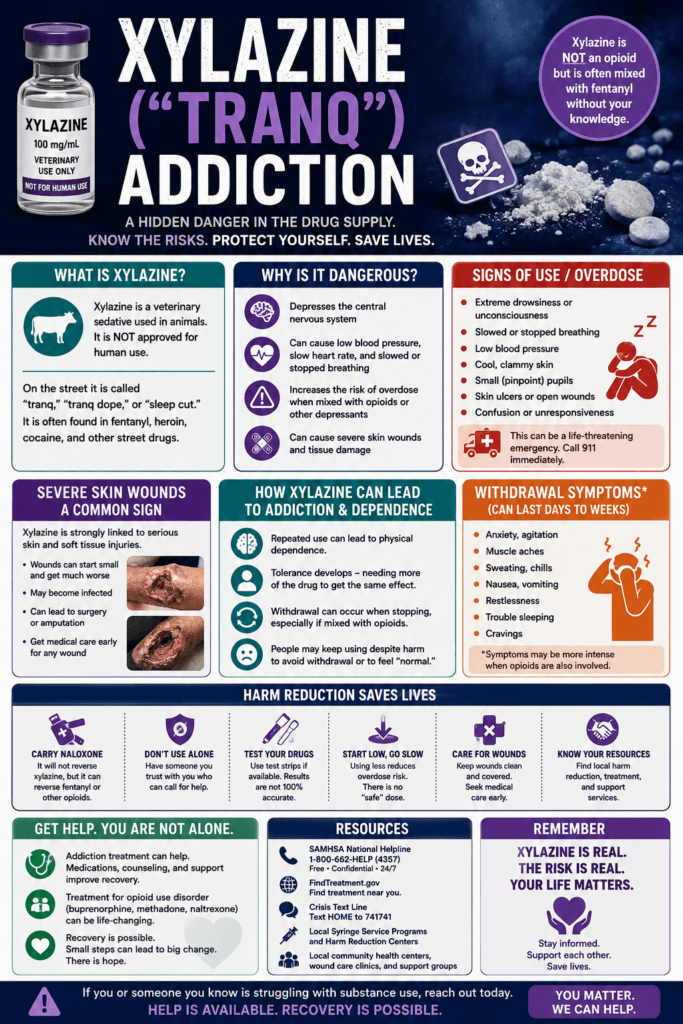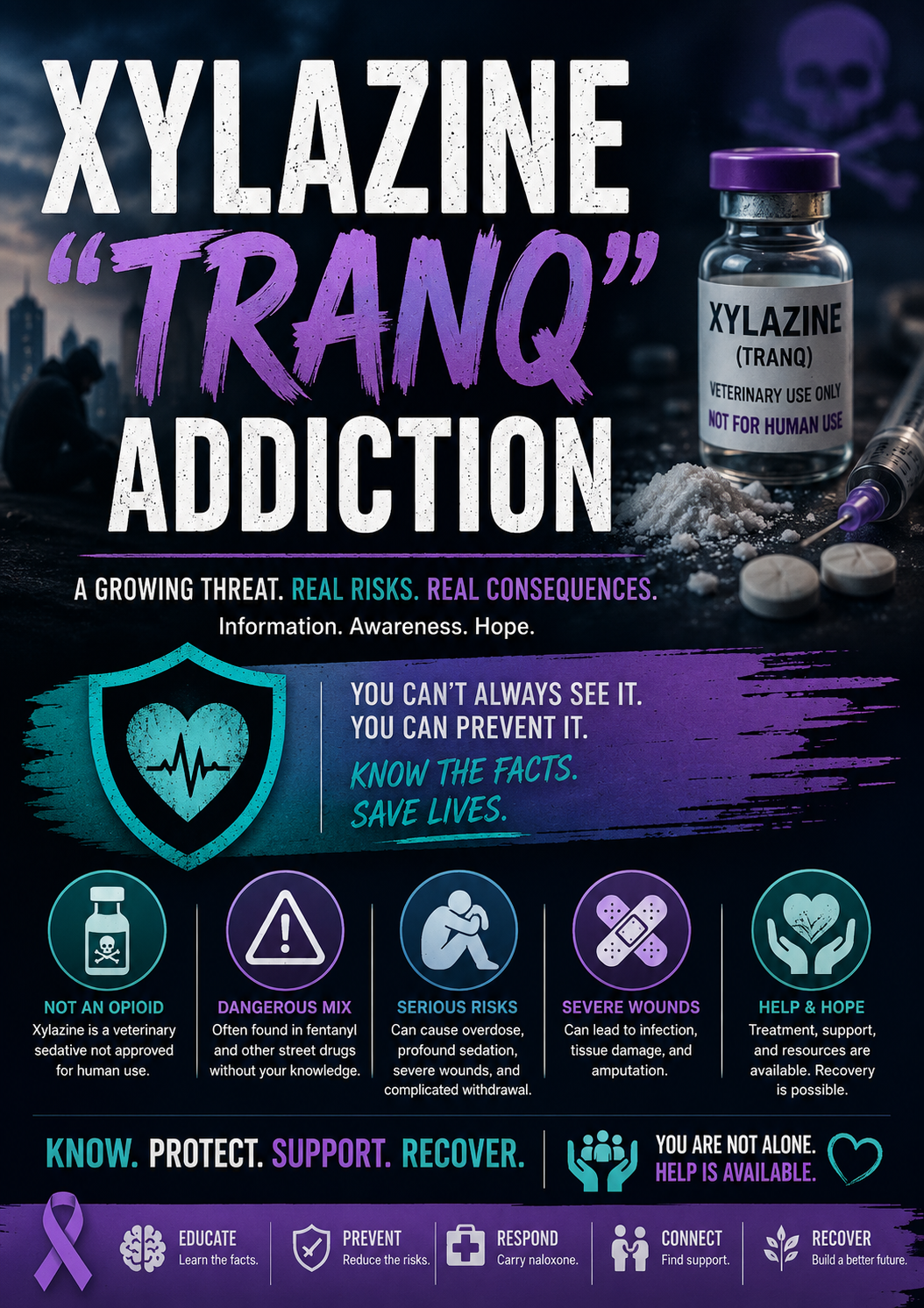
Xylazine, commonly called “tranq,” is a non-opioid veterinary sedative that is not approved for human use in the United States but has increasingly appeared in the illicit drug supply, particularly alongside illegally manufactured fentanyl. People may be exposed to xylazine without knowing it is present, making its effects especially concerning. Xylazine can cause profound sedation, slowed heart rate, low blood pressure, breathing problems, and serious skin and soft-tissue wounds. Repeated exposure may also contribute to physical dependence and complicated withdrawal, particularly when opioids are being used at the same time. Understanding xylazine requires recognizing not only its medical dangers but also its connection to opioid use disorder, polysubstance use, overdose, and barriers to treatment.
Xylazine (“Tranq”) and Addiction
Xylazine, commonly called “tranq” or “tranq dope,” is a non-opioid sedative and tranquilizer used in veterinary medicine. It is not approved for human use in the United States. The major addiction-related concern is that xylazine has increasingly appeared in the illicit drug supply, particularly in combination with illegally manufactured fentanyl. People may therefore be exposed without realizing it.
Is Xylazine Addictive?
It is more accurate to discuss xylazine in the context of physical dependence, withdrawal, polysubstance use, and opioid use disorder rather than assuming that everyone exposed develops a distinct “xylazine addiction.” Research on human xylazine dependence and withdrawal is still developing.
In practice, people may repeatedly use fentanyl or other opioids containing xylazine and become dependent on the drug mixture. This can complicate withdrawal and treatment because clinicians may need to address both opioid withdrawal and symptoms potentially associated with xylazine exposure. NIDA continues to study xylazine withdrawal, overdose, wounds, and treatment approaches.
Why Is Xylazine Especially Dangerous?
Xylazine depresses the central nervous system and can cause profound sedation, slowed breathing, low blood pressure, slowed heart rate, and other potentially life-threatening effects. Combining it with fentanyl or other depressants increases concern because multiple substances can contribute to sedation and respiratory compromise.
Xylazine has also become increasingly important in U.S. overdose mortality. CDC data published in 2026 show that xylazine rose to the fourth most commonly mentioned drug in overdose deaths in 2023, while fentanyl remained first.
Xylazine and Severe Skin Wounds
One of the most recognizable complications associated with xylazine exposure is serious skin and soft-tissue injury. Wounds can become extensive and may require prolonged medical treatment. Severe tissue damage can lead to infection and, in extreme situations, surgical intervention or amputation.
These wounds deserve medical attention rather than stigma. Delaying treatment can allow tissue damage or infection to worsen.
What Happens During an Overdose?
A person exposed to xylazine may become extremely sedated and have impaired breathing. Because illicit xylazine is frequently encountered with fentanyl, an apparent “tranq overdose” should be treated as a possible opioid overdose.
Naloxone should still be given when opioid overdose is suspected. Naloxone does not reverse xylazine itself, but it can reverse the opioid component—such as fentanyl—and restore breathing affected by opioids. Emergency medical assistance and supportive care remain essential because sedation from xylazine can persist after naloxone administration.
Warning Signs of a Serious Problem
Concerning patterns can include repeated use of fentanyl or other street drugs containing xylazine, increasing tolerance or dependence, difficulty stopping, severe withdrawal symptoms, continued use despite wounds or other medical complications, recurrent overdose, and prioritizing drug use over work, relationships, health, or other responsibilities.
Importantly, someone purchasing fentanyl, heroin, cocaine, or another illicit substance may not know xylazine is present, so exposure does not necessarily mean the person intentionally sought xylazine.
Treatment and Recovery
There is currently no simple medication that specifically reverses xylazine dependence in the way that medications such as buprenorphine and methadone treat opioid use disorder. Care may therefore involve medical management of withdrawal, evidence-based treatment for co-occurring opioid use disorder, wound care, behavioral treatment, harm-reduction services, and ongoing medical monitoring.
The distinction is important: treating the opioid component alone may not address every complication associated with xylazine exposure.
Key Message
Xylazine represents a particularly dangerous development in the illicit drug supply because people may unknowingly receive it alongside fentanyl. The combination can produce profound sedation, complicated withdrawal, severe wounds, and increased overdose risk. Recognizing xylazine exposure early and connecting individuals with overdose prevention, wound care, addiction treatment, and harm-reduction services can prevent serious complications and save lives.
Self-Management Strategies for Xylazine (“Tranq”) and Addiction
Self-management for xylazine exposure requires extra caution because xylazine is often found with illicit fentanyl and other drugs, sometimes without the person’s knowledge. Xylazine is a veterinary sedative rather than an opioid, and repeated exposure can involve physical dependence and complicated withdrawal. Self-management should therefore focus on reducing overdose risk, recognizing complications, treating co-occurring substance use disorders, and obtaining medical care rather than attempting to manage everything alone.
- Understand what xylazine is. Xylazine is not an opioid and is not approved for human use. Learning how it differs from fentanyl helps people understand why its effects and complications may require additional medical management.
- Assume the illicit drug supply may be unpredictable. A person may not know that xylazine is present in fentanyl or another illicit substance. Appearance alone cannot reliably identify what a street drug contains.
- Keep naloxone available when opioids may be involved. Naloxone does not reverse xylazine, but it can reverse accompanying fentanyl or another opioid. Because xylazine is commonly encountered with opioids, naloxone should still be administered when opioid overdose is suspected.
- Avoid using drugs alone. Having another person present who can recognize an overdose, administer naloxone, and contact emergency services can reduce the risk of a fatal outcome.
- Avoid combining depressants. Alcohol, benzodiazepines, opioids, and other sedating substances can contribute to dangerous central nervous system and respiratory depression when combined with xylazine.
- Learn overdose warning signs. Extreme sedation, inability to wake, abnormal or inadequate breathing, and blue, gray, or pale skin or lips require immediate attention. Treat suspected opioid involvement with naloxone and obtain emergency medical assistance.
- Pay close attention to wounds. Xylazine exposure has been associated with serious skin and soft-tissue wounds. Check the skin regularly and seek medical care for worsening pain, redness, swelling, drainage, foul odor, fever, expanding wounds, or dark/dead tissue.
- Do not attempt aggressive wound treatment yourself. Cutting away tissue, using harsh chemicals, or otherwise performing procedures on wounds can cause additional injury or infection. Professional wound assessment is safer.
- Do not attempt to manage significant dependence on your own abruptly. Withdrawal after repeated exposure may be complicated, particularly when fentanyl or other substances are involved. Medical assessment can determine whether supervised withdrawal management is appropriate.
- Seek treatment for opioid use disorder when applicable. If fentanyl or another opioid is also being used, medications such as buprenorphine or methadone can treat the opioid use disorder even though they do not specifically treat xylazine exposure.
- Identify triggers and patterns. Recording when substances are used, what triggers cravings, and what consequences follow can help identify stress, withdrawal, environments, people, or emotions associated with continued use.
- Build a recovery support system. Addiction treatment professionals, primary-care clinicians, wound-care specialists, peer-recovery programs, harm-reduction services, and trusted family members can address different aspects of recovery.
Key Self-Management Message
With xylazine, self-management should not mean self-treatment. The safest approach combines overdose prevention, naloxone availability, wound monitoring, reduced exposure to unpredictable illicit drugs, professional management of withdrawal, and evidence-based treatment for any accompanying opioid use disorder.
Because xylazine frequently appears alongside fentanyl, addressing the entire pattern of substance use—not just the “tranq”—is essential for reducing overdose risk and supporting long-term recovery.
Family Support Strategies for Xylazine (“Tranq”) Addiction
Families can play an important role in helping someone who is exposed to or repeatedly using xylazine, often in combination with fentanyl. Xylazine is a non-opioid veterinary sedative that is not approved for human use, and people may consume it unknowingly because it can be mixed into the illicit drug supply. Family support should focus on education, overdose prevention, wound awareness, treatment engagement, and compassionate boundaries.
- Learn about xylazine. Understand that xylazine is not an opioid and that exposure often occurs alongside fentanyl. This distinction matters because xylazine can cause profound sedation and other complications that opioid-focused treatment alone may not address.
- Avoid blame and stigma. A family member may not have intentionally chosen to use xylazine. Approach conversations with concern rather than accusations, especially because shame can discourage people from disclosing drug use or seeking medical treatment.
- Learn the signs of overdose. Extreme sedation, inability to wake, and inadequate or abnormal breathing require immediate attention. Because fentanyl or another opioid may also be present, families should treat the situation as a potential opioid overdose.
- Keep naloxone accessible. Naloxone does not reverse xylazine, but it can reverse fentanyl or another opioid that may have been taken with it. Family members should learn how to recognize an opioid overdose and administer naloxone.
- Call emergency services when an overdose is suspected. Even after naloxone is administered, emergency medical evaluation remains important because xylazine-related sedation may continue after the opioid component has been reversed.
- Pay attention to skin wounds. Xylazine exposure has been associated with severe skin and soft-tissue wounds. Encourage early professional wound care rather than waiting until wounds become extensive, infected, or medically dangerous.
- Encourage treatment without issuing threats. Help the person connect with addiction medicine, primary care, wound care, behavioral-health services, or harm-reduction programs. Treatment should address the person’s overall substance-use pattern rather than xylazine exposure alone.
- Support treatment for opioid use disorder. When fentanyl or another opioid is involved, medications such as buprenorphine or methadone can be important components of treatment for opioid use disorder, even though they do not specifically treat xylazine effects.
- Understand that withdrawal may be complicated. Families should avoid assuming that someone can simply stop using without difficulty. Dependence on fentanyl, xylazine, or other substances may require professional assessment and medically supervised management.
- Create a family emergency plan. Family members should know where naloxone is kept, how to use it, who will contact emergency services, and what information to provide to responders.
- Set healthy boundaries. Supporting recovery does not mean providing money for drugs, covering up dangerous behavior, or accepting abuse. Families can provide transportation to treatment, help locate resources, offer emotional support, and reinforce recovery-oriented decisions while maintaining appropriate boundaries.
- Take care of family members too. Living with addiction can create fear, exhaustion, grief, and chronic stress. Counseling, family therapy, peer-support programs, and caregiver support can help relatives maintain their own well-being.
Key Message for Families
The most effective family approach combines compassion with safety and accountability. Learn about xylazine, keep naloxone available when opioid exposure is possible, recognize overdose and wound complications, encourage evidence-based treatment, and maintain healthy boundaries.
Most importantly, families should remember that someone may not even know xylazine is present in the drugs they are using. Treating the situation as a medical and behavioral-health problem rather than a moral failure can make it easier for the person to accept help and remain connected to care.
Community Resource Strategies for Xylazine (“Tranq”) Addiction
Community resources are especially important in responding to xylazine because it is often found with illegally manufactured fentanyl, and people may not know they have been exposed. Effective community strategies should combine education, overdose prevention, wound care, harm reduction, addiction treatment, and coordinated healthcare services.
- Increase community education. Public-health departments, healthcare systems, schools, treatment programs, and community organizations can provide accurate information about xylazine, including its presence in the illicit drug supply and its association with severe sedation, overdose risk, and serious wounds.
- Expand naloxone availability. Community organizations can distribute naloxone and teach people how to recognize and respond to opioid overdose. Naloxone does not reverse xylazine itself, but it remains essential because fentanyl or another opioid is frequently involved.
- Strengthen harm-reduction programs. Syringe-service programs and other harm-reduction organizations can provide naloxone, safer-use education, infectious-disease prevention, wound-care supplies, testing services where available, and referrals to treatment.
- Provide accessible wound-care services. Communities experiencing xylazine exposure need low-barrier wound assessment and treatment. Mobile clinics, street-medicine teams, emergency departments, primary-care practices, and wound-care clinics can help identify complications before they become severe.
- Improve drug-checking resources. Where legally and practically available, drug-checking programs and xylazine test strips can provide additional information about the local drug supply. Results should be interpreted cautiously because testing does not guarantee that a substance is safe.
- Expand evidence-based opioid treatment. Because xylazine is commonly encountered with fentanyl, communities should maintain easy access to medications for opioid use disorder, particularly buprenorphine and methadone, along with counseling and recovery support.
- Educate healthcare professionals. Emergency clinicians, primary-care providers, addiction specialists, nurses, physician assistants, pharmacists, and first responders should understand that xylazine is not an opioid and may contribute to prolonged sedation, complicated withdrawal presentations, and significant wounds.
- Develop coordinated referral systems. Emergency departments, addiction programs, wound-care clinics, harm-reduction organizations, shelters, and community health centers should establish pathways that allow people to move quickly from crisis care into continuing treatment.
- Support mobile and outreach services. Individuals experiencing homelessness or unstable housing may have difficulty attending traditional appointments. Mobile treatment, street medicine, peer outreach, and transportation assistance can bring services closer to vulnerable populations.
- Use peer recovery specialists. People with lived recovery experience can help build trust, reduce stigma, explain available services, accompany individuals to appointments, and support continued engagement in treatment.
- Monitor the local drug supply. Public-health agencies can use overdose surveillance, toxicology information, and community reports to identify emerging xylazine trends and communicate appropriate warnings without creating unnecessary fear.
- Educate families and caregivers. Community programs should teach families about overdose recognition, naloxone administration, wound warning signs, treatment options, and ways to support recovery without enabling continued substance use.
Building a Community Response
The strongest response to xylazine is a continuum of care:
Outreach & Education → Harm Reduction → Naloxone → Wound Care → Addiction Treatment → Peer Support → Long-Term Recovery
Xylazine should not be addressed as an isolated drug problem. Because exposure frequently occurs within a complex illicit drug supply involving fentanyl and other substances, communities need coordinated strategies addressing overdose prevention, opioid use disorder, physical health, wounds, housing and social needs, and long-term recovery.
A community that makes treatment and harm-reduction services easier to reach can intervene earlier—before an overdose, infection, severe wound, or other medical crisis becomes the first opportunity to offer help.
Frequently Asked Questions
Here are some common questions:
1. What is xylazine (“tranq”)?
Xylazine is a non-opioid sedative used in veterinary medicine. It is not approved by the FDA for human use. In the illicit drug supply, it is often found with fentanyl and other substances.
2. Is xylazine an opioid?
No. Xylazine is not an opioid. It acts primarily as an alpha-2 adrenergic agonist and produces significant sedation and other central nervous system effects.
3. Why is xylazine called “tranq”?
“Tranq” is a street term derived from its tranquilizing effects. The term “tranq dope” is often used for illicit drug mixtures containing xylazine, frequently alongside fentanyl.
4. Can a person become dependent on xylazine?
Repeated exposure can produce physical dependence, and withdrawal symptoms have been reported. However, human xylazine dependence and withdrawal are still being studied, particularly because exposure frequently occurs together with opioids and other substances.
5. Can people take xylazine without knowing it?
Yes. Xylazine can be added to illicit fentanyl or other street drugs without the person’s knowledge. This makes exposure especially difficult to predict.
6. Why is fentanyl frequently discussed with xylazine?
Xylazine has commonly been detected in combination with illegally manufactured fentanyl. Because fentanyl is a powerful opioid and xylazine is a sedative, exposure to the combination can create particularly serious overdose risks.
7. What are signs of possible xylazine intoxication?
Signs can include profound drowsiness or unconsciousness, slowed heart rate, low blood pressure, and impaired breathing. Because other substances are usually involved, symptoms can vary considerably.
8. Does naloxone reverse xylazine?
No. Naloxone does not reverse xylazine because xylazine is not an opioid. However, naloxone should still be administered when an opioid overdose is suspected, because fentanyl or another opioid may also be present.
9. What should someone do during a suspected overdose?
Call emergency medical services, administer naloxone when opioid exposure is possible, and follow emergency-dispatch instructions. A person may remain sedated after naloxone because it does not reverse xylazine’s effects.
10. Why does xylazine cause concern about skin wounds?
Xylazine exposure has been associated with serious skin and soft-tissue wounds that can become extensive. These wounds may occur in areas other than an injection site and can become infected or cause significant tissue damage.
11. When should a xylazine-associated wound receive medical attention?
Worsening redness, swelling, pain, drainage, foul odor, fever, rapidly expanding wounds, or dark or dead-appearing tissue should receive prompt medical evaluation. Earlier wound care can help prevent serious complications.
12. Can xylazine withdrawal be treated at home?
Attempting to manage significant dependence alone can be risky, especially when fentanyl or other substances are also involved. Professional medical assessment can help determine the safest approach to withdrawal management.
13. Are buprenorphine and methadone treatments for xylazine?
They do not specifically treat xylazine dependence. However, they are evidence-based medications for opioid use disorder, which is particularly important when someone is also using fentanyl or another opioid.
14. How can families help someone exposed to xylazine?
Families can learn overdose warning signs, keep naloxone available, encourage early wound treatment, communicate without stigma, help connect the person with addiction treatment, and maintain healthy boundaries.
15. What community resources can help?
Addiction-treatment programs, harm-reduction organizations, syringe-service programs where available, wound-care clinics, community health centers, peer-recovery programs, and opioid-treatment services can provide different forms of assistance.
16. Can xylazine test strips identify it in drugs?
Xylazine test strips may help identify the presence of xylazine where available, but testing has limitations. A negative result should never be interpreted as proof that an illicit substance is safe.
17. Can xylazine exposure be fatal?
Yes, particularly in polysubstance exposures involving fentanyl and other depressants. Severe sedation, respiratory problems, and other complications can contribute to life-threatening emergencies.
18. Is recovery possible?
Yes. Recovery may involve treating co-occurring opioid use disorder, managing withdrawal safely, receiving appropriate wound care, reducing overdose risk, addressing other substance use, and maintaining behavioral-health and recovery support.
Conclusion
Xylazine has added another layer of complexity to the overdose crisis because it can appear unexpectedly in an already unpredictable illicit drug supply. Naloxone does not reverse xylazine itself, but it should still be administered when an opioid overdose is suspected because fentanyl or another opioid may also be involved. Effective responses include overdose education, naloxone availability, early wound care, harm-reduction services, professional management of withdrawal, and evidence-based treatment for co-occurring opioid use disorder. Families, healthcare professionals, and communities can reduce harm by responding with accurate information rather than stigma and by connecting people to appropriate medical and addiction services. Understanding xylazine as part of a broader substance-use and public-health challenge is essential for preventing complications, supporting recovery, and saving lives.
Video: What You Don’t Know About Xylazine Can Kill You