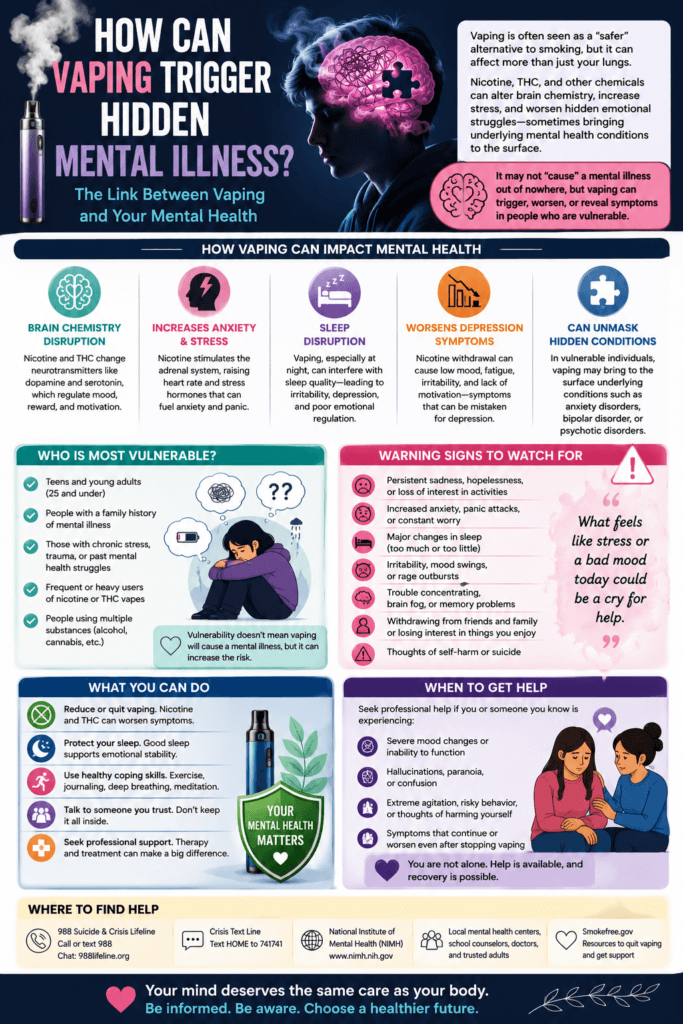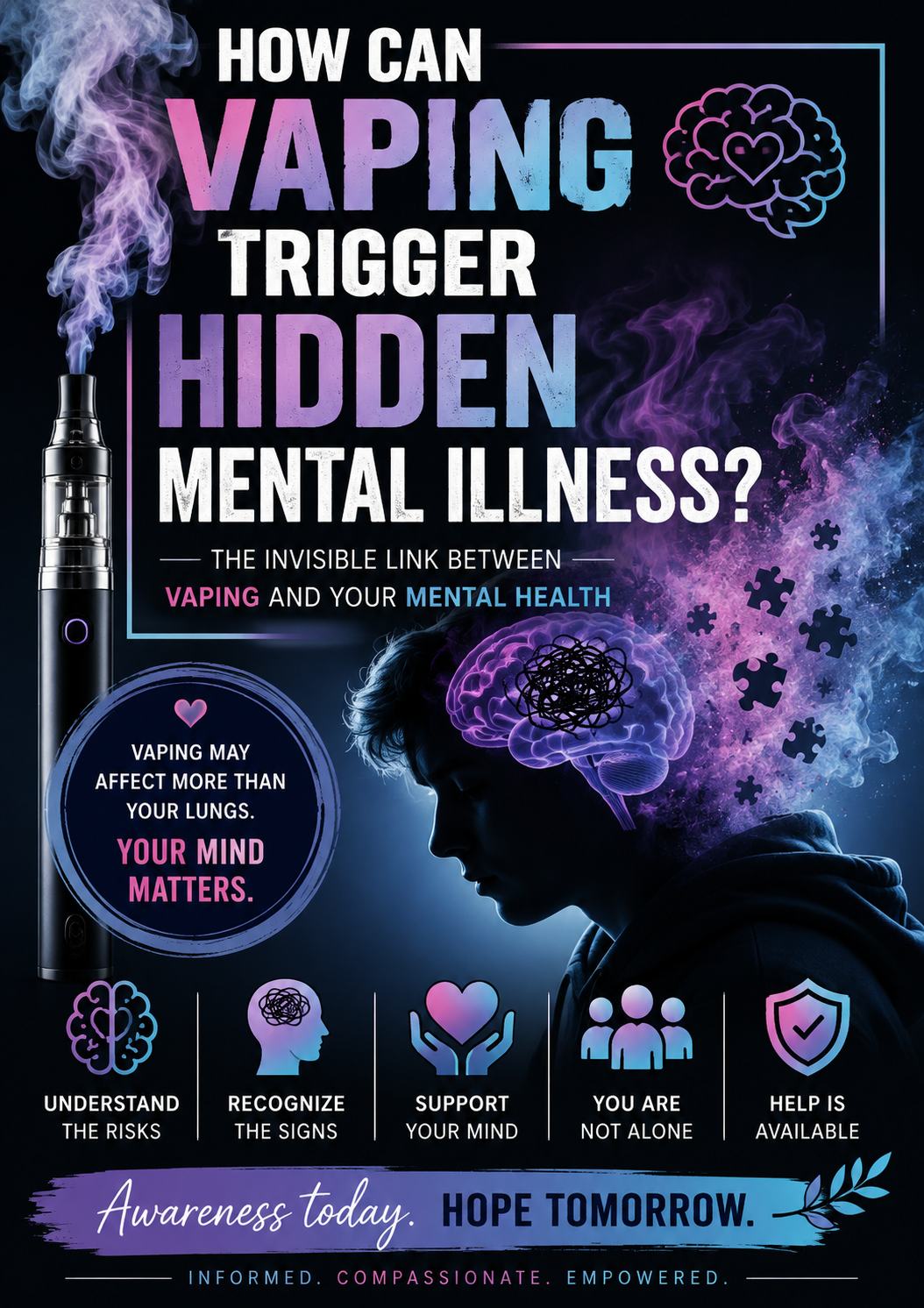
Can vaping trigger a hidden mental illness? The relationship is more complicated than a simple yes-or-no answer. Vaping is not proven to suddenly activate a psychiatric disorder that would otherwise remain permanently hidden, but nicotine dependence, withdrawal, disrupted sleep, chronic stress, and exposure to THC or other substances may worsen psychological symptoms or make an underlying vulnerability more noticeable. Adolescents and young adults deserve particular attention because their brains are still developing and many mental-health conditions naturally begin to emerge during these years. Understanding what is being vaped, how frequently it is used, and whether changes in anxiety, mood, sleep, thinking, or behavior occur alongside vaping can help identify problems earlier and guide appropriate intervention.
Can Vaping Trigger Hidden Mental Illness?
Vaping is often discussed primarily as a lung-health issue, but its relationship with mental health—especially nicotine vaping—is increasingly important. A useful way to frame the question is: vaping is not known to simply “switch on” a hidden psychiatric disorder, but nicotine exposure, dependence, withdrawal, sleep disruption, and heavy use may worsen or reveal symptoms in someone who is already vulnerable to anxiety, depression, or other mental-health problems.
Nicotine and the Developing Brain
Most discussions about vaping and mental health focus on nicotine-containing products. Nicotine rapidly activates nicotinic acetylcholine receptors and influences dopamine and other neurotransmitter systems involved in reward, attention, learning, mood, and stress.
This is particularly concerning for adolescents and young adults because the brain continues developing into the mid-20s. Repeated nicotine exposure can strengthen learned associations between stress and nicotine use, making dependence easier to establish.
Can Vaping Cause Anxiety?
Nicotine can temporarily produce feelings of stimulation, concentration, or relief. However, it can also increase heart rate and physiological arousal. In susceptible individuals, these sensations may resemble or intensify anxiety.
Once dependence develops, another problem appears: nicotine withdrawal itself can cause anxiety, irritability, restlessness, difficulty concentrating, and low mood.
This can create a cycle:
Stress or anxiety → vaping → temporary relief → nicotine level falls → withdrawal and anxiety → vaping again.
The person may eventually believe vaping is treating their anxiety when some of the relief actually comes from temporarily relieving nicotine withdrawal.
What About Depression?
Research consistently finds an association between youth vaping and depressive symptoms, but association does not automatically prove that vaping directly causes depression.
The relationship can work in several directions. Someone experiencing depression may be more likely to vape as a coping mechanism, while nicotine dependence, withdrawal, disrupted sleep, and continued exposure may contribute to worsening emotional symptoms. Shared factors—including chronic stress, genetics, peer influences, trauma, and other substance use—may also contribute to both.
Therefore, it is more scientifically accurate to describe the relationship as complex and potentially bidirectional rather than saying vaping directly causes depression in everyone.
Can Vaping “Unmask” a Hidden Mental Illness?
This requires careful terminology.
Some people have an underlying vulnerability to psychiatric illness because of genetics, developmental factors, trauma, environmental stress, or family history. Symptoms may not appear until adolescence or young adulthood—the same developmental period when many psychiatric disorders naturally first emerge.
Nicotine use, dependence, sleep deprivation, chronic stress, and withdrawal could potentially aggravate existing vulnerability or make previously subtle symptoms more noticeable.
But if someone develops panic attacks, depression, mania, paranoia, or another psychiatric symptom while vaping, it should not automatically be assumed that vaping caused an underlying disorder to emerge.
A professional evaluation should consider the person’s symptoms, family history, sleep, medications, nicotine exposure, cannabis or other substance use, and the timing of symptoms.
Nicotine Vaping vs. Cannabis Vaping
This distinction is particularly important.
A nicotine vape and a THC-containing cannabis vape have very different psychiatric risk profiles. High-THC cannabis products can produce anxiety, panic, paranoia, perceptual disturbances, and, in vulnerable individuals, psychotic symptoms.
Cannabis use has also been associated with increased risk of psychotic disorders, particularly with frequent use of high-potency products and in people who are already vulnerable.
Therefore, when someone says that “vaping caused psychiatric symptoms,” healthcare professionals need to determine what was actually being vaped.
Sleep Can Be the Missing Link
Nicotine is stimulating, and frequent vaping—particularly late at night—may interfere with sleep.
Poor sleep can worsen irritability, anxiety, depression, concentration, emotional regulation, and impulsivity. In people vulnerable to bipolar disorder, major sleep disruption can be particularly concerning because changes in sleep may accompany or contribute to mood destabilization.
Reducing nighttime nicotine exposure and restoring a regular sleep schedule can therefore be an important part of mental-health assessment and recovery.
Warning Signs That Should Not Be Ignored
Someone who vapes should receive professional evaluation if they develop significant new symptoms such as persistent depression, severe anxiety or panic attacks, dramatic personality changes, extreme irritability, inability to sleep, unusually elevated energy despite little sleep, paranoia, hallucinations, major deterioration in school or work performance, or suicidal thinking.
The goal is not simply to blame the vape. The important question is what is happening psychologically, what substances are being used, and what intervention is needed.
Breaking the Nicotine–Mental Health Cycle
Stopping nicotine can temporarily produce withdrawal symptoms, including irritability, anxiety, restlessness, cravings, sleep changes, and difficulty concentrating. These symptoms can sometimes be mistaken for worsening psychiatric illness.
Support can make quitting easier. Behavioral counseling, trigger management, social support, structured routines, exercise, adequate sleep, and appropriate healthcare guidance can help individuals manage withdrawal while monitoring underlying mental-health symptoms.
Key Takeaway
Vaping should not be described as a proven switch that activates a previously hidden mental illness. The relationship is more complicated. Nicotine vaping can produce dependence and withdrawal and may contribute to anxiety, mood changes, and sleep disruption. These effects may worsen symptoms or make an underlying vulnerability more apparent in some individuals.
The strongest concern is among adolescents, young adults, people with existing psychiatric symptoms or a strong family history, and those using THC or multiple substances.
If significant psychiatric symptoms begin or worsen after vaping starts, the safest approach is not simply to assume they will disappear after quitting. Both substance use and mental health should be professionally evaluated, because early recognition provides the best opportunity for appropriate treatment and recovery.
Self-Management Strategies: Can Vaping Trigger Hidden Mental Illness?
Vaping does not necessarily “activate” a hidden mental illness. However, nicotine dependence, withdrawal, sleep disruption, stress, and THC exposure can worsen psychiatric symptoms or make an underlying vulnerability more noticeable. Self-management should focus on recognizing patterns early and knowing when professional evaluation is necessary.
- Know what you are vaping. Determine whether the product contains nicotine, THC/cannabis, or other substances. Different substances carry different mental-health risks, and unregulated products may contain unexpected ingredients.
- Track vaping and mood together. Keep a simple record of vaping frequency alongside anxiety, depression, irritability, concentration, sleep, and cravings. Patterns may reveal whether symptoms appear after vaping, between vaping sessions, or during attempts to quit.
- Recognize nicotine withdrawal. Anxiety, irritability, restlessness, difficulty concentrating, low mood, cravings, and sleep changes can occur when nicotine levels fall. These symptoms may sometimes be mistaken for a new psychiatric disorder.
- Watch for escalating nicotine use. Needing to vape immediately after waking, vaping more frequently, being unable to go several hours without vaping, or repeatedly failing to cut down can indicate nicotine dependence.
- Protect your sleep. Nicotine is stimulating. Avoiding vaping close to bedtime and maintaining consistent sleeping and waking times may improve sleep and emotional regulation. Major changes in sleep should not be ignored.
- Identify emotional triggers. Ask yourself what usually happens immediately before vaping. Stress, boredom, loneliness, anger, social anxiety, and sadness can become triggers that teach the brain to associate nicotine with emotional relief.
- Develop alternative coping strategies. Exercise, deep breathing, mindfulness, music, hobbies, journaling, spending time outdoors, and talking with supportive people can provide alternatives when vaping has become an automatic response to stress.
- Be cautious with THC vaping. THC-containing products require separate consideration from nicotine. Cannabis can cause anxiety, panic, paranoia, and perceptual disturbances, and high-potency use may be particularly concerning for people vulnerable to psychosis.
- Know your personal vulnerability. A personal or family history of significant mental-health problems may be relevant when psychiatric symptoms appear. This does not mean vaping will inevitably cause illness, but emerging symptoms deserve careful evaluation.
- Do not self-diagnose. Anxiety after vaping does not automatically mean an anxiety disorder, and paranoia after THC exposure does not automatically mean schizophrenia. Clinicians need to consider substance effects, withdrawal, sleep, medications, medical conditions, and underlying psychiatric disorders.
- Consider reducing or quitting nicotine. If vaping is affecting mood, sleep, finances, relationships, or daily functioning, quitting may be beneficial. Evidence-based cessation support can make the process more manageable than relying exclusively on willpower.
- Expect temporary changes during quitting. Nicotine withdrawal can temporarily increase irritability, anxiety, cravings, concentration problems, and sleep disturbances. Knowing this beforehand can prevent someone from interpreting every withdrawal symptom as evidence that quitting is harming their mental health.
- Monitor symptoms after stopping. If anxiety, depression, paranoia, severe insomnia, or other significant symptoms persist after substance exposure has stopped, professional evaluation becomes especially important. Vaping may not be the only factor involved.
- Avoid replacing vaping with another substance. Increasing alcohol, cannabis, sedatives, or other substances to manage nicotine withdrawal can create additional problems rather than resolving the original one.
- Recognize psychiatric warning signs. New hallucinations, paranoia, severe confusion, extreme agitation, dramatically decreased need for sleep accompanied by unusual energy or risky behavior, severe depression, or suicidal thinking require prompt professional assessment.
Key Takeaway
The most useful question is not simply “Did vaping cause my mental illness?” but rather “What changed after I started vaping, what substance am I using, and what happens to my symptoms when I use it or stop?”
Tracking vaping + mood + sleep + cravings + other substance use can reveal important patterns. If significant psychiatric symptoms appear, self-management should complement—not replace—professional assessment. Early evaluation can help distinguish nicotine effects or withdrawal from an emerging mental-health condition and guide appropriate treatment.
Family Support Strategies: Can Vaping Trigger Hidden Mental Illness?
Families can play an important role when someone who vapes develops anxiety, depression, severe mood changes, paranoia, or other concerning symptoms. Vaping should not automatically be blamed for a psychiatric disorder, but nicotine dependence and withdrawal, disrupted sleep, THC exposure, and other substance use can worsen symptoms or make an underlying vulnerability more noticeable.
- Learn what the person is actually vaping. Families should distinguish nicotine vaping from THC/cannabis vaping because their psychiatric effects differ. Ask calmly about the substance, frequency, strength, and other substances being used.
- Avoid immediately labeling the person mentally ill. New anxiety, irritability, insomnia, or mood changes can have many explanations. Nicotine intoxication or withdrawal, cannabis, stress, medications, medical conditions, and psychiatric disorders may produce overlapping symptoms.
- Learn the signs of nicotine dependence. Frequent vaping, strong cravings, vaping shortly after waking, irritability when unable to vape, increasing use, and unsuccessful attempts to quit can indicate dependence.
- Watch for changes in behavior. Families may notice social withdrawal, declining grades or work performance, unusual irritability, panic attacks, major changes in appetite, worsening concentration, or loss of interest in normal activities.
- Pay particular attention to sleep. Nicotine can interfere with sleep, while severe sleep disruption can worsen emotional regulation. Dramatically reduced sleep combined with unusual energy, agitation, impulsivity, or behavioral changes deserves professional evaluation.
- Understand nicotine withdrawal. When someone reduces or stops vaping, temporary anxiety, irritability, restlessness, cravings, difficulty concentrating, and sleep disturbances can occur. Families should recognize these symptoms without assuming the person is simply being difficult.
- Take THC-related symptoms seriously. High-potency cannabis products can produce severe anxiety, panic, paranoia, or perceptual disturbances. New psychiatric symptoms following THC vaping should not automatically be dismissed as ordinary experimentation.
- Know the family’s mental-health history. A family history of bipolar disorder, psychotic disorders, depression, or other significant psychiatric conditions may be clinically relevant. Families can share accurate history with healthcare professionals while avoiding predictions that the individual will inevitably develop the same condition.
- Communicate without confrontation. Instead of saying, “Vaping is making you crazy,” try focusing on observations: “I’ve noticed you’re sleeping much less and seem more anxious since you’ve been vaping more.” Specific observations encourage conversation without assigning a diagnosis.
- Help identify patterns. Encourage tracking of vaping, sleep, mood, anxiety, cravings, and other substance use. This information can help healthcare professionals understand whether symptoms occur during use, between vaping episodes, or after stopping.
- Support quitting without relying on punishment. Removing privileges or demanding immediate abstinence may not address nicotine dependence. Families can help the person access evidence-based cessation counseling and appropriate healthcare guidance.
- Encourage healthy alternatives. Exercise, regular meals, adequate sleep, hobbies, relaxation techniques, family activities, and supportive social connections can help replace vaping as a response to boredom or emotional distress.
- Avoid substituting another substance. Families should discourage replacing nicotine vaping with alcohol, cannabis, sedatives, or other substances to manage stress or withdrawal symptoms.
- Encourage professional evaluation when symptoms persist. Significant depression, recurring panic attacks, severe insomnia, paranoia, unusual behavioral changes, or worsening functioning should be evaluated rather than assuming that quitting vaping alone will resolve everything.
- Know when the situation requires urgent intervention. Hallucinations, severe paranoia, extreme confusion or agitation, dangerous behavior, inability to care for oneself, or suicidal thinking require prompt professional assessment.
Family Takeaway
Families should avoid two extremes: assuming vaping caused every psychological symptom or assuming vaping has nothing to do with mental health. The relationship can be complicated.
A supportive family can help by identifying what is being vaped, monitoring changes in sleep, mood, behavior, and functioning, recognizing nicotine dependence and withdrawal, encouraging cessation, and obtaining professional assessment when concerning symptoms develop.
Most importantly, approach the person with curiosity rather than accusation. The goal is not simply to prove that vaping caused the problem—it is to determine what is happening and help the person receive the appropriate support before symptoms become more serious.
Community Resource Strategies: Can Vaping Trigger Hidden Mental Illness?
Communities can help people understand the relationship between vaping and mental health without overstating the science. Nicotine vaping is not proven to simply “activate” a hidden psychiatric disorder, but nicotine dependence, withdrawal, disrupted sleep, stress, and other substance exposure may worsen psychological symptoms or make an existing vulnerability more noticeable. THC/cannabis vaping should be considered separately because its psychiatric effects differ from nicotine.
- Provide evidence-based vaping education. Schools, colleges, healthcare organizations, libraries, and community centers can explain how nicotine affects reward pathways, dependence, withdrawal, mood, attention, and sleep rather than focusing only on lung damage.
- Teach the difference between nicotine and THC vaping. Community education should identify what substance is being used. THC-containing products can cause anxiety, panic, paranoia, and other psychiatric symptoms, particularly with high-potency exposure.
- Integrate vaping screening into healthcare. Primary-care clinicians, pediatric practices, behavioral-health programs, and school health services can routinely ask about vaping, nicotine dependence, cannabis use, sleep, anxiety, depression, and other substances.
- Expand youth prevention programs. Adolescents and young adults deserve particular attention because nicotine exposure can establish dependence during an important period of brain development. Prevention programs should address peer pressure, advertising, stress management, and misconceptions about vaping safety.
- Connect vaping cessation with mental-health services. Someone experiencing anxiety or depression may use nicotine to cope. Treating nicotine dependence without addressing psychological distress—or treating anxiety while ignoring heavy vaping—may leave an important part of the problem unresolved.
- Provide accessible cessation programs. Community clinics, schools, pharmacies, and healthcare systems can offer counseling, behavioral support, quit plans, and appropriate medical guidance, rather than simply telling people to rely on willpower.
- Educate families. Parent and caregiver workshops can explain nicotine dependence, withdrawal symptoms, THC-related psychiatric effects, warning signs of deteriorating mental health, and ways to discuss vaping without immediately becoming confrontational.
- Promote healthy coping alternatives. Recreation centers, schools, youth organizations, and community groups can provide exercise, sports, arts, music, mindfulness programs, mentoring, and social activities that give young people alternatives for managing stress and boredom.
- Improve sleep education. Community programs should explain the connection between nicotine, nighttime vaping, sleep disruption, and emotional regulation. Healthy sleep should be incorporated into both vaping-prevention and mental-health programs.
- Train educators and youth professionals. Teachers, coaches, counselors, and youth workers can learn to recognize behavioral changes such as increasing isolation, declining academic performance, panic symptoms, severe insomnia, unusual agitation, or escalating substance use.
- Create referral pathways for psychiatric symptoms. Communities should establish clear connections among schools, primary-care offices, addiction services, mental-health professionals, and crisis programs so people with significant symptoms are not simply told to stop vaping without further evaluation.
- Address multiple substance use. Community assessments should include alcohol, cannabis, prescription medications, and other drugs because vaping may be only one component of a broader pattern of substance exposure.
- Use reliable public-health resources. CDC Smoking and Tobacco Use provides information about vaping and nicotine, while Smokefree Teen provides resources designed to help young people quit vaping and tobacco. Mental-health education is also available through the National Institute of Mental Health.
- Reduce stigma around both addiction and mental illness. Young people may hide vaping because they fear punishment and hide psychiatric symptoms because they fear being labeled. Community messaging should make disclosure an opportunity for assessment and support rather than humiliation.
- Teach when symptoms require urgent evaluation. Severe paranoia, hallucinations, extreme agitation, profound confusion, dramatically reduced need for sleep accompanied by major behavioral changes, dangerous behavior, or suicidal thinking should prompt immediate professional assessment rather than being dismissed as ordinary vaping effects.
Community Takeaway
Communities should move beyond the simple message that “vaping is bad for you.” Effective prevention explains why nicotine dependence matters and how vaping may interact with stress, anxiety, depression, sleep, withdrawal, cannabis exposure, and underlying psychiatric vulnerability.
The strongest approach combines prevention, early screening, cessation support, family education, mental health assessment, and accessible treatment. When significant psychological symptoms develop alongside vaping, the goal should not be merely to decide whether vaping “caused” them. The priority is to identify which substances are being used, understand the person’s symptoms, and connect them with appropriate care.
Frequently Asked Questions
Here are some common questions:
1. Can vaping trigger a hidden mental illness?
Vaping is not proven to simply “switch on” a hidden mental illness. However, nicotine dependence, withdrawal, sleep disruption, stress, and exposure to THC or other substances may worsen psychiatric symptoms or make an underlying vulnerability more noticeable.
2. Can vaping cause anxiety?
Nicotine can increase heart rate, alertness, and physiological arousal, which may intensify anxiety in some people. Once dependence develops, falling nicotine levels can also cause withdrawal symptoms such as anxiety, irritability, and restlessness.
3. Why does vaping sometimes seem to relieve anxiety?
Nicotine may produce short-term changes in attention and reward pathways. For someone who is nicotine-dependent, vaping may also temporarily relieve withdrawal symptoms. This can create a cycle in which withdrawal produces discomfort and vaping briefly makes that discomfort disappear.
4. Can vaping contribute to depression?
Research has found associations between vaping and depressive symptoms, particularly among adolescents and young adults. However, this does not prove that vaping directly causes depression. Depression may increase the likelihood of vaping, vaping may contribute to factors that worsen mood, or both may share other risk factors.
5. Can vaping trigger panic attacks?
Nicotine can cause rapid heartbeat, dizziness, trembling, nausea, and increased physiological arousal. People vulnerable to panic may interpret these sensations as threatening, potentially contributing to panic symptoms.
6. Can vaping cause psychosis or schizophrenia?
Nicotine vaping alone has not been established as a direct cause of schizophrenia. However, THC-containing cannabis vapes are different. High-potency cannabis can cause paranoia, hallucinations, or other psychotic symptoms, and frequent high-potency cannabis use is associated with increased psychosis risk, particularly among vulnerable individuals.
7. Does family history matter?
Yes. Genetics contribute to vulnerability to several psychiatric conditions, including bipolar disorder and schizophrenia. A family history does not mean someone will inevitably develop a disorder, but significant new psychiatric symptoms deserve careful evaluation.
8. Why are teenagers and young adults especially important?
The brain continues developing into young adulthood, while nicotine can establish dependence relatively quickly. Adolescence and early adulthood are also periods when several mental-health conditions commonly first become apparent, making it especially important not to dismiss new symptoms as “just vaping” or “just being a teenager.”
9. Can vaping interfere with sleep?
Yes. Nicotine is a stimulant, and frequent or nighttime use can interfere with sleep. Poor sleep can subsequently worsen anxiety, irritability, concentration, emotional regulation, and mood.
10. Can nicotine withdrawal look like mental illness?
Sometimes. Reducing or stopping nicotine can temporarily cause irritability, anxiety, low mood, restlessness, concentration difficulties, cravings, and sleep changes. These symptoms can overlap with psychiatric symptoms.
11. How can you tell withdrawal from an underlying mental-health disorder?
Timing is important but is not always enough to make the distinction. A healthcare professional may evaluate when symptoms began, vaping frequency, nicotine exposure, THC or other substance use, sleep patterns, family history, medications, and whether symptoms persist after withdrawal improves.
12. Does THC vaping carry the same mental-health risks as nicotine vaping?
No. Nicotine and THC affect the brain differently. THC can produce anxiety, panic, paranoia, altered perception, and, in some circumstances, psychotic symptoms. Knowing what substance is actually being vaped is essential when evaluating new mental-health symptoms.
13. What mental-health warning signs should families watch for?
Concerning changes include persistent depression, severe anxiety, repeated panic attacks, major social withdrawal, dramatic personality changes, deteriorating school or work performance, severe insomnia, unusual agitation, paranoia, hallucinations, or suicidal thoughts.
14. Will quitting vaping automatically make psychiatric symptoms disappear?
Not necessarily. Nicotine-related symptoms may improve after withdrawal resolves, but an independent mental-health condition may continue. Persistent or severe symptoms should therefore receive professional assessment even after vaping stops.
15. Can someone quit vaping if they also have anxiety or depression?
Yes. Mental-health symptoms may make quitting more challenging, but cessation support can be adapted to the individual’s needs. Counseling, behavioral strategies, appropriate cessation treatment, healthy routines, and concurrent mental health care may help.
16. What can families do to help?
Families can avoid accusations, ask what substances are being used, monitor major changes in sleep and behavior, encourage healthier coping strategies, support cessation efforts, and arrange professional assessment when significant symptoms appear.
17. When should someone seek professional help?
Professional evaluation is appropriate when anxiety, depression, sleep problems, behavioral changes, substance use, or other symptoms become persistent, severe, or interfere with school, work, relationships, or everyday functioning.
18. When is urgent help needed?
Hallucinations, severe paranoia, profound confusion, extreme agitation, dangerous behavior, inability to remain safe, or suicidal thinking require prompt professional attention.
19. Where can someone get help quitting vaping?
Smokefree Teen provides vaping-cessation resources for young people, while Smokefree.gov offers quitting information for adults. CDC Tobacco and Nicotine Resources provides additional education about nicotine and e-cigarettes.
20. What is the most important message about vaping and mental health?
Avoid oversimplifying the relationship. Vaping does not automatically cause a hidden psychiatric disorder, but it can interact with nicotine dependence, withdrawal, sleep, stress, THC exposure, and individual vulnerability. When significant psychological symptoms emerge, both vaping and mental health should be evaluated rather than assuming one explanation.
Conclusion
Vaping and mental health should be evaluated together rather than assuming that every psychological symptom is caused by vaping—or that vaping has no influence at all. Nicotine can contribute to dependence, withdrawal, anxiety, irritability, and sleep disruption, while THC-containing products may produce additional concerns such as panic, paranoia, and perceptual disturbances, particularly in vulnerable individuals. When significant changes in mood, sleep, behavior, or thinking develop after vaping begins or increases, both substance use and mental health deserve professional assessment. Prevention, early recognition, healthier coping strategies, cessation support, adequate sleep, and appropriate behavioral-health care can reduce risk. The key message is simple: pay attention to changes, take emerging psychiatric symptoms seriously, and seek help early rather than waiting for a problem to become a crisis.
Video: Vaping’s Grip on Your Mind #NicotineAddiction #MentalHealth