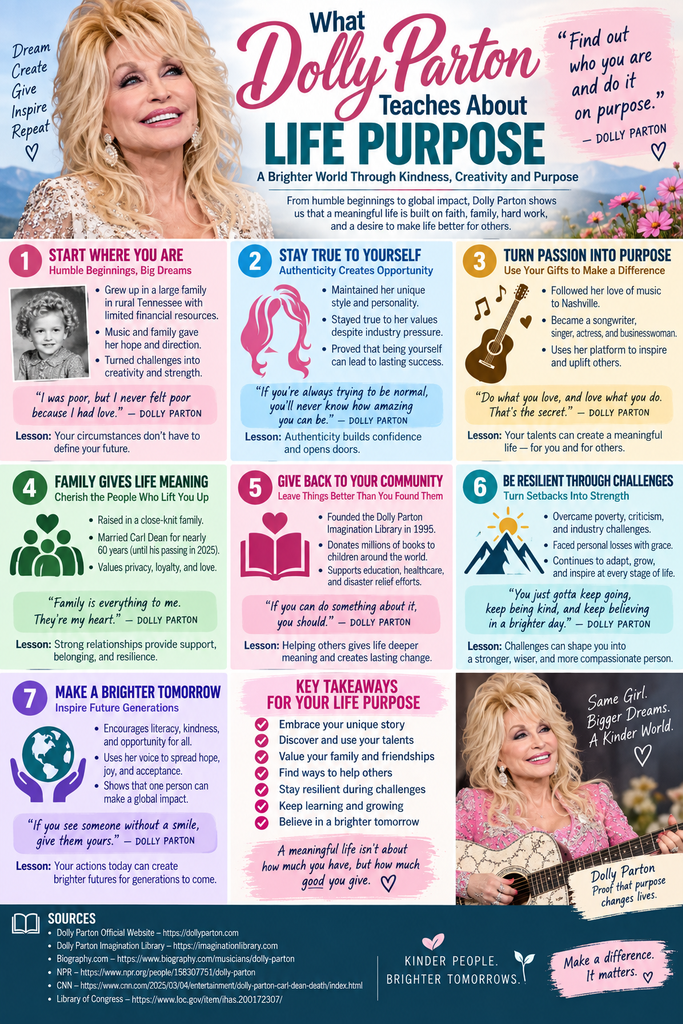
Dolly Parton is more than a country music legend. She is a singer, songwriter, actress, entrepreneur, and philanthropist whose career has inspired generations. From her humble beginnings in rural Tennessee to becoming an internationally recognized entertainer, Parton’s journey demonstrates how personal values, determination, creativity, and compassion can shape a meaningful life.
Despite experiencing poverty, professional challenges, personal losses, and the pressures of fame, Parton has maintained a strong sense of identity and purpose. Her commitment to music, family, education, and helping others illustrates that a fulfilling life is not measured solely by wealth, recognition, or professional achievements.
Her story offers valuable lessons for anyone seeking greater meaning, particularly individuals navigating emotional difficulties, major life transitions, or addiction recovery.
By examining Parton’s approach to life, we can explore how self-management, supportive relationships, and community involvement help individuals develop resilience, discover their strengths, and create a lasting sense of purpose.
1. Dolly Parton’s Early Life: Finding Purpose Through Humble Beginnings
Growing Up With Limited Resources but Strong Family Values
Dolly Parton was born on January 19, 1946, in Sevier County, Tennessee. She grew up in a large family with 11 siblings in a rural Appalachian community.
Her family experienced financial hardship, but music, storytelling, and close family relationships played important roles in her childhood.
Parton’s mother encouraged her creativity, while her family’s musical traditions helped shape her interest in songwriting and performing.
From an early age, Parton recognized music as a way to express herself and connect with others.
Her childhood experiences eventually influenced many of her songs, including Coat of Many Colors, which explores themes of poverty, family love, dignity, and personal identity.
Rather than allowing her circumstances to define her future, Parton pursued opportunities to develop her musical talents.
Her journey illustrates that life purpose can emerge from personal experiences, meaningful relationships, and the desire to create something valuable.
Lessons From Her Early Life
Parton’s childhood offers several lessons about developing purpose:
- Financial circumstances do not determine a person’s potential or worth.
- Personal talents can become sources of meaning and direction.
- Family traditions and cultural experiences can strengthen identity.
- Difficult experiences can inspire creativity and personal growth.
- Encouragement from others can help individuals recognize their strengths.
These lessons can be particularly meaningful for people who feel limited by their past or uncertain about their future.
2. Staying True to Yourself: The Importance of Personal Identity
Dolly Parton’s Commitment to Authenticity
Throughout her career, Parton has maintained a distinctive personal style, musical identity, and public personality.
Although she has adapted to changing musical trends and entertainment opportunities, she has consistently emphasized the importance of remaining true to herself.
Her career demonstrates that personal identity can provide stability during periods of change.
For individuals struggling with self-esteem, social pressure, or uncertainty about their future, developing a strong sense of identity can help guide important life decisions.
Rather than measuring personal worth solely by others’ approval, individuals can learn to recognize their values, strengths, and personal goals.
Self-Management Strategies for Developing Personal Identity
Self-management involves developing awareness of one’s thoughts, emotions, behaviors, and personal values.
Strategies for strengthening personal identity include:
- Identify personal values such as honesty, compassion, creativity, or responsibility.
- Recognize individual strengths, talents, and interests.
- Establish goals that reflect personal priorities rather than outside expectations.
- Practice self-acceptance while remaining open to personal growth.
- Set healthy boundaries in relationships and professional environments.
- Avoid defining personal worth solely through achievements, appearance, or social approval.
- Develop hobbies and interests that provide enjoyment and fulfillment.
A strong sense of identity can help individuals make decisions that align with their long-term well-being.
For people in addiction recovery, rebuilding personal identity may involve recognizing that substance use does not define their entire life or determine their future.
3. Finding Purpose Through Passion and Meaningful Work
Turning Personal Talents Into a Lifelong Mission
Parton’s passion for music began during childhood and became the foundation of her professional career.
After graduating from high school in 1964, she moved to Nashville to pursue opportunities in the music industry.
Her career developed through songwriting, performing, recording, acting, and business ventures.
However, her professional journey also required persistence, adaptation, and the willingness to pursue opportunities despite uncertainty.
Her experience illustrates how personal interests can develop into meaningful work when individuals consistently invest time and effort in their goals.
Importantly, life purpose does not have to involve fame, financial success, or a particular profession.
For some individuals, purpose may involve raising children, caring for loved ones, volunteering, developing creative talents, or helping others overcome difficult circumstances.
How to Discover Your Own Life Purpose
Finding purpose is often a gradual process rather than a single life-changing realization.
Individuals can begin by identifying activities, relationships, and goals that provide a sense of meaning.
Practical strategies include:
- Reflect on activities that create genuine enjoyment and satisfaction.
- Identify personal strengths that could benefit others.
- Explore new hobbies, educational opportunities, or career interests.
- Establish short-term goals that support long-term aspirations.
- Participate in volunteer work or community service.
- Develop meaningful relationships with people who share similar values.
- Recognize that personal purpose may change during different stages of life.
Purpose can evolve as individuals experience new responsibilities, relationships, and opportunities.
For someone recovering from addiction, discovering meaningful activities may help create a daily routine that supports long-term recovery.
4. Overcoming Challenges: Building Resilience Through Difficult Experiences
Learning From Dolly Parton’s Persistence
Parton’s career has included professional challenges, public criticism, and personal disappointments.
Like many entertainers, she has experienced pressure to meet industry expectations while maintaining her individual identity.
She has also spoken publicly about difficult emotional experiences and the importance of maintaining hope during challenging periods.
Her continued involvement in music, business, and philanthropy illustrates how personal goals can provide direction through changing circumstances.
However, resilience does not mean ignoring emotional pain or handling every difficulty independently.
Developing resilience involves recognizing challenges, seeking appropriate support, and adapting when circumstances change.
Self-Management Strategies for Building Resilience
Helpful approaches include:
- Recognize difficult emotions without judging yourself for experiencing them.
- Develop realistic expectations about personal growth and recovery.
- Break overwhelming challenges into smaller, manageable steps.
- Practice healthy coping strategies such as exercise, journaling, and mindfulness.
- Seek professional counseling when emotional difficulties interfere with daily functioning.
- Maintain supportive relationships with trusted individuals.
- Recognize progress rather than focusing exclusively on setbacks.
Resilience is not the absence of hardship. It is the ability to adapt, access support, and continue working toward meaningful goals.
For individuals experiencing addiction or mental health challenges, resilience may involve engaging in treatment, developing coping skills, and rebuilding confidence over time.
5. Family Support: The Importance of Meaningful Relationships
Dolly Parton’s Family Connections
Family has remained an important theme throughout Parton’s personal life and music.
Her childhood experiences influenced her appreciation for family relationships, and she has frequently acknowledged the role her parents and siblings played in shaping her values.
Parton was married to Carl Dean for nearly six decades, until his death in March 2025. Their relationship was characterized by a strong commitment to maintaining privacy despite her highly public career.
Her life illustrates that meaningful relationships can provide emotional connection and a sense of belonging, even when personal and professional circumstances change.
However, healthy relationships do not require individuals to sacrifice their independence or ignore their personal needs.
Family Strategies for Supporting Life Purpose
Families can encourage personal growth by creating environments where individuals feel respected, supported, and comfortable exploring their interests.
Helpful family support strategies include:
- Encourage family members to pursue meaningful interests and personal goals.
- Recognize individual strengths rather than comparing achievements.
- Maintain open and respectful communication.
- Provide emotional support during periods of uncertainty or disappointment.
- Celebrate personal progress and important milestones.
- Respect individual boundaries and personal decisions.
- Encourage professional assistance when mental health or substance use concerns arise.
- Participate in meaningful family traditions and shared activities.
Supportive family relationships can strengthen confidence and help individuals maintain motivation during difficult periods.
Supporting a Loved One Who Feels Lost or Unmotivated
Individuals experiencing depression, grief, addiction, or major life transitions may struggle to identify meaningful goals.
Family members can help by listening without judgment and encouraging manageable steps toward personal growth.
Rather than pressuring someone to immediately discover their purpose, loved ones can offer companionship, practical assistance, and opportunities to explore new interests.
When emotional distress becomes persistent or interferes with daily functioning, professional evaluation may be appropriate.
6. Community Support: Finding Purpose Through Helping Others
Dolly Parton’s Commitment to Literacy and Education
One of Parton’s most significant philanthropic contributions is the Dolly Parton Imagination Library.
Established in 1995, the program provides free, age-appropriate books to eligible children from birth until they begin school.
The initiative was inspired in part by her father’s experience with limited literacy and her desire to help children develop a love of reading.
The program has expanded internationally, providing books to millions of children.
Parton’s commitment to literacy demonstrates how personal experiences can inspire community involvement and create opportunities for others.
Her philanthropic work also illustrates that life’s purpose can extend beyond personal achievements to include improving the lives of others.
How Community Involvement Can Strengthen Life Purpose
Community participation can provide opportunities to develop relationships, learn new skills, and contribute to causes that reflect personal values.
Community support strategies include:
- Volunteer with organizations that address meaningful social needs.
- Participate in educational, literacy, or mentorship programs.
- Support local initiatives that improve access to healthcare and mental health services.
- Join community groups centered on shared interests or hobbies.
- Participate in neighborhood improvement projects.
- Encourage opportunities for people recovering from addiction to contribute their skills and experiences.
- Support programs that provide employment, education, and housing assistance.
Community involvement can strengthen social connections and help individuals recognize the value of their contributions.
For people in addiction recovery, participating in meaningful community activities may also help reduce isolation and create opportunities to establish healthier relationships.
7. The Connection Between Life Purpose, Mental Health, and Addiction Recovery
Why Purpose Matters During Recovery
People experiencing addiction may find that substance use gradually becomes central to their daily routines, relationships, and decision-making.
As recovery progresses, individuals may need to rebuild areas of life that were disrupted by substance use.
Developing a sense of purpose can help provide direction during this process.
Purpose may involve reconnecting with family, pursuing education, maintaining employment, improving physical health, or helping others who face similar challenges.
However, finding purpose is not a substitute for evidence-based addiction treatment.
Individuals with substance use disorders may benefit from medications, behavioral therapies, peer recovery support, and treatment for co-occurring mental health conditions.
Self-Management Strategies for Finding Purpose in Recovery
Individuals can begin rebuilding purpose by:
- Identifying personal values that support a healthier lifestyle.
- Establishing realistic short-term and long-term recovery goals.
- Developing daily routines that include meaningful activities.
- Exploring educational, professional, or creative interests.
- Rebuilding supportive relationships when appropriate.
- Participating in peer recovery or community support programs.
- Recognizing personal achievements and progress.
- Seeking professional treatment when additional support is needed.
Purpose does not have to be extraordinary to be meaningful.
Maintaining sobriety, caring for family members, rebuilding trust, or helping another person can provide a sense of accomplishment and direction.
8. Creating a Life That Reflects Your Values
Lessons From Dolly Parton’s Approach to Life
Parton’s public career and philanthropic work illustrate several ways that personal values can influence life decisions.
Her dedication to music reflects the importance of pursuing meaningful interests.
Her commitment to family highlights the value of supportive relationships.
Her literacy initiatives demonstrate how personal experiences can inspire efforts to help others.
Together, these aspects of her life offer an opportunity to reflect on what makes life meaningful beyond professional recognition or financial success.
Five Practical Steps Toward a More Purposeful Life
1. Identify what matters most.
Reflect on the relationships, values, and activities that bring meaning to your life.
2. Recognize your personal strengths.
Consider how your experiences, talents, and abilities can contribute to your own well-being and the lives of others.
3. Establish meaningful goals.
Choose achievable goals that align with your personal values and current circumstances.
4. Build supportive relationships.
Surround yourself with people who respect your individuality and encourage healthy personal growth.
5. Contribute to something beyond yourself.
Explore opportunities to help others through volunteering, mentorship, family involvement, or community service.
These steps can help individuals gradually develop a stronger sense of direction and fulfillment.
9. Understanding That Life Purpose Can Change
One important lesson from Parton’s career is that purpose need not be limited to a single role or achievement.
Her professional life expanded from music into acting, business, entertainment, and philanthropy.
Similarly, individuals may discover new sources of meaning as they experience different stages of life.
A person’s purpose may change after retirement, the loss of a loved one, a health challenge, or recovery from addiction.
These transitions can create uncertainty, but they may also provide opportunities to explore new interests and priorities.
Strategies for navigating changes in life purpose include:
- Accept that personal priorities may evolve over time.
- Reflect on experiences that have influenced your values.
- Explore new activities without expecting immediate success.
- Maintain connections with supportive family members and friends.
- Seek counseling or community support during difficult transitions.
- Focus on meaningful daily actions rather than finding one permanent life mission.
A fulfilling life can include several different sources of purpose that develop and change over time.
Conclusion: Living a Life Filled With Meaning
Dolly Parton’s journey demonstrates how personal values, creativity, determination, and compassion can shape a person’s life.
From her childhood in rural Tennessee to her achievements in entertainment and philanthropy, she has used her talents and experiences to pursue meaningful goals while creating opportunities for others.
Her story reminds us that life purpose is not determined by fame, wealth, or the approval of others. It can emerge through meaningful relationships, personal growth, creative expression, and acts of kindness.
For individuals navigating addiction recovery, emotional challenges, or major life transitions, developing a sense of purpose can provide direction and encourage healthier daily choices.
Self-management helps individuals recognize their values and establish meaningful goals. Family support provides encouragement and emotional connection. Community involvement creates opportunities to contribute, develop relationships, and experience a sense of belonging.
You do not have to achieve extraordinary things to live an extraordinary life. Sometimes, the greatest purpose comes from discovering who you are, caring for the people around you, and using your experiences to make a meaningful difference in someone else’s life.
Frequently Asked Questions
Here are some common questions:
1. What does Dolly Parton teach us about finding our life purpose?
Dolly Parton’s life demonstrates that purpose can develop through personal values, creativity, determination, and helping others. From her childhood in rural Tennessee to her successful career in entertainment and philanthropy, she has pursued activities that reflect her interests and beliefs.
Her journey reminds us that life purpose does not have to involve fame or financial success. Meaning can come from supporting loved ones, developing personal talents, pursuing meaningful goals, and making a positive difference in others’ lives.
2. How did Dolly Parton’s childhood influence her sense of purpose?
Dolly Parton grew up in a large family in rural Tennessee, where financial resources were limited but music, storytelling, and family relationships played important roles in her childhood.
Her early experiences influenced her songwriting, appreciation for family, and commitment to helping children access educational opportunities.
Her upbringing illustrates how personal experiences, including difficult circumstances, can influence an individual’s values and inspire meaningful goals.
3. What is Dolly Parton’s most important lesson about staying true to yourself?
One of Parton’s most recognizable messages is the importance of maintaining personal authenticity.
Throughout her career, she has embraced her distinctive appearance, musical style, personality, and creative interests despite criticism and shifting expectations in the entertainment industry.
Her experience encourages individuals to recognize their strengths, establish personal values, and pursue goals that reflect their identity rather than relying entirely on others’ approval.
4. How can someone discover their own life purpose?
Discovering life purpose often involves exploring personal interests, identifying values, and developing meaningful relationships.
Helpful strategies include:
- Identify activities that bring enjoyment and personal satisfaction.
- Reflect on your strengths, talents, and experiences.
- Establish realistic short-term and long-term goals.
- Explore new hobbies, educational opportunities, or career interests.
- Participate in volunteer work or community activities.
- Build relationships with people who share similar values.
- Recognize that personal purpose may change throughout life.
Finding purpose is usually an ongoing process rather than a single life-changing discovery.
5. How did Dolly Parton turn her passion into a meaningful career?
Parton developed an interest in music during childhood and began performing at a young age.
After graduating from high school in 1964, she moved to Nashville to pursue a professional music career.
Through songwriting, performing, acting, and business ventures, she transformed her creative interests into a lifelong profession.
Her experience illustrates how developing personal talents, pursuing opportunities, and maintaining determination can help individuals build meaningful careers.
However, a fulfilling life does not require turning every personal passion into a profession.
6. What can Dolly Parton teach us about overcoming difficult circumstances?
Parton’s journey demonstrates how persistence, creativity, and supportive relationships can help individuals navigate challenging circumstances.
Growing up with limited financial resources did not prevent her from pursuing her musical interests and professional aspirations.
Her experience encourages individuals to recognize their abilities, seek opportunities for growth, and develop healthy coping strategies when facing difficulties.
Resilience does not mean avoiding emotional pain or handling every challenge independently. Seeking support from family, friends, and healthcare professionals can also be an important part of overcoming adversity.
7. How does Dolly Parton’s life demonstrate the importance of family?
Family has remained an important theme throughout Parton’s personal life, songwriting, and public statements.
Her childhood experiences influenced her appreciation for family relationships, while her long marriage to Carl Dean reflected her commitment to maintaining a private personal life alongside her public career.
Her story illustrates how meaningful relationships can provide emotional connection, encouragement, and a sense of belonging.
Supportive family relationships can also help individuals maintain confidence while pursuing personal goals.
8. How can family members help someone who is struggling to find their purpose?
Family members can provide encouragement by listening without judgment and helping individuals explore their interests and personal strengths.
Helpful strategies include:
- Encourage open conversations about personal goals and concerns.
- Recognize individual strengths and achievements.
- Support participation in meaningful activities.
- Avoid comparing family members or pressuring them to follow a particular career path.
- Celebrate small accomplishments and personal progress.
- Respect individual choices and healthy boundaries.
- Encourage professional support when emotional difficulties interfere with daily functioning.
Family support should focus on helping individuals develop their own sense of purpose rather than determining what their purpose should be.
9. Why is helping others an important part of Dolly Parton’s life purpose?
Parton has used her professional success to support education, literacy, healthcare, and other charitable initiatives.
Her philanthropic work demonstrates how personal experiences and resources can be used to create opportunities for others.
Helping others may provide a sense of connection, accomplishment, and meaning.
However, individuals should also maintain healthy boundaries and recognize that their personal worth does not depend entirely on how much they do for other people.
10. What is Dolly Parton’s Imagination Library?
The Dolly Parton Imagination Library is a literacy program established in 1995 that provides free, age-appropriate books to enrolled children from birth until they begin school.
The program was inspired partly by Parton’s father, who had limited opportunities to develop literacy skills.
The initiative has expanded beyond Tennessee to serve children in multiple countries.
The Imagination Library demonstrates how personal experiences can inspire community programs that create educational opportunities for future generations.
11. How can community involvement help someone develop a stronger sense of purpose?
Community involvement provides opportunities to develop relationships, contribute personal skills, and participate in activities that reflect individual values.
Volunteering, mentoring, participating in educational programs, and supporting local organizations can help individuals experience a sense of belonging.
Community activities may also reduce social isolation and provide opportunities for personal growth.
People do not need significant financial resources or professional recognition to contribute meaningfully to their communities.
12. What self-management strategies can help someone live a more purposeful life?
Self-management involves developing awareness of personal values, establishing meaningful goals, and making decisions that support long-term well-being.
Helpful strategies include:
- Establish a consistent daily routine.
- Identify personal strengths and areas for growth.
- Set realistic goals that reflect individual priorities.
- Practice mindfulness and emotional self-awareness.
- Develop healthy coping strategies for stress.
- Maintain a balance between personal responsibilities and enjoyable activities.
- Reflect regularly on personal progress and changing priorities.
These strategies can help individuals develop a greater sense of direction while maintaining their physical and emotional well-being.
13. How does having a sense of purpose affect mental health?
Having a sense of purpose is associated with several aspects of psychological well-being, including greater life satisfaction, resilience, and perceived meaning.
Meaningful activities and supportive relationships may help individuals manage stress and maintain motivation during difficult circumstances.
However, purpose alone does not prevent or treat mental health conditions.
Individuals experiencing persistent depression, anxiety, or other mental health concerns may benefit from professional evaluation and evidence-based treatment.
14. Can finding life purpose help someone recovering from addiction?
Developing a sense of purpose can be an important component of addiction recovery.
Substance use disorders may disrupt relationships, employment, education, and personal interests. During recovery, individuals may need to rebuild these areas of their lives.
Meaningful goals can provide direction and encourage participation in activities that support long-term well-being.
Examples include reconnecting with family, pursuing education, maintaining employment, developing hobbies, and participating in community service.
However, finding purpose is not a substitute for addiction treatment. Individuals may also need medications, behavioral therapy, peer recovery support, and ongoing medical care.
15. What can people in addiction recovery learn from Dolly Parton’s journey?
Parton’s experiences offer several lessons that may be relevant to individuals rebuilding their lives during addiction recovery.
Her commitment to personal identity illustrates the importance of recognizing that past experiences do not have to define a person’s future.
Her dedication to music demonstrates how meaningful interests can provide direction and motivation.
Her family relationships and philanthropic work highlight the value of social connections and community involvement.
For individuals in recovery, these lessons may encourage the development of healthy routines, supportive relationships, and meaningful personal goals.
Parton’s life should not be presented as a personal addiction recovery story; these are broader lessons drawn from her career and public life.
16. What should someone do if they feel lost or have no sense of purpose?
Feeling uncertain about life direction can occur during major transitions, including career changes, retirement, relationship difficulties, grief, or recovery from addiction.
Individuals may benefit from exploring personal interests, reconnecting with supportive people, and establishing small, achievable goals.
Helpful activities include journaling, volunteering, participating in hobbies, and discussing personal concerns with trusted individuals.
If feelings of emptiness, hopelessness, or lack of motivation persist or interfere with daily functioning, speaking with a mental health professional may be beneficial.
A person does not need to discover a single lifelong mission to experience meaning and fulfillment.
17. How can someone maintain their sense of purpose after experiencing loss or major life changes?
Major life changes can affect personal identity, daily routines, and long-term goals.
After experiencing the loss of a loved one, retirement, illness, or other significant transitions, individuals may need time to reconsider what gives their lives meaning.
Helpful strategies include maintaining supportive relationships, allowing time for emotional adjustment, exploring new interests, and establishing manageable daily routines.
Grief counseling or other professional support may be helpful when emotional distress becomes difficult to manage.
Purpose can evolve over time, and developing new sources of meaning does not diminish the importance of previous relationships or experiences.
18. What role does self-compassion play in developing life purpose?
Self-compassion involves treating oneself with understanding and kindness during periods of difficulty, disappointment, or uncertainty.
Individuals who struggle with perfectionism or negative self-judgment may feel that their lives lack meaning when they fail to achieve specific goals.
Practicing self-compassion can help individuals recognize that personal worth is not determined solely by productivity, financial success, or the approval of others.
Helpful approaches include acknowledging personal progress, accepting mistakes as opportunities for learning, and establishing realistic expectations.
Self-compassion can support personal growth by allowing individuals to pursue meaningful goals without requiring perfection.
19. Does everyone need to have one specific life purpose?
No. Life purpose can involve multiple meaningful roles, relationships, interests, and responsibilities.
For example, an individual may find purpose through parenting, professional work, creative activities, friendships, and community involvement.
Personal priorities may also change throughout life.
Someone who once found meaning primarily through a career may later discover greater fulfillment through family relationships, volunteering, or creative pursuits.
A meaningful life does not require identifying one permanent purpose. It can develop through everyday experiences and choices that reflect personal values.
20. What is the most important lesson Dolly Parton teaches about living a meaningful life?
Dolly Parton’s life illustrates how personal authenticity, creativity, perseverance, supportive relationships, and generosity can contribute to a meaningful existence.
Her journey from rural Tennessee to international recognition demonstrates how personal talents and experiences can create opportunities for growth.
Her philanthropic work also highlights how individuals can use their abilities and resources to benefit others.
For people navigating personal challenges, mental health concerns, or addiction recovery, her story offers an opportunity to reflect on their own values and goals.
A meaningful life is not measured solely by what you achieve or accumulate. It can also be found in the relationships you nurture, the challenges you overcome, the passions you pursue, and the positive difference you make in others’ lives.
Video: