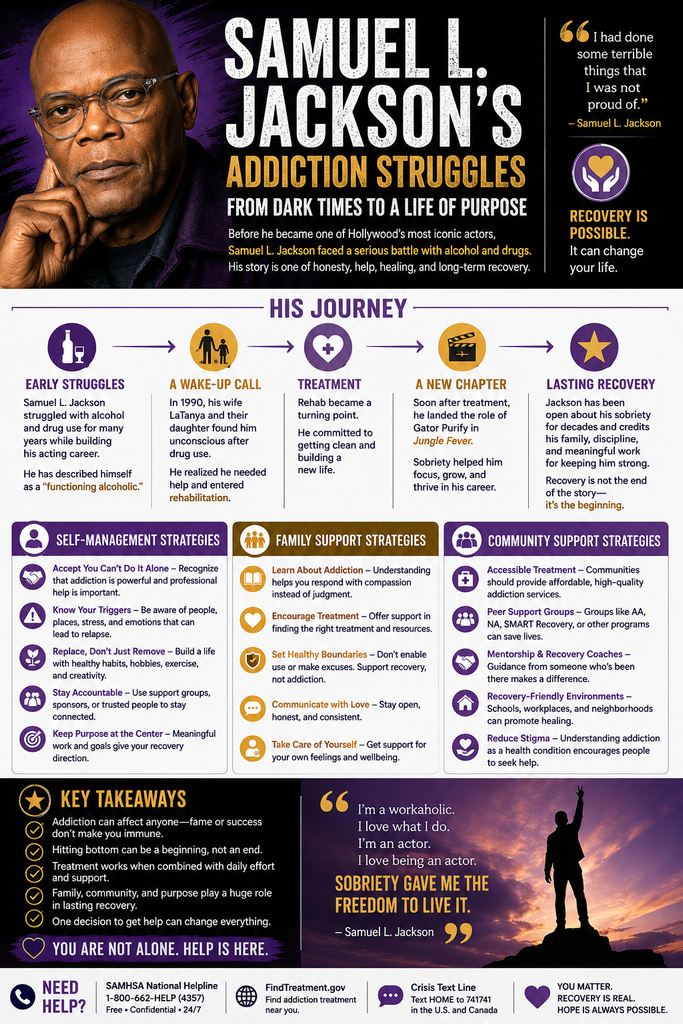
Samuel L. Jackson is recognized worldwide for roles in Pulp Fiction, Jungle Fever, The Avengers, and many other films. Long before becoming one of Hollywood’s most recognizable actors, however, Jackson experienced serious problems with alcohol and drugs.
Jackson has spoken publicly about years of drinking and drug use while building his acting career. His experience demonstrates an important reality about addiction: a person can continue working, meeting responsibilities, and appearing functional while substance use is causing significant problems behind the scenes.
His journey also illustrates the importance of family intervention, professional treatment, self-awareness, and finding a meaningful life beyond substance use.
Addiction Behind a Functioning Life
Jackson has described himself during part of this period as a “functioning alcoholic.” He continued performing and developing his acting career despite his substance use.
This is important because addiction does not always look like complete social or occupational collapse.
Someone struggling with a substance use disorder may still:
- Go to work every day
- Maintain relationships
- Pay bills
- Meet deadlines
- Appear successful professionally
- Hide the severity of substance use from others
- Believe that functioning means the problem is under control
Being productive does not necessarily mean substance use is safe.
Jackson has discussed using alcohol and multiple drugs during this period, with cocaine eventually becoming particularly problematic.
When Addiction Became Impossible to Ignore
Jackson’s family played an important role in the turning point of his story.
He has recounted an episode in which his wife, LaTanya Richardson Jackson, and their daughter found him unconscious at home after drug use. The incident helped bring the severity of his addiction into the open.
Jackson subsequently entered rehabilitation around 1990.
Family involvement cannot guarantee that someone will recover, but loved ones can sometimes recognize danger before the individual is ready to acknowledge its full significance.
Treatment Became a Turning Point
Entering rehabilitation did not magically create Jackson’s successful career. He had already spent years developing his craft as a stage actor.
What sobriety changed was his ability to engage with his work differently.
Soon after treatment, Jackson portrayed Gator Purify, a man struggling with crack addiction, in Spike Lee’s Jungle Fever. Jackson has described this as his first major acting experience after getting clean.
The role was especially significant because it required him to portray circumstances closely related to experiences he had recently lived through.
Rather than returning to substance use, Jackson continued building his career.
His experience demonstrates an important recovery principle:
Treatment does not erase someone’s abilities. It can give those abilities room to develop.
Self-Management Strategies: Lessons From Jackson’s Journey
Recovery ultimately requires the individual to participate in change. Professional treatment can provide structure and skills, but those skills have to become part of everyday life.
Jackson’s public comments about recovery suggest several broader lessons.
Accept That Control May Not Be Realistic
Jackson has described recognizing that he was not someone who could simply have one drink and stop.
For people with substance use disorders, repeatedly testing whether controlled use is possible can become dangerous.
Self-management may involve:
- Recognizing personal limits
- Avoiding high-risk substances and environments
- Remembering previous consequences
- Identifying rationalizations for returning to use
- Developing plans for unexpected exposure to substances
Remember Why You Chose Recovery
Long-term recovery does not necessarily eliminate every temptation.
A useful strategy is remembering what substance use actually produced rather than romanticizing the temporary pleasure associated with it.
Ask:
What did substances eventually cost me?
The answer may involve relationships, health, emotional stability, finances, employment, or self-respect.
Replace Substance Use With Meaningful Activities
Jackson has frequently described his strong commitment to acting and work.
Recovery often becomes more sustainable when life contains meaningful alternatives to substance use.
Healthy replacements can include:
- Work
- Exercise
- Creative activities
- Hobbies
- Family relationships
- Travel
- Volunteering
- Recovery communities
- Spiritual practices
- Education
Recovery should become more than simply avoiding substances. It involves building a life worth protecting.
Recognize Triggers
Triggers can occur even years after substance use stops.
A smell, location, stressful event, celebration, old relationship, or unexpected exposure to alcohol or drugs can activate memories.
A relapse-prevention strategy should answer:
What will I do when a trigger appears?
Planning ahead of the situation can make the response easier.
Ask for Help Before a Crisis
Jackson’s experience reached a serious point before treatment occurred.
Others do not have to wait for a similar crisis.
Treatment can begin when someone first recognizes that substance use is becoming difficult to control.
Family Support Strategies
LaTanya Richardson Jackson remained an important figure throughout Jackson’s struggles and recovery. Their story demonstrates how addiction affects an entire family rather than only the person using substances.
Families can provide support while still establishing boundaries.
Helpful strategies include:
- Express concerns calmly and specifically
- Avoid discussing serious issues while the person is intoxicated
- Encourage professional assessment
- Learn about substance use disorders
- Avoid providing money that supports substance use
- Do not repeatedly cover up consequences
- Establish boundaries around unsafe behavior
- Keep communication open when possible
- Recognize recovery progress
- Seek counseling or support for family members
Support Without Enabling
Helping someone does not require protecting them from every consequence of substance use.
There is an important difference between:
Support: “I will help you find treatment.”
and
Enabling: “I will repeatedly lie for you so nobody discovers what is happening.”
Families can love someone deeply while refusing to participate in destructive behavior.
Families Need Recovery Too
Living with addiction can produce chronic stress, anger, fear, distrust, and emotional exhaustion.
Family members may benefit from:
- Individual counseling
- Family therapy
- Al-Anon
- SMART Recovery Family & Friends
- Family education programs
- Peer-support communities
Family support should include care for the family—not only the person with the substance use disorder.
Community Support Strategies
Jackson had access to professional rehabilitation, but effective recovery resources should not be limited to celebrities or people with substantial financial resources.
Communities can strengthen recovery by providing:
- Accessible addiction treatment
- Addiction medicine specialists
- Mental health counseling
- Peer recovery specialists
- Intensive outpatient programs
- Residential treatment when appropriate
- Recovery community organizations
- Mutual-support groups
- Medication treatment for appropriate substance use disorders
- Naloxone and overdose education
- Family education
- Employment and housing assistance
- Recovery-friendly social activities
Reducing Stigma Encourages Treatment
Successful people sometimes delay seeking help because addiction does not fit the image others have of them.
A physician, teacher, parent, executive, entertainer, or healthcare professional can experience addiction while continuing to perform important responsibilities.
The question should not be:
“How could someone this successful become addicted?”
A better question is:
“What support will help this person recover?”
Recovery and Career Success
One of the most interesting parts of Jackson’s story is what happened professionally after treatment.
His acting career expanded dramatically during his years of sobriety. He has spoken about a connection between becoming clean and becoming more successful.
This does not mean sobriety guarantees fame or professional achievement.
The broader lesson is more useful:
Recovery can restore opportunities that addiction gradually takes away.
Improved concentration, emotional availability, reliability, relationships, physical health, and decision-making can allow a person’s existing abilities to emerge more fully.
Recovery Is More Than Stopping Drugs
Long-term recovery involves developing a new relationship with stress, emotions, relationships, responsibility, and personal identity.
A strong recovery plan may include:
Treatment + structure + meaningful activities + supportive relationships + accountability + relapse prevention
Different people require different combinations of these supports.
There is no single recovery pathway that works for everyone.
What Samuel L. Jackson’s Journey Can Teach Us
Jackson’s public story provides several valuable lessons:
- Addiction can exist alongside professional success.
- Functioning does not necessarily mean someone is healthy.
- Families may play an important role in recognizing a crisis.
- Professional treatment can provide a turning point.
- Sobriety does not eliminate someone’s creativity or personality.
- Meaningful work and activities can support a recovery lifestyle.
- Recovery can continue for decades.
- Seeking treatment can open opportunities rather than end them.
Most importantly, his experience challenges the idea that addiction permanently defines someone’s identity.
Conclusion
Samuel L. Jackson’s journey from problematic alcohol and drug use to long-term sobriety demonstrates that outward success can coexist with a serious substance use problem. His family witnessed the consequences firsthand, and rehabilitation became an important turning point.
His experience also shows why recovery cannot depend on a single intervention. Individuals need strategies to manage triggers and maintain meaningful routines. Families need education, boundaries, and support of their own. Communities need accessible, evidence-based treatment and environments where asking for help is not treated as a personal failure.
Jackson had already developed considerable talent before becoming sober. Recovery allowed him to move forward without addiction standing in the way.
His story reminds us that treatment is not the end of someone’s story. For many people, it can become the beginning of an entirely different chapter.
Frequently Asked Questions
Here are some common questions:
1. Did Samuel L. Jackson struggle with addiction?
Yes. Samuel L. Jackson has publicly discussed experiencing serious problems with alcohol and drugs before achieving his greatest Hollywood success. He has described being able to continue working despite his substance use.
2. What substances did Samuel L. Jackson struggle with?
Jackson has spoken about heavy alcohol use and using several drugs. Cocaine and later crack cocaine became particularly significant parts of his addiction before he entered treatment.
3. Did Samuel L. Jackson consider himself a functioning alcoholic?
Yes. Jackson has described himself as a “functioning alcoholic.” He continued acting and fulfilling responsibilities, demonstrating that a substance use disorder can exist even when someone remains employed and outwardly successful.
4. What was the turning point in his addiction?
Jackson has recounted that his wife, LaTanya Richardson Jackson, and their daughter found him unconscious at home after drug use. His family confronted the seriousness of the situation, and he subsequently entered rehabilitation.
5. When did Samuel L. Jackson enter rehabilitation?
Jackson entered rehabilitation around 1990. Treatment became an important turning point between his years of problematic substance use and his long-term sobriety.
6. What role did his family play in his recovery?
His family played a significant role. Jackson has credited his wife with helping him enter treatment. His experience demonstrates how loved ones can encourage treatment while recognizing that the individual ultimately has to participate in recovery.
7. Did Jackson’s acting career suffer before treatment?
He was already an experienced working actor, particularly in theater, but his addiction affected his personal and professional life. His most internationally recognized success came during his years of sobriety.
8. What happened to his career shortly after rehabilitation?
Soon after becoming sober, Jackson played Gator Purify, a man struggling with crack addiction, in Spike Lee’s Jungle Fever. The performance became an important milestone in his career.
9. Was playing a person with addiction difficult after his own experience?
The role had an unusual personal connection because Jackson had recently entered recovery himself. He has discussed the role in interviews when reflecting on the transition between addiction, sobriety, and his developing film career.
10. Did becoming sober immediately make Samuel L. Jackson successful?
No. Jackson had spent years developing his acting skills before treatment. Sobriety did not create his talent, but recovery allowed him to pursue his career without active addiction interfering in the same way.
11. Has Samuel L. Jackson maintained long-term sobriety?
Jackson has publicly described maintaining sobriety for decades. His experience is frequently discussed as an example of long-term recovery following treatment.
12. Does his story show that successful people can develop addiction?
Absolutely. Fame, intelligence, talent, employment, and financial success do not make someone immune to substance use disorders. Some people continue functioning professionally while experiencing serious problems privately.
13. What can people in recovery learn from his experience?
His story highlights several useful principles:
- Recognize when substance use has become difficult to control.
- Accept professional help rather than waiting for additional consequences.
- Identify personal triggers and high-risk situations.
- Build meaningful activities into everyday life.
- Maintain supportive relationships.
- Remember the consequences that led to seeking recovery.
- Develop a long-term recovery plan rather than viewing rehabilitation as a one-time solution.
14. How can families support someone experiencing addiction?
Families can express concerns clearly, encourage professional assessment and treatment, establish healthy boundaries, avoid repeatedly covering up consequences, and educate themselves about substance use disorders. Families may also benefit from counseling and peer-support programs.
15. What community resources can support long-term recovery?
Depending on individual needs, resources may include addiction medicine providers, behavioral health professionals, residential or outpatient treatment, peer recovery specialists, AA, NA, SMART Recovery, family-support programs, and recovery community organizations.
16. Does someone have to “hit rock bottom” before getting treatment?
No. Waiting for catastrophic consequences can be dangerous. Treatment can begin whenever someone recognizes problematic substance use or when family members and healthcare professionals identify concerning patterns.
17. Is rehabilitation alone enough to guarantee lifelong recovery?
No treatment can guarantee lifelong sobriety. Rehabilitation can establish an important foundation, but long-term recovery may also involve continuing care, coping strategies, supportive relationships, lifestyle changes, treatment of co-occurring conditions, and relapse-prevention planning.
18. What does Samuel L. Jackson’s story teach families about “functional” addiction?
One of the most important lessons is that functioning does not necessarily mean healthy. A person can maintain employment, relationships, or professional success while experiencing a serious substance use problem.
19. Why is Samuel L. Jackson’s recovery story inspiring?
His experience demonstrates that a period of serious addiction does not have to determine the rest of someone’s life. After entering treatment, Jackson continued developing his career and eventually became one of the world’s most recognizable actors.
20. What is the biggest takeaway from Samuel L. Jackson’s addiction journey?
Addiction can exist behind talent and success, but recovery can create opportunities for profound change. Jackson’s journey highlights the importance of recognizing the problem, accepting help, maintaining supportive relationships, and building a meaningful life that supports long-term recovery.
Video: What You Didn’t Know About Samuel L. Jackson’s Past 🧐 #celebritynews #recovery