Understanding the levels of care in addiction rehab is an important step in navigating the recovery process. Treatment is not a one-size-fits-all solution—individuals have different needs depending on the severity of substance use, mental health conditions, and personal circumstances. Levels of care, ranging from medical detox to outpatient support, are designed to provide the right intensity of treatment at each stage of recovery. Gaining a clear understanding of these options helps individuals and families make informed decisions and approach treatment with greater confidence and direction.
Understanding Levels of Care in Addiction Rehab: A Guide to the Recovery Process
Addiction recovery is not a one-size-fits-all journey. Different individuals require different types and intensities of care depending on their substance use, mental health needs, and life circumstances. That’s where levels of care in addiction rehab come in—a structured system designed to provide the right support at the right time.
Understanding these levels can help you or your loved one make informed decisions and build a strong foundation for long-term recovery.
What Are Levels of Care?
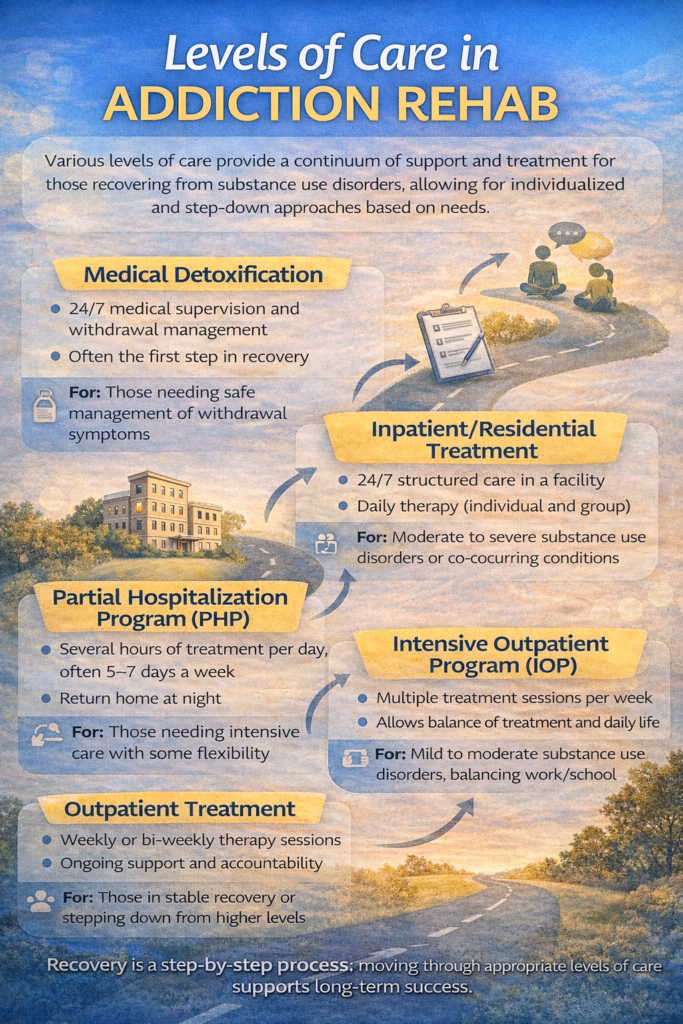
Levels of care refer to the range of treatment options, from highly structured medical support to more flexible, independent programs. These levels are often part of a continuum of care, meaning individuals can move between them as their needs change.
The goal is simple: provide enough support to stabilize and heal—without being more restrictive than necessary.
1. Medical Detox (Detoxification)
Detox is often the first step for individuals with physical dependence on substances.
What it includes:
- 24/7 medical supervision
- Management of withdrawal symptoms
- Medication support when needed
Who it’s for:
- Individuals at risk for withdrawal complications
- Those using substances like alcohol, opioids, or benzodiazepines
Detox focuses on physical stabilization, not long-term recovery—so ongoing treatment is essential afterward.
2. Inpatient/Residential Treatment
This is one of the most structured levels of care, where individuals live at the facility.
What it includes:
- 24-hour support and supervision
- Daily therapy (individual and group)
- Structured schedules and routines
- Limited outside distractions
Who it’s for:
- Moderate to severe substance use disorders
- Individuals needing a stable, controlled environment
- Those with co-occurring mental health conditions
Residential care provides a safe space to focus fully on recovery.
3. Partial Hospitalization Program (PHP)
PHP is a step down from inpatient care but still offers intensive support.
What it includes:
- Several hours of treatment per day (often 5–7 days a week)
- Therapy, medical monitoring, and skill-building
- Ability to return home or to sober living at night
Who it’s for:
- Individuals who need structure but not 24/7 supervision
- Those transitioning from inpatient care
4. Intensive Outpatient Program (IOP)
IOP offers flexibility while maintaining consistent therapeutic support.
What it includes:
- Treatment sessions multiple times per week
- Group therapy, individual counseling, and education
- Focus on relapse prevention and life skills
Who it’s for:
- Individuals with mild to moderate substance use issues
- Those balancing treatment with work, school, or family
IOP helps individuals apply recovery skills in real-life settings.
5. Standard Outpatient Treatment
This is the least intensive level of formal care.
What it includes:
- Weekly or biweekly therapy sessions
- Ongoing support and accountability
- Continued focus on mental health and relapse prevention
Who it’s for:
- Individuals in stable recovery
- Those stepping down from higher levels of care
6. Aftercare and Continuing Support
Recovery doesn’t end when formal treatment does. Aftercare is critical for maintaining progress.
What it may include:
- Support groups (AA, NA, SMART Recovery)
- Ongoing therapy or counseling
- Sober living environments
- Alumni programs
This stage focuses on long-term stability and relapse prevention.
Why the Continuum of Care Matters
Recovery is a process, not a single event. Moving through different levels of care allows individuals to:
- Build skills gradually
- Adjust support as needed
- Maintain progress over time
Programs that follow recognized standards—such as those accredited by The Joint Commission or CARF—are more likely to offer this structured approach.
Choosing the Right Level of Care
The “right” level depends on several factors:
- Severity of substance use
- Physical health and withdrawal risk
- Mental health conditions
- Home environment and support system
- Previous treatment history
A professional assessment can help determine the best starting point.
Final Thought
Understanding levels of care in addiction rehab can make the treatment process feel less overwhelming and more manageable. Each step—from detox to aftercare—serves a purpose in building a sustainable recovery.
The goal isn’t just to stop using—it’s to create a stable, healthy life, one level of care at a time.
Taking Charge of Your Recovery: Self-Management Strategies for Understanding Levels of Care in Addiction Rehab
Navigating the different levels of care in addiction rehab can feel overwhelming at first. Terms like detox, inpatient, PHP, and IOP may seem confusing, especially when you’re already dealing with the stress of seeking help. Self-management strategies can make this process more manageable by helping you stay informed, organized, and actively involved in your treatment decisions.
Understanding how to match your needs with the right level of care is not just a clinical decision—it’s a personal one. The more engaged you are, the more effective your recovery plan can be.
Start with Honest Self-Assessment
Self-management begins with understanding where you are right now.
Ask yourself:
- How severe is my substance use?
- Have I experienced withdrawal symptoms before?
- Are there mental health concerns like anxiety, depression, or trauma?
- What does my current environment look like (supportive or triggering)?
Being honest about your situation helps you avoid choosing a level of care that is either too minimal or unnecessarily restrictive.
Learn the Continuum of Care
A key self-management skill is educating yourself on what each level of care actually provides.
Quick breakdown:
- Detox: Medical stabilization
- Inpatient/Residential: 24/7 structured support
- PHP: Intensive daytime treatment
- IOP: Flexible, part-time therapy
- Outpatient/Aftercare: Ongoing maintenance and support
Understanding this progression allows you to see recovery as a step-down process, not a one-time event.
Match Your Needs to the Right Level
Instead of choosing based on convenience or fear, align your needs with the appropriate level of care.
For example:
- If withdrawal is a concern → start with detox
- If your environment is unstable → consider inpatient
- If you need flexibility → IOP or outpatient may work
This strategy prevents under-treatment (which increases relapse risk) and over-treatment (which may not be necessary).
Create a Personal Decision Framework
When options feel overwhelming, structure helps.
Try creating a checklist:
- Level of care offered
- Mental health services included
- Length and intensity of the program
- Cost and insurance coverage
- Aftercare planning
Rate or compare programs based on these factors to stay objective.
Track Your Progress and Adjust as Needed
Self-management doesn’t stop after entering treatment. Recovery needs can change over time.
Ask regularly:
- Am I benefiting from this level of care?
- Do I need more structure—or more independence?
- Am I ready to step down to the next level?
Being aware of your progress helps you transition smoothly through the continuum of care.
Advocate for Yourself
You are an active participant in your recovery—not just a patient.
Don’t hesitate to:
- Ask why a certain level of care is recommended
- Request adjustments if something isn’t working
- Speak up about your goals and concerns
Quality programs will involve you in decisions rather than make them for you.
Manage Emotional Reactions to Treatment Decisions
It’s normal to feel fear, resistance, or even denial when considering higher levels of care, like inpatient treatment.
Self-management includes recognizing these reactions:
- Fear of change or commitment
- Minimizing the severity of the problem
- Wanting the quickest or easiest option
Pause and ask: Am I choosing what feels comfortable, or what I actually need?
Plan for Transitions Between Levels
Each step in treatment leads to another. Preparing ahead reduces uncertainty.
Think about:
- What comes after this level of care?
- What support will I have during transitions?
- How will I maintain progress outside structured settings?
Planning ahead is a key part of sustaining recovery.
Use Reliable Indicators of Quality
As part of self-management, verify that programs meet recognized standards. Accreditation from organizations like The Joint Commission or CARF can indicate a structured, evidence-based continuum of care.
Final Thought
Understanding the levels of care in addiction rehab is more than learning definitions—it’s about using that knowledge to make informed, intentional decisions. Self-management empowers you to move through treatment with clarity, confidence, and purpose.
Recovery isn’t just about entering a program—it’s about actively engaging in the process every step of the way.
Supporting the Journey: Family Strategies for Understanding Levels of Care in Addiction Rehab
When a loved one is struggling with addiction, families often feel overwhelmed—not just by the situation itself, but by the complexity of treatment options. Terms like detox, inpatient, PHP, and outpatient can be confusing, especially when decisions feel urgent. Family support plays a critical role in helping individuals understand and navigate these levels of care, ensuring they receive the right kind of help at the right time.
By becoming informed and involved in a healthy way, families can provide clarity, stability, and encouragement throughout the recovery process.
Learn the Continuum of Care Together
One of the most helpful things families can do is educate themselves about the different levels of care.
Understanding the basics:
- Detox: Medical supervision for withdrawal
- Inpatient/Residential: 24/7 structured environment
- Partial Hospitalization (PHP): Intensive daytime care
- Intensive Outpatient (IOP): Flexible but consistent treatment
- Outpatient/Aftercare: Ongoing support
When families understand this progression, they can better support decisions and reduce confusion or fear.
Encourage the Right Level—Not Just the Easiest One
It’s natural to want the quickest or least disruptive option, but the appropriate level of care is what truly matters.
Families can help by:
- Supporting professional recommendations
- Avoiding pressure to “skip steps” (like going straight to outpatient when more support is needed)
- Recognizing when a higher level of care may be necessary for safety and stability
The focus should be on effectiveness—not convenience.
Communicate with Support and Clarity
Discussions about treatment can be emotional. How families communicate can influence whether a loved one accepts help.
Helpful strategies:
- Use calm, non-judgmental language
- Express concern without blame
- Focus on safety and well-being
- Be open to listening, not just advising
Clear, respectful communication builds trust and reduces resistance.
Participate in the Decision-Making Process
Families can play an important role in gathering information and evaluating options.
Ways to stay involved:
- Research treatment centers together
- Help ask questions about levels of care and services
- Take notes during calls or assessments
- Compare programs based on needs, not just cost or location
Being part of the process helps ensure decisions are thoughtful and informed.
Prepare for Transitions Between Levels of Care
Recovery is not a single step—it’s a progression. Transitions (like moving from inpatient to outpatient) can be vulnerable times.
Families can support by:
- Understanding what each transition involves
- Helping create structure at home when needed
- Encouraging continued engagement in treatment
- Watching for signs that more support may be needed again
Consistency during transitions helps maintain progress.
Set Healthy Expectations
Families may hope for quick results, but recovery takes time and often includes ups and downs.
It’s important to:
- Understand that each level of care serves a purpose
- Avoid expecting immediate or perfect outcomes
- Focus on progress rather than perfection
Patience and realistic expectations reduce frustration for everyone involved.
Support Without Enabling
While involvement is important, boundaries are equally necessary.
Healthy support includes:
- Encouraging treatment participation
- Holding firm boundaries around harmful behaviors
- Avoiding rescuing or minimizing the need for care
This balance helps reinforce accountability while still offering support.
Utilize Family-Inclusive Services
Many treatment programs offer services specifically for families, such as:
- Family therapy sessions
- Educational workshops about addiction and recovery
- Support groups for loved ones
Participating in these services can improve understanding of the levels of care and strengthen the overall recovery process.
Look for Quality and Structure
Families can help ensure a treatment program offers a full continuum of care. Accreditation from organizations such as The Joint Commission or CARF can indicate that a center adheres to recognized standards and offers structured treatment options.
Take Care of the Family System
Addiction affects the entire family, not just the individual. Supporting someone through treatment can be emotionally exhausting.
Families should also:
- Seek their own support (therapy or peer groups)
- Maintain routines and self-care
- Recognize their own limits
A healthier family system creates a stronger environment for recovery.
Final Thought
Understanding levels of care in addiction rehab can feel complicated, but families don’t have to navigate it blindly. By learning, communicating effectively, and staying appropriately involved, families can help guide their loved one toward the level of care that truly meets their needs.
Recovery is a shared journey—and informed, balanced family support can make a lasting difference every step of the way.
Connecting the Dots: Community Resource Strategies for Understanding Levels of Care in Addiction Rehab
Understanding the different levels of care in addiction rehab can feel complicated—especially when you’re trying to make decisions quickly or support someone in crisis. Community resources can play a powerful role in simplifying this process. By tapping into local networks, professional guidance, and peer support, individuals and families can gain clarity on treatment options and make more informed choices.
Recovery doesn’t happen in isolation, and neither should the process of understanding how treatment works.
Start with Community-Based Education
Many communities offer educational resources that explain addiction and treatment in practical, easy-to-understand ways.
Look for:
- Workshops or seminars hosted by local health organizations
- Public health education programs
- Informational materials at clinics or community centers
These resources often break down levels of care—like detox, inpatient, PHP, and outpatient—into clear, real-life examples.
Use Local Mental Health and Addiction Services
Community mental health centers are among the most valuable resources for understanding treatment options.
They can provide:
- Professional assessments to determine appropriate levels of care
- Referrals to detox, residential, or outpatient programs
- Guidance on navigating the treatment system
These services are especially helpful for individuals who feel unsure about where to start.
Consult Healthcare Providers
Primary care doctors, therapists, and social workers often have firsthand knowledge of treatment systems.
They can help:
- Explain the differences between levels of care
- Recommend appropriate starting points
- Coordinate care across different services
This professional input helps ensure that decisions are based on clinical need—not guesswork.
Connect with Peer Support Communities
People who have experienced treatment themselves can offer valuable insight into how levels of care work in real life.
Consider:
- 12-step groups (AA, NA)
- SMART Recovery meetings
- Local recovery community organizations
These groups can share what it’s like to move from one level of care to another and what helped them succeed.
Leverage National and Local Resource Networks
Organizations such as the Substance Abuse and Mental Health Services Administration (SAMHSA) provide tools to locate treatment centers and to understand available services.
They offer:
- Treatment locators
- Helplines for immediate guidance
- Educational materials on levels of care
These resources can connect you to reputable programs in your area.
Address Practical Barriers Through Community Support
Understanding levels of care is one thing—accessing them is another. Community resources can help remove obstacles.
Support may include:
- Transportation services to attend treatment
- Housing or sober living options
- Financial assistance or sliding-scale programs
- Employment or legal support
Reducing these barriers makes it easier to engage in the appropriate level of care.
Gather Multiple Perspectives
No single resource will give you the full picture. The best understanding comes from combining:
- Professional recommendations
- Community-based education
- Peer experiences
If multiple sources point toward the same level of care, it often reinforces that it’s the right fit.
Stay Connected Beyond Initial Treatment
Community resources remain important even after entering a program.
They can support:
- Transitions between levels of care
- Ongoing outpatient treatment
- Long-term recovery through support groups and services
This continuity helps maintain progress and reduce the risk of relapse.
Look for Quality and Accountability
Community resources can also help verify whether a treatment program offers a full continuum of care. Accreditation from organizations such as The Joint Commission or CARF indicates that a facility meets established standards and offers structured treatment options.
Final Thought
Understanding levels of care in addiction rehab doesn’t have to be overwhelming. Community resources provide guidance, support, and real-world insight that can turn confusion into confidence.
By reaching out, asking questions, and using the support systems around you, you can make informed decisions that lead to the right level of care—and a stronger path toward recovery.
Frequently Asked Questions
Here are some common questions:
1. What are “levels of care” in addiction rehab?
Levels of care refer to the different types and intensities of treatment available, ranging from highly structured medical support to more flexible outpatient services. They are designed to match the individual’s needs at each stage of recovery.
2. What is the first step in addiction treatment?
For many people, the first step is medical detox, especially if there is physical dependence. Detox helps manage withdrawal symptoms safely under medical supervision.
3. What is inpatient or residential treatment?
Inpatient (residential) treatment involves living at a facility with 24/7 support. It provides a structured environment focused on therapy, stability, and the removal of outside triggers.
4. What is a Partial Hospitalization Program (PHP)?
PHP is a step down from inpatient care. It includes several hours of treatment per day, but individuals can return home or to sober living in the evenings.
5. What is an Intensive Outpatient Program (IOP)?
IOP offers flexible treatment with multiple therapy sessions per week while allowing individuals to maintain work, school, or family responsibilities.
6. What is standard outpatient treatment?
Outpatient care is the least intensive level, involving weekly or periodic therapy sessions to support ongoing recovery and relapse prevention.
7. How do I know which level of care I need?
The appropriate level depends on:
- Severity of substance use
- Risk of withdrawal
- Mental health conditions
- Home environment and support
A professional assessment can help determine the best starting point.
8. Can I move between levels of care?
Yes. Treatment is often a continuum of care, meaning individuals may step down from more intensive to less intensive levels as they progress—or step up if they need more support.
9. How long do people stay in each level of care?
Length varies depending on individual needs. Some may spend:
- A few days in detox
- Weeks in inpatient care
- Months in outpatient or aftercare
Longer engagement is often linked to better outcomes.
10. What is aftercare, and why is it important?
Aftercare includes ongoing support after formal treatment, such as therapy, support groups, or sober living. It helps maintain progress and reduce the risk of relapse.
11. Are all treatment centers the same?
No. Programs differ in quality, services, and approaches. Look for licensed facilities and accreditation from organizations such as The Joint Commission or CARF to ensure adherence to standards of care.
12. Does insurance cover all levels of care?
Coverage varies by plan. Many insurance providers cover multiple levels of care, but it’s important to verify:
- What services are included
- Length of coverage
- Out-of-pocket costs
Conclusion
The different levels of care in addiction rehab work together as a continuum, supporting individuals from initial stabilization through long-term recovery. Each level plays a specific role in building skills, maintaining progress, and reducing the risk of relapse. By understanding how these levels connect and when each is appropriate, individuals can engage more fully in their recovery journey. Ultimately, choosing the right level of care is not just about starting treatment—it’s about creating a sustainable path toward lasting health and stability.
Video: Which Level of Care Do You Actually Need? #AddictionRecovery #Rehab