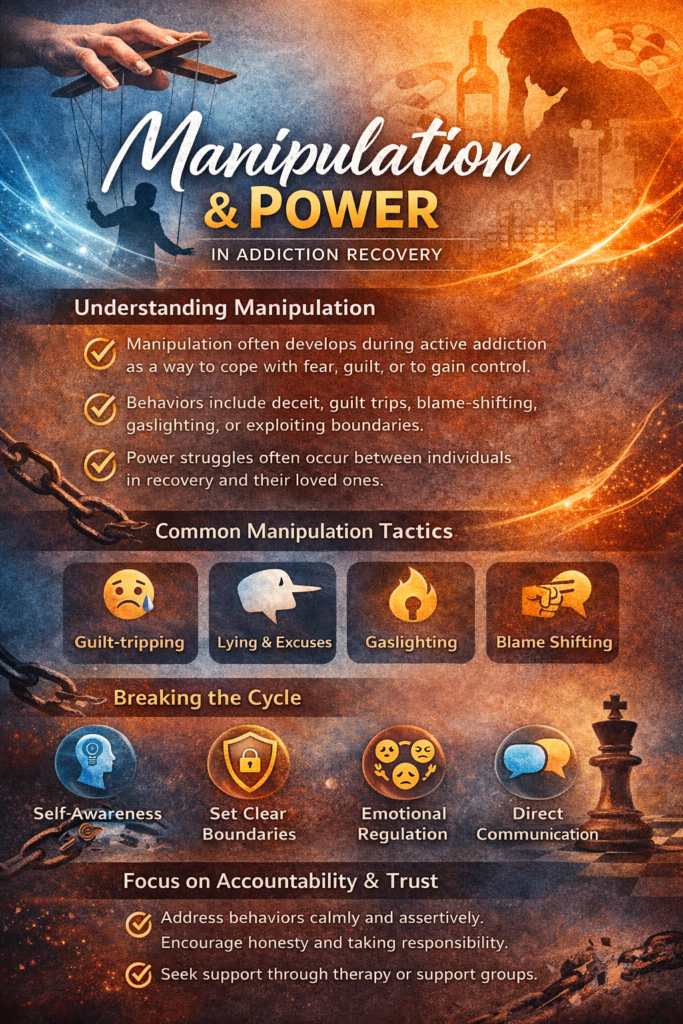
Manipulation and power dynamics are often deeply embedded in the experience of addiction, shaping how individuals interact with others and navigate difficult situations. During active addiction, manipulation can emerge as a coping strategy—used to avoid consequences, manage fear, or maintain access to substances. At the same time, family members and loved ones may respond with their own forms of control, creating a cycle of influence, resistance, and mistrust. In recovery, understanding these patterns becomes essential. Recognizing how manipulation operates—both internally and within relationships—allows individuals to shift from control-based behaviors to more honest, accountable, and balanced ways of interacting.
“Unseen Influence: Understanding Manipulation and Power in Addiction Recovery”
Addiction recovery is not only a process of stopping substance use—it is also a process of rebuilding honesty, autonomy, and healthy relationships. One of the more complex and often misunderstood aspects of this journey is the role of manipulation and power dynamics. During active addiction, manipulation can become a learned survival strategy, used to obtain substances, avoid consequences, or maintain a sense of control. In recovery, recognizing and addressing these patterns is essential for long-term growth.
Manipulation in addiction is rarely about intentional harm in a calculated sense. More often, it develops as a coping mechanism rooted in fear, shame, or dependency. Individuals may distort the truth, shift blame, or use emotional appeals to manage overwhelming situations. At the same time, family members may also engage in their own forms of manipulation—such as guilt, ultimatums, or control—in an attempt to influence behavior. This creates a cycle in which power is constantly shifting, and trust becomes increasingly fragile.
In recovery, the focus shifts toward awareness and accountability. Individuals begin to recognize how manipulative behaviors—whether subtle or overt—have impacted their relationships. This awareness is a critical turning point. It allows for the development of healthier communication patterns in which needs and concerns are expressed directly rather than indirectly through control or persuasion.
Power dynamics also begin to change in recovery. During addiction, power may feel uneven—either the individual feels controlled by others, or family members feel controlled by the addiction itself. Recovery aims to restore a balanced sense of personal power, in which individuals take responsibility for their choices while respecting others’ autonomy. This shift reduces the need for manipulation, as control is replaced with clarity and mutual respect.
Another key aspect is learning boundaries and transparency. Healthy boundaries limit the space for manipulation by making expectations clear and consistent. Transparency, on the other hand, rebuilds trust by replacing secrecy with openness. Together, these practices create a more stable relational environment in which influence is based on honesty rather than pressure.
It is also important to understand that unlearning manipulation takes time. These patterns are often deeply ingrained and may resurface under stress. Recovery involves practicing new ways of interacting—such as asking for help directly, tolerating discomfort, and accepting consequences without deflection.
Ultimately, addressing manipulation and power in addiction recovery is about moving from control to connection. When individuals and families begin to interact with honesty, respect, and accountability, relationships become less about influence and more about understanding. This transformation not only supports recovery but also lays the foundation for healthier, more authentic connections moving forward.
Key Points
- Focus on progress, not perfection
Manipulation as a Coping Mechanism
- Often rooted in fear, shame, or dependency
- Used to avoid consequences or maintain control
Common Manipulation Patterns
- Minimizing or denying behavior
- Shifting blame onto others
- Using guilt or emotional pressure
Family Dynamics and Power
- Family members may also use control or guilt
- Creates cycles of conflict and mistrust
Awareness and Accountability
- Recognizing manipulative behaviors is a key step
- Taking responsibility helps rebuild trust
Shifting Power Dynamics
- Move from control → personal responsibility
- Promote balance and mutual respect
Healthy Boundaries
- Clarify expectations and limits
- Reduce opportunities for manipulation
Transparency and Honesty
- Replace secrecy with open communication
- Strengthen trust over time
Developing New Skills
- Practice direct communication
- Learn to tolerate discomfort without manipulation
Long-Term Growth
- Change takes time and consistency
“From Control to Clarity: Self-Management Strategies for Understanding Manipulation and Power in Addiction Recovery”
In addiction recovery, one of the most important—and often challenging—areas of growth involves recognizing patterns of manipulation and power. These patterns may have developed during active addiction as ways to cope with fear, avoid consequences, or maintain a sense of control. In recovery, however, the focus shifts toward self-management—the ability to regulate thoughts, emotions, and behaviors in ways that support honesty, accountability, and healthier relationships.
The first step in self-management is self-awareness. Manipulative behaviors are often automatic and subtle, making them difficult to recognize in the moment. Individuals may minimize situations, shift blame, or use emotional pressure without fully realizing it. Developing awareness involves asking reflective questions such as: “Am I being fully honest?” or “Am I trying to influence this situation instead of expressing my needs directly?” This level of insight is essential for breaking long-standing patterns.
Another critical strategy is impulse control and emotional regulation. Manipulation is often driven by discomfort—fear of consequences, anxiety, or the desire to avoid conflict. Learning to tolerate these emotions without reacting impulsively allows individuals to respond more authentically. Techniques such as pausing, deep breathing, or stepping away from a situation can create space to choose honesty over control.
Cognitive restructuring is also an important part of self-management. Many manipulative behaviors are supported by distorted thinking patterns, such as “I have to say this to avoid trouble” or “They won’t understand unless I push them.” Challenging these thoughts and replacing them with more balanced perspectives—like “I can be honest and accept the outcome”—helps shift behavior over time.
Another key element is taking responsibility and practicing direct communication. Instead of influencing situations indirectly, recovery encourages expressing needs, concerns, and mistakes openly. This can feel uncomfortable at first, especially if manipulation has been a long-standing habit. However, direct communication builds trust and reduces the need for control-based behaviors.
Boundary awareness also supports self-management. Understanding both your own boundaries and those of others helps reduce manipulation by clarifying what is and isn’t acceptable. When boundaries are respected, relationships become more balanced, and power struggles decrease.
Self-management also involves tracking patterns and triggers. Certain situations—such as conflict, criticism, or stress—may increase the urge to manipulate. By identifying these triggers, individuals can prepare healthier responses in advance, reducing the likelihood of falling back into old behaviors.
Importantly, this process requires consistency and self-compassion. Changing manipulation patterns is not immediate. There may be moments of relapse into old habits, especially under stress. The goal is not perfection, but progress—gradually increasing awareness and choosing more honest, intentional responses over time.
Ultimately, self-management in this context is about shifting from external control to internal regulation. Instead of trying to manage others or outcomes, individuals learn to manage themselves. This shift not only supports recovery but also creates the foundation for more authentic, respectful, and stable relationships.
Key Self-Management Strategies
- Embrace progress rather than perfection
Self-Awareness
- Recognize subtle manipulation patterns (minimizing, blaming, deflecting)
- Ask reflective questions about honesty and intent
Impulse Control
- Pause before responding in stressful situations
- Avoid reacting out of fear or discomfort
Emotional Regulation
- Use grounding techniques (breathing, stepping away)
- Learn to tolerate difficult emotions without acting on them
Cognitive Restructuring
- Identify distorted thinking patterns
- Replace with balanced, reality-based thoughts
Direct Communication
- Express needs and concerns openly
- Take responsibility without deflection
Boundary Awareness
- Respect your own limits and others’ boundaries
- Reduce power struggles through clarity
Trigger Identification
- Recognize situations that increase manipulative tendencies
- Prepare healthier responses in advance
Accountability
- Acknowledge mistakes and their impact
- Focus on rebuilding trust over time
Consistency and Growth
- Practice new behaviors regularly
“Supporting Without Controlling: Family Strategies for Navigating Manipulation and Power in Addiction Recovery”
Addiction recovery is not only about changing substance use—it also involves transforming the relational dynamics that developed during active addiction. One of the most complex of these dynamics is the use of manipulation and power within families. While individuals in recovery may have used manipulation as a coping strategy, family members may also have responded with control, guilt, or pressure. These patterns can persist into recovery unless they are actively understood and addressed. For families, learning how to support without reinforcing these dynamics is essential.
A foundational strategy is recognizing manipulation without reacting emotionally. When families become aware of behaviors such as deflection, blame-shifting, or guilt appeals, it can be tempting to respond with frustration or confrontation. However, reacting emotionally often escalates the situation and reinforces the cycle. Instead, responding with calm, clear communication helps reduce the power of manipulation and shifts the interaction toward accountability.
Another critical component is maintaining consistent boundaries. Manipulation often thrives in environments where boundaries are unclear or inconsistently enforced. Families can support recovery by clearly defining what behaviors they will and will not accept, and by following through consistently. For example, refusing to engage in arguments involving dishonesty or to provide support that enables harmful behavior helps reduce opportunities for manipulation.
Avoiding counter-manipulation is equally important. In an effort to influence change, family members may resort to guilt, ultimatums, or emotional pressure. While these strategies may seem effective in the short term, they often perpetuate the same power struggles they are trying to resolve. Healthy support focuses on honesty and respect rather than control or persuasion.
Encouraging direct communication is a key strategy for breaking patterns of manipulation. Families can model and reinforce open, honest expression by asking clear questions and validating truthful responses. For example, instead of engaging with excuses, a response like “I’d rather hear the honest version, even if it’s difficult” encourages accountability without aggression.
Another important strategy is understanding the emotional roots of manipulation. These behaviors are often driven by fear, shame, or a desire to avoid consequences. When families recognize this, they can respond with empathy while still holding firm boundaries. This balance—compassion without enabling—is essential for supporting recovery.
Families should also focus on their own self-awareness. Emotional reactions such as anger, fear, or the need to “fix” the situation can unintentionally reinforce power struggles. By managing their own responses, family members reduce the intensity of interactions and create a more stable environment.
Encouraging external support is another valuable approach. Therapy, counseling, or support groups provide neutral spaces where both individuals and families can explore manipulation and power dynamics with guidance. These settings help develop healthier communication patterns and reduce reliance on dysfunctional coping strategies.
Ultimately, family support in this context is about shifting from power struggles to mutual respect. Instead of trying to control outcomes, families learn to create conditions where honesty, accountability, and autonomy can grow. Over time, this shift helps rebuild trust and supports more balanced, authentic relationships.
Family Support Strategies
- Support autonomy and responsibility
Recognize Manipulation Patterns
- Identify behaviors like blame-shifting, denial, or guilt appeals
- Stay aware without reacting impulsively
Respond Calmly and Clearly
- Avoid emotional escalation
- Use steady, direct communication
Set and Maintain Boundaries
- Clearly define acceptable behaviors
- Follow through consistently
Avoid Counter-Manipulation
- Do not use guilt, threats, or pressure
- Focus on honesty rather than control
Encourage Direct Communication
- Promote openness and truthfulness
- Reinforce honest expression, even when difficult
Understand Emotional Drivers
- Recognize fear, shame, or avoidance behind behaviors
- Balance empathy with accountability
Practice Self-Awareness
- Manage your own emotional reactions
- Avoid reinforcing power struggles
Support External Help
- Encourage therapy, counseling, or support groups
- Use structured environments for guidance
Promote Healthy Power Dynamics
- Shift from control → respect
“Shared Support, Balanced Power: Community Resource Strategies in Addiction Recovery”
Understanding manipulation and power dynamics in addiction recovery can be challenging, especially when these patterns have developed over time within close relationships. While individual and family efforts are important, community resources provide essential structure, guidance, and perspective that help break cycles of control, influence, and emotional reactivity. These external supports create an environment where healthier patterns—such as honesty, accountability, and mutual respect—can be learned and practiced.
One of the most effective strategies is engaging in peer support groups, such as Alcoholics Anonymous or Narcotics Anonymous. These groups emphasize principles like honesty, personal responsibility, and self-reflection. By sharing experiences and listening to others, individuals begin to recognize patterns of manipulation in themselves and understand how these behaviors affect relationships. The group setting also reduces isolation and provides accountability, which weakens the need for control-based behaviors.
Another key resource is professional therapy and counseling, including approaches like Cognitive Behavioral Therapy. Therapy helps individuals identify distorted thinking patterns that contribute to manipulation—such as fear-based assumptions or avoidance of responsibility. It also provides tools to develop direct communication and emotional regulation, which are essential for moving away from manipulative behaviors.
Community resources also offer structured recovery environments, such as outpatient programs, inpatient treatment, and recovery coaching. These settings establish clear expectations, routines, and boundaries, which reduce opportunities for manipulation and clarify power dynamics. In structured environments, individuals learn that accountability and transparency are necessary for progress.
Another important strategy is utilizing educational programs and workshops. Learning about addiction, communication styles, and interpersonal dynamics helps individuals and families understand the underlying causes of manipulation. Education reduces stigma and replaces reactive responses with informed strategies, making it easier to respond constructively rather than emotionally.
Accountability networks—such as sponsors, mentors, or peer partners—are also critical. These relationships provide a space to process thoughts and behaviors before acting on them. Having someone to check in with encourages honesty and helps challenge manipulative thinking patterns in real time.
Community resources also include support systems for families, such as Al-Anon Family Groups. These groups help family members understand their role in power dynamics and learn to set boundaries without resorting to control or counter-manipulation. This creates a more balanced dynamic where responsibility is shared appropriately.
Additionally, community-based services—such as case management, mental health services, and social support programs—help reduce external stressors, including financial strain and instability. These stressors often contribute to manipulative behaviors, so addressing them creates a more stable foundation for recovery.
Ultimately, community resources shift the focus from power struggles to shared growth. They provide tools, accountability, and perspective that are difficult to develop in isolation. By engaging with these supports, individuals and families can move toward healthier dynamics in which influence is based on respect and control is replaced by clarity and responsibility.
Community Resource Strategies
- Encourage honesty, respect, and shared responsibility
Engage in Peer Support Groups
- Join Alcoholics Anonymous or Narcotics Anonymous
- Learn from shared experiences and build accountability
Seek Professional Therapy
- Use approaches like Cognitive Behavioral Therapy
- Identify and change manipulation-related thought patterns
Utilize Structured Recovery Programs
- Participate in outpatient or inpatient treatment
- Follow clear routines and expectations
Access Educational Resources
- Attend workshops on addiction and communication
- Build understanding of power and relational dynamics
Develop Accountability Networks
- Connect with sponsors, mentors, or recovery peers
- Process decisions before acting on them
Support Family Involvement
- Encourage participation in Al-Anon Family Groups
- Help families understand and manage their role
Use Community Support Services
- Access mental health care, housing, or financial assistance
- Reduce external stressors that contribute to manipulation
Promote Healthy Power Dynamics
- Shift from control → accountability
Frequently Asked Questions
Here are some common questions:
1. What does “manipulation” mean in addiction recovery?
Manipulation refers to behaviors used to influence others indirectly—often to avoid consequences, gain control, or meet needs without being fully honest. In addiction, it can develop as a coping strategy rather than intentional harm.
2. Why do people use manipulation during addiction?
Manipulation often comes from:
- Fear (of consequences or loss)
- Shame (avoiding judgment)
- Dependency (needing access to substances)
It becomes a learned way to manage difficult situations when healthier coping skills are lacking.
3. Does manipulation stop automatically in recovery?
No. Even after substance use stops, manipulation patterns can continue because they are behavioral habits, not just substance-related actions. Recovery involves actively unlearning these patterns.
4. What are common manipulation tactics in addiction?
- Lying or minimizing behavior
- Blame-shifting (“It’s not my fault”)
- Guilt-tripping others
- Making excuses
- Gaslighting (distorting reality)
5. What are “power dynamics” in addiction?
Power dynamics refer to how control and influence are distributed in relationships. In addiction:
- The individual may try to control situations through manipulation
- Family members may try to control behavior through pressure or monitoring
This creates ongoing power struggles.
6. Can family members also be manipulative?
Yes. Families may use:
- Guilt (“Look what you’re doing to us”)
- Ultimatums
- Emotional pressure
These responses often come from fear but can reinforce unhealthy dynamics.
7. Why is manipulation harmful in recovery?
It:
- Prevents honest communication
- Damages trust
- Maintains unhealthy relationships
- Avoids true accountability
Recovery requires transparency and responsibility, which manipulation undermines.
8. How can someone recognize their own manipulation?
Ask:
- Am I being fully honest?
- Am I trying to control the outcome?
- Am I avoiding responsibility?
Self-awareness is the first step to change.
9. What replaces manipulation in healthy recovery?
- Direct communication
- Taking responsibility
- Accepting consequences
- Asking for help honestly
These behaviors build trust and reduce the need for control.
10. How do boundaries reduce manipulation?
Boundaries:
- Clarify what is acceptable
- Limit opportunities for control-based behavior
- Create consistency in relationships
They shift interactions from emotional reactions to structured responses.
11. What is the role of accountability in this process?
Accountability means:
- Owning actions without excuses
- Acknowledging impact on others
- Making changes consistently
It restores balance in power dynamics.
12. Why is it hard to stop manipulating?
Because it often:
- Feels automatic
- Was reinforced over time
- Temporarily “works” to avoid discomfort
Recovery involves learning to tolerate discomfort rather than control it.
13. Can relationships heal after manipulation?
Yes, but it takes:
- Time
- Consistent honesty
- Clear boundaries
- Mutual effort
Trust is rebuilt through repeated, reliable behavior.
14. What is the biggest mindset shift in this area?
Moving from:
- Control → Responsibility
- Influence → Honesty
- Avoidance → Accountability
15. What’s the main takeaway about manipulation and power in recovery?
Recovery is not about controlling others or situations—it’s about learning to manage yourself. When self-regulation replaces manipulation, relationships become more stable, honest, and respectful.
Conclusion
Addressing manipulation and power in addiction recovery is a critical step toward building healthier, more authentic relationships. Recovery encourages a shift from controlling outcomes to taking responsibility for one’s own thoughts, emotions, and actions. Through self-awareness, clear boundaries, and direct communication, individuals can begin to replace manipulation with transparency and respect. While these changes take time and consistent effort, they create the foundation for trust, stability, and long-term growth. Ultimately, moving beyond manipulation is not just about changing behavior—it is about redefining how power is understood and used, transforming it from a tool of control into a source of personal responsibility and connection.
Video: How Addicts Learn to Manipulate (Without Knowing) #addictionrecovery #psychology