Learning disabilities can affect more than a person’s ability to succeed in school. Difficulties with reading, writing, mathematics, organization, or information processing can also affect confidence, relationships, employment, and emotional well-being. While learning disabilities are not mental illnesses, repeated frustration, misunderstanding, academic struggles, or criticism may contribute to anxiety, depression, low self-esteem, and social isolation.
Recognizing the connection between learning difficulties and mental health can help replace labels such as “lazy” or “unmotivated” with understanding and support. With early identification, appropriate instruction, accommodations, family encouragement, and mental health care when needed, children and adults with learning disabilities can build confidence, develop their strengths, and achieve meaningful personal, educational, and professional goals.
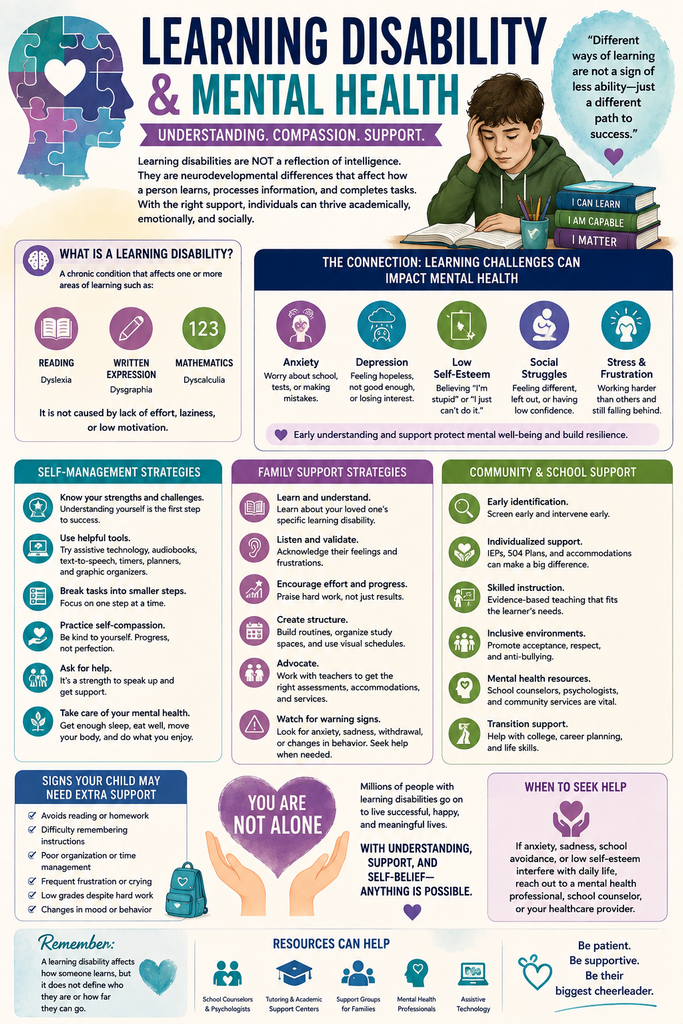
What Is a Learning Disability?
A learning disability is a neurodevelopmental condition that interferes with the acquisition or use of specific academic skills despite appropriate opportunities to learn. Learning disabilities are not caused by laziness, poor parenting, or lack of intelligence.
Specific Learning Disorder may involve difficulties with:
- Reading: Problems with word recognition, decoding, reading accuracy, or fluency.
- Written expression: Difficulties with spelling, grammar, organization, or expressing ideas in writing.
- Mathematics: Problems understanding numbers, mathematical facts, calculations, or mathematical reasoning.
Terms such as dyslexia, dysgraphia, and dyscalculia are commonly used to describe particular patterns of learning difficulty.
The severity and presentation vary considerably. One person might struggle primarily with reading while excelling in mathematics, art, science, sports, or verbal communication.
Learning Disabilities Are Not a Sign of Low Intelligence
One of the most damaging misconceptions is that a person with a learning disability is less intelligent.
Learning disabilities affect how someone learns particular types of information, not their overall worth or potential. A student may understand a complicated concept during a conversation but struggle to demonstrate that knowledge on a timed written examination.
Being judged repeatedly solely on an area of difficulty can gradually change how someone views themselves.
Instead of thinking:
“Reading is difficult for me.”
The person may eventually begin thinking:
“I’m stupid.”
That shift from recognizing a specific challenge to developing a negative identity can have significant mental health consequences.
The Connection Between Learning Disabilities and Mental Health
Learning disabilities and mental health disorders are separate conditions, but they can occur together.
Imagine spending years watching classmates complete assignments faster than you can. You may study longer yet receive lower grades. Teachers might mistakenly believe you are not paying attention. Parents may become frustrated. Other students may tease you.
Over time, those experiences can create emotional distress.
Possible mental health effects include:
- Anxiety about school or work.
- Low self-esteem.
- Fear of failure.
- Depression.
- Chronic stress.
- Frustration and anger.
- Social withdrawal.
- School avoidance.
- Perfectionism.
- Feelings of inadequacy or hopelessness.
Not everyone with a learning disability develops these difficulties. Strong relationships, early intervention, appropriate instruction, accommodations, and opportunities to experience success can be highly protective.
Anxiety and Learning Disabilities
Anxiety may develop when academic situations repeatedly become associated with embarrassment or failure.
A student might become extremely nervous before reading aloud, taking a mathematics test, writing an essay, or completing a timed assignment.
Eventually, the anxiety can begin before the task even starts.
Physical symptoms may include headaches, stomachaches, sweating, rapid heartbeat, difficulty sleeping, or feeling sick before school.
Avoiding the situation may temporarily decrease anxiety, but repeated avoidance can make returning to the activity increasingly difficult.
Depression and Low Self-Esteem
Persistent academic difficulties can also influence self-esteem.
Children naturally compare themselves with their peers. When someone repeatedly sees others succeed at tasks that require tremendous effort, they may begin to question their own abilities.
Statements such as:
“Everyone is smarter than me.”
“I’ll never be good at anything.”
“Why should I even try?”
Should not simply be dismissed as complaining.
They may indicate significant emotional distress.
Depression is a separate clinical condition and should never automatically be attributed to a learning disability. Persistent sadness, hopelessness, withdrawal, loss of interest, major sleep or appetite changes, or thoughts of self-harm deserve professional evaluation.
The Cycle of Academic Struggle and Emotional Distress
Learning difficulties and mental health symptoms can sometimes reinforce one another.
A student struggles academically.
The struggle creates anxiety.
Anxiety makes concentrating more difficult.
Poor concentration affects academic performance.
The student receives another disappointing result.
Confidence decreases.
The student begins avoiding assignments.
Academic problems become worse.
Breaking this cycle may require addressing both learning needs and emotional well-being rather than treating one while ignoring the other.
Self-Management Strategies
People with learning disabilities can develop strategies that increase independence while reducing unnecessary stress. Self-management does not mean simply trying harder. It means understanding how you learn and using appropriate tools.
Helpful strategies include:
- Understand your learning profile. Identify which tasks are difficult and which learning approaches work best.
- Break large assignments into smaller steps. Smaller goals can reduce feelings of being overwhelmed.
- Use assistive technology. Text-to-speech, speech-to-text, audiobooks, calculators, electronic organizers, and spelling tools can improve accessibility.
- Create predictable routines. Regular study times and organized workspaces can reduce cognitive overload.
- Use visual supports. Charts, diagrams, calendars, checklists, and graphic organizers can make information easier to manage.
- Ask for clarification. Requesting instructions in another format is a learning strategy, not a weakness.
- Allow sufficient time. Some tasks may require additional processing time.
- Develop self-advocacy skills. Learn how to explain your needs and request appropriate accommodations.
- Recognize strengths. Academic difficulty in one area does not erase abilities in others.
- Protect mental health. Seek help when anxiety, sadness, hopelessness, or stress becomes difficult to manage.
Building Confidence Beyond Grades
Academic achievement is only one part of a person’s identity.
Children and adults need opportunities to discover areas where they feel competent and valued. These might include art, music, sports, technology, science, cooking, mechanical work, leadership, communication, entrepreneurship, caregiving, or creative problem-solving.
Families and educators should avoid assuming that everyone with a learning disability possesses particular talents. Instead, they can help the individual discover their own strengths and interests.
Success in meaningful activities can provide an important counterbalance to academic frustration.
Family Support Strategies
Family support can dramatically influence how someone understands a learning disability.
A child who repeatedly hears, “You’re lazy” may internalize shame.
A child who hears, “I can see you’re working hard. Let’s figure out what type of support you need,” receives a very different message.
Families can help by:
- Learning about the individual’s specific learning disability.
- Avoiding labels such as lazy, careless, stupid, or unmotivated.
- Listening to frustration without immediately criticizing.
- Praising effort, persistence, improvement, and problem-solving.
- Helping establish consistent homework and sleep routines.
- Communicating with teachers and educational specialists.
- Advocating for appropriate assessments and accommodations.
- Encouraging interests outside academics.
- Avoiding comparisons with siblings or classmates.
- Watching for bullying and social isolation.
- Monitoring for anxiety, depression, or school avoidance.
- Seeking professional mental health support when needed.
Support should encourage independence rather than completing every difficult task for the individual.
What Parents Can Say
Language matters.
Instead of:
“You’re smart. You just need to try harder.”
Consider:
“I know you’re trying. This particular task is harder for you, so let’s find a strategy that works better.”
Instead of:
“Your sister can do this. Why can’t you?”
Consider:
“Everyone learns differently. Let’s focus on what helps you learn.”
These small changes can reduce shame while encouraging persistence.
School and Community Support Strategies
Learning disabilities should not be managed by families alone. Schools and communities play an essential role in identification, intervention, accessibility, and emotional support.
Helpful strategies include:
- Providing early screening when academic difficulties appear.
- Offering comprehensive educational evaluations when indicated.
- Providing evidence-based academic interventions.
- Training educators to recognize learning difficulties.
- Offering appropriate classroom and testing accommodations.
- Making assistive technology accessible.
- Providing school counseling and psychological services.
- Creating anti-bullying programs.
- Teaching students about different ways of learning.
- Supporting parents through educational workshops.
- Connecting families with community mental health resources.
- Providing transition services for college or employment.
- Promoting inclusive environments where asking for accommodations is normalized.
In the United States, eligible students may receive specialized education through an Individualized Education Program (IEP) or accommodations through a Section 504 plan, depending on their individual needs and eligibility.
Learning Disabilities in Adulthood
Learning disabilities do not necessarily disappear after graduation.
Adults may continue to experience difficulty reading complex documents, completing paperwork, writing reports, performing calculations, following written instructions, organizing information, or completing tasks under strict time limits.
Some adults were never diagnosed as children. They may have spent decades believing they were simply poor students.
Recognizing a learning disability later in life can sometimes explain longstanding difficulties and open the door to new strategies.
Adults may benefit from:
- Formal assessment when appropriate.
- Assistive technology.
- Organizational systems.
- Workplace accommodations.
- Additional training.
- Counseling for persistent shame or anxiety.
- Career environments that recognize individual strengths.
- Disability-support services in college or vocational programs.
When Learning Disabilities and Other Conditions Occur Together
A person can have a learning disability and another neurodevelopmental or mental health condition at the same time.
For example, learning disabilities may coexist with:
- ADHD.
- Anxiety disorders.
- Depression.
- Autism spectrum disorder.
- Other developmental or behavioral conditions.
This is why comprehensive assessment is important.
A student’s declining grades might result from a learning disability, ADHD, anxiety, depression, inadequate instruction, environmental stress, or several factors occurring together.
Treatment should address each identified problem rather than assuming that a single diagnosis explains everything.
When Should Families Seek Additional Help?
Professional evaluation should be considered when learning or emotional difficulties significantly interfere with school, relationships, work, or everyday functioning.
Warning signs may include:
- Persistent school refusal.
- Frequent unexplained physical complaints before school.
- Severe test anxiety.
- Increasing isolation.
- Loss of interest in previously enjoyed activities.
- Persistent irritability or sadness.
- Major changes in sleep or appetite.
- Repeated statements about being worthless or stupid.
- Significant behavioral changes.
- Substance use as a coping mechanism.
- Expressions of hopelessness.
- Thoughts about self-harm or suicide.
Statements involving self-harm or suicide should always be taken seriously and addressed immediately.
From “What’s Wrong With Me?” to “How Do I Learn Best?”
One of the most powerful changes occurs when people stop defining themselves by their difficulties.
Instead of asking:
“What’s wrong with me?”
they can begin asking:
“How do I learn best?”
That change does not eliminate the learning disability. It changes the way the individual approaches it.
Appropriate instruction develops skills. Accommodations improve access. Technology increases independence. Families provide encouragement. Communities reduce barriers. Mental health professionals can address anxiety, depression, trauma, or low self-esteem when these problems occur.
Together, these supports can transform the person’s experience.
Conclusion
A learning disability is not a mental illness, a character flaw, or evidence of low intelligence. It is a neurodevelopmental condition that affects specific areas of learning. However, the emotional consequences of repeatedly struggling, being misunderstood, experiencing bullying, or feeling different can have a significant impact on mental health.
Supporting someone with a learning disability therefore requires more than improving grades. Self-management strategies can build independence, families can protect confidence and encourage self-advocacy, and schools and communities can provide appropriate instruction, accommodations, technology, and mental health resources.
The goal should not be to make every person learn in exactly the same way. The goal is to recognize differences early, remove unnecessary barriers, strengthen skills, and help individuals understand that needing a different approach to learning does not make them less capable.
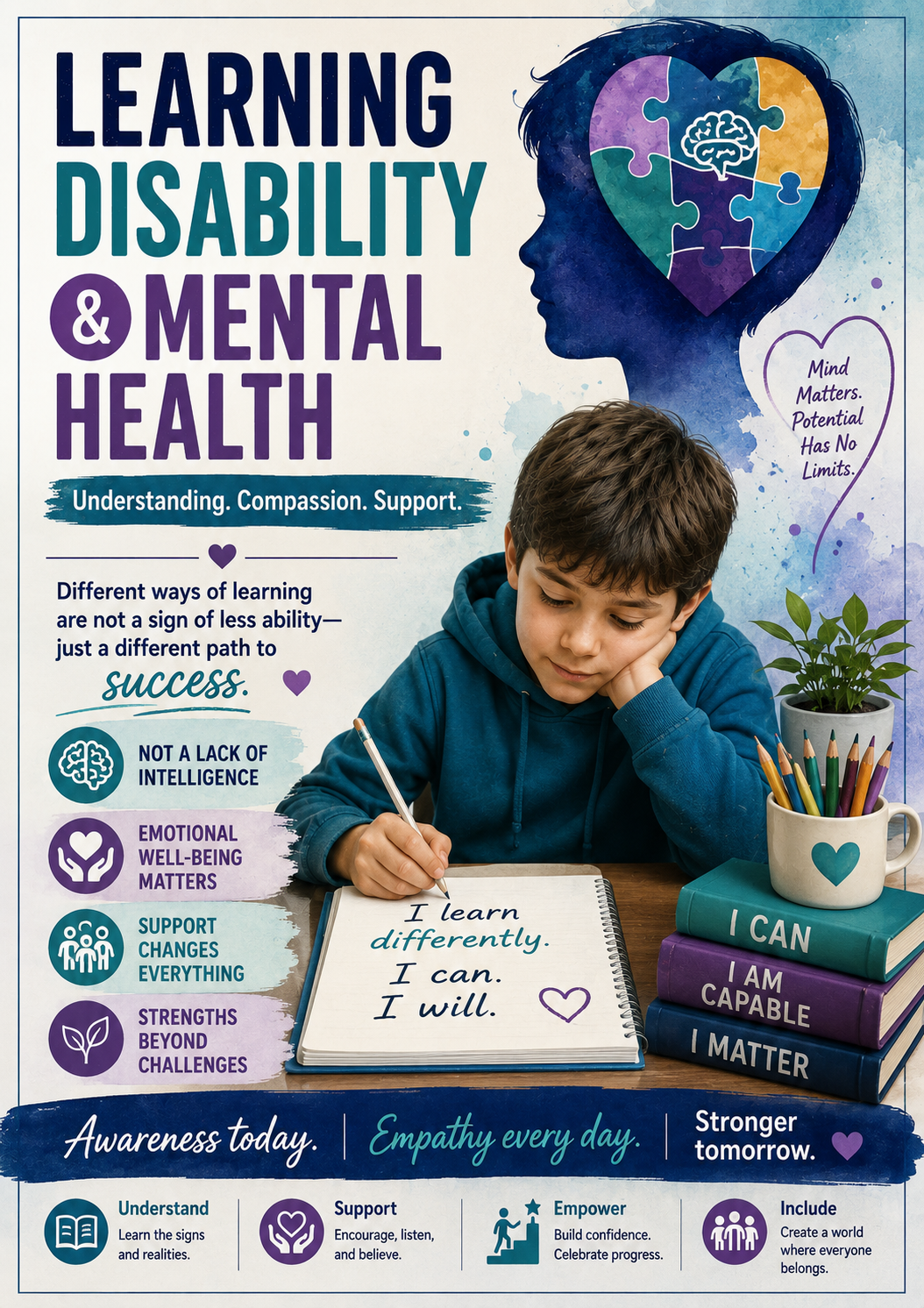
Different ways of learning deserve different ways of teaching—and every learner deserves the opportunity to succeed.
Frequently Asked Questions
Here are some common questions:
1. What is a learning disability?
A learning disability is a neurodevelopmental condition that affects how a person learns or uses specific academic skills, such as reading, writing, spelling, or mathematics. Learning disabilities are not caused by laziness, poor motivation, or lack of intelligence.
2. Is a learning disability a mental illness?
No. A learning disability is not the same as a mental illness. Learning disabilities involve differences in learning and information processing, while mental health disorders primarily affect areas such as mood, thinking, behavior, and emotional functioning. However, the two can occur together.
3. What are common types of learning disabilities?
Common learning difficulties include dyslexia, which primarily affects reading; dysgraphia, a term commonly associated with difficulties involving writing; and dyscalculia, which involves significant difficulties with mathematics and numerical concepts.
4. Does having a learning disability mean someone has low intelligence?
No. A learning disability does not determine intelligence. Someone can have significant difficulty with reading or mathematics while demonstrating strong abilities in other academic, creative, social, or practical areas.
5. Can learning disabilities affect mental health?
Yes. Learning disabilities do not automatically cause mental illness, but repeated academic difficulties, criticism, bullying, embarrassment, or feeling different from peers can contribute to anxiety, depression, chronic stress, low self-esteem, and social withdrawal.
6. Why are children with learning disabilities vulnerable to anxiety?
A child who repeatedly struggles with reading, writing, homework, or examinations may begin anticipating failure before the activity even starts. This can create test anxiety, fear of reading aloud, perfectionism, school avoidance, or physical complaints such as headaches and stomachaches.
7. Can learning disabilities contribute to depression?
They can be an indirect contributing factor. Persistent frustration, social comparison, bullying, academic failure, and negative beliefs about intelligence may increase emotional distress. Depression is a separate condition, however, and persistent symptoms should receive appropriate professional evaluation.
8. How can a learning disability affect self-esteem?
Repeatedly struggling despite working hard can cause someone to believe they are incapable or unintelligent. Comments such as “I’m stupid,” “I’ll never understand this,” or “Everyone is smarter than me” may signal declining confidence and deserve attention.
9. Can learning disabilities and ADHD occur together?
Yes. ADHD and learning disabilities are separate neurodevelopmental conditions, but a person can have both. When they occur together, problems involving attention, organization, reading, writing, mathematics, or completing assignments may become more complicated.
10. What mental health warning signs should families watch for?
Families should pay attention to significant or persistent changes such as:
- Increasing sadness or irritability.
- Severe anxiety about school.
- School refusal or frequent unexplained absences.
- Withdrawal from friends and activities.
- Loss of confidence or motivation.
- Changes in sleeping or eating.
- Frequent negative statements about intelligence or self-worth.
- Substance use as a coping strategy.
- Hopelessness, self-harm, or suicidal thoughts.
11. What self-management strategies can help?
Helpful strategies include breaking assignments into smaller tasks, creating structured routines, using calendars and checklists, requesting clarification, using assistive technology, allowing adequate time for difficult activities, recognizing personal strengths, and developing self-advocacy skills.
12. Can assistive technology improve mental well-being?
It can help reduce unnecessary academic stress. Tools such as text-to-speech, speech-to-text, audiobooks, electronic organizers, spelling assistance, and digital calendars can make information more accessible and increase independence.
13. How can parents support a child with a learning disability?
Parents can learn about the child’s specific needs, listen without judgment, avoid comparing the child with siblings or classmates, praise effort and improvement, communicate with teachers, advocate for appropriate services, encourage activities where the child can experience success, and monitor the child’s emotional well-being.
14. What should parents avoid saying?
Statements such as “You’re lazy,” “You’re not trying,” “Everyone else can do it,” or “Why can’t you be more like your sibling?” can increase shame. A more supportive approach recognizes the difficulty while helping the child find strategies that work.
15. How can schools support students with learning disabilities?
Schools can provide appropriate assessments, evidence-based instruction, individualized interventions, assistive technology, classroom accommodations, additional testing time when appropriate, counseling services, and environments that discourage bullying and stigma.
16. What are IEPs and 504 plans?
In the United States, an Individualized Education Program (IEP) provides specialized educational services for eligible students under federal special-education law. A Section 504 plan can provide accommodations that help eligible students access education. Eligibility and services depend on the student’s individual circumstances.
17. Do learning disabilities continue into adulthood?
Yes. Learning disabilities are generally lifelong, although people often develop effective compensatory strategies. Adults may continue experiencing difficulty with paperwork, reading speed, written communication, calculations, organization, or other specific tasks.
18. Can adults with learning disabilities experience mental health problems?
Yes. Adults may experience anxiety, embarrassment, low confidence, workplace stress, or depression—particularly when a learning disability went unidentified for many years. Assessment, counseling, assistive technology, and appropriate accommodations can help.
19. When should professional mental health help be considered?
Professional help should be considered when anxiety, depression, low self-esteem, behavioral changes, or school avoidance persist or interfere with everyday functioning. Learning needs and mental health symptoms may require separate but coordinated interventions.
20. What is the most important message about learning disabilities and mental health?
Learning differently does not mean being less intelligent or less capable. Early identification, effective instruction, accommodations, supportive relationships, and attention to emotional well-being can help individuals develop confidence and reach their potential.
Video: What I wish people knew about learning disabilities #learningdisability #shorts