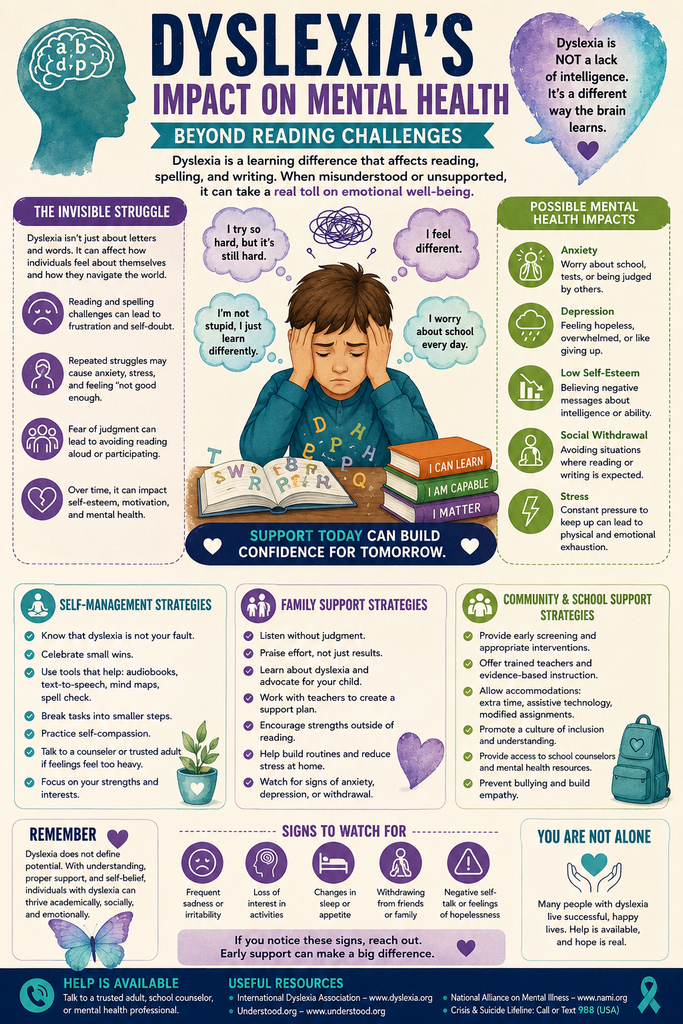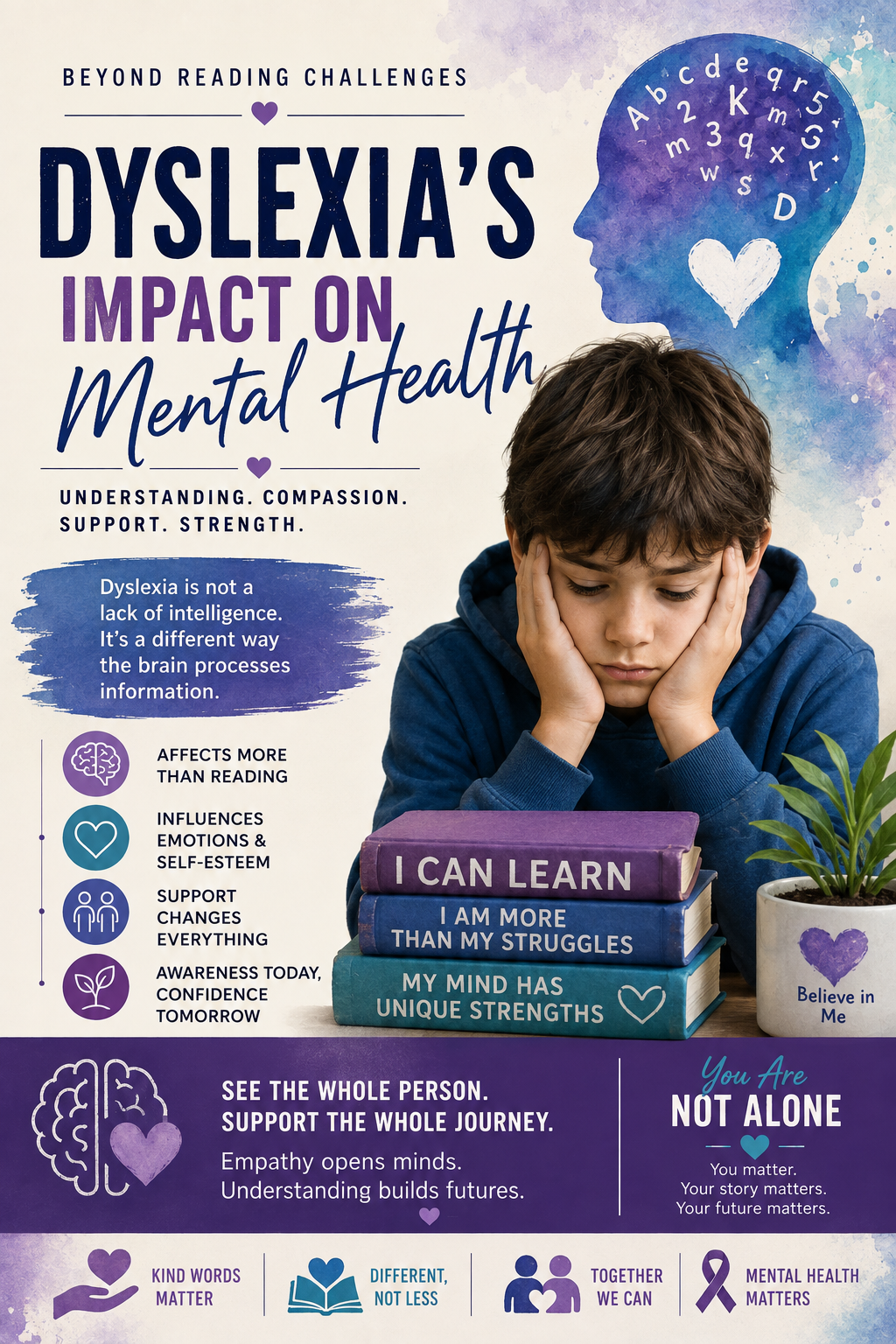
Dyslexia is more than a challenge with reading and spelling. It is a neurodevelopmental learning disorder that affects how a person processes written language, but it does not mean someone has low intelligence or a mental illness. Many people with dyslexia have average or above-average intelligence and can thrive when given appropriate instruction and support.
The emotional impact of dyslexia, however, can be significant. Repeated difficulties at school, fear of making mistakes, bullying, criticism, or constantly comparing oneself with others may contribute to frustration, anxiety, low self-esteem, school avoidance, or symptoms of depression. Recognizing the connection between dyslexia and mental health can help individuals, families, educators, and communities replace judgment with understanding and provide the support needed to build confidence and succeed.
What Is Dyslexia?
Dyslexia affects how the brain processes written language. A person may understand a concept perfectly when it is explained verbally but have difficulty reading the same information from a textbook. These difficulties are not caused simply by laziness, poor motivation, or inadequate intelligence.
Common difficulties associated with dyslexia may include:
- Reading slowly or inaccurately.
- Difficulty sounding out unfamiliar words.
- Problems connecting letters with speech sounds.
- Frequent spelling difficulties.
- Avoiding reading aloud.
- Needing more time to complete reading-heavy assignments.
- Difficulty remembering written sequences or instructions.
- Becoming mentally exhausted after prolonged reading.
- Understanding spoken information more easily than written information.
Dyslexia varies considerably from person to person. Some people experience relatively mild difficulties, while others require substantial educational accommodations.
Is Dyslexia a Mental Disorder?
The terminology can be confusing. Dyslexia falls within the broad category of neurodevelopmental disorders in diagnostic systems, but it should not be described as a mental illness in the same way as major depression, bipolar disorder, or schizophrenia.
A learning disorder describes persistent difficulties acquiring particular academic skills despite appropriate opportunities to learn. The person’s brain processes certain types of information differently; it does not mean the person lacks intelligence or has a psychiatric illness.
This distinction is important because labeling someone with dyslexia as mentally ill may unnecessarily increase stigma.
Dyslexia and Mental Health
Dyslexia can nevertheless have important psychological consequences.
Imagine repeatedly being asked to perform a task that is unusually difficult for you while watching classmates complete it easily. A child may eventually conclude, “I’m stupid,” even though intelligence is not the problem.
Repeated negative experiences can contribute to:
- Low academic confidence.
- Anxiety about school or testing.
- Fear of reading in front of other people.
- Frustration and anger.
- Social embarrassment.
- Low self-esteem.
- Avoidance of challenging assignments.
- Depression or hopelessness in some individuals.
These psychological difficulties are not inevitable consequences of dyslexia. Early identification, effective instruction, appropriate accommodations, supportive relationships, and recognition of a person’s strengths can make an enormous difference.
The Journey From Frustration to Understanding
For some people, receiving a dyslexia diagnosis can actually bring relief. Years of struggling may finally have an explanation.
Instead of thinking:
“I can’t read well because I’m not smart.”
The individual can begin understanding:
“My brain processes written language differently, and there are strategies that can help me learn.”
That shift can be important for rebuilding confidence.
Treatment and educational intervention generally focus on improving reading skills while simultaneously helping the individual develop strategies for areas that remain challenging. Structured, explicit instruction in areas such as phonemic awareness, phonics, decoding, spelling, vocabulary, fluency, and comprehension may be appropriate depending on the person’s needs.
Self-Management Strategies for Dyslexia
Self-management does not mean overcoming dyslexia through willpower. It means learning how to work effectively with one’s individual strengths and challenges.
Helpful strategies include:
- Understand your learning profile. Knowing which tasks are difficult and which approaches work best can reduce unnecessary frustration.
- Use assistive technology. Text-to-speech software, audiobooks, speech-to-text programs, electronic dictionaries, and spelling tools can improve access to information.
- Break large assignments into smaller steps. Smaller tasks can make reading-intensive work feel more manageable.
- Allow additional time. Reading and proofreading may require more time, and that does not reflect intelligence.
- Combine reading with listening. Listening to an audiobook while following the printed text may improve comprehension for some learners.
- Use visual organization. Calendars, diagrams, color-coded notes, and graphic organizers can help organize information.
- Practice self-advocacy. Learn how to explain accommodations that make learning more accessible.
- Recognize personal strengths. Academic reading ability represents only one area of functioning.
- Protect mental health. Persistent anxiety, depression, shame, or school avoidance deserves professional attention.
Building Self-Esteem
Children and adults with dyslexia may spend considerable time focusing on what they find difficult. Support should also identify what they do well.
A person with dyslexia may have strengths in areas such as creativity, problem-solving, sports, art, music, interpersonal communication, mechanical skills, entrepreneurship, or other fields. These strengths vary by individual and should not be assumed simply because someone has dyslexia.
Developing competence outside difficult academic areas can help prevent a learning difference from becoming someone’s entire identity.
Family Support Strategies
Family responses can strongly influence how a child interprets dyslexia. Constant criticism may turn an academic difficulty into a source of shame, while appropriate support can help the child understand that needing a different learning approach does not mean being less capable.
Families can help by:
- Learning about dyslexia from reliable sources.
- Avoiding labels such as “lazy,” “slow,” or “not trying.”
- Praising effort, persistence, creativity, and improvement rather than only grades.
- Reading together without turning every mistake into criticism.
- Asking the child what types of learning support feel helpful.
- Communicating regularly with teachers and specialists.
- Advocating for appropriate educational evaluations and accommodations.
- Helping establish predictable homework routines.
- Encouraging interests that allow the child to experience success.
- Watching for anxiety, depression, bullying, or school avoidance.
- Seeking mental health care when emotional difficulties become significant.
Parents should remember that helping does not mean completing assignments for the child. The goal is to provide enough support for the student to develop independence and confidence.
Supporting a Child Who Says, “I’m Stupid”
Statements like this deserve attention rather than immediate dismissal.
Instead of simply saying, “No, you’re not,” parents can explore what happened. Perhaps the child struggled during a reading exercise, received a poor grade, or was embarrassed in front of classmates.
A supportive response communicates that the difficulty is real while separating it from intelligence:
“Reading is harder for you because of dyslexia. That doesn’t mean you’re not intelligent. We can find another way to work on this together.”
This approach validates the frustration without reinforcing the negative belief.
School and Community Support Strategies
Successful management of dyslexia frequently requires cooperation among the student, family, teachers, reading specialists, psychologists, and other professionals.
Helpful community and educational strategies include:
- Providing early screening when reading difficulties emerge.
- Offering comprehensive educational evaluation when indicated.
- Using evidence-based structured reading instruction.
- Providing additional instructional time when necessary.
- Allowing appropriate testing and classroom accommodations.
- Making audiobooks and assistive technology accessible.
- Training teachers to recognize possible signs of dyslexia.
- Preventing bullying related to learning differences.
- Providing school counseling when emotional difficulties develop.
- Educating families about available educational rights and services.
- Creating classrooms where different learning needs are normalized.
- Supporting transitions into college and employment.
Depending on eligibility and individual circumstances in the United States, students may receive services or accommodations through an Individualized Education Program (IEP) or a Section 504 plan.
Dyslexia in College and Adulthood
Dyslexia does not disappear automatically when someone graduates from high school. Adults may continue experiencing difficulties with reading speed, spelling, written communication, paperwork, examinations, or rapidly processing written instructions.
However, many adults develop highly effective compensatory strategies.
College students and working adults may benefit from:
- Text-to-speech technology.
- Audiobooks and digital textbooks.
- Speech-to-text software.
- Additional testing time when formally approved.
- Quiet testing environments.
- Written and verbal instructions.
- Organizational applications and reminders.
- Disability-support services at colleges and universities.
- Workplace accommodations when appropriate.
Seeking accommodations is not cheating. Appropriate accommodations are intended to provide equitable access rather than lower academic or professional expectations.
When Dyslexia and Mental Health Conditions Occur Together
A person with dyslexia can also have ADHD, anxiety, depression, or another mental health condition. When multiple conditions are present, each deserves appropriate evaluation rather than assuming every difficulty comes from dyslexia.
For example, a student who refuses to attend school might be experiencing academic frustration, but severe anxiety, depression, bullying, ADHD, or another problem could also be contributing.
A comprehensive assessment can help determine what is happening and guide treatment.
Moving From Stigma to Support
One of the greatest challenges surrounding dyslexia is often not the learning difference itself but what people believe it means.
A struggling reader may hear:
“Try harder.”
“You’re careless.”
“Everyone else can do it.”
Those messages can create shame without addressing the underlying learning difficulty.
A more productive message is:
“You can learn, but you may need a different approach.”
Early recognition changes the conversation from blame to problem-solving. Effective instruction can build reading skills, accommodations can improve access, technology can increase independence, and emotional support can protect self-esteem.
Conclusion
Dyslexia is a neurodevelopmental learning disorder, not a sign of low intelligence or a psychiatric illness. However, the emotional consequences of struggling academically without adequate support can be significant. Anxiety, low self-esteem, frustration, and depression may develop when individuals repeatedly experience failure, misunderstanding, or stigma.
Understanding dyslexia therefore requires looking beyond reading difficulties. Self-management strategies can help individuals become more independent, families can protect confidence while advocating for appropriate services, and schools and communities can provide evidence-based instruction and accommodations.
The goal is not simply to help someone read better. It is to create an environment in which a learning difference does not become a lifelong belief that the person is less intelligent or less capable. With appropriate instruction, accommodations, encouragement, and mental health support when needed, people with dyslexia can build confidence and pursue meaningful educational, professional, and personal goals.
Frequently Asked Questions
Here are some common questions:
1. Is dyslexia a mental illness?
No. Dyslexia is not a mental illness. It is a neurodevelopmental learning disorder that primarily affects reading, spelling, word recognition, and decoding. Clinically, it is commonly identified under Specific Learning Disorder with impairment in reading.
2. Can dyslexia affect mental health?
Yes. Dyslexia does not directly mean someone will develop a mental health condition, but repeated academic difficulties, embarrassment, misunderstanding, or criticism can contribute to emotional distress. Some people with dyslexia may experience anxiety, low self-esteem, frustration, or depression.
3. Does dyslexia mean someone has low intelligence?
No. Dyslexia is not a measure of intelligence. People with dyslexia can have average, above-average, or below-average intelligence, just like people without dyslexia. The primary difficulty lies in processing written language rather than in a person’s overall intellectual ability.
4. Why can dyslexia cause anxiety?
Reading aloud, taking timed examinations, completing written assignments, or worrying about making mistakes can create significant stress. If these situations repeatedly produce embarrassment or failure, a person may begin anticipating them with anxiety.
5. Can dyslexia contribute to depression?
It can indirectly contribute. Persistent academic frustration, bullying, social comparison, low confidence, or feeling misunderstood may increase emotional distress. However, depression is a separate mental health condition and should be professionally evaluated rather than automatically attributed to dyslexia.
6. How does dyslexia affect self-esteem?
Someone who repeatedly struggles with tasks classmates complete easily may incorrectly conclude that they are “stupid” or incapable. Supportive adults can counter this belief by explaining dyslexia accurately, recognizing effort and strengths, and providing appropriate educational assistance.
7. Can children with dyslexia develop school avoidance?
Yes. Some children may try to avoid school, reading aloud, homework, or testing because these activities have become associated with anxiety or embarrassment. Sudden or persistent school avoidance deserves attention because dyslexia, bullying, anxiety, depression, ADHD, or other difficulties may be contributing.
8. Can dyslexia and ADHD occur together?
Yes. Dyslexia and ADHD are different neurodevelopmental disorders, but they can occur in the same person. When they coexist, difficulties with reading, attention, organization, working memory, and completing assignments may become more complicated.
9. What emotional warning signs should parents watch for?
Parents and caregivers should pay attention to significant changes such as:
- Frequent statements like “I’m stupid” or “I can’t do anything.”
- Increasing anxiety about school.
- Persistent sadness or irritability.
- Withdrawal from friends or activities.
- Frequent physical complaints before school.
- Major changes in sleep or appetite.
- Loss of confidence or motivation.
- Refusing to attend school.
- Expressions of hopelessness or self-harm.
10. What self-management strategies can help?
People with dyslexia can learn strategies that make reading and studying more manageable. Audiobooks, text-to-speech technology, speech-to-text tools, graphic organizers, breaking assignments into smaller steps, additional time, structured routines, and asking for accommodations can reduce unnecessary stress.
11. How can families protect a child’s self-esteem?
Families can avoid labels such as “lazy” or “not trying hard enough.” Instead, acknowledge that reading may genuinely require more effort. Praise persistence and improvement, encourage activities where the child experiences success, and remind them that reading ability does not determine intelligence or personal worth.
12. Should parents correct every reading mistake?
Not necessarily. Constant interruption can make reading stressful and discourage practice. Correction should match the child’s educational plan and learning needs while preserving confidence and comprehension. Parents can work with teachers or reading specialists to determine the most appropriate approach.
13. How can schools support students with dyslexia?
Schools can provide appropriate assessment, evidence-based reading instruction, assistive technology, additional time when appropriate, accessible learning materials, reading specialists, counseling services, and individualized accommodations.
14. Can a student with dyslexia qualify for an IEP or 504 plan?
Potentially. In the United States, some students with dyslexia may qualify for services through an Individualized Education Program (IEP) or accommodations through a Section 504 plan, depending on their individual evaluation, educational needs, and eligibility.
15. Does dyslexia disappear in adulthood?
Dyslexia is generally lifelong, although its effects may change as people develop reading skills and compensatory strategies. Adults may continue experiencing difficulties with reading speed, spelling, written instructions, paperwork, or other language-heavy tasks.
16. Can adults with dyslexia experience mental health difficulties?
Yes. Adults may experience workplace anxiety, embarrassment about spelling or reading, low confidence, or stress from hiding their difficulties. Appropriate accommodations, assistive technology, self-advocacy, and mental health support can help.
17. When should professional mental health support be considered?
Professional help should be considered when anxiety, depression, persistent low self-esteem, school refusal, social withdrawal, or emotional distress begins interfering with everyday life. Learning difficulties and mental health symptoms may require separate but coordinated treatment.
18. What is the most important message about dyslexia and mental health?
Dyslexia does not define intelligence, ability, or future potential. The emotional consequences of being misunderstood can sometimes be more damaging than the learning difference itself. Early identification, effective reading instruction, appropriate accommodations, supportive families, and compassionate schools can protect both academic development and mental well-being.
Video: Why you feel behind (it’s not your fault) #dyslexia #neurodiversity