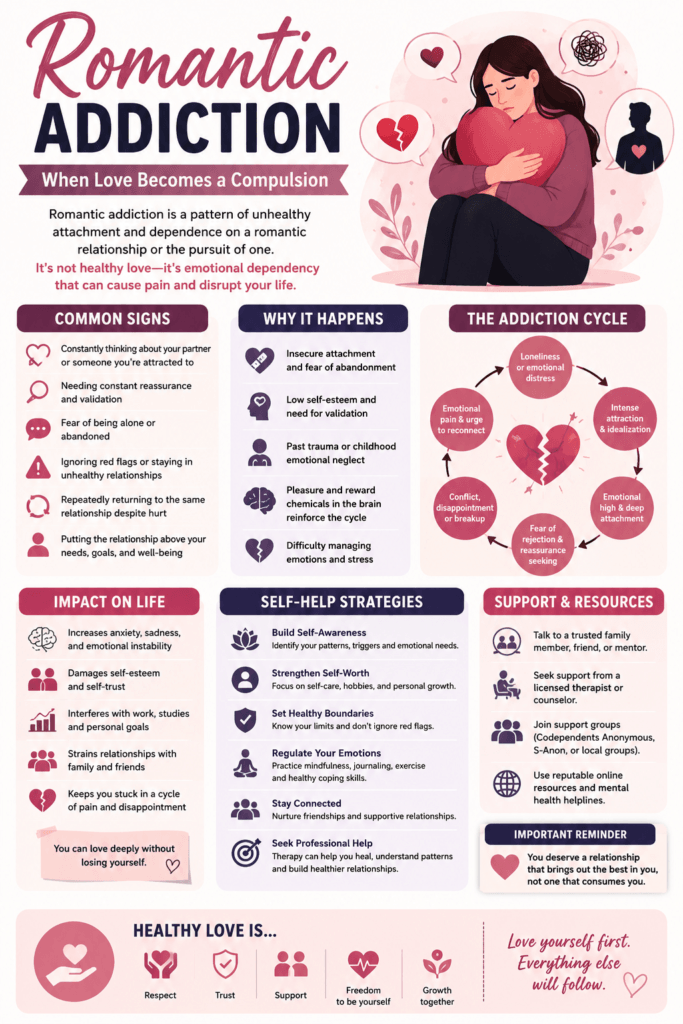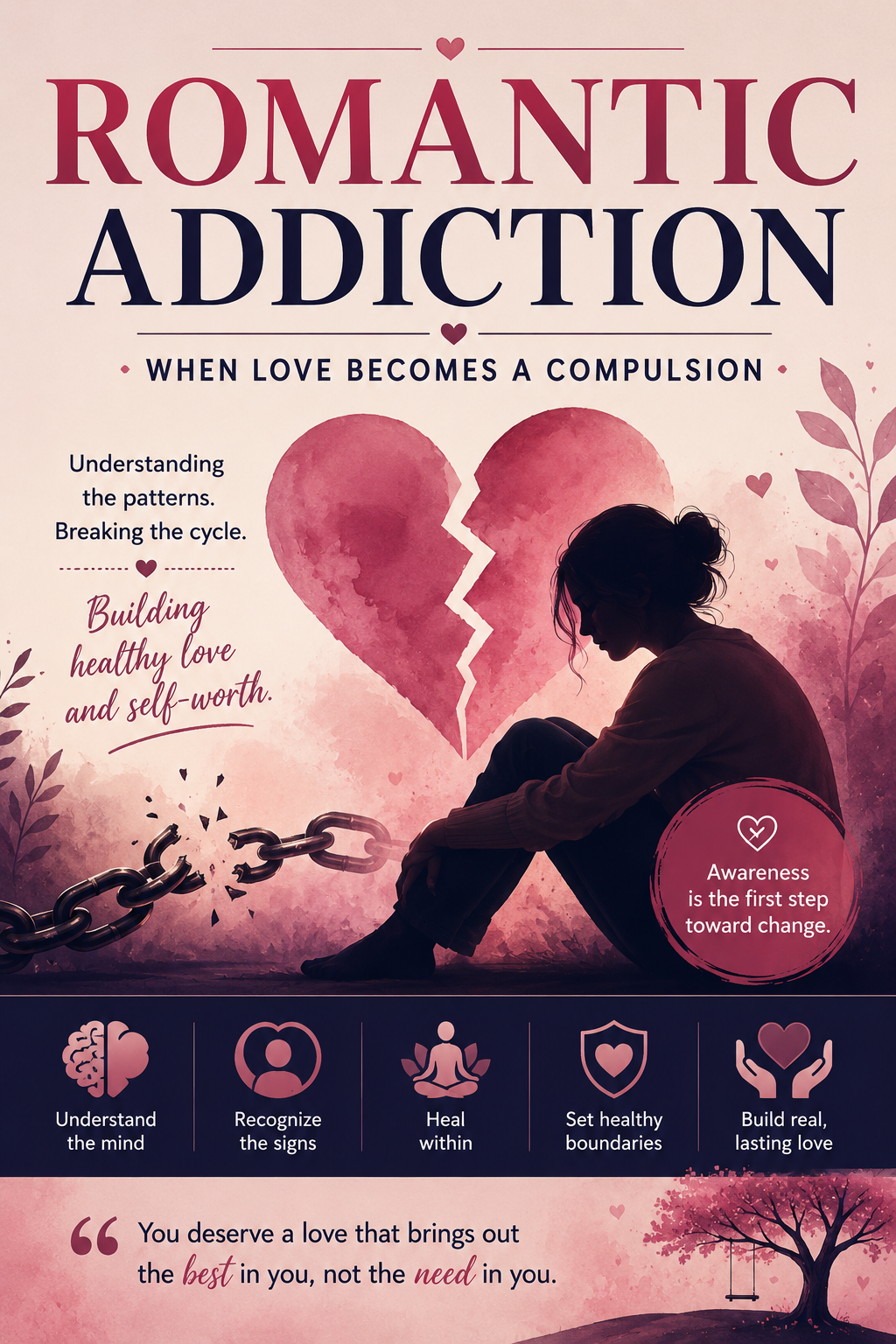
Romantic addiction, also referred to as love or relationship addiction, describes an unhealthy pattern in which the need for romantic attention, connection, or emotional reassurance becomes increasingly difficult to manage and begins affecting a person’s emotional well-being and daily life. Although romantic addiction is not an official diagnosis in the DSM-5-TR, the term is sometimes used to describe behaviors such as becoming emotionally attached very quickly, needing constant reassurance, idealizing a romantic partner, experiencing intense fears of rejection or abandonment, and repeatedly returning to unhealthy relationships despite harmful consequences. Romantic relationships naturally engage brain systems associated with attachment, motivation, and reward, but difficulties can develop when a relationship becomes the primary source of self-worth or the main way of coping with loneliness, insecurity, anxiety, or emotional distress. Recognizing these patterns can help individuals better distinguish healthy love from emotional dependency while developing greater self-awareness, healthier boundaries, emotional independence, and more effective coping skills.
Romantic Addiction: When Love Becomes Compulsive
Romantic addiction, sometimes called love addiction or relationship addiction, describes a pattern in which a person becomes intensely preoccupied with romantic attachment, validation, or the pursuit of a relationship. It is not a formal diagnosis in the DSM-5-TR, but the term is commonly used to describe relationship behaviors that become compulsive, emotionally destabilizing, and difficult to control.
What Romantic Addiction Can Look Like
A person experiencing romantic addiction may feel that being loved or desired is necessary to feel secure, valuable, or emotionally complete. The relationship can become the primary source of emotional regulation. Common patterns include:
- Constantly thinking about a romantic partner or potential partner
- Becoming emotionally attached very quickly
- Feeling intense anxiety when a partner is unavailable
- Repeatedly checking texts, calls, or social media for reassurance
- Ignoring red flags because of fear of losing the relationship
- Staying in unhealthy or harmful relationships
- Sacrificing personal values, friendships, responsibilities, or goals to maintain a relationship
- Moving rapidly from one relationship to another to avoid being alone
- Experiencing an intense emotional “high” during attraction followed by distress when attention decreases
- Repeatedly returning to a relationship despite knowing it is causing significant harm
Why Can Romantic Relationships Feel Addictive?
Romantic attraction activates the brain’s reward and motivation systems. Dopamine contributes to pleasure, anticipation, motivation, and reinforcement, while hormones and neurochemicals such as oxytocin and vasopressin are involved in attachment and bonding. Early romantic relationships can therefore produce powerful feelings of excitement, focus, and emotional reward.
This does not mean that normal romantic love is an addiction. The concern arises when a person begins to lose control over relationship-related behavior and continues the pattern despite significant negative consequences.
For example, someone may repeatedly tell themselves, “I know this relationship is hurting me, but I cannot stay away.” Reconciliation can temporarily relieve loneliness or anxiety, reinforcing the cycle.
The Romantic Addiction Cycle
A common pattern can resemble:
Loneliness or emotional distress → intense attraction → idealization → emotional high → increased attachment → fear of rejection → reassurance-seeking → conflict or disappointment → breakup or withdrawal → emotional distress → renewed pursuit or another relationship.
The temporary relief from contact, reconciliation, or a new romantic interest can reinforce the pattern.
Attachment and Emotional Vulnerability
Romantic addiction may be associated with insecure attachment, low self-esteem, difficulty tolerating loneliness, abandonment fears, trauma histories, poor emotional regulation, or previous unstable relationships. For some people, romantic attention becomes a way to escape uncomfortable emotions rather than simply to enjoy intimacy.
An important distinction is that attachment problems are not evidence that someone is weak or incapable of healthy relationships. They are patterns that can often be recognized and changed.
Romantic Addiction vs. Healthy Love
Healthy relationships generally allow both people to maintain their identities, boundaries, friendships, interests, and independence. Partners can tolerate reasonable periods apart and communicate disagreements without experiencing every conflict as evidence that the relationship is ending.
In romantic addiction, the relationship may increasingly become the person’s emotional center. Thoughts such as “I can’t function without this person,” “I need them to feel okay,” or “I’ll accept anything as long as they don’t leave” may become dominant.
Healthy love tends to involve connection plus autonomy. Romantic addiction tends to involve connection at the expense of autonomy.
Connection With Substance Use and Other Addictions
Romantic addiction can also be relevant in addiction recovery. Some individuals who stop using alcohol or drugs may begin relying heavily on relationships, sex, dating, shopping, gambling, food, or other rewarding behaviors to manage emotions. This is sometimes informally described as addiction substitution, although clinicians should carefully assess what is actually occurring rather than assuming that one addiction has simply been replaced by another.
An unstable relationship can also become a relapse trigger when rejection, jealousy, conflict, or separation produces overwhelming distress.
Treatment and Recovery
Because romantic addiction is not a formal standalone psychiatric diagnosis, treatment generally focuses on the underlying behaviors and contributing problems. Cognitive behavioral therapy (CBT), attachment-focused psychotherapy, trauma-informed therapy, emotion-regulation skills, boundary development, and treatment of co-occurring depression, anxiety, trauma, or substance use disorders may be helpful depending on the individual.
Recovery does not require avoiding love. The goal is learning to experience intimacy without making another person responsible for one’s identity, self-worth, or emotional survival.
Ultimately, healthy romantic relationships are characterized not simply by intense feelings, but by mutual respect, emotional safety, realistic expectations, boundaries, trust, and the ability to remain an individual while being connected to another person.
Self-Management Strategies for Understanding Romantic Addiction
Self-management for romantic addiction focuses on recognizing unhealthy relationship patterns, strengthening emotional independence, and developing healthier ways to respond to loneliness, rejection, uncertainty, and attachment. Because “romantic addiction” or “love addiction” is not a formal DSM-5-TR diagnosis, these strategies are best viewed as tools for addressing compulsive or harmful relationship behaviors rather than treating a specific psychiatric disorder.
- Identify your relationship patterns. Reflect on previous relationships and look for recurring behaviors such as becoming attached very quickly, idealizing partners, ignoring red flags, repeatedly returning to unhealthy relationships, or feeling unable to function when single.
- Recognize emotional triggers. Loneliness, rejection, jealousy, boredom, stress, conflict, and fear of abandonment can trigger compulsive contact or reassurance-seeking. Keeping a journal can help identify the situations and emotions that precede these behaviors.
- Practice delaying impulsive contact. When you feel compelled to repeatedly text, call, check social media, or reconnect after a breakup, create a waiting period before acting. Use the time for walking, breathing exercises, journaling, exercise, or talking with a trusted person.
- Separate feelings from facts. Intense attraction does not automatically mean a relationship is healthy or compatible. Ask yourself whether the relationship demonstrates respect, honesty, consistency, emotional safety, shared values, and appropriate boundaries.
- Challenge idealization. Romantic addiction can involve focusing heavily on someone’s positive qualities while minimizing harmful behavior. Try evaluating the whole relationship rather than the person you hope your partner will eventually become.
- Strengthen your identity outside relationships. Maintain friendships, hobbies, education, career goals, exercise, family relationships, and personal interests. A healthy relationship should become part of your life rather than replacing the rest of it.
- Develop emotional regulation skills. Mindfulness, meditation, exercise, adequate sleep, structured routines, and relaxation techniques can help you tolerate uncomfortable emotions without immediately seeking romantic reassurance.
- Establish healthy boundaries. Decide what behaviors you will and will not accept. Boundaries may involve communication, privacy, finances, sexual activity, personal time, substance use, or how conflict is handled. A boundary should protect your well-being rather than control another person.
- Learn to tolerate being alone. Spending intentional time alone can help distinguish loneliness from emotional dependence. Start with manageable activities such as eating a meal alone, exercising, attending an event, or pursuing a hobby independently.
- Reduce digital reinforcement. Constantly checking someone’s online activity can maintain obsessive thinking after rejection or separation. Muting notifications, limiting social-media checking, or temporarily unfollowing someone may help interrupt the cycle.
- Use a “relationship reality check.” Ask: Am I emotionally safe? Can I say no? Can I disagree? Do I still have my own life? Am I repeatedly sacrificing my well-being to prevent this person from leaving? These questions can reveal the difference between closeness and unhealthy dependence.
- Seek professional support when needed. Psychotherapy can help address attachment difficulties, trauma, low self-esteem, anxiety, depression, or compulsive relationship patterns. Professional support is especially important when relationship distress contributes to substance use, severe emotional instability, or repeated involvement in unsafe relationships.
The goal of self-management is not to become emotionally detached or avoid relationships. It is to develop enough emotional stability and self-awareness to choose relationships rather than feeling controlled by the need to have one. Healthy intimacy allows a person to love someone deeply while maintaining boundaries, self-respect, independence, and a stable sense of identity.
Family Support Strategies for Understanding Romantic Addiction
Family support can play an important role when someone struggles with compulsive romantic attachment or unhealthy relationship patterns. Because romantic or “love” addiction is not a formal DSM-5-TR diagnosis, families should focus less on labeling the person and more on understanding behaviors, emotional needs, boundaries, and possible underlying concerns.
- Learn about unhealthy attachment patterns. Family members can educate themselves about emotional dependence, insecure attachment, fear of abandonment, compulsive reassurance-seeking, and relationship idealization. Understanding these patterns can replace criticism with more constructive responses.
- Listen without judgment. Allow the person to discuss relationship difficulties without immediately criticizing the partner or saying, “I told you so.” Judgment can increase shame and make someone less likely to seek support.
- Validate feelings without reinforcing harmful behavior. Families can acknowledge emotions—such as loneliness, grief, jealousy, or rejection—without agreeing that returning to an unhealthy relationship is the solution. For example, recognizing that a breakup hurts is different from encouraging reconciliation.
- Avoid enabling the relationship cycle. Family members do not have to repeatedly provide money, transportation, excuses, housing arrangements, or other assistance that allows harmful relationship behaviors to continue. Support and enabling are not the same.
- Encourage healthy boundaries. Help the person recognize that healthy relationships include respect, privacy, independence, consent, honesty, and the ability to spend time apart. Family members should also maintain their own boundaries.
- Encourage independence. Support hobbies, friendships, education, employment, exercise, volunteering, and other activities that strengthen identity outside romantic relationships. A person’s sense of purpose should not depend entirely on having a partner.
- Recognize triggers. Breakups, loneliness, rejection, anniversaries, conflict, social media, or seeing a former partner may intensify compulsive thoughts and behaviors. Families can help the person develop a plan for managing these situations before they occur.
- Avoid becoming the relationship investigator. Constantly monitoring the person’s phone, social media, or partner can create additional conflict and dependence. Unless immediate safety is involved, encourage the individual to develop their own judgment and decision-making skills.
- Watch for co-occurring concerns. Compulsive relationship patterns can occur alongside depression, anxiety, trauma-related difficulties, low self-esteem, substance misuse, or other behavioral problems. Significant changes in sleep, functioning, substance use, or emotional stability deserve attention.
- Encourage professional counseling. Psychotherapy may help someone examine attachment patterns, develop emotional-regulation skills, strengthen self-esteem, establish boundaries, and address trauma or co-occurring mental health conditions.
- Consider family counseling. When relationship problems repeatedly affect the entire household, family therapy can improve communication and clarify appropriate boundaries without making one family member the sole focus of the problem.
- Keep safety separate from ordinary relationship conflict. Controlling behavior, threats, stalking, coercion, physical violence, or sexual abuse should not simply be described as “romantic addiction.” These behaviors require appropriate safety assessment and professional intervention.
The family’s role is not to control whom someone loves or force them to end a relationship. Effective support combines compassion with boundaries. Families can help individuals recognize unhealthy patterns while encouraging self-respect, emotional independence, healthy coping skills, and relationships based on mutual respect rather than fear of abandonment.
Community Resource Strategies for Understanding Romantic Addiction
Community resources can help people recognize unhealthy romantic attachment patterns, build healthier relationships, and address underlying concerns such as trauma, loneliness, anxiety, low self-esteem, or substance use. Because romantic addiction, or “love addiction,” is not a formal DSM-5-TR diagnosis, resources should focus on specific behaviors and emotional difficulties rather than relying only on the label.
- Connect with mental health professionals. Community mental health centers, counselors, psychologists, and licensed therapists can assess relationship patterns and identify underlying attachment difficulties, trauma, depression, anxiety, or other concerns.
- Explore relationship-focused therapy. Therapists experienced in attachment, CBT, trauma-informed care, interpersonal therapy, or relationship concerns can help individuals understand why certain relationship patterns repeatedly occur and develop healthier responses.
- Consider peer-support groups. Some communities and online organizations offer peer groups focused on codependency, relationship dependency, healthy boundaries, or compulsive relationship behaviors. Peer support can decrease isolation, although it should complement—not replace—professional treatment when significant impairment is present.
- Use community mental health centers. Local behavioral health organizations may provide individual counseling, group therapy, case management, and referrals. Community programs can be particularly helpful for people with limited insurance coverage or who have difficulty accessing private therapy.
- Attend healthy-relationship education programs. Community centers, colleges, healthcare organizations, and nonprofit agencies may provide workshops covering communication, conflict resolution, consent, boundaries, emotional regulation, and recognizing unhealthy relationship dynamics.
- Use domestic-violence resources when appropriate. Emotional dependence should never be used to excuse coercion, stalking, threats, sexual violence, or physical abuse. Domestic-violence organizations can provide specialized safety planning and advocacy when these behaviors are present.
- Seek substance-use resources when needed. Romantic conflict, rejection, or breakups can trigger alcohol or drug use for some individuals. Addiction treatment programs and recovery-support organizations can help address substance use while clinicians simultaneously work on relationship triggers.
- Look for trauma-informed services. People with histories of childhood adversity, abandonment, interpersonal trauma, or unstable relationships may benefit from community programs that understand how earlier experiences can influence adult attachment and emotional regulation.
- Use reputable educational resources. Public health agencies, universities, professional mental health organizations, and established healthcare systems can provide information about attachment, relationships, mental health, and coping strategies. Educational material should distinguish evidence-based concepts from unsupported claims circulating on social media.
- Build non-romantic community connections. Volunteering, recreational programs, exercise groups, faith communities, educational classes, and hobby organizations can provide a sense of belonging and purpose outside romantic relationships. Developing multiple sources of social connection can reduce excessive dependence on one person.
- Encourage family and caregiver education. Family education programs can teach relatives how to provide emotional support without enabling unhealthy behaviors, repeatedly rescuing the individual, or attempting to control their relationships.
- Promote coordinated care. When romantic dependency occurs alongside significant anxiety, depression, trauma symptoms, or substance use, collaboration among primary care, behavioral health, addiction treatment, and community services can provide more comprehensive support.
Community support should ultimately help a person develop connection without dependency. The goal is not to discourage romantic relationships, but to provide education, treatment, peer connection, and opportunities for personal growth so individuals can build relationships based on mutual respect, emotional safety, healthy boundaries, and independence.
Frequently Asked Questions
Here are some common questions:
1. What is romantic addiction?
Romantic addiction, often called love addiction, describes a pattern of becoming excessively preoccupied with romantic relationships, attraction, or emotional validation. A person may feel unable to function comfortably without a romantic connection or repeatedly pursue relationships despite harmful consequences.
2. Is romantic addiction a recognized mental health disorder?
No. Romantic or love addiction is not a formal diagnosis in the DSM-5-TR. However, clinicians may address compulsive relationship behaviors and underlying concerns such as attachment difficulties, anxiety, trauma, depression, low self-esteem, or problems with emotional regulation.
3. What are common signs of romantic addiction?
Possible signs include constantly thinking about a partner, becoming attached very quickly, needing frequent reassurance, fearing abandonment, ignoring red flags in a relationship, repeatedly returning to unhealthy relationships, and sacrificing personal needs or responsibilities to maintain a relationship.
4. Why can romantic love feel addictive?
Romantic attraction involves brain systems associated with reward, motivation, pleasure, and attachment. Dopamine contributes to reward and motivation, while neurochemicals such as oxytocin are involved in bonding. These normal processes can create powerful feelings, particularly during the early stages of a relationship.
5. What causes romantic addiction?
There is no single cause. Compulsive relationship patterns may be associated with insecure attachment, childhood adversity, previous relationship trauma, loneliness, low self-esteem, fear of abandonment, difficulty regulating emotions, or a strong need for external validation.
6. How is romantic addiction different from being deeply in love?
Healthy love allows room for individuality, boundaries, friendships, interests, and independence. Romantic addiction becomes concerning when maintaining the relationship feels necessary for emotional survival and a person repeatedly sacrifices their well-being, values, or safety to avoid losing someone.
7. Can someone become addicted to a specific person?
People can develop an extremely intense emotional attachment to a particular individual and experience powerful urges to seek contact or reassurance. However, describing this clinically as an “addiction to a person” may oversimplify the problem. Attachment patterns, emotional dependence, obsessive thinking, and other mental health concerns should also be considered.
8. Why does a breakup feel like withdrawal?
A breakup removes an important source of attachment, routine, companionship, and emotional reward. This can produce intense sadness, anxiety, sleep difficulties, intrusive thoughts, and strong urges to reconnect. These experiences can resemble aspects of withdrawal without necessarily meaning the person has a clinical addiction.
9. Can romantic addiction contribute to substance use?
It can. Relationship conflict, rejection, loneliness, and breakups may become triggers for alcohol or drug use, particularly for someone with a substance use disorder. Addressing relationship triggers can therefore be an important part of relapse-prevention planning.
10. Can social media make romantic addiction worse?
For some people, yes. Constant access to a partner or former partner’s posts, location updates, messages, and online activity can reinforce reassurance-seeking and obsessive checking. Setting digital boundaries may help interrupt this cycle.
11. Can a person recover and still have romantic relationships?
Yes. The goal is not to stop loving or avoid intimacy. Recovery involves developing self-worth, emotional regulation, realistic expectations, healthy boundaries, independence, and the ability to tolerate periods of uncertainty or being alone.
12. How can families help?
Families can listen without judgment, encourage healthy boundaries, avoid enabling destructive relationship behaviors, support activities outside the romantic relationship, and encourage professional counseling when the pattern significantly affects daily life.
13. What treatments may help?
Depending on the underlying concerns, psychotherapy approaches such as cognitive behavioral therapy (CBT), interpersonal therapy, attachment-focused approaches, and trauma-informed therapy may be useful. Treatment should be individualized rather than based solely on the label “love addiction.”
14. When should someone seek professional help?
Professional help should be considered when relationship behaviors repeatedly interfere with work, school, sleep, finances, friendships, substance-use recovery, emotional health, or personal safety—or when the person feels unable to change the pattern independently.
15. What does healthy romantic love look like?
Healthy love involves trust, respect, consent, communication, emotional safety, appropriate boundaries, mutual support, and independence. A healthy relationship adds to a person’s life without requiring them to surrender their identity or self-worth.
Conclusion
Romantic addiction is more than simply loving someone deeply; it refers to patterns in which the need for romantic attachment begins to compromise emotional stability, independence, boundaries, or everyday functioning. Recognizing unhealthy relationship cycles can help individuals understand their triggers, challenge idealization, tolerate periods of loneliness, and strengthen their identity outside of romantic relationships. Families, mental health professionals, peer-support networks, and community resources can also provide valuable support when these patterns become difficult to manage alone. With greater self-awareness and appropriate professional help when needed, individuals can learn to pursue relationships based on mutual respect, trust, emotional safety, and healthy independence. The goal is not to avoid love, but to develop the ability to experience meaningful connection without losing one’s sense of self.
Video: Is It True Love or Just Fear of Being Alone? #dating #psychology