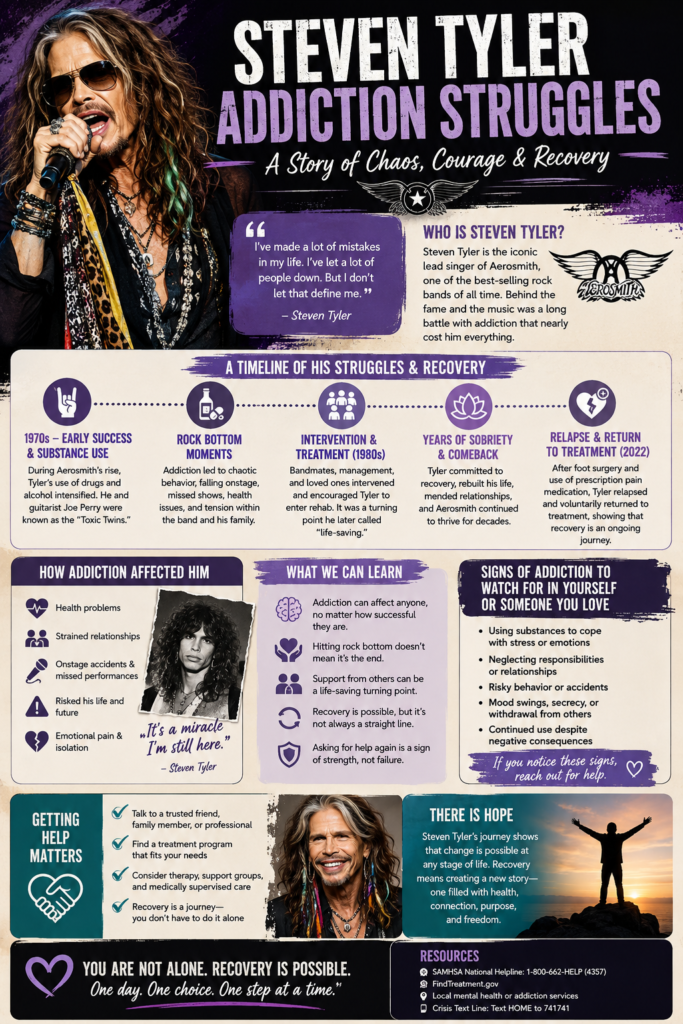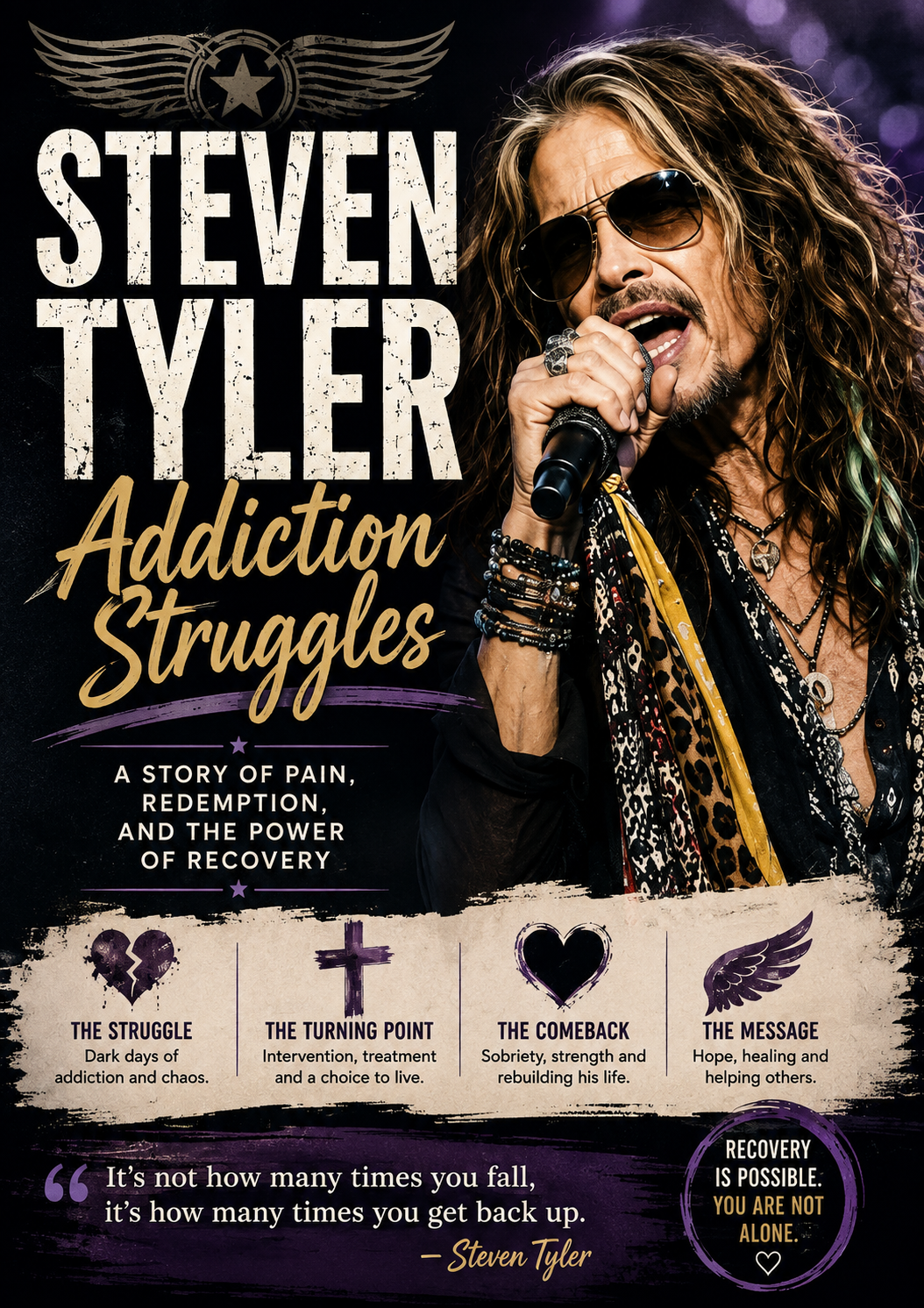
Steven Tyler, the legendary lead singer of Aerosmith, has publicly discussed a long history of struggles with alcohol and drug addiction that developed during the height of his music career. During the 1970s and 1980s, substance use became deeply intertwined with the rock-and-roll lifestyle surrounding the band and eventually affected his health, relationships, performances, and career. Tyler later entered treatment and achieved significant periods of sobriety, while also experiencing challenges with relapse and returning to treatment. His experiences demonstrate that fame, talent, wealth, and professional success do not protect someone from substance use disorder. Tyler’s story provides an opportunity to understand addiction as a complex health condition and highlights the importance of intervention, professional treatment, supportive relationships, relapse prevention, and long-term commitment to recovery.
Steven Tyler’s Addiction Struggles and Recovery
Steven Tyler, the longtime lead singer of Aerosmith, has spoken publicly about decades of struggles with alcohol and drug addiction. His story illustrates how substance use disorder can affect someone regardless of fame, wealth, talent, or professional success—and how recovery can involve treatment, relapse, intervention, and recommitment over many years.
Addiction During Aerosmith’s Rise
During the 1970s and early 1980s, Tyler’s substance use became closely intertwined with the intense lifestyle surrounding Aerosmith’s success. He and guitarist Joe Perry became known as the “Toxic Twins” because of their heavy drug use. Tyler has described using substances including cocaine and alcohol, and accounts of this period describe substance use eventually interfering with performances and the band’s functioning. In a 1997 Fresh Air interview, Tyler recalled becoming so intoxicated before a performance that he fell down onstage and could not get back up.
When Substance Use Begins Taking Everything
Tyler’s experience demonstrates an important characteristic of addiction: continued substance use despite serious consequences. Substance use was no longer simply part of a rock-and-roll lifestyle; it was affecting his health, relationships, career, performances, and Aerosmith’s stability.
Years later, Tyler described addiction in especially stark terms, explaining that his sobriety had effectively cost him “everything” after addiction affected his family, band, and career.
Intervention and Treatment
Eventually, people around Tyler intervened. His bandmates, management, and others pushed him toward treatment during the 1980s. Tyler later acknowledged that he initially resented being forced into rehabilitation, but eventually came to appreciate the intervention and credited those around him with helping save his life.
His experience highlights why family members, friends, coworkers, and healthcare professionals can sometimes play critical roles in recognizing addiction when the individual is not yet prepared to recognize its severity.
Recovery Was Not a Straight Line
Tyler’s history also illustrates that recovery does not necessarily follow a simple path of addiction → treatment → permanent abstinence.
After substantial periods of sobriety, Tyler experienced additional problems involving prescription pain medication following medical treatment. In 2022, Aerosmith announced that Tyler had voluntarily entered a treatment program after relapsing following foot surgery and the need for pain management.
This is particularly relevant to addiction education. A history of substance use disorder can remain clinically important even after many years of recovery. Surgery, significant pain, exposure to potentially addictive medications, stress, and major life changes may require careful planning between patients, addiction specialists, surgeons, and other healthcare professionals.
Relapse Does Not Erase Previous Recovery
Tyler’s experiences also demonstrate an important principle of addiction medicine: relapse should be treated as a signal to reassess treatment rather than as proof that treatment has failed.
Someone may maintain recovery for years and later encounter circumstances that increase vulnerability. Returning to treatment quickly can prevent a recurrence from progressing further. Tyler’s decision to return to rehabilitation after his 2022 relapse provides a public example of seeking additional treatment when recovery became vulnerable.
The Importance of Long-Term Recovery
Tyler has repeatedly discussed addiction and sobriety publicly over the years. His experiences demonstrate several important lessons:
Addiction can become severe despite professional success. Intervention can sometimes become a turning point. Long periods of recovery are possible. Medical exposure to addictive medications deserves special attention in people with previous substance use disorders. Relapse can occur after years of sobriety. Most importantly, returning to treatment remains worthwhile whenever difficulties reappear.
Steven Tyler’s story should therefore not be viewed simply as a celebrity story about drugs. It provides an example of substance use disorder as a potentially chronic and relapsing condition requiring ongoing self-awareness, support, treatment, and recovery management. His history also reminds us that asking for help again is not starting recovery over—it is continuing the work of protecting it.
Self-Management Strategies for Understanding Steven Tyler’s Addiction Struggles
Steven Tyler’s publicly discussed experiences with substance use, treatment, long-term recovery, and relapse can provide useful lessons about managing substance use disorder. His experience also demonstrates that recovery may require continued attention even after many years of improvement.
- Recognize addiction as a health condition. Substance use disorder involves changes in reward, motivation, decision-making, and behavior. Understanding addiction this way can reduce stigma and encourage people to seek appropriate treatment rather than relying solely on willpower.
- Identify personal triggers. Stress, pain, relationship difficulties, social environments, substance availability, and major life changes can increase vulnerability. Recognizing individual triggers makes it possible to develop coping strategies before cravings become overwhelming.
- Create a relapse-prevention plan. Recovery planning can include identifying warning signs, coping strategies, supportive contacts, treatment providers, and specific actions to take when cravings or substance use return.
- Be especially careful with pain management. Tyler’s publicly reported 2022 treatment followed a relapse after foot surgery and pain management. People with histories of substance use disorder should discuss that history with healthcare professionals so pain treatment can be individualized and appropriately monitored.
- Build healthy coping mechanisms. Exercise, mindfulness, music, hobbies, adequate sleep, structured routines, relaxation techniques, and meaningful social activities can provide healthier ways of responding to stress and uncomfortable emotions.
- Maintain a strong support network. Trusted family members, friends, recovery peers, counselors, and healthcare professionals can provide accountability and recognize warning signs that may be difficult for the individual to notice.
- Continue recovery practices during successful periods. Feeling better does not necessarily mean vulnerability has disappeared. Maintaining supportive routines and treatment recommendations during stable periods can help protect long-term recovery.
- Respond quickly to warning signs. Increasing cravings, isolation, romanticizing previous substance use, reconnecting with high-risk environments, stopping recovery activities, or hiding behaviors may indicate increasing vulnerability. Early intervention can prevent further escalation.
- Avoid an all-or-nothing response to relapse. A return to substance use does not erase previous progress. It should prompt reassessment of triggers, treatment needs, medication when appropriate, and the recovery plan.
- Accept professional treatment when needed. Detoxification, residential treatment, outpatient programs, psychotherapy, peer recovery services, and medications for certain substance use disorders can all play roles depending on an individual’s clinical needs.
- Address physical and mental health together. Chronic pain, anxiety, depression, sleep problems, and other conditions can complicate recovery. Comprehensive treatment should address these concerns rather than focusing exclusively on substance use.
- Develop an identity beyond addiction. Recovery involves more than avoiding substances. Meaningful work, creativity, relationships, personal goals, community involvement, and other sources of purpose can strengthen a person’s life in recovery.
Key lesson: Steven Tyler’s publicly documented experiences demonstrate that recovery can be long-term without necessarily being perfectly linear. Effective self-management means recognizing vulnerabilities, maintaining support, preparing for high-risk situations, and seeking treatment promptly when difficulties return. A relapse can become an opportunity to strengthen a recovery plan rather than a reason to abandon it.
Family Support Strategies for Understanding Steven Tyler’s Addiction Struggles
Steven Tyler’s publicly discussed experiences with addiction, treatment, periods of sobriety, and relapse demonstrate how important supportive relationships can be throughout recovery. His story can help families understand that substance use disorder often requires long-term support rather than a single episode of treatment.
- Learn about substance use disorder. Families can educate themselves about addiction as a treatable health condition involving biological, psychological, behavioral, and environmental factors. Education can reduce blame and help relatives respond more effectively.
- Communicate without shame. Express concern using respectful, specific language rather than accusations. Conversations focused on observable behaviors and consequences are generally more productive than labeling someone as irresponsible or weak.
- Recognize the importance of intervention. Tyler has publicly described how people around him pushed him toward treatment during the 1980s. Families should not assume they must wait until someone “hits rock bottom.” Encouraging professional assessment earlier may prevent additional harm.
- Support treatment rather than trying to provide it. Family members can encourage counseling, addiction medicine, rehabilitation, peer support, or other appropriate services, but they cannot personally treat another person’s substance use disorder.
- Understand that recovery may not be linear. Tyler’s publicly reported return to treatment in 2022 after a relapse illustrates that vulnerability can remain even after long periods of recovery. Families can respond to recurrence by encouraging prompt treatment instead of treating it as proof that recovery has failed.
- Learn the warning signs of recurrence. Increased isolation, secrecy, changes in sleep or mood, abandoning recovery activities, renewed contact with high-risk environments, or changes in medication use may warrant a supportive conversation and professional evaluation.
- Pay attention during medical treatment and pain management. Surgery, injury, and significant pain can create challenges for people with previous substance use disorders. With the individual’s consent, families can encourage communication between healthcare professionals and addiction specialists so treatment considers the person’s recovery history.
- Set healthy boundaries. Supporting recovery does not require tolerating harmful behavior. Families can establish clear limits involving money, housing, substance use in the home, transportation, threats, or other behaviors while continuing to communicate care and concern.
- Avoid enabling. Repeatedly covering up consequences, providing money that may support substance use, making excuses, or taking over responsibilities can unintentionally allow harmful patterns to continue. Support should encourage recovery and responsibility.
- Recognize progress. Recovery involves more than counting days without substances. Attending treatment, rebuilding relationships, developing coping skills, accepting responsibility, and asking for help when struggling are meaningful signs of progress.
- Take care of the entire family. Addiction can produce chronic stress, fear, anger, and exhaustion among relatives. Family members may benefit from counseling, family therapy, educational programs, or peer-support groups.
- Maintain hope while remaining realistic. Families can believe in someone’s capacity for recovery without assuming they can control the outcome. Ultimately, the individual remains responsible for participating in treatment and making recovery-related decisions.
Key lesson: Steven Tyler’s story demonstrates that family members, friends, colleagues, and treatment professionals can become important parts of a recovery network, but support works best when compassion is combined with appropriate boundaries. Families cannot recover for someone else, but they can encourage treatment, recognize warning signs, avoid enabling, support renewed treatment after relapse, and create an environment where asking for help is viewed as a responsible step forward.
Community Resource Strategies for Understanding Steven Tyler’s Addiction Struggles
Steven Tyler’s publicly discussed experiences with substance use, rehabilitation, long-term recovery, and recurrence can be used to highlight the importance of community resources in treating substance use disorder. His story reinforces that recovery may require professional treatment and continued support over time.
- Increase access to addiction treatment services. Communities should make evidence-based outpatient, intensive outpatient, residential, and medically supervised withdrawal services accessible so individuals can receive the appropriate level of care.
- Promote addiction medicine services. Primary care practices, behavioral health clinics, hospitals, and addiction specialists can screen for substance use disorders and connect individuals with appropriate treatment before consequences become more severe.
- Expand peer-recovery programs. Recovery community organizations and mutual-support groups can provide connection, accountability, mentorship, and opportunities to learn from others with lived experience.
- Provide family education programs. Community organizations can teach families about substance use disorder, recurrence, communication, boundaries, enabling behaviors, overdose prevention, and ways to support treatment without assuming responsibility for another person’s recovery.
- Integrate mental health and addiction treatment. Depression, anxiety, trauma, chronic stress, and other mental health concerns may coexist with substance use disorders. Integrated behavioral healthcare can address these concerns simultaneously rather than treating them as unrelated problems.
- Improve pain-management resources. Tyler’s publicly reported 2022 return to treatment followed a relapse associated with pain management after foot surgery. Healthcare systems can develop individualized pain-management plans for patients with histories of substance use disorder, including appropriate monitoring and non-opioid or nonpharmacologic approaches when clinically suitable.
- Educate healthcare professionals about addiction. Training in screening, stigma reduction, evidence-based treatment, safer prescribing, and recurrence prevention can help clinicians recognize addiction earlier and provide appropriate referrals.
- Increase access to medications for substance use disorders. Communities should ensure that evidence-based medications are available when appropriate, particularly medications for opioid and alcohol use disorders, alongside counseling and psychosocial support based on individual needs.
- Support harm-reduction and overdose-prevention programs. Naloxone availability, overdose education, drug-checking programs where legally available, syringe-service programs, and connections to treatment can reduce preventable deaths and create additional opportunities for engagement with healthcare.
- Use recovery community centers. These organizations may provide recovery coaching, employment assistance, educational programs, sober recreational activities, support meetings, and connections with treatment services.
- Challenge addiction stigma through public education. Celebrity experiences can generate attention, but educational programs should emphasize that addiction affects people across socioeconomic and professional backgrounds. Seeking treatment should be presented as healthcare rather than a moral failure.
- Create strong transitions after treatment. Discharge from rehabilitation should not represent the end of care. Communities can connect individuals with outpatient clinicians, primary care providers, recovery coaches, mutual-support groups, housing assistance, employment resources, and other ongoing services.
Key Community Lesson: Steven Tyler’s experience illustrates why addiction recovery should be supported by a continuum of care rather than a single treatment episode. Strong communities connect prevention, healthcare, addiction treatment, mental health services, harm reduction, peer recovery, family education, and long-term follow-up. The broader lesson from his story is that returning to treatment when substance use reappears should be viewed as an appropriate healthcare response—and community systems should make that return to care as accessible as possible.
Frequently Asked Questions
Here are some common questions:
1. What substances did Steven Tyler struggle with?
Tyler has publicly described extensive use of drugs and alcohol during his career, particularly during the 1970s and 1980s. His substance use included cocaine and other drugs, and he later experienced problems involving prescription pain medication.
2. When did Steven Tyler’s addiction problems begin?
His most severe period of substance use became widely associated with Aerosmith’s rise during the 1970s and early 1980s, when heavy drug and alcohol use was common within the band’s environment.
3. Why were Steven Tyler and Joe Perry called the “Toxic Twins”?
Tyler and Aerosmith guitarist Joe Perry became known by this nickname because of their reputation for heavy drug use during the band’s early years.
4. How did addiction affect Steven Tyler’s career?
Tyler has described substance use interfering with his ability to perform and function. Addiction also contributed to instability surrounding his personal life and Aerosmith during difficult periods of the band’s history.
5. Did other people encourage Steven Tyler to enter treatment?
Yes. Tyler has publicly discussed how his bandmates and management intervened during the 1980s and encouraged him to enter rehabilitation. He has said that although he initially resented the intervention, he later recognized its importance.
6. Did Steven Tyler achieve long-term sobriety?
Tyler experienced substantial periods of sobriety following treatment. His experience demonstrates that people with serious histories of substance use can achieve meaningful and sustained recovery.
7. Did Steven Tyler ever relapse?
Yes. In May 2022, Aerosmith publicly announced that Tyler had voluntarily entered a treatment program after relapsing following foot surgery and pain management. The band’s statement said the relapse occurred after the necessity of pain management during the process.
8. What can his relapse teach us about addiction?
It demonstrates that substance use disorder can have a long-term, recurring course for some people. A relapse after years of recovery does not mean that previous years of sobriety were meaningless. Instead, it can indicate that treatment and relapse-prevention strategies need to be reassessed.
9. Why can surgery and pain management be challenging during addiction recovery?
People with histories of substance use disorder may face additional considerations when potentially addictive medications are medically necessary. Patients should discuss their substance-use history with their healthcare team so clinicians can develop individualized pain-management and monitoring plans.
10. Does relapse mean addiction treatment failed?
Not necessarily. Recurrence of substance use can occur during recovery. The appropriate response is generally to assess what happened, address immediate risks, identify new or recurring triggers, and determine whether treatment needs to be restarted or intensified.
11. What role did support play in Tyler’s recovery?
Tyler’s public accounts demonstrate the potential importance of bandmates, family, treatment professionals, and other supportive people. A strong recovery network can encourage treatment, provide accountability, and recognize warning signs.
12. What self-management lessons can be learned from his experience?
Important strategies include recognizing triggers, maintaining recovery routines, developing healthy coping mechanisms, addressing stress and pain appropriately, staying connected with supportive people, and seeking professional assistance quickly when warning signs appear.
13. What can families learn from Steven Tyler’s story?
Families can learn to combine compassion with appropriate boundaries. They can educate themselves about addiction, recognize warning signs, encourage professional treatment, avoid enabling harmful behavior, and continue supporting recovery when setbacks occur.
14. Can someone recover after decades of substance use?
Yes. Long histories of substance use do not eliminate the possibility of recovery. Evidence-based treatment, behavioral changes, supportive relationships, appropriate medications for certain substance use disorders, and continuing recovery support can substantially improve outcomes.
15. What is the most important lesson from Steven Tyler’s addiction struggles?
Perhaps the most useful lesson is that recovery does not have to be perfect to remain meaningful. Tyler’s publicly discussed experiences illustrate that severe addiction can have major consequences, long-term recovery is possible, and returning to treatment after a relapse can be an important act of protecting recovery rather than evidence of failure.
Conclusion
Steven Tyler’s addiction struggles demonstrate that successful recovery does not always follow a perfectly straight path. Even after significant periods of sobriety, circumstances such as physical pain, medical treatment, emotional stress, or exposure to previously misused substances may increase vulnerability. Effective self-management therefore includes identifying triggers, maintaining healthy routines, strengthening a recovery support system, communicating openly with healthcare professionals, developing a relapse-prevention plan, and responding quickly when warning signs appear. Most importantly, a recurrence of substance use does not erase years of recovery progress. Tyler’s experiences reinforce an important message for anyone managing substance use disorder: long-term recovery is strengthened by continued self-awareness, appropriate treatment, supportive relationships, and a willingness to seek help again whenever it is needed.
Video: The Steven Tyler You Don’t Know: A Story of Addiction and Recovery #steventyler #biography