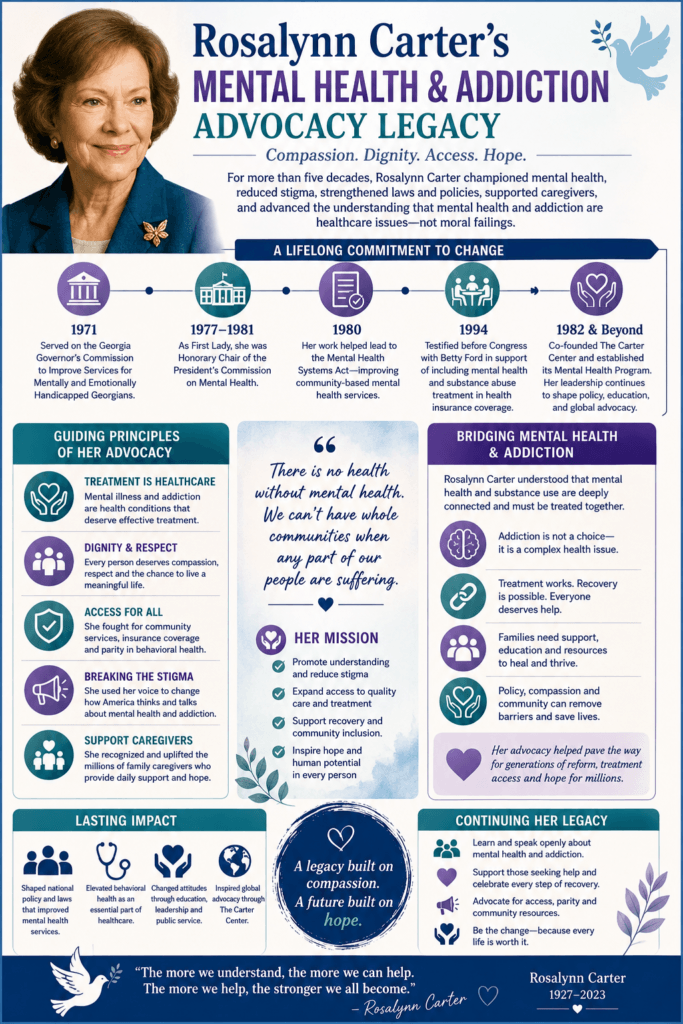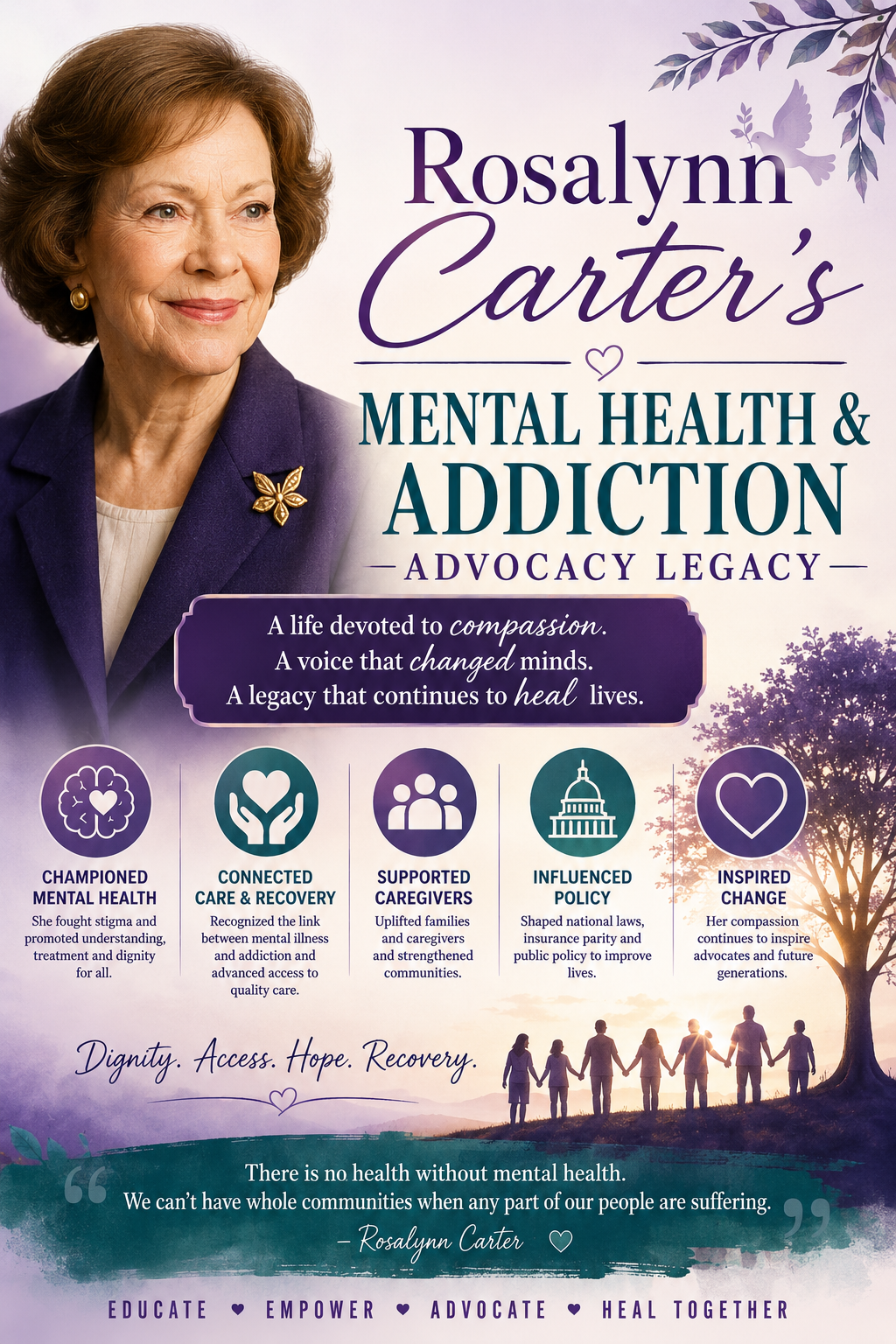
Rosalynn Carter left an extraordinary legacy as one of America’s most persistent advocates for mental health, behavioral healthcare, and the dignity of people living with mental illness. Beginning her advocacy in Georgia in the early 1970s and continuing for more than five decades, she worked to reduce stigma, improve access to community-based treatment, strengthen mental health policy, support caregivers, and promote greater insurance coverage for behavioral health services. Although she was primarily known as a mental-health advocate rather than an addiction-specific advocate, her work increasingly recognized the connection between mental illness and substance use disorders and supported the principle that both deserve appropriate healthcare rather than judgment or discrimination. Through her leadership in the White House and later through The Carter Center, she helped move conversations about mental health and addiction from secrecy and stigma toward treatment, compassion, inclusion, and recovery.
Rosalynn Carter’s Mental Health and Addiction Advocacy Legacy
Rosalynn Carter became one of the most influential American advocates for mental health reform. For more than five decades, she worked to reduce stigma, improve access to treatment, strengthen mental health policy, and ensure that people living with mental illness could participate fully in their communities. Her advocacy eventually encompassed the closely connected issues of mental health, substance use disorders, caregiving, and access to treatment.
How Her Advocacy Began
Carter’s commitment to mental health began in Georgia in the early 1970s. In 1971, she served on the Governor’s Commission to Improve Services for Mentally and Emotionally Handicapped Georgians. Mental illness was still heavily stigmatized at the time, and institutionalization was common. Carter increasingly emphasized that people with mental illnesses deserved appropriate healthcare, dignity, community services, and opportunities to live meaningful lives.
Mental Health Reform in the White House
As First Lady from 1977 to 1981, Carter served as an active honorary chair of the President’s Commission on Mental Health. The commission examined deficiencies in America’s mental health system and helped shape recommendations for reform.
Her advocacy contributed to the Mental Health Systems Act of 1980, legislation intended to strengthen community-based mental health services and improve the nation’s approach to mental health care.
Her involvement was significant because she treated mental health as a legitimate healthcare and public-policy issue, rather than something families should hide.
Fighting Stigma
One of Carter’s lifelong priorities was changing how society talked about mental illness.
She consistently promoted the idea that mental illnesses can be recognized, treated, and managed, and that people experiencing them can lead meaningful lives. She understood that stigma could prevent individuals from acknowledging symptoms, seeking treatment, maintaining employment, and participating in their communities.
This philosophy also has important implications for addiction. Stigma surrounding substance use disorders can similarly discourage people from seeking healthcare or remaining engaged in treatment.
Connecting Mental Health and Addiction
Although Carter is best remembered primarily as a mental-health advocate rather than an addiction-specific advocate, her work increasingly recognized the overlap between mental health and substance use.
A particularly important moment occurred in 1994, when Rosalynn Carter and former First Lady Betty Ford testified before Congress in support of including mental health and substance abuse treatment benefits in national healthcare reform.
That position reinforced a principle that remains central to modern addiction medicine: substance use disorders should be addressed as health conditions requiring treatment, rather than solely as moral or criminal problems.
Mental Health Parity
Carter also became a major supporter of mental-health parity—the principle that insurance coverage for mental-health and substance-use treatment should be comparable to coverage for physical illnesses.
This helped advance a broader cultural shift toward recognizing behavioral healthcare as an essential component of healthcare rather than an optional service. The Carter Center continues to advocate for improved access and policy protections involving both mental-health and substance-use conditions.
The Carter Center
After leaving the White House, Rosalynn and Jimmy Carter co-founded The Carter Center in 1982. Rosalynn Carter later established its Mental Health Program and created and chaired its Mental Health Task Force.
For decades, she convened experts, policymakers, consumers, advocates, journalists, and healthcare leaders to address treatment access, stigma, and public policy. The first Rosalynn Carter Symposium on Mental Health Policy was held in 1985, and her annual symposia continued for decades.
Changing How the Media Talks About Mental Health and Addiction
Carter recognized that newspapers, television, and other media could either reinforce stigma or challenge it.
The Carter Center developed initiatives to improve mental-health journalism, including the Rosalynn Carter Fellowships for Mental Health Journalism. Today, this work includes promoting responsible reporting about both mental health and substance use disorders.
This remains especially relevant during the opioid and overdose crisis, when stigmatizing terminology can influence how communities perceive people with substance use disorders.
Supporting Families and Caregivers
Another major part of Carter’s legacy was recognizing that mental illness and other chronic health conditions affect entire families, not only the person receiving treatment.
She championed caregivers and helped establish the Rosalynn Carter Institute for Caregivers. In 2025, the Institute merged with the Carter Center’s Mental Health Program, bringing together two of her major causes. The resulting Rosalynn Carter Mental Health and Caregiver Program continues work involving mental health, substance-use conditions, caregiving, policy, stigma reduction, and access to services.
Her Lasting Impact on Addiction Advocacy
Rosalynn Carter helped establish several principles that are now fundamental to mental health and addiction care:
Mental illness and substance use disorders are healthcare concerns.
Treatment should be accessible and covered appropriately by insurance.
Stigma can prevent people from seeking treatment.
People deserve dignity rather than judgment.
Families and caregivers need education and support too.
Mental health and substance-use services should be integrated into the broader healthcare system.
Her work therefore helped create an environment in which today’s conversations about addiction medicine, behavioral health, treatment access, recovery, and stigma reduction could move forward.
Rosalynn Carter’s Legacy
Rosalynn Carter died on November 19, 2023, at age 96, after more than five decades of mental-health advocacy. Her work did not end with her death. The Carter Center continues programs addressing mental health, substance-use conditions, caregiving, policy reform, professional education, and stigma around the world.
Her legacy can be summarized by a fundamental change in perspective: people experiencing mental illness or addiction should not be defined by their condition. They deserve evidence-based treatment, dignity, community support, and the opportunity to recover and live meaningful lives.
Self-Management Strategies to Understand Rosalynn Carter’s Mental Health and Addiction Advocacy Legacy
Rosalynn Carter’s advocacy provides several principles that individuals can apply to their own approach to mental health, substance use, recovery, and personal well-being. Her work emphasized education, early intervention, access to treatment, dignity, stigma reduction, and support for caregivers. Self-management does not replace professional care, but it can help people recognize concerns earlier and become more active participants in their health.
- Educate yourself about mental health and addiction. Learn to recognize common symptoms of mental-health conditions and substance use disorders. Carter’s advocacy emphasized that understanding these conditions helps replace fear and misinformation with informed responses.
- Treat behavioral health as healthcare. Approach depression, anxiety, addiction, and other behavioral-health concerns with the same seriousness as physical illnesses. Seeking treatment should be viewed as healthcare rather than personal failure.
- Recognize problems early. Pay attention to changes in sleep, mood, concentration, relationships, substance use, work performance, and daily functioning. Early recognition can create opportunities for intervention before problems become more severe.
- Challenge personal stigma. Notice thoughts such as “I should handle this myself” or “People will judge me if I get treatment.” Carter spent decades challenging the stigma that prevents people from acknowledging mental illness and seeking care.
- Ask for professional help when needed. Primary-care professionals, mental-health clinicians, addiction specialists, counselors, and other healthcare professionals can provide assessment and appropriate treatment.
- Become an active participant in treatment. Learn about diagnoses, medications, counseling approaches, addiction treatments, expected benefits, possible side effects, and alternatives. Ask questions and participate in shared healthcare decisions.
- Recognize the connection between mental health and substance use. Alcohol or drugs may sometimes be used to cope with depression, anxiety, trauma, loneliness, or stress. Addressing both concerns can be more effective than focusing on one while ignoring the other.
- Build a personal support network. Identify trusted family members, friends, healthcare professionals, recovery peers, or community organizations that can provide encouragement and accountability.
- Develop healthy coping strategies. Exercise, adequate sleep, balanced nutrition, relaxation techniques, hobbies, social connection, and structured routines can support emotional well-being alongside professional treatment.
- Monitor your progress. Keep track of symptoms, substance-use patterns, triggers, treatment goals, medications, and improvements in daily functioning. Self-monitoring can help identify what is working and when additional support is needed.
- Protect treatment continuity. Attend appointments, take prescribed medications as directed, communicate concerns with clinicians, and avoid stopping psychiatric or addiction medications without discussing the decision with the prescribing professional.
- Learn about your healthcare rights. Carter strongly advocated for better access and insurance coverage for behavioral healthcare. Understanding available mental-health and substance-use benefits can help individuals advocate for appropriate treatment.
- Use respectful language. Avoid defining yourself or others solely by a diagnosis or substance-use history. Person-centered language reinforces the dignity that was central to Carter’s advocacy.
- Support your caregivers. Family members and caregivers can experience significant emotional and physical strain. Encourage them to maintain their own health, relationships, boundaries, and support systems.
- Turn personal experience into advocacy when appropriate. Individuals who feel comfortable doing so can educate others, challenge misinformation, support recovery organizations, or advocate for improved behavioral-health services.
Applying Rosalynn Carter’s Legacy Personally
Her advocacy can be translated into a practical self-management pathway:
Learn → Recognize → Speak Up → Seek Treatment → Stay Engaged → Build Support → Challenge Stigma → Advocate
Rosalynn Carter’s legacy reminds us that improving mental health and addiction outcomes is not simply about treating symptoms. It also means creating an environment where people feel safe acknowledging a problem, comfortable seeking treatment, respected while receiving care, and supported throughout recovery.
Her work ultimately reinforces a powerful self-management principle: asking for appropriate help is not the opposite of independence—it can be an important part of taking responsibility for your health.
Family Support Strategies to Understand Rosalynn Carter’s Mental Health and Addiction Advocacy Legacy
Rosalynn Carter’s decades of advocacy emphasized that mental illness and substance use disorders affect not only individuals but also their families and caregivers. Her legacy encourages families to replace stigma and isolation with education, compassion, appropriate treatment, advocacy, and caregiver support.
- Educate the entire family. Learn about mental health conditions, substance use disorders, available treatments, medications, recovery, and relapse. Accurate information can replace fear and misconceptions with understanding.
- Treat mental health and addiction as healthcare issues. Avoid viewing symptoms as laziness, weakness, poor character, or lack of willpower. Encourage the same seriousness toward behavioral healthcare that the family would give a physical illness.
- Use respectful, person-centered language. Avoid labels that define someone entirely by a diagnosis or addiction. Language can either reinforce stigma or communicate dignity and hope.
- Recognize warning signs early. Families should pay attention to significant changes in mood, sleep, behavior, substance use, relationships, work or school performance, and ability to manage everyday responsibilities.
- Encourage professional treatment. Help loved ones connect with primary care, mental-health professionals, addiction specialists, counseling, and other appropriate services. Offer practical assistance such as transportation or help organizing appointments when welcomed.
- Listen without immediately judging. Create opportunities for loved ones to discuss symptoms, cravings, treatment concerns, setbacks, or fears without expecting every conversation to produce an immediate solution.
- Understand co-occurring conditions. Mental-health conditions and substance use disorders can occur together. Families should support comprehensive assessment rather than assuming that every behavioral change is caused exclusively by either addiction or mental illness.
- Support treatment adherence without becoming controlling. Encourage appointments, medications, counseling, and recovery plans while respecting the individual’s appropriate role in healthcare decisions.
- Develop a family crisis plan. Families can discuss whom to contact and what steps to take if a loved one experiences a severe mental-health crisis, overdose, intoxication, or another behavioral-health emergency.
- Set compassionate boundaries. Supporting a loved one does not mean accepting violence, financial exploitation, repeated dishonesty, or other harmful behaviors. Healthy boundaries protect both the individual and the family.
- Avoid enabling addiction. Families can provide emotional and practical support without supplying money for substances, hiding serious consequences, or repeatedly rescuing someone in ways that allow harmful behavior to continue.
- Support recovery rather than demanding perfection. Recovery from mental illness and addiction may involve setbacks. Focus on treatment engagement, improved functioning, healthier decisions, and long-term progress.
- Recognize caregiver stress. One of Carter’s major contributions was drawing attention to caregivers. Family members may experience exhaustion, anxiety, financial strain, isolation, and burnout while supporting someone with a chronic condition.
- Encourage caregivers to seek their own support. Counseling, family therapy, support groups, respite care, and trusted social networks can help caregivers protect their own physical and emotional health.
- Advocate for appropriate care. Families can help navigate insurance, treatment programs, healthcare systems, schools, workplaces, and community resources when a loved one has difficulty accessing behavioral-health services.
- Challenge stigma within the community. Families can correct misinformation and demonstrate through their language and behavior that mental illness and substance use disorders deserve evidence-based care rather than shame.
Applying Rosalynn Carter’s Legacy to Families
Her philosophy can be translated into a practical family pathway:
Learn → Listen → Recognize → Support → Seek Treatment → Set Boundaries → Protect Caregivers → Advocate → Maintain Hope
Rosalynn Carter’s legacy reminds families that caregiving should not mean carrying everything alone. Effective family support combines compassion with education, professional treatment, healthy boundaries, and attention to the caregiver’s own well-being.
Perhaps the most enduring lesson from her advocacy is that individuals experiencing mental illness or addiction—and the families supporting them—deserve dignity, accessible healthcare, accurate information, community inclusion, and hope for recovery.
Community Resource Strategies to Understand Rosalynn Carter’s Mental Health and Addiction Advocacy Legacy
Rosalynn Carter’s advocacy demonstrates how communities can transform mental health and addiction care through education, stigma reduction, accessible treatment, caregiver support, responsible communication, and public-policy advocacy. Her work emphasized that behavioral health belongs within healthcare and that individuals and families should not have to navigate mental illness or substance use disorders alone.
- Expand community mental-health education. Schools, libraries, healthcare systems, workplaces, and community organizations can provide accurate education about mental illness, substance use disorders, treatment, recovery, and prevention.
- Promote stigma-reduction campaigns. Community messaging should challenge stereotypes and emphasize that people experiencing mental-health or substance-use conditions deserve dignity, evidence-based healthcare, and opportunities for recovery.
- Improve access to behavioral healthcare. Community health centers, hospitals, mental-health clinics, and addiction-treatment programs can strengthen pathways to screening, counseling, psychiatric care, medications, and recovery services.
- Integrate mental health and addiction services. Because mental-health conditions and substance use disorders frequently occur together, communities can promote coordinated assessment and treatment rather than separating the two systems unnecessarily.
- Strengthen crisis-response resources. Communities need accessible behavioral health crisis services that connect people to appropriate evaluation and ongoing treatment, rather than relying exclusively on emergency departments or law enforcement.
- Expand evidence-based addiction treatment. Treatment systems should provide behavioral interventions and appropriate medications for substance use disorders, including medications for opioid and alcohol use disorders when clinically indicated.
- Support caregivers. Carter was a major advocate for recognizing caregiver needs. Communities can provide caregiver education, counseling, peer groups, respite services, and practical assistance to families supporting people with behavioral health conditions.
- Develop peer-support programs. Individuals with lived experience of mental illness, addiction, or recovery can provide encouragement, navigation assistance, and connections to treatment and community resources.
- Train healthcare professionals. Continuing education can help physicians, physician assistants, nurses, counselors, social workers, pharmacists, and other professionals recognize behavioral health conditions and communicate with patients without stigmatizing them.
- Promote responsible media coverage. Carter recognized that journalism can influence public attitudes. Community organizations can encourage media professionals to use accurate, person-centered language when reporting on suicide, mental illness, addiction, overdose, and recovery.
- Increase school and college resources. Educational institutions can provide mental health screening, counseling, substance use prevention, peer programs, and clear pathways to professional treatment.
- Engage faith and cultural organizations. Trusted community organizations can provide education, social support, and referrals while reinforcing that seeking behavioral healthcare should not be associated with shame.
- Promote mental health and addiction parity. Community advocates can educate people about the principle that behavioral health treatment should receive appropriate coverage alongside physical healthcare and help individuals understand the available benefits.
- Build partnerships between organizations. Hospitals, behavioral health providers, addiction programs, schools, housing organizations, public health departments, law enforcement, peer recovery groups, and community organizations can create coordinated referral networks.
- Address social barriers to recovery. Transportation, housing instability, unemployment, food insecurity, childcare, and lack of insurance can interfere with treatment. Effective community strategies address these practical barriers alongside clinical needs.
- Continue Carter’s advocacy through education. Community programs can use Rosalynn Carter’s work as a historical example of how sustained advocacy can change public attitudes, healthcare systems, legislation, and access to treatment.
Turning Her Legacy Into Community Action
Rosalynn Carter’s approach can be summarized as:
Educate → Reduce Stigma → Improve Access → Integrate Care → Support Families → Strengthen Caregivers → Advocate → Build Community
Her legacy demonstrates that improving behavioral health requires more than asking individuals to seek help. Communities must make appropriate help available, affordable, understandable, and socially acceptable to seek.
Organizations such as The Carter Center continue their work in mental health, caregiving, stigma reduction, journalism, and behavioral health policy, inspired by her decades of advocacy. Her enduring message remains highly relevant to addiction care: people experiencing mental illness or substance use disorders should be treated with dignity, supported by their communities, and given meaningful access to evidence-based care and recovery.
Frequently Asked Questions
Here are some common questions:
1. Who was Rosalynn Carter?
Rosalynn Carter (1927–2023) was First Lady of the United States from 1977 to 1981 and one of the country’s most prominent long-term advocates for mental health. She spent more than five decades working to reduce stigma, improve access to treatment, influence public policy, and support families and caregivers.
2. Why did Rosalynn Carter become involved in mental-health advocacy?
Her involvement began while Jimmy Carter was governor of Georgia. In 1971, she served on the Governor’s Commission to Improve Services for Mentally and Emotionally Handicapped Georgians. Her experiences with individuals, families, and an inadequate mental-health system strengthened her commitment to reform.
3. What did she accomplish as First Lady?
As First Lady, Carter served as active honorary chair of the President’s Commission on Mental Health. The commission examined gaps in the nation’s mental health system and developed recommendations to improve services, prevention, research, and community care.
4. What was the Mental Health Systems Act of 1980?
The Mental Health Systems Act was federal legislation designed to strengthen community-based mental health services. Carter’s advocacy and work with the President’s Commission contributed to the national conversation and policy efforts that led to the legislation.
5. Was Rosalynn Carter primarily an addiction advocate?
Her primary focus was mental health, so describing her mainly as an addiction advocate would overstate that part of her work. However, her later advocacy explicitly included substance-use treatment, behavioral-health coverage, and the relationship between mental health and substance use disorders.
6. How did her work relate to addiction?
Carter promoted a healthcare-based approach to behavioral-health conditions. This philosophy supports the modern understanding that substance use disorders deserve prevention, evidence-based treatment, insurance coverage, dignity, and recovery support rather than stigma.
7. Did she advocate for substance-use treatment specifically?
Yes. In 1994, Rosalynn Carter and former First Lady Betty Ford testified before Congress in support of healthcare reform that included coverage for mental health and substance abuse treatment.
8. Why was reducing stigma so important to her?
Carter recognized that stigma can cause people to hide symptoms, delay treatment, experience discrimination, and become socially isolated. She worked to change public attitudes so people could discuss mental illness and seek treatment without shame.
9. What did Rosalynn Carter believe about treatment?
A central theme of her advocacy was that people experiencing mental illness deserve appropriate healthcare, respect, and opportunities to participate meaningfully in their communities. This principle also supports compassionate approaches to substance use disorders.
10. What is mental-health parity?
Mental-health parity generally means that insurance coverage for mental-health and substance-use disorder services should not be subject to more restrictive treatment limitations than comparable medical and surgical benefits. Carter became a prominent advocate for improved behavioral-health coverage.
11. What role did The Carter Center play in her advocacy?
Rosalynn and Jimmy Carter co-founded The Carter Center in 1982. Rosalynn Carter subsequently developed major mental-health initiatives through the organization, bringing together experts, policymakers, advocates, journalists, and people with lived experience.
12. What were the Rosalynn Carter Symposia on Mental Health Policy?
Beginning in 1985, these gatherings brought together leaders to examine important behavioral health issues and develop strategies to improve policies and services. They helped maintain national attention on mental-health reform.
13. Why did Carter focus on journalism and the media?
She understood that media coverage influences how society perceives mental illness and behavioral-health conditions. Responsible reporting can educate the public and reduce stigma, while inaccurate or sensationalized reporting can reinforce harmful stereotypes.
14. What are the Rosalynn Carter Fellowships for Mental Health Journalism?
The fellowships were established to help journalists improve their reporting on mental health issues. The program has contributed to more informed public discussion of mental health and related behavioral-health concerns.
15. Why were caregivers important to Rosalynn Carter?
Carter recognized that mental illness and other chronic health conditions affect entire families. She became a major advocate for caregivers, emphasizing that they also need education, resources, recognition, and support.
16. How does caregiver support relate to addiction?
Families affected by substance use disorders can experience chronic stress, financial difficulties, fear, grief, and burnout. Carter’s broader caregiver philosophy reinforces the importance of supporting the family while the individual receives appropriate treatment.
17. What can families learn from her legacy?
Families can educate themselves, communicate without stigma, encourage professional treatment, maintain healthy boundaries, support recovery, recognize caregiver stress, and advocate for appropriate behavioral-health services.
18. What can healthcare professionals learn from her work?
Healthcare professionals can treat behavioral health as an essential part of healthcare, use person-centered language, recognize co-occurring mental-health and substance-use conditions, involve families appropriately, and advocate for accessible evidence-based treatment.
19. How can communities continue her legacy?
Communities can improve behavioral health education, reduce stigma, expand access to treatment, support caregivers, integrate mental health and addiction services, promote responsible media coverage, and advocate for equitable healthcare policies.
20. What is Rosalynn Carter’s lasting legacy?
Her greatest contribution was helping move mental illness from the margins of public discussion toward healthcare, policy, human dignity, and community responsibility. Her advocacy also helped strengthen the broader framework through which substance use disorders can be understood as treatable behavioral-health conditions.
Conclusion
Rosalynn Carter’s mental-health and addiction advocacy demonstrates how sustained education, policy reform, stigma reduction, caregiver support, and public engagement can influence generations. Her work reinforced the idea that mental illness and substance use disorders should be treated as healthcare concerns and that individuals and families deserve accessible, evidence-based services and respect throughout treatment and recovery. She also recognized that caregivers need support and that communities, healthcare professionals, policymakers, and the media all influence whether people feel safe seeking help. Although Rosalynn Carter died in 2023, the principles she championed continue to shape behavioral-health advocacy today. Her enduring legacy reminds us that meaningful change occurs when society replaces stigma with understanding, isolation with community, and barriers to care with opportunities for treatment, dignity, and hope.
Video: A Life of Dedication to Mental Health 🙏 #RosalynnCarter #MentalHealthAdvocacy