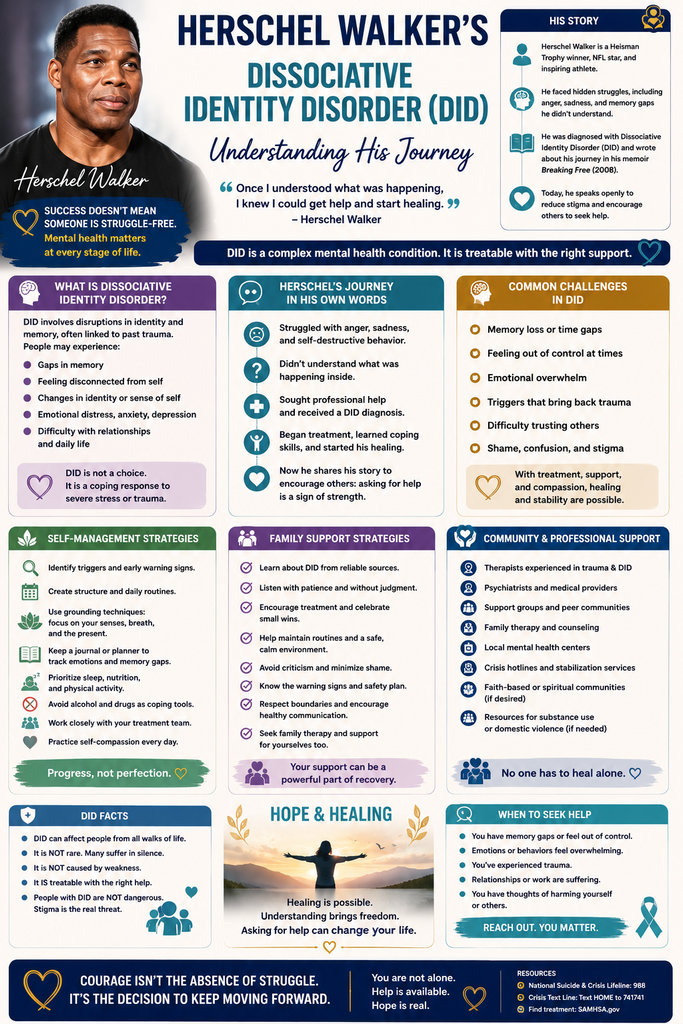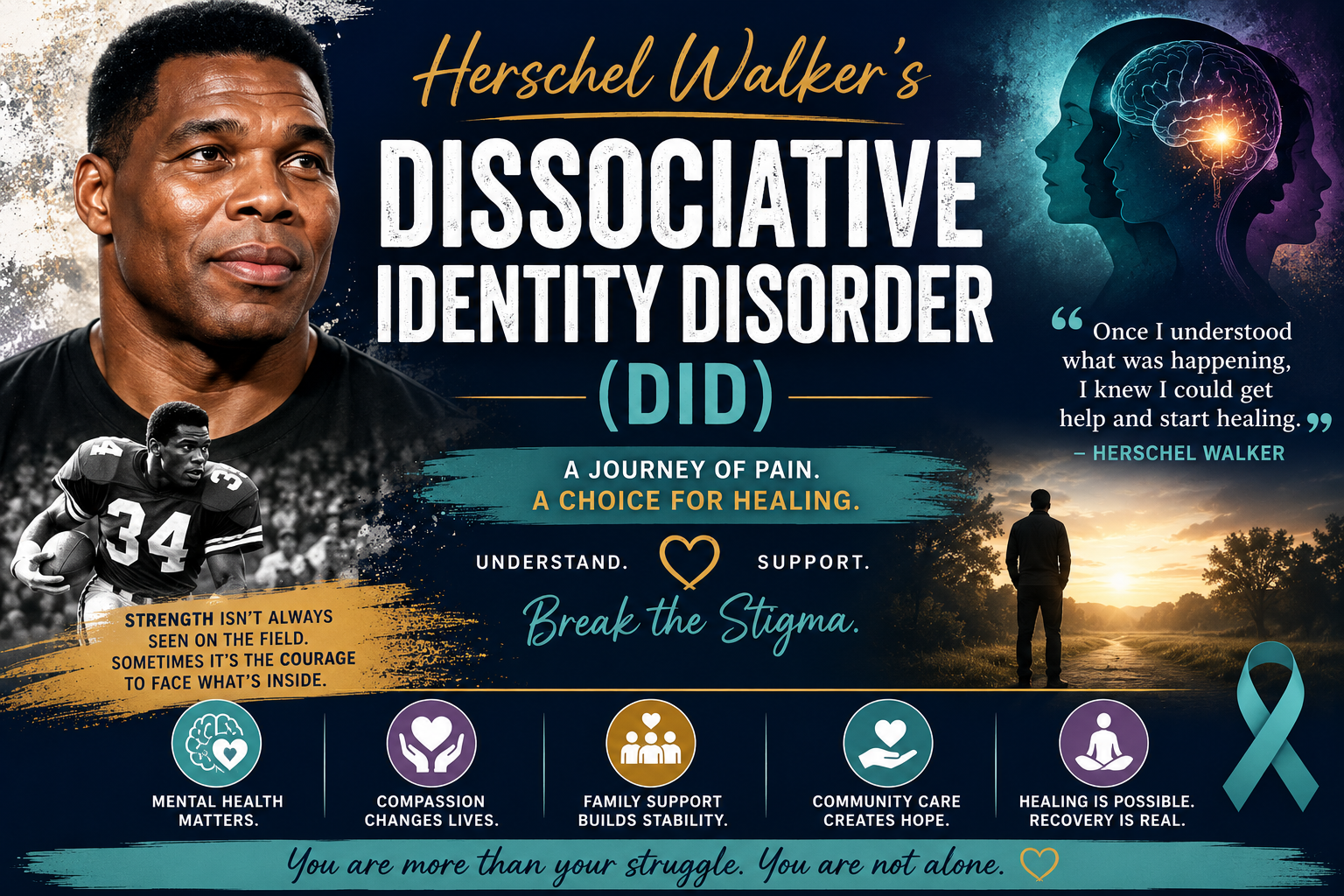
Herschel Walker became famous as a Heisman Trophy winner and professional football player, but behind his athletic success was a complex mental health journey. Walker has publicly shared that he was diagnosed with dissociative identity disorder (DID) and later discussed his experiences in his memoir, Breaking Free. His story highlights the importance of understanding dissociation, reducing stigma, seeking professional treatment, and providing family and community support. However, Walker’s experience is personal and should not be generalized to everyone living with DID.
Understanding Dissociative Identity Disorder
Dissociative identity disorder is a complex mental health condition involving disruption in a person’s experience of identity, along with recurrent gaps in memory that are more extensive than ordinary forgetting.
Dissociation itself can involve feeling disconnected from thoughts, emotions, memories, surroundings, or one’s sense of self.
Possible experiences associated with DID can include:
- Significant gaps in memory.
- Feeling disconnected from oneself.
- Changes in sense of identity.
- Difficulty recalling certain events or periods of time.
- Feeling as though actions or emotions are beyond one’s usual control.
- Depression or anxiety.
- Emotional distress.
- Difficulty maintaining relationships.
- Problems functioning in everyday life.
DID requires careful assessment by qualified mental health professionals because other psychiatric, neurological, substance-related, sleep-related, and medical conditions may sometimes produce overlapping symptoms.
Walker’s Experience
Walker has said that he did not initially understand what was happening to him. He described periods of anger, sadness, self-destructive behavior, and feeling that his life was out of control.
He has also connected his difficulties to painful childhood experiences. Walker has spoken about being overweight, having a speech impediment, and experiencing significant bullying while growing up.
After recognizing that something was wrong, he eventually sought professional help.
Receiving a diagnosis provided a framework through which he could begin to understand experiences that had previously seemed confusing.
Success Can Hide Emotional Distress
One important lesson from Walker’s experience is that external achievement does not necessarily reveal what someone is experiencing internally.
He became an extraordinary athlete.
He competed at the highest levels.
He received national recognition.
Yet serious psychological difficulties existed alongside those achievements.
Mental illness does not automatically disappear because someone is talented, wealthy, physically strong, successful, or famous.
Sometimes achievement can even make recognizing a problem more difficult because the person and everyone around them may think:
“How could something be wrong when everything looks so successful?”
Mental health should be evaluated based on symptoms and functioning—not on someone’s résumé.
Self-Management Strategies
DID is a complex condition that generally warrants professional treatment. Self-management should complement appropriate mental health care rather than replace it.
Helpful strategies may include:
- Recognize patterns and triggers. Keeping track of stress, dissociative experiences, emotions, memory difficulties, and environmental triggers may help identify patterns.
- Create predictable routines. Regular sleep, meals, exercise, appointments, and daily activities can provide stability.
- Practice grounding techniques. Focusing on sights, sounds, textures, breathing, or other aspects of the present environment can help during some dissociative experiences.
- Use journals and planners. Written schedules and notes may help organize activities and track experiences when memory difficulties occur.
- Develop a safety plan. Work with a mental health professional to establish specific steps for periods of severe emotional distress or unsafe thoughts.
- Reduce unnecessary stress. Excessive stress may intensify symptoms for some people.
- Avoid using alcohol or drugs as coping mechanisms. Substance use can complicate symptoms, memory, judgment, and treatment.
- Protect sleep. Sleep disruption can make emotional regulation and mental health symptoms more difficult to manage.
- Stay connected with treatment. Regular professional support can help identify changes before a crisis develops.
- Practice self-compassion. Confusing psychological symptoms deserve assessment and treatment rather than shame.
Grounding During Dissociation
Grounding techniques help redirect attention toward the present moment.
A person might:
- Name objects they can see.
- Notice the feeling of their feet against the floor.
- Hold a cool object.
- Identify sounds in the environment.
- State their name, location, and current date.
- Practice slow, comfortable breathing.
- Describe their surroundings aloud.
- Review a written daily schedule.
Different techniques work for different people, so strategies are best developed with professional guidance.
Family Support Strategies
DID can also be confusing and stressful for family members. Families may struggle to understand changes in behavior, memory difficulties, emotional reactions, or periods when their loved one appears disconnected.
Education can reduce confusion and stigma.
Families can help by:
- Learning about dissociation and DID from reliable sources.
- Listening without ridicule or humiliation.
- Encouraging consistent professional treatment.
- Supporting predictable routines.
- Learning the person’s warning signs and triggers.
- Helping develop a crisis or safety plan.
- Encouraging healthy sleep and daily routines.
- Avoiding unnecessary confrontation during periods of severe distress.
- Maintaining clear and respectful boundaries.
- Participating in family therapy when recommended.
- Seeking their own emotional support when necessary.
- Taking immediate safety concerns seriously.
Supporting someone does not require tolerating threatening, abusive, or dangerous behavior. Mental illness may help explain behavior in some circumstances, but it does not eliminate the need for safety, boundaries, and accountability.
Family Members Need Support Too
Walker has publicly discussed serious difficulties within his past relationships. These experiences reinforce another important principle: mental health treatment should consider the well-being and safety of everyone involved.
Family members may experience fear, confusion, anger, grief, or exhaustion.
They may benefit from:
- Individual counseling.
- Family therapy.
- Psychoeducation.
- Caregiver support groups.
- Domestic violence resources when appropriate.
- Crisis planning.
- Healthy boundaries.
Supporting someone’s treatment should never require sacrificing personal safety.
Community and Professional Support Strategies
DID should generally be evaluated and treated by mental health professionals experienced with trauma and dissociative disorders.
Community and professional resources may include:
- Psychiatrists.
- Psychologists.
- Licensed therapists.
- Trauma-informed mental health professionals.
- Dissociative-disorder specialists.
- Community mental health centers.
- Individual psychotherapy.
- Family therapy.
- Peer-support programs.
- Crisis stabilization services.
- Hospital-based psychiatric services when necessary.
- Substance use treatment when addiction is also present.
- Domestic violence resources when safety is threatened.
- Faith or spiritual communities when desired by the individual and used alongside appropriate clinical care.
Treatment should be individualized because symptoms, trauma histories, relationships, medical conditions, and personal needs differ substantially.
Therapy and DID
Psychotherapy is generally central to treatment for DID. Treatment may focus on improving safety, emotional regulation, communication, daily functioning, understanding dissociative symptoms, processing traumatic experiences appropriately, and developing greater integration and coordination of identity and memory.
Treatment can take time.
The goal is not to force someone to confront traumatic memories before they are prepared. Establishing safety and stabilization is an important part of trauma-informed treatment.
Medication may sometimes be prescribed for co-occurring conditions or symptoms such as depression or anxiety, although medication does not specifically eliminate DID itself.
Challenging the Stigma
DID has frequently been sensationalized in movies, television, and popular culture.
That can create the false impression that people with DID are inherently unpredictable or dangerous.
They are not.
A person’s diagnosis should never automatically be treated as evidence of violence or bad character. Risk should be evaluated according to the individual’s actual behavior, circumstances, symptoms, and clinical assessment.
Responsible mental health education requires discussing Walker’s personal history without turning one person’s experiences into a stereotype about everyone living with DID.
Asking for Help Is Important
Perhaps one of the most useful lessons from Walker’s public discussion of his mental health is the importance of recognizing when something is wrong and seeking help.
Confusion, memory problems, severe emotional changes, dissociation, self-destructive thoughts, or significant changes in behavior should not simply be ignored because someone appears successful.
Professional evaluation can provide answers that friends, relatives, or internet searches cannot.
Early support may also prevent symptoms from becoming more disruptive.
Recovery Does Not Mean Perfection
Living with a serious mental health condition may require ongoing awareness, professional support, coping skills, healthy relationships, and willingness to ask for help when difficulties return.
Recovery does not necessarily mean that every symptom disappears.
It can mean understanding symptoms better, improving everyday functioning, developing healthier relationships, responding to distress differently, and creating greater stability.
Conclusion
Herschel Walker’s public discussion of dissociative identity disorder demonstrates that serious mental health difficulties can exist behind extraordinary achievement. After struggling to understand periods of anger, sadness, self-destructive behavior, and other troubling experiences, Walker sought professional help and eventually spoke publicly about receiving a DID diagnosis.
His story can help start conversations about dissociation, but it should not define everyone with the disorder.
People experiencing DID need individualized, evidence-informed mental health care rather than stereotypes or judgment. Self-management techniques such as grounding, routines, sleep, symptom tracking, and safety planning can complement treatment. Families can provide education, encouragement, and stability while maintaining necessary boundaries, and community mental health resources can provide specialized professional care.
Most importantly, mental illness should never be viewed as a personal failure.
When something feels psychologically out of control, asking for professional help can be the first step toward understanding what is happening and building a safer, more stable future.
Frequently Asked Questions
Here are some common questions:
1. What mental health condition has Herschel Walker said he was diagnosed with?
Herschel Walker has publicly said that he was diagnosed with dissociative identity disorder (DID), formerly called multiple personality disorder. He discussed his experiences and diagnosis in his 2008 memoir, Breaking Free: My Life with Dissociative Identity Disorder.
2. What is dissociative identity disorder?
DID is a complex mental health condition involving disruptions in identity and recurrent gaps in memory that go beyond ordinary forgetting. Dissociation can also involve feeling disconnected from thoughts, emotions, memories, surroundings, or one’s sense of self.
3. When did Herschel Walker publicly discuss having DID?
Walker discussed his diagnosis publicly around the time of the publication of his memoir, Breaking Free, in 2008. He has subsequently spoken in interviews about his mental health experiences and decision to seek treatment.
4. Did Walker always know he had a mental health condition?
No. Walker has described periods when he did not fully understand his emotions and behaviors. Seeking professional help eventually gave him a framework for understanding some of what he was experiencing.
5. What experiences has Walker associated with his mental health struggles?
Walker has publicly discussed experiences involving anger, emotional difficulties, troubling behavior, and periods of his life that were difficult for him to understand. These are his individual experiences and should not be assumed to represent everyone with DID.
6. Did childhood experiences contribute to Walker’s difficulties?
Walker has spoken about having a difficult childhood, including being bullied, struggling with his weight, and having a speech impediment. However, determining the causes of any individual’s psychiatric condition requires professional assessment.
7. Is DID associated with trauma?
DID is strongly associated with overwhelming and often chronic childhood trauma in clinical literature. However, every person’s history is different, and an individual’s diagnosis or trauma history should not be assumed without appropriate evidence.
8. What are possible symptoms of DID?
Symptoms may include:
- Significant memory gaps
- Disruptions in identity
- Feeling disconnected from oneself
- Episodes of dissociation
- Difficulty remembering certain experiences
- Emotional distress
- Depression or anxiety
- Relationship or everyday-functioning difficulties
Symptoms can overlap with other conditions, making professional evaluation important.
9. Does having DID make someone violent?
No. DID should not be equated with violence. Popular entertainment sometimes portrays people with dissociative disorders as dangerous, but a psychiatric diagnosis alone cannot predict someone’s behavior.
10. Should Walker’s past behavior be attributed entirely to DID?
No. Mental health conditions can provide important context for understanding someone’s experiences, but they should not automatically be used to explain every behavior. Accountability and mental health treatment can exist together.
11. How is DID diagnosed?
Diagnosis typically involves a detailed evaluation by a qualified mental health professional. Clinicians assess identity disruption, memory problems, dissociation, trauma history, functioning, and other possible explanations for the symptoms.
12. Can DID be confused with other conditions?
Yes. Symptoms can overlap with post-traumatic stress disorder, depression, anxiety disorders, substance-related conditions, certain neurological problems, and other psychiatric disorders. This is one reason self-diagnosis should be avoided.
13. How is dissociative identity disorder treated?
Psychotherapy is generally the primary treatment. Treatment is individualized and may focus on safety, stabilization, emotional regulation, understanding dissociation, improving everyday functioning, and carefully addressing traumatic experiences when appropriate.
14. Is there medication specifically for DID?
There is no medication that specifically eliminates DID. However, medications may sometimes be prescribed for co-occurring problems such as depression, anxiety, sleep difficulties, or other psychiatric symptoms.
15. What self-management strategies may help someone with DID?
Alongside professional treatment, helpful strategies may include:
- Maintaining predictable routines
- Using grounding techniques
- Keeping journals, calendars, or planners
- Identifying stressors and triggers
- Protecting healthy sleep
- Avoiding alcohol or drugs as coping mechanisms
- Developing a professional safety plan
- Staying connected with treatment
- Practicing self-compassion
16. How can family members support someone with DID?
Families can educate themselves about dissociation, listen without ridicule, encourage treatment, support healthy routines, recognize warning signs, respect boundaries, and participate in family therapy when appropriate.
17. Should families excuse harmful behavior because someone has DID?
No. Compassion for mental illness does not require accepting threatening, abusive, or dangerous behavior. Families can support treatment while maintaining clear boundaries and protecting everyone’s safety.
18. What community resources can help?
Resources may include:
- Trauma-informed therapists
- Psychologists and psychiatrists
- Community mental health centers
- Dissociation-informed treatment programs
- Family counseling
- Peer-support communities
- Crisis stabilization services
- Substance use treatment when needed
- Domestic violence resources when safety is a concern
19. Can someone with DID live a productive life?
Yes. A psychiatric diagnosis does not determine a person’s potential. With appropriate treatment, coping strategies, supportive relationships, and ongoing care, people with dissociative disorders can work toward improved stability and functioning.
20. What can we learn from Herschel Walker’s public discussion of DID?
His story can encourage conversations about the fact that mental health difficulties can exist behind extraordinary achievement. At the same time, his individual experiences should not be generalized to everyone living with DID.
21. What is the most important message for families?
Try to replace fear and stigma with education, appropriate boundaries, compassion, and professional support. DID is complex and should be understood through qualified mental health care rather than stereotypes.
22. When should immediate help be sought?
Immediate professional or emergency assistance is appropriate when someone is at imminent risk of harming themselves or another person, is unable to maintain basic safety, or is experiencing a severe psychiatric crisis.
Video: What nobody tells you about Herschel Walker’s disorder #did #psychology #revealed