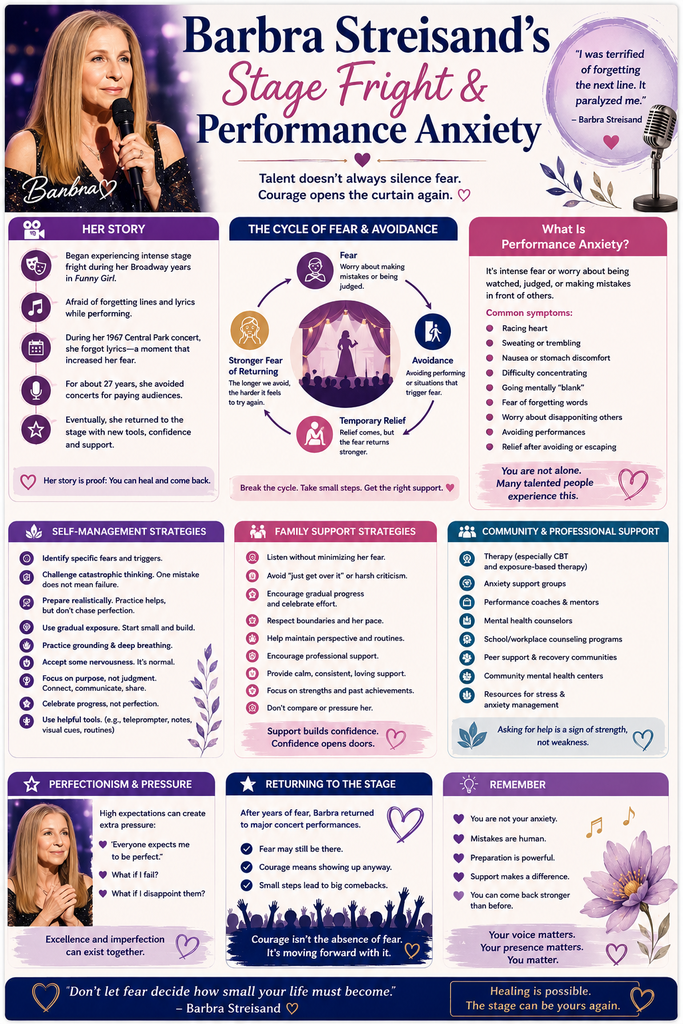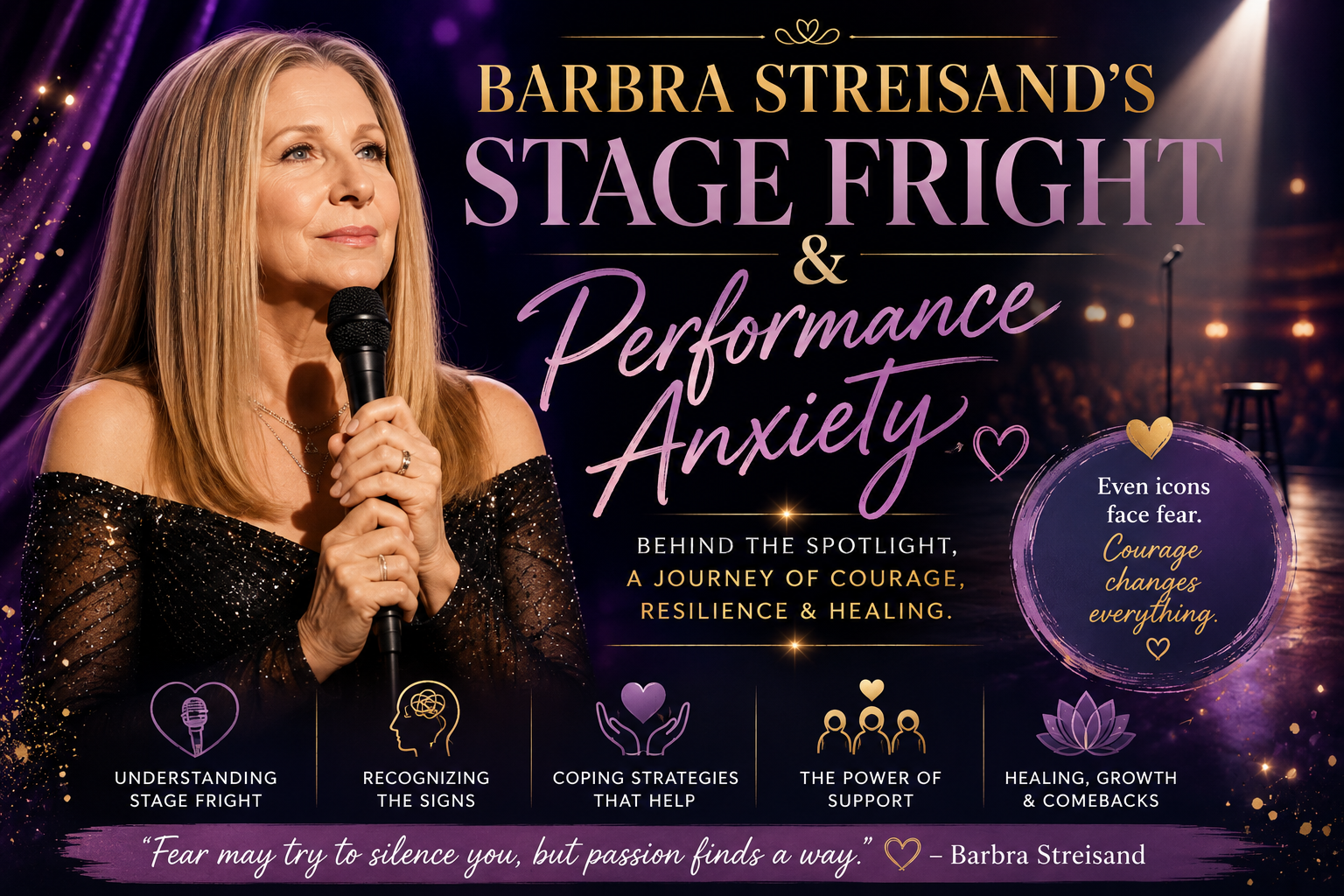
Barbra Streisand is one of the most accomplished entertainers in modern history, yet extraordinary talent did not protect her from intense performance anxiety. Streisand has spoken openly about experiencing severe stage fright and a persistent fear of forgetting words while performing. Her experience demonstrates an important mental health lesson: confidence and competence in one part of life do not automatically eliminate anxiety in another.
Although Streisand’s experience is sometimes described online as “social phobia,” it is more accurate to discuss what she herself has described—significant stage fright and performance anxiety. Social anxiety disorder is a clinical diagnosis that can involve broader fears of being scrutinized or negatively evaluated in social situations.
The Experience That Intensified Her Fear
Streisand has attributed her stage fright in part to stressful experiences during her Broadway years in Funny Girl. She later described becoming afraid of forgetting her next line while performing.
That fear became especially powerful after her famous 1967 Central Park concert. Streisand forgot lyrics during the performance, an experience she later described as frightening and difficult to overcome.
The incident had a remarkable impact on her relationship with live performance. She has said that for approximately 27 years she did not perform concerts for paying audiences, although she continued to appear at some benefits and fundraisers.
Her story illustrates how one frightening experience can become associated with future situations. A person may begin thinking:
“What if it happens again?”
That anticipation can sometimes become almost as distressing as the original event.
Understanding Performance Anxiety
Performance anxiety can occur when someone becomes intensely worried about being observed, evaluated, embarrassed, or making mistakes in front of other people.
Possible symptoms include:
- Racing heartbeat.
- Sweating or trembling.
- Nausea or stomach discomfort.
- Difficulty concentrating.
- Feeling mentally “blank.”
- Fear of making mistakes.
- Excessive concern about disappointing others.
- Repeatedly imagining something going wrong.
- Avoiding performances or other feared situations.
- Feeling relief after escaping or avoiding the situation.
Streisand has described fear surrounding live performance and concern about disappointing audiences. Her experience reminds us that anxiety can affect someone even when that person has successfully performed many times.
The Cycle of Fear and Avoidance
Anxiety can create a powerful cycle:
Fear → avoidance → temporary relief → stronger fear of returning.
Avoiding a frightening situation can feel protective because anxiety immediately decreases. However, long-term avoidance may prevent someone from discovering that they can tolerate the discomfort or successfully manage the situation.
This does not mean people should force themselves into overwhelming situations. Treatment often involves gradual, manageable steps that help rebuild confidence.
Self-Management Strategies
People experiencing performance or social anxiety can develop skills that make feared situations more manageable.
Helpful strategies may include:
- Identify specific fears. Instead of simply saying, “I’m anxious,” identify the feared outcome: forgetting words, being judged, making a mistake, or disappointing others.
- Challenge catastrophic thinking. One mistake does not automatically mean complete failure.
- Prepare realistically. Practice can increase confidence, but excessive preparation can sometimes become another attempt to eliminate all uncertainty.
- Use gradual exposure. Start with manageable situations before progressing toward more challenging ones.
- Practice grounding. Focus attention on the present environment when anxious thoughts begin escalating.
- Use slow, comfortable breathing. Controlled breathing may help reduce physical arousal.
- Accept some nervousness. The goal does not always have to be zero anxiety. A person can perform successfully while feeling nervous.
- Reduce perfectionism. Even highly accomplished people make mistakes.
- Focus on purpose rather than judgment. Think about communicating, singing, speaking, teaching, or connecting rather than constantly monitoring how others might evaluate you.
- Recognize accomplishments. Give successful experiences as much attention as mistakes.
Streisand eventually incorporated practical supports such as teleprompters when performing. Her example shows that coping does not always mean eliminating every source of anxiety. Sometimes it means developing tools that make a challenging situation manageable.
Family Support Strategies
Family members and close friends can provide valuable support when someone struggles with social or performance anxiety.
They can help by:
- Listening without minimizing the fear.
- Avoiding statements such as “Just get over it.”
- Recognizing that anxiety can occur despite talent or experience.
- Encouraging gradual progress rather than demanding immediate change.
- Celebrating effort as well as achievement.
- Avoiding excessive criticism after mistakes.
- Helping the person maintain perspective.
- Encouraging professional treatment when anxiety significantly limits life.
- Supporting healthy sleep, routines, and stress management.
- Asking what type of support is actually helpful.
Support should encourage confidence without creating complete dependence on reassurance.
Community and Professional Support Strategies
Professional treatment can be particularly helpful when anxiety leads to significant avoidance or interferes with work, education, relationships, or everyday activities.
Resources may include:
- Cognitive behavioral therapy (CBT).
- Therapists experienced in anxiety disorders.
- Gradual exposure-based treatment.
- Mental health counseling.
- Performance coaches working alongside appropriate mental health professionals.
- Anxiety support groups.
- Community mental health centers.
- Telehealth counseling.
- School or workplace counseling programs.
- Peer-support communities.
- Educational programs about anxiety and stress management.
CBT can help people examine fearful predictions, develop coping skills, and gradually approach situations they have been avoiding.
Perfectionism and Fear of Disappointing Others
Performance anxiety can become especially difficult for highly successful people because success itself may create additional pressure.
After repeatedly performing at an exceptional level, a person may begin thinking:
“Everyone expects me to be perfect.”
“What happens if I fail?”
“What if I disappoint them?”
Streisand has spoken about worrying whether audiences would be receptive and whether she would meet expectations.
The healthier alternative is not lowering every standard. It is recognizing that human performance naturally includes uncertainty.
Excellence and imperfection can coexist.
Returning to What Fear Took Away
One of the most encouraging aspects of Streisand’s experience is that avoidance was not necessarily permanent. She eventually returned to major concert performances.
Returning after years of fear does not mean the anxiety completely disappeared. A person can still experience nervousness while becoming increasingly willing to do something meaningful despite that discomfort.
That is an important principle in anxiety recovery:
Courage is not always feeling calm. Sometimes courage means continuing while anxiety is present.
What Barbra Streisand’s Experience Can Teach Us
Streisand’s story challenges the assumption that talented, wealthy, famous, or successful people should automatically be confident.
Anxiety does not measure talent.
It does not prove weakness.
And experiencing fear does not erase previous accomplishments.
Her experience also demonstrates how strongly a frightening performance can influence future behavior. At the same time, it shows that people can develop accommodations, coping strategies, and renewed confidence that allow them to return to activities anxiety once restricted.
Conclusion
Barbra Streisand’s experience with stage fright provides a powerful example of how performance anxiety can affect even someone with extraordinary talent and professional success. After frightening experiences involving fears of forgetting lines and lyrics, live performance became something she largely avoided for many years.
Her journey also demonstrates that anxiety does not have to permanently determine someone’s choices.
Self-management strategies can help people recognize triggers, challenge catastrophic thinking, tolerate imperfection, and gradually approach feared situations. Families can encourage progress without criticism or excessive pressure, while therapists, support groups, and community mental health resources can provide structured treatment.
The goal is not necessarily to become completely fearless.
The goal is to prevent fear from deciding how small your life must become.
Frequently Asked Questions
Here are some common questions:
1. Did Barbra Streisand have social phobia?
Streisand has publicly discussed severe stage fright and performance anxiety, especially fears about forgetting lyrics while performing. It is more accurate to use those terms rather than assume a formal diagnosis of social anxiety disorder.
2. What contributed to Barbra Streisand’s stage fright?
Streisand has discussed anxiety about forgetting lines during her Broadway career. Her fear became particularly significant after she forgot lyrics during her famous 1967 Central Park concert.
3. Did Barbra Streisand stop performing because of stage fright?
She largely withdrew from paid public concerts for many years. Streisand has said that she went approximately 27 years without performing concerts for paying audiences, although she continued making some benefit appearances.
4. How can someone so successful still have performance anxiety?
Talent and anxiety can exist simultaneously. A person can be exceptionally skilled while experiencing intense fear of making mistakes, being judged, being embarrassed, or disappointing an audience.
5. What are common symptoms of performance anxiety?
Symptoms can include:
- Racing heartbeat
- Trembling or sweating
- Nausea or stomach discomfort
- Difficulty concentrating
- Going mentally “blank”
- Fear of forgetting words
- Excessive worry about mistakes
- Avoiding performances or presentations
6. Is stage fright the same as social anxiety disorder?
Not necessarily. Stage fright generally occurs around performing in front of others. Social anxiety disorder can involve significant fear across a broader range of social situations in which someone believes they may be scrutinized or negatively evaluated.
7. Why can one bad performance create lasting anxiety?
A frightening or embarrassing experience can become strongly associated with future performances. The person may begin to anticipate the same outcome and think, “What if it happens again?” That anticipation can strengthen anxiety.
8. How does avoidance make performance anxiety stronger?
Avoidance produces immediate relief, which can teach the brain that escaping was necessary for safety. Gradually approaching feared situations in an appropriate therapeutic setting can help weaken this fear-avoidance cycle.
9. What self-management strategies can help?
People may benefit from identifying specific fears, challenging catastrophic thoughts, practicing grounding and comfortable breathing, preparing appropriately, reducing perfectionism, and gradually approaching feared situations.
10. Can someone perform successfully while still feeling anxious?
Yes. Successful anxiety management does not necessarily mean eliminating nervousness. An important goal is learning that anxiety can be present without controlling behavior.
11. How can family and friends provide support?
Loved ones can listen without judgment, avoid minimizing the person’s anxiety, encourage gradual progress, recognize accomplishments, respect boundaries, and encourage professional treatment when anxiety substantially interferes with life.
12. What professional treatment can help performance anxiety?
Cognitive behavioral therapy (CBT) and appropriately designed exposure-based approaches can be helpful. Treatment may address catastrophic thinking, avoidance, perfectionism, physical anxiety symptoms, and fear of negative evaluation.
13. Did Streisand eventually return to major live performances?
Yes. She eventually returned to major concert performances. Her return illustrates that longstanding anxiety does not necessarily mean someone must permanently abandon something meaningful.
14. What can we learn from Barbra Streisand’s experience?
Her experience demonstrates that success does not make someone immune to anxiety. Fear can affect even highly accomplished performers, and needing coping strategies or support does not diminish talent.
15. What is the most important lesson from her journey?
Recovery from performance anxiety does not necessarily mean becoming fearless. It can mean developing enough confidence, support, and coping skills to pursue meaningful experiences despite fear.
Video: From Fear to Courage: Barbra Streisand’s Journey #desire #inspiration