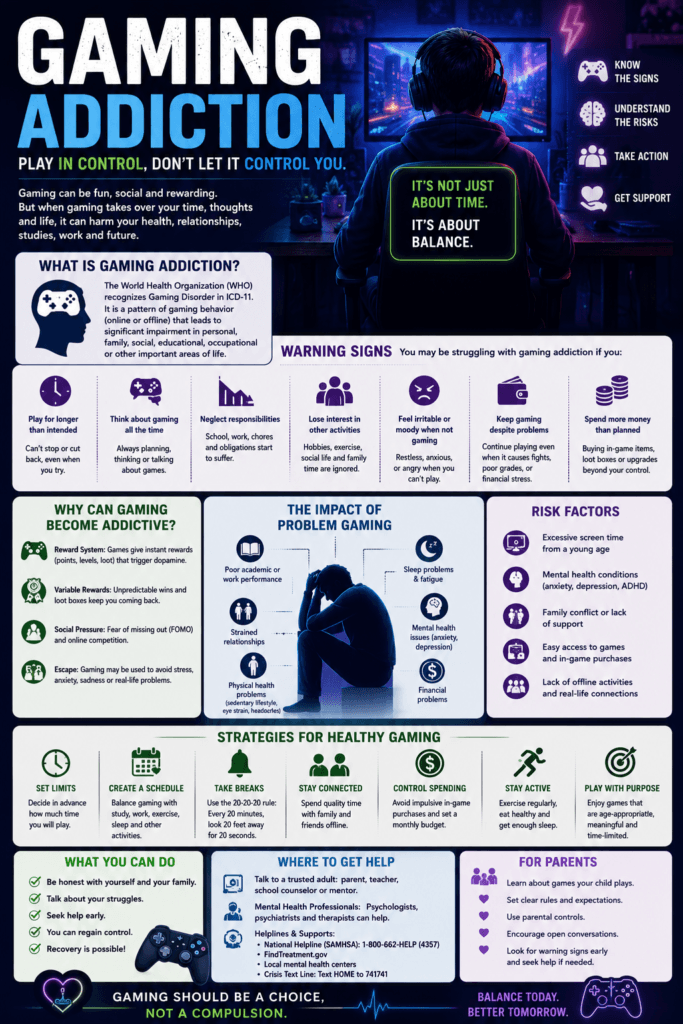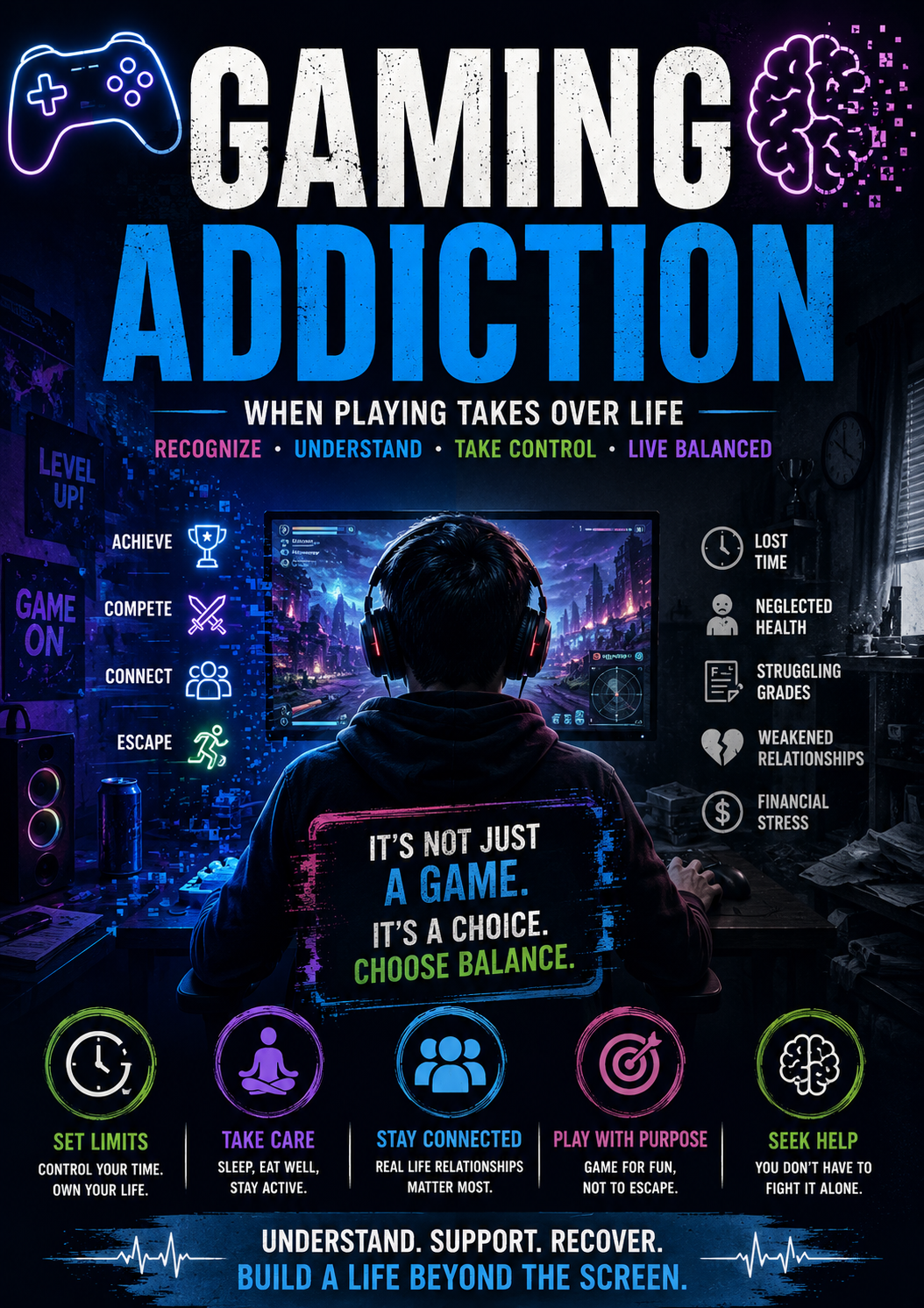
Gaming has become a major source of entertainment, competition, creativity, and social connection for people of all ages. For most individuals, playing video games is an enjoyable activity that can be balanced with school, work, relationships, sleep, and other responsibilities. However, gaming can become problematic when a person develops difficulty controlling how often or how long they play and continues despite significant negative consequences. The World Health Organization recognizes gaming disorder in ICD-11, characterized by impaired control over gaming, increasing priority given to gaming over other activities, and continued or escalating gaming despite harm. Features such as online competition, achievement systems, daily rewards, microtransactions, and randomized loot boxes may further encourage prolonged engagement or spending in some vulnerable individuals. Understanding gaming addiction means looking beyond screen time and examining whether gaming is beginning to control a person’s behavior, finances, relationships, health, and everyday functioning.
Microtransactions & Loot Boxes: Gaming Addiction
Microtransactions and loot boxes have transformed how many video games make money. Microtransactions allow players to purchase digital items, currencies, upgrades, characters, cosmetic features, or other content with real money. Loot boxes are a particular type of in-game purchase that provides randomized rewards, meaning players may not know exactly what they will receive before opening one.
These features do not automatically cause gaming addiction, and most people who play games or make occasional in-game purchases do not develop a disorder. However, certain designs can encourage repetitive spending, prolonged engagement, and difficulty stopping, particularly among vulnerable players.
Why Loot Boxes Can Be So Compelling
Loot boxes use uncertain or variable rewards. A player might receive an ordinary item most of the time but occasionally obtain something rare or highly desirable. The anticipation surrounding an unpredictable reward can strongly engage the brain’s reward-learning and motivation systems.
The important point is that dopamine is not simply a “pleasure chemical.” It plays a major role in motivation, learning, anticipation, and reinforcing behaviors. Uncertain rewards can encourage someone to repeat an action because the next attempt might produce the desired outcome.
The Connection With Gambling
Loot boxes have attracted particular concern because they share some characteristics with gambling: a player may spend something of value, receive an uncertain outcome, and be motivated to spend again after an undesirable result.
However, whether a particular loot-box system legally constitutes gambling varies by jurisdiction and by how the system operates. Researchers have also repeatedly found associations between greater loot-box spending and problem-gambling symptoms, although an association alone does not prove that loot boxes cause gambling problems.
Microtransactions Can Create a Spending Cycle
Not every microtransaction involves chance. Buying a specific character skin, for example, is different from purchasing a randomized loot box.
Problems may arise when games combine purchases with limited-time offers, virtual currencies, progress shortcuts, repeated prompts, social competition, or fear of missing out. Small individual purchases can feel insignificant, making it easier for cumulative spending to go unnoticed.
A cycle can develop:
Trigger → urge to purchase → anticipation → reward or disappointment → desire for another purchase → repeated spending.
For some players, disappointment can paradoxically encourage another purchase: Maybe the next one will be better.
Adolescents May Be Particularly Vulnerable
Children and adolescents deserve special attention because abilities involving impulse control, long-term decision-making, and financial judgment continue to develop through adolescence and into young adulthood.
Young players may also have difficulty understanding how quickly repeated small purchases accumulate. Social pressure can contribute when desirable characters, skins, or equipment become symbols of status within a peer group.
Parental controls, purchase authorization, spending limits, and conversations about randomized rewards can therefore be important preventive measures.
Gaming Disorder Is Different From Spending Too Much
It is important not to label every enthusiastic gamer as “addicted.”
Gaming disorder is recognized by the World Health Organization in ICD-11. The disorder involves impaired control over gaming, increasing priority given to gaming over other activities, and continuation or escalation despite negative consequences, with significant impairment in important areas of functioning.
Someone can also develop problematic spending behaviors without meeting criteria for gaming disorder. Gaming behavior and financial behavior should therefore be evaluated separately.
Warning Signs of a Problem
Concerning patterns can include repeatedly spending more money than intended, hiding purchases, unsuccessfully trying to stop buying loot boxes, becoming extremely distressed when unable to play or purchase items, chasing rare rewards, borrowing or stealing money for gaming purchases, and allowing gaming to interfere with sleep, relationships, school, work, or finances.
The most important issue is not simply the number of hours played. Loss of control and harmful consequences are more clinically meaningful.
Mental Health and Gaming
Problematic gaming may occur alongside depression, anxiety, ADHD, loneliness, social difficulties, or other behavioral health concerns. For some individuals, gaming becomes a way of escaping uncomfortable emotions or stressful circumstances.
That does not mean gaming caused the underlying problem. A thorough assessment should ask what role gaming and spending are serving in the person’s life and whether other conditions require treatment.
Strategies That Can Help
Players can disable stored payment methods, establish monthly gaming budgets, turn off purchase notifications, avoid randomized purchases, track spending in actual dollars rather than virtual currency, schedule gaming-free periods, and recognize emotional triggers for spending.
Parents can require authorization for purchases and teach children that virtual currencies are designed to make real-world costs less obvious. Someone experiencing significant loss of control may benefit from evaluation by a mental health professional familiar with behavioral addictions, gaming disorder, or gambling-related problems.
Key Message
Microtransactions are not inherently addictive, and gaming itself can provide entertainment, social connection, competition, creativity, and relaxation. The concern arises when game mechanics and individual vulnerabilities interact in ways that encourage compulsive play or uncontrolled spending.
Loot boxes deserve particular attention because randomized rewards can blur the boundary between gaming and gambling-like behavior. Understanding these mechanisms helps players and families move beyond simply asking, “How much are you gaming?” and instead ask the more important questions: “Can you control it? How much are you spending? And is gaming beginning to harm the rest of your life?”
Self-Management Strategies for Understanding Gaming Addiction
Gaming can be enjoyable and socially meaningful, but problems can develop when it becomes difficult to control and begins to interfere with sleep, relationships, school, work, finances, or physical and emotional health. The World Health Organization recognizes gaming disorder in ICD-11, emphasizing impaired control, increasing priority given to gaming, and continued gaming despite significant negative consequences.
- Track gaming time honestly. Keep a daily record of when you start and stop gaming. Compare perceived gaming time with actual hours spent to identify patterns that might otherwise go unnoticed.
- Identify your gaming triggers. Ask what makes you want to play: boredom, loneliness, anxiety, anger, stress, competition, achievement, or escaping problems. Understanding the purpose gaming serves can make alternative coping strategies easier to develop.
- Set gaming limits before starting. Decide when gaming will begin and end rather than waiting until you feel like stopping. Timers, device controls, and scheduled breaks can reinforce these boundaries.
- Create gaming-free periods. Establish specific times when gaming is unavailable, such as during meals, work or school, family activities, and the hour before bedtime.
- Protect your sleep. Late-night gaming can interfere with sleep duration and quality. Establish a consistent bedtime, stop gaming before bed, and consider keeping gaming devices outside the bedroom.
- Use the “responsibilities first” rule. Complete essential responsibilities—schoolwork, employment duties, household tasks, exercise, appointments, and self-care—before beginning recreational gaming.
- Monitor microtransaction spending. Track purchases in actual dollars rather than virtual currency. Establish a monthly budget and consider removing saved credit card information or disabling one-click purchases.
- Be cautious with loot boxes. Randomized rewards can encourage repeated purchasing because players do not know what they will receive. Avoid chasing rare items after an unsuccessful purchase and consider disabling these purchases whenever possible.
- Recognize emotional escape. Gaming can temporarily distract from stress, anxiety, loneliness, or sadness. If gaming has become your primary method of avoiding uncomfortable emotions, develop additional coping strategies rather than relying on gaming alone.
- Replace rather than simply remove gaming. Cutting gaming time creates free time that needs somewhere to go. Exercise, hobbies, outdoor activities, volunteering, reading, creative projects, and face-to-face social activities can provide alternative sources of reward and a sense of accomplishment.
- Practice tolerating urges. When you feel compelled to start gaming, delay for 10–20 minutes and do something else. Gaming urges can increase and then decrease without requiring immediate action.
- Turn off unnecessary gaming cues. Disable notifications about limited-time events, rewards, sales, daily bonuses, and new content if they repeatedly trigger gaming or spending.
- Watch for loss of control. Warning signs include repeatedly gaming longer than intended, making unsuccessful attempts to reduce gaming, lying about gaming time, sacrificing sleep, neglecting responsibilities, or continuing to game despite significant consequences.
- Strengthen offline relationships. Maintain friendships, family interactions, work or school involvement, and activities that do not depend on gaming. Gaming should ideally be one part of life rather than the primary source of identity and connection.
- Seek professional support when needed. If gaming repeatedly interferes with functioning or attempts to reduce it are unsuccessful, a mental health professional can assess gaming behaviors and possible co-occurring concerns such as depression, anxiety, ADHD, or problematic gambling.
Key Self-Management Strategy
The goal does not necessarily have to be “never play video games again.” For many people, healthier gaming means restoring control and balance.
A useful self-check is to ask: “Am I choosing when to game, or does gaming feel like it is choosing for me?”
When gaming begins controlling time, money, sleep, responsibilities, relationships, or emotional well-being, stronger boundaries and professional support may be appropriate.
Family Support Strategies for Understanding Gaming Addiction
Families can play an important role in helping someone recognize and manage problematic gaming. Gaming itself is not inherently harmful, and frequent gaming does not automatically mean addiction. The World Health Organization recognizes gaming disorder in ICD-11 when impaired control over gaming, increasing priority given to gaming, and continued gaming despite negative consequences result in significant impairment. Family support should therefore focus on functioning, balance, communication, and safety rather than simply counting hours played.
- Learn about gaming disorder. Families should understand the difference between enthusiastic recreational gaming and gaming that significantly interferes with daily functioning. This can prevent both minimizing serious problems and unnecessarily labeling normal gaming as addiction.
- Communicate without judgment. Avoid statements such as “You’re wasting your life playing games.” Instead, discuss specific concerns such as missed school, declining work performance, disrupted sleep, excessive spending, or withdrawal from family activities.
- Understand what gaming provides. Gaming may offer achievement, competition, friendship, stress relief, a sense of identity, or an escape from difficult emotions. Understanding why someone games excessively can help families address the underlying need rather than focusing exclusively on removing the game.
- Create reasonable household boundaries. Establish clear expectations about gaming during meals, school or work hours, family activities, and bedtime. Rules are more effective when they are predictable and consistently applied.
- Develop limits collaboratively. Whenever developmentally appropriate, involve the person in creating gaming schedules and consequences. Collaborative planning can increase responsibility and reduce power struggles.
- Protect sleep. Encourage consistent sleep and wake times, and consider keeping gaming devices out of bedrooms overnight, particularly for children and adolescents.
- Monitor microtransactions and loot boxes. Families should understand how virtual currencies, limited-time offers, and randomized rewards can encourage repeated spending. Parents can use purchase authorization, spending limits, and parental controls for minors.
- Teach financial awareness. Convert virtual currency into actual dollars when discussing purchases. Reviewing monthly gaming expenses can help make the financial consequences of small repeated transactions easier to recognize.
- Avoid suddenly removing every game without a plan. Abrupt restrictions may create significant conflict and do not address why gaming became excessive. When immediate safety is not an issue, gradually restructuring gaming while adding healthier activities may be more sustainable.
- Encourage offline alternatives. Exercise, sports, hobbies, music, volunteering, outdoor activities, family outings, and face-to-face friendships can provide alternative sources of enjoyment, accomplishment, and connection.
- Model healthy technology habits. Family expectations are more credible when adults also demonstrate reasonable boundaries with phones, social media, streaming, and other digital activities.
- Watch for co-occurring concerns. Excessive gaming may occur alongside depression, anxiety, ADHD, loneliness, bullying, academic difficulties, or other behavioral health concerns. Treating these underlying problems may be an important part of improving gaming behavior.
- Avoid enabling problematic gaming. Repeatedly completing someone’s responsibilities, excusing absences, paying excessive gaming expenses, or ignoring serious consequences can unintentionally allow the pattern to continue.
- Recognize positive progress. Celebrate improvements such as maintaining gaming limits, getting adequate sleep, completing responsibilities, reducing spending, exercising, and reconnecting with family or friends.
- Seek professional help when functioning significantly declines. Consider a mental health evaluation when gaming repeatedly disrupts school, employment, relationships, sleep, hygiene, finances, or emotional health—or when attempts to establish reasonable limits repeatedly fail.
Key Family Message
The family’s goal should not necessarily be to eliminate video games. Instead, families can help restore a healthy balance in which gaming remains entertainment rather than controlling everyday life.
Effective family support combines education, respectful communication, consistent boundaries, financial safeguards, healthy alternatives, and professional treatment when necessary. Rather than asking only, “How many hours are you gaming?” families should also ask: “What is gaming replacing, what need is it meeting, and is it interfering with the life you want to live?”
Community Resource Strategies for Understanding Gaming Addiction
Community resources can help individuals and families recognize when gaming has shifted from healthy recreation to a pattern that significantly interferes with everyday functioning. Because the World Health Organization recognizes gaming disorder in ICD-11, communities can approach problematic gaming as a behavioral health concern while avoiding the assumption that frequent gaming automatically means addiction.
- Increase access to behavioral health services. Community mental health centers can provide assessment and counseling for individuals experiencing loss of control over gaming, sleep disruption, family conflict, academic decline, or other gaming-related difficulties.
- Provide specialized gaming-disorder assessment. Healthcare systems can train clinicians to distinguish recreational gaming, problematic gaming, gaming disorder, and gambling-related behaviors associated with features such as loot boxes.
- Educate schools and colleges. Counselors, teachers, nurses, and student health programs can provide education about healthy gaming, sleep, digital balance, microtransactions, and warning signs of problematic gaming.
- Develop parent education programs. Community centers and schools can teach parents about parental controls, gaming ratings, virtual currencies, loot boxes, spending limits, privacy, online interactions, and strategies for establishing reasonable household boundaries.
- Offer peer-support programs. Community and online support groups can provide connection for individuals trying to reduce problematic gaming. Peer support may decrease isolation and provide accountability while complementing professional treatment when needed.
- Integrate gaming questions into primary care. Healthcare professionals can ask about gaming time, sleep, physical activity, spending, relationships, school or work performance, and emotional health during routine assessments.
- Address co-occurring mental health concerns. Gaming problems may occur alongside depression, anxiety, ADHD, loneliness, trauma, or social difficulties. Community behavioral health programs should assess these concerns rather than treating gaming as an isolated problem.
- Provide financial education about microtransactions. Libraries, schools, financial-literacy programs, and youth organizations can teach individuals how small in-game purchases accumulate and how virtual currencies can make real-world spending less obvious.
- Educate communities about loot boxes. Public education can explain how randomized rewards may encourage repetitive purchasing and why loot-box spending has raised concerns about gambling-like mechanisms, particularly among young people.
- Promote recreational alternatives. Parks, sports programs, arts organizations, libraries, community centers, volunteering programs, and youth clubs can provide meaningful offline opportunities for social connection, achievement, creativity, and stress relief.
- Develop digital-wellness programs. Workshops can teach time management, healthy screen habits, sleep hygiene, emotional regulation, and strategies for balancing gaming with education, employment, exercise, relationships, and other responsibilities.
- Provide family counseling resources. Gaming problems can create significant household conflict. Family therapy can help establish reasonable expectations, improve communication, reduce power struggles, and develop consistent gaming boundaries.
- Train community professionals. Pediatricians, primary care clinicians, therapists, social workers, school counselors, and addiction professionals can receive education about gaming disorder and problematic digital behaviors, so individuals receive appropriate assessment rather than simply being told to “stop playing.”
- Promote responsible gaming design and consumer awareness. Community advocacy and consumer education can encourage transparency around probabilities, virtual currencies, spending, parental controls, and age-appropriate access to randomized purchasing systems.
- Create clear referral pathways. Schools, healthcare practices, community organizations, and families should know where to refer someone when gaming begins seriously interfering with sleep, education, employment, finances, relationships, or mental health.
Key Community Message
Effective community responses should avoid treating all gaming as harmful. Video games can provide entertainment, creativity, social interaction, competition, and relaxation. The concern arises when gaming becomes difficult to control and causes significant impairment.
A comprehensive community approach combines education, early identification, mental healthcare, family support, financial literacy, digital wellness, recreational alternatives, and appropriate professional treatment. With microtransactions and loot boxes increasingly incorporated into games, communities should also teach young people and families to recognize when gaming is no longer just consuming time—it is beginning to control behavior, money, sleep, relationships, and everyday life.
Frequently Asked Questions
Here are some common questions:
1. What is gaming addiction?
Gaming addiction generally refers to a pattern in which a person has difficulty controlling gaming and continues despite significant negative consequences. The World Health Organization recognizes gaming disorder in ICD-11.
2. Is gaming addiction a real disorder?
Yes. WHO’s gaming disorder diagnosis focuses on impaired control over gaming, increasing priority given to gaming over other activities, and continued or escalating gaming despite negative consequences. The pattern must be sufficiently severe to cause significant impairment.
3. Does playing video games for many hours mean someone is addicted?
Not necessarily. Time alone does not establish gaming disorder. A person may game frequently without significant impairment. Loss of control and consequences involving school, work, relationships, sleep, health, or other responsibilities are more concerning.
4. What are common warning signs?
Warning signs may include repeatedly gaming longer than intended, unsuccessful attempts to cut back, neglecting responsibilities, sacrificing sleep, losing interest in other activities, hiding gaming behavior, and continuing despite serious consequences.
5. Why can video games become difficult to stop playing?
Games may provide achievement, competition, social interaction, exploration, immediate feedback, and rewards. Features such as daily rewards, rankings, limited-time events, and unpredictable rewards can encourage continued engagement.
6. Does dopamine cause gaming addiction?
The explanation is more complicated than simply saying gaming “releases dopamine.” Dopamine contributes to motivation, reward learning, anticipation, and reinforcement. Gaming can engage these systems, but addiction develops through an interaction of behavioral, psychological, social, and environmental factors.
7. Can loot boxes contribute to problematic behavior?
Potentially. Loot boxes provide randomized rewards and may encourage repeated purchasing. Research has found associations between loot-box spending and problem-gambling symptoms, although this does not mean every person who purchases loot boxes will develop a problem.
8. Are microtransactions the same as gambling?
Not necessarily. Purchasing a specific digital item is different from paying for an uncertain outcome. Randomized purchases such as some loot boxes have gambling-like characteristics, although their legal classification varies between jurisdictions.
9. Who may be more vulnerable to problematic gaming?
Risk can be influenced by many factors, including emotional distress, loneliness, impulsivity, difficulties with self-regulation, family conflict, limited offline activities, and certain mental health conditions. Risk factors do not mean someone will necessarily develop gaming disorder.
10. Can gaming addiction affect sleep?
Yes. Late-night gaming can delay bedtime and reduce sleep duration. Competitive or highly stimulating gaming immediately before bed may also make it more difficult for some people to fall asleep.
11. Can gaming affect school or work?
Problematic gaming may contribute to missed assignments, absenteeism, reduced concentration, declining performance, or difficulty completing responsibilities when gaming consistently takes priority.
12. Can gaming addiction affect relationships?
Yes. Relationships may become strained when gaming repeatedly replaces communication, family activities, intimacy, parenting responsibilities, or time with friends.
13. Can gaming addiction cause financial problems?
It can, particularly when excessive gaming is combined with uncontrolled spending on microtransactions, virtual currencies, upgrades, subscriptions, or randomized rewards.
14. Can gaming be used as an emotional escape?
Yes. Some people use gaming to temporarily escape stress, loneliness, anxiety, sadness, conflict, or other uncomfortable experiences. Gaming becomes more concerning when it becomes the primary or only coping strategy.
15. Should someone with gaming addiction completely stop gaming?
Not always. The appropriate goal depends on the individual. Some people may successfully establish controlled gaming, while others may benefit from a period of abstinence or stronger restrictions. A clinician can help determine an appropriate strategy when impairment is significant.
16. How can parents help a child who games excessively?
Parents can establish consistent schedules, protect sleep and school responsibilities, use parental controls, monitor spending, encourage offline activities, and discuss gaming without automatically treating it as bad behavior.
17. What should parents do about microtransactions?
Parents can disable unauthorized purchases, require passwords or approval, remove stored payment information, establish spending limits, and teach children to translate virtual currencies into actual dollars.
18. What are healthy self-management strategies?
Helpful strategies include tracking gaming time, setting predetermined stopping times, taking regular breaks, protecting sleep, completing responsibilities before gaming, limiting spending, exercising, maintaining offline relationships, and identifying emotional triggers.
19. When should professional help be considered?
Professional evaluation may be appropriate when gaming repeatedly interferes with education, employment, relationships, sleep, physical health, finances, or emotional well-being—or when repeated attempts to reduce gaming have been unsuccessful.
20. Can someone recover from problematic gaming?
Yes. Behavioral changes, family support, structured routines, psychotherapy when appropriate, treatment of co-occurring mental health concerns, and healthier offline activities can help individuals regain control.
Conclusion
Gaming addiction is not defined simply by enjoying video games or spending many hours playing them. The greater concern is loss of control and significant impairment in important areas of life, including sleep, education, employment, relationships, finances, physical activity, and emotional well-being. Healthy gaming can remain part of a balanced lifestyle when individuals establish reasonable limits, monitor spending, recognize emotional triggers, maintain offline relationships, and continue meeting everyday responsibilities. Families and communities can support healthier gaming through education, consistent boundaries, financial safeguards, recreational alternatives, and access to behavioral health services when needed. Ultimately, the goal is not necessarily to eliminate gaming, but to restore control so that gaming remains an enjoyable part of life rather than becoming the activity around which everything else must revolve.
Video: The Dark Side Of Gaming: What You Need To Know #GamingDisorder #DigitalAddiction