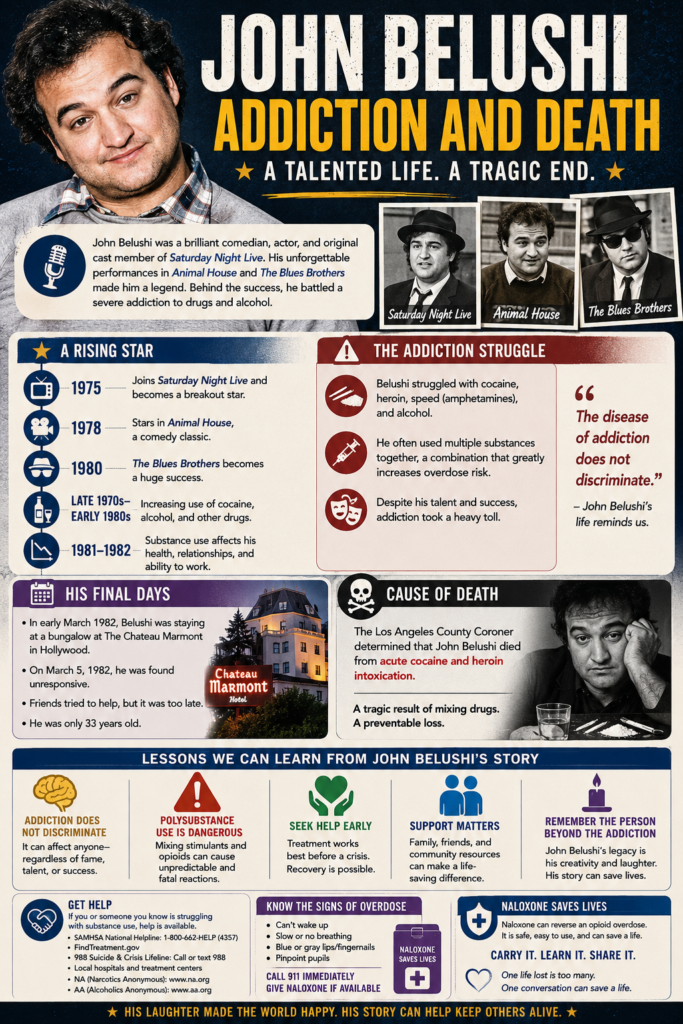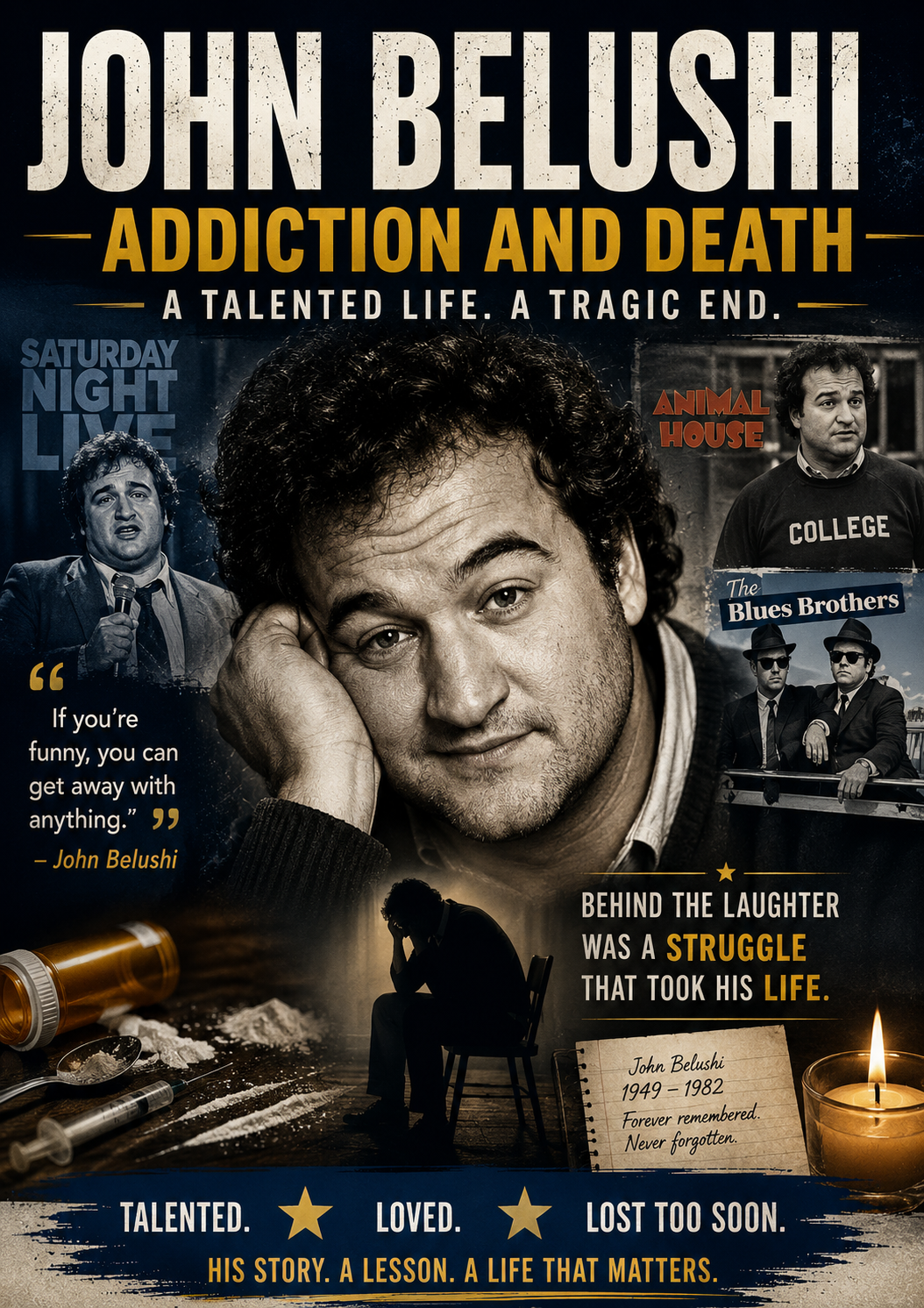
John Belushi was a remarkably talented comedian and actor whose rapid rise to fame was accompanied by increasingly serious struggles with substance use. Best known for his work on Saturday Night Live, Animal House, and The Blues Brothers, Belushi became one of the most recognizable comedians of his generation. Behind his professional success, however, cocaine, alcohol, heroin, and other substance use increasingly affected his health, relationships, behavior, and career. On March 5, 1982, Belushi died at age 33 from acute cocaine and heroin intoxication. His death demonstrates that addiction can affect anyone regardless of fame, talent, wealth, or professional achievement. His story remains an important reminder of the dangers of escalating substance use, polysubstance exposure, and waiting until addiction reaches a crisis before seeking help.
John Belushi’s Addiction and Death
John Belushi was an influential comedian, actor, and original cast member of Saturday Night Live, remembered for Animal House and The Blues Brothers. Behind his rapid professional success, however, Belushi developed serious problems involving drugs and alcohol. He died on March 5, 1982, at age 33, from acute cocaine and heroin intoxication.
Addiction During a Rapid Rise to Fame
Belushi became enormously successful during the late 1970s. His intense performance style, demanding work schedule, celebrity lifestyle, and the widespread availability of drugs within entertainment culture formed the background to increasingly problematic substance use.
Accounts of his final years describe particularly serious cocaine use along with heroin and other substance use. By the period shortly before his death, his drug use was affecting his health, behavior, relationships, and ability to work consistently.
His story illustrates an important feature of substance use disorder: external success does not necessarily indicate internal stability. Someone can remain talented, productive, wealthy, or socially connected while simultaneously developing increasingly dangerous substance-use patterns.
Cocaine, Heroin, and the “Speedball”
Belushi’s death involved both cocaine, a stimulant, and heroin, an opioid—a combination commonly known as a speedball. The Los Angeles County coroner determined that his death resulted from an overdose involving intravenous cocaine and heroin.
Combining stimulants and opioids is especially dangerous. The stimulant does not reliably protect someone from opioid-induced respiratory depression. Instead, the competing effects can make intoxication unpredictable, and serious toxicity can result in respiratory failure, cardiovascular complications, loss of consciousness, and death.
His Final Hours
Belushi was staying in a bungalow at the Chateau Marmont in Hollywood during his final days.
On March 5, 1982, he was found dead there. The official investigation determined that cocaine and heroin intoxication caused his death. Contemporary reporting from the coroner emphasized that the drug combination was sufficiently dangerous to have been fatal even in an otherwise healthy individual.
Cathy Smith, who acknowledged involvement in administering drugs to Belushi, was later prosecuted and ultimately pleaded guilty to involuntary manslaughter and drug-related charges.
A Wake-Up Call for Hollywood
Belushi’s death shocked the entertainment industry. Cocaine had become heavily associated with portions of celebrity culture during the 1970s and early 1980s, and its risks were often minimized.
His death challenged that perception. Even decades later, his Animal House co-star Tim Matheson has described Belushi’s death as a major wake-up call regarding Hollywood’s cocaine culture.
His death also profoundly affected friends and colleagues. Robin Williams, who experienced his own substance-use problems, later identified Belushi’s overdose death as an important wake-up call in changing his relationship with drugs.
What John Belushi’s Story Teaches About Addiction
Belushi’s death demonstrates how quickly escalating substance use can become life-threatening. It also shows why addiction should not be romanticized as part of artistic creativity, celebrity culture, or a “party lifestyle.”
Several broader lessons emerge from his experience: substance use disorder can affect highly successful people; mixing substances substantially increases risk; friends and colleagues may recognize deterioration before the person is able or willing to change; and treatment is most valuable before someone reaches a catastrophic “rock bottom.”
Today, Belushi’s death also carries an important overdose-prevention message. Modern illicit opioid supplies create additional dangers because fentanyl and other potent synthetic opioids may be present unexpectedly. Anyone witnessing suspected opioid overdose should treat it as an emergency and administer naloxone when available while obtaining emergency medical assistance.
Remembering the Person Beyond the Addiction
John Belushi should not be remembered solely for how he died. His performances helped shape American comedy, and his influence remains visible decades later. His addiction represents one part of a much larger life.
From an addiction-education perspective, however, his death remains a powerful reminder that addiction can progress rapidly, polysubstance use can be deadly, and professional success cannot protect someone from overdose. Early recognition, compassionate intervention, evidence-based treatment, and overdose-prevention measures can save lives.
Self-Management Strategies for Understanding John Belushi’s Addiction and Death
John Belushi’s death from acute cocaine and heroin intoxication provides important lessons about recognizing escalating substance use, avoiding dangerous drug combinations, seeking treatment early, and preventing overdose. His experience demonstrates why addiction should be addressed before severe consequences occur.
- Recognize early signs of problematic substance use. Increasing tolerance, using larger amounts, unsuccessful attempts to cut down, neglecting responsibilities, continuing despite consequences, and spending increasing amounts of time obtaining or using substances can indicate a developing substance use disorder.
- Avoid normalizing substance use because others are doing it. Belushi worked in an entertainment environment where heavy drug use could be socially normalized. A behavior being common within a social or professional group does not make it medically safe.
- Understand the dangers of combining substances. Belushi died after cocaine and heroin use. Combining stimulants and opioids can produce unpredictable and potentially fatal effects. A stimulant does not reliably prevent opioid-induced respiratory depression.
- Identify personal triggers. Stress, exhaustion, social pressure, loneliness, emotional distress, easy access to substances, and environments associated with previous drug use can increase vulnerability. Recognizing triggers allows a person to develop alternative responses before cravings intensify.
- Change high-risk environments. If certain people, locations, parties, or routines consistently encourage substance use, reducing exposure to those environments can be an important part of recovery.
- Develop healthier coping strategies. Exercise, adequate sleep, structured routines, mindfulness, counseling, creative activities, hobbies, and supportive relationships can provide alternatives to using substances for stress relief or emotional regulation.
- Do not wait to “hit rock bottom.” Treatment does not require losing a career, a relationship, a home, or your health first. Seeking help when early warning signs appear can prevent addiction from progressing to more dangerous stages.
- Build a recovery support network. Trusted family members, friends, healthcare professionals, therapists, addiction specialists, and recovery peers can provide accountability and recognize changes that may be difficult to identify on one’s own.
- Create an overdose-response plan when opioid exposure is possible. People who use opioids—or may unknowingly encounter them—should understand overdose warning signs and have naloxone available when possible. People around them should also know how to respond to an emergency.
- Never assume previous drug tolerance guarantees safety. Tolerance can decrease after periods of abstinence or reduced use. Returning to a previously tolerated amount can significantly increase overdose risk.
- Treat relapse as a reason for immediate action. Returning to substance use should trigger reassessment of treatment, triggers, support systems, and overdose risk rather than shame or abandonment of recovery efforts.
- Protect basic physical health. Chronic sleep deprivation, poor nutrition, stress, and untreated medical problems can make recovery more difficult. Regular medical care should be part of managing substance use disorder.
- Separate professional success from health. Belushi’s fame and career did not protect him from addiction. Someone can appear successful externally while experiencing severe substance-related problems privately.
- Accept professional treatment when self-management is not enough. Substance use disorder often requires more than personal determination. Addiction medicine, psychotherapy, structured treatment programs, peer recovery services, and medications for certain substance use disorders can provide evidence-based support.
Key Self-Management Lesson
John Belushi’s death illustrates why early intervention is safer than waiting until catastrophic consequences occur. Effective self-management involves recognizing escalating use, understanding the dangers of polysubstance exposure, changing high-risk environments, developing healthier coping strategies, maintaining supportive relationships, and seeking professional treatment when substance use becomes difficult to control.
His story also provides a crucial overdose-prevention message: mixing opioids with other substances can be fatal, and an overdose can happen before someone gets another opportunity to seek recovery. Prevention, treatment, access to naloxone, and rapid emergency response can save lives.
Family Support Strategies for Understanding John Belushi’s Addiction and Death
John Belushi’s struggle with substance use and his death at age 33 from acute cocaine and heroin intoxication provide important lessons for families affected by addiction. His experience demonstrates why families should recognize escalating substance use early, encourage treatment, understand overdose risks, and combine compassion with appropriate boundaries.
- Learn about substance use disorder. Families can educate themselves about addiction, tolerance, cravings, withdrawal, relapse, polysubstance use, and overdose. Understanding addiction as a treatable health condition can reduce shame while still recognizing personal responsibility.
- Recognize warning signs early. Increasing substance use, secrecy, dramatic mood changes, missed responsibilities, financial difficulties, declining health, risky behavior, changing social groups, and continuing drug use despite serious consequences may indicate escalating problems.
- Do not normalize substance use because of someone’s environment. Belushi worked during an era when cocaine and heavy substance use were present in parts of entertainment culture. Families should remember that socially accepted behavior can still be medically dangerous.
- Talk openly without humiliation. Families can describe specific behaviors they have observed and explain why they are concerned. Shame, insults, or repeated confrontations while someone is intoxicated are unlikely to create productive communication.
- Encourage treatment before “rock bottom.” Families do not need to wait for an overdose, arrest, job loss, or medical emergency before encouraging professional help. Earlier assessment and treatment can prevent increasingly severe consequences.
- Understand the danger of polysubstance use. Belushi’s death involved cocaine and heroin. Families should understand that combining opioids with stimulants or other substances does not make opioid use safer. Drug combinations can create unpredictable and potentially fatal effects.
- Learn to recognize an opioid overdose. Warning signs can include inability to wake, very slow or absent breathing, pinpoint pupils, choking or gurgling sounds, and blue, gray, or unusually pale lips or skin. An opioid overdose is a medical emergency.
- Keep naloxone accessible when opioid exposure is possible. Family members should know where naloxone is stored and how to administer it. If an opioid overdose is suspected, naloxone should be given promptly and emergency medical services contacted. Additional doses may sometimes be required.
- Set clear and consistent boundaries. Families can establish limits regarding substance use in the home, intoxicated driving, violence, money, childcare, or other unsafe behaviors. Boundaries protect family members while avoiding attempts to control every decision they make.
- Avoid enabling harmful behavior. Repeatedly providing money for unexplained expenses, covering up substance-related consequences, making excuses, or rescuing someone from every problem may unintentionally allow the addiction cycle to continue.
- Create an emergency plan. Families can decide beforehand who will call emergency services, where naloxone is located, which treatment facilities or clinicians to contact, and what steps will be taken if substance use returns.
- Support recovery after treatment. Family involvement should not end when rehabilitation or detoxification ends. Recovery may require continuing outpatient care, peer support, medical treatment, counseling, structured routines, and ongoing relapse-prevention planning.
- Take care of the family as well. Living with addiction can produce fear, anger, guilt, grief, and exhaustion. Family counseling, behavioral health services, and family-oriented recovery groups can help relatives protect their own well-being.
- Remember the person beyond the addiction. Addiction should not become someone’s entire identity. Belushi was also a son, brother, husband, friend, comedian, actor, and creative artist. Families can acknowledge the seriousness of addiction while continuing to recognize the whole person.
Key Family Lesson
John Belushi’s death demonstrates why families should not assume that fame, talent, financial resources, or professional success provide protection from severe addiction or overdose. Families can make a meaningful difference by recognizing warning signs, discussing concerns early, encouraging evidence-based treatment, establishing healthy boundaries, and preparing for overdose emergencies.
Most importantly, families should not wait for someone to experience a catastrophic “rock bottom” before taking addiction seriously. Treatment can begin before everything is lost, and overdose prevention can keep someone alive long enough to have another opportunity for recovery.
Community Resource Strategies for Understanding John Belushi’s Addiction and Death
John Belushi’s struggle with substance use and his death from acute cocaine and heroin intoxication provide important lessons about the need for accessible addiction treatment, overdose prevention, public education, and long-term recovery resources. Communities can use these lessons to reduce stigma and intervene before substance use results in irreversible consequences.
- Expand access to addiction treatment. Communities should provide timely access to outpatient treatment, intensive outpatient programs, residential care, medically supervised withdrawal when appropriate, and continuing recovery services.
- Promote early screening and intervention. Primary care offices, emergency departments, behavioral health clinics, schools, and community organizations can screen for unhealthy substance use and connect individuals with treatment before severe consequences develop.
- Increase access to medications for substance use disorders. Evidence-based medications should be readily available when clinically appropriate. For opioid use disorder, medications such as buprenorphine and methadone substantially reduce illicit opioid use and overdose risk.
- Expand naloxone availability. Community organizations, pharmacies, healthcare facilities, treatment programs, and harm-reduction organizations can distribute naloxone and teach people how to recognize and respond to opioid overdose.
- Educate the public about polysubstance use. Belushi’s death involved both cocaine and heroin. Community education should emphasize that combining stimulants and opioids does not make either drug safer and can result in unpredictable, life-threatening toxicity.
- Provide overdose-response education. Community members should learn to recognize signs such as unresponsiveness and slow or absent breathing. When opioid overdose is suspected, naloxone should be administered when available and emergency medical assistance obtained immediately.
- Support harm-reduction programs. Syringe-service programs, naloxone distribution, overdose education, infectious-disease testing, and drug-checking services where legally available can reduce immediate harms while connecting people with healthcare and treatment.
- Address today’s contaminated illicit drug supply. Belushi died in 1982, but the modern overdose environment is different. Illicit fentanyl and other potent synthetic opioids may appear unexpectedly in drugs sold as heroin, cocaine, or counterfeit pills. Community education should reflect these current risks.
- Develop peer-recovery services. Recovery coaches and peer-support organizations can provide mentorship, encouragement, practical assistance, and connection with people who have lived experience with addiction and recovery.
- Provide family education and support. Families need resources that explain addiction, enabling, boundaries, relapse, overdose recognition, naloxone use, and how to encourage professional treatment without attempting to control another person’s recovery.
- Integrate mental health and addiction care. Substance use may occur alongside depression, anxiety, trauma, or other psychiatric concerns. Coordinated behavioral healthcare can address these problems together rather than requiring individuals to navigate separate systems.
- Challenge cultural normalization of substance use. Belushi’s story illustrates how substance use can become normalized within particular social or professional environments. Public education should challenge the idea that heavy drug use is simply part of entertainment, nightlife, creativity, or professional success.
- Create strong treatment-to-community transitions. Recovery support should continue after detoxification or residential treatment. Outpatient care, primary healthcare, peer recovery, housing assistance, employment services, and social support can help individuals maintain progress after treatment.
- Reduce addiction stigma. Public campaigns can emphasize that substance use disorder is treatable, and that seeking help should be encouraged rather than viewed as evidence of weakness or moral failure.
Key Community Lesson
John Belushi’s death demonstrates why communities need more than emergency responses after an overdose has already occurred. Effective community strategies combine prevention, early identification, evidence-based treatment, medications for substance use disorders, harm reduction, naloxone access, mental healthcare, family education, and long-term recovery support.
His story also carries an especially relevant message today: the illicit drug supply has become increasingly unpredictable. Communities should ensure that people understand that any possible opioid exposure can carry overdose risk and that naloxone, rapid emergency response, and accessible addiction treatment can save lives.
Frequently Asked Questions
Here are some common questions:
1. What substances did John Belushi struggle with?
Belushi’s substance use included cocaine, heroin, alcohol, and other drugs. Cocaine became particularly prominent during the later years of his life.
2. Did fame contribute to his addiction?
Fame itself does not cause addiction, but Belushi worked in an entertainment environment where drugs were readily available and sometimes normalized. Stress, demanding schedules, social influences, and easy access to substances may all contribute to risk.
3. Did addiction affect his career?
Yes. Accounts of Belushi’s later years describe increasingly problematic substance use affecting his health, relationships, behavior, reliability, and ability to work consistently, despite his extraordinary professional success.
4. How old was John Belushi when he died?
Belushi was 33 years old when he died on March 5, 1982.
5. Where did John Belushi die?
He died while staying at the Chateau Marmont in West Hollywood, California.
6. What was John Belushi’s official cause of death?
The Los Angeles County coroner determined that Belushi died from acute cocaine and heroin intoxication. His death was classified as accidental.
7. What is a “speedball”?
The term generally refers to combining an opioid, traditionally heroin, with a stimulant such as cocaine. Belushi’s fatal intoxication involved cocaine and heroin.
8. Why is mixing cocaine and heroin so dangerous?
Cocaine stimulates the cardiovascular and nervous systems, while heroin can profoundly suppress breathing. Cocaine does not reliably protect someone from opioid-induced respiratory depression. Combining substances can make their effects more unpredictable and increase the risk of fatal toxicity.
9. Can a person overdose even if they have used drugs many times before?
Yes. Tolerance does not guarantee safety. Drug potency, amount consumed, combinations of substances, physical health, and changes in tolerance can all influence overdose risk. Today’s unpredictable illicit fentanyl supply adds additional danger that was not the primary context of Belushi’s 1982 death.
10. Was anyone charged in connection with his death?
Yes. Cathy Smith admitted involvement in administering drugs to Belushi during his final hours. She was later prosecuted and ultimately pleaded guilty to involuntary manslaughter and drug-related charges.
11. Did people around Belushi recognize his substance-use problems?
Accounts from friends, colleagues, and biographers indicate that people around him were aware of his escalating drug use. His experience demonstrates that recognizing a problem does not necessarily mean friends or relatives can control another person’s substance use.
12. How did his death affect other entertainers?
Belushi’s death shocked the entertainment community and prompted some of his friends and colleagues to reconsider their own substance use. Robin Williams later discussed Belushi’s death as an important wake-up call during a period when Williams was also using cocaine.
13. Could naloxone help in an overdose involving heroin?
Yes. Naloxone can rapidly reverse the opioid component of an overdose. It does not reverse cocaine toxicity, but when opioid exposure is suspected, naloxone should be administered promptly when available while emergency medical assistance is obtained.
14. What can families learn from John Belushi’s story?
Families can learn the importance of recognizing escalating substance use, communicating concerns early, encouraging evidence-based treatment, maintaining appropriate boundaries, understanding overdose warning signs, and keeping naloxone available when opioid exposure is possible.
15. What can communities learn from his death?
Communities can strengthen early screening, addiction treatment, harm-reduction services, naloxone distribution, overdose education, peer recovery programs, and family support. Treatment should be accessible before someone experiences a catastrophic consequence.
16. What is the most important lesson from John Belushi’s death?
His experience demonstrates that talent, fame, money, and professional achievement cannot protect someone from substance use disorder or overdose. Addiction can become life-threatening before a person reaches the stereotypical idea of “rock bottom.”
Conclusion
John Belushi’s addiction and premature death remain a powerful reminder of how quickly substance use can become life-threatening. His fatal combination of cocaine and heroin illustrates the serious risks associated with polysubstance use and demonstrates why stimulants should never be assumed to protect against opioid overdose. His experience also emphasizes the importance of recognizing warning signs, encouraging treatment early, providing family and community support, and expanding access to overdose-prevention resources such as naloxone. Although Belushi’s death is an important part of addiction history, it should not define his entire life or legacy. Remembering both his creative contributions and the circumstances surrounding his death allows his story to carry an important public-health message: addiction deserves early, compassionate, evidence-based intervention, and people should not have to reach “rock bottom” before receiving help.
Video: A Star’s Descent into Darkness #addiction #johnbelushi