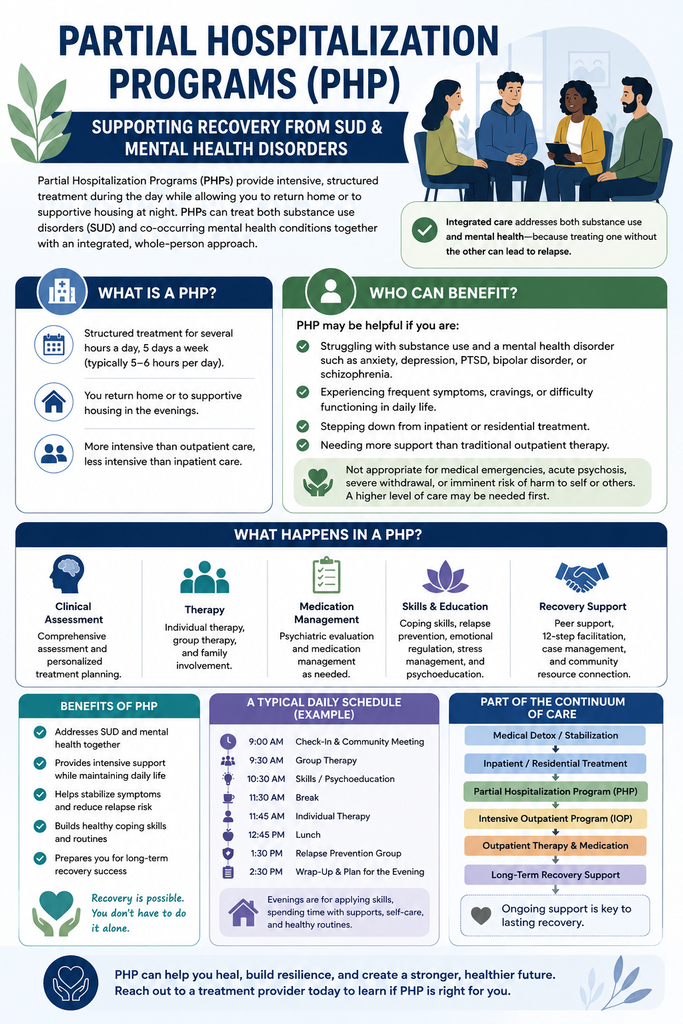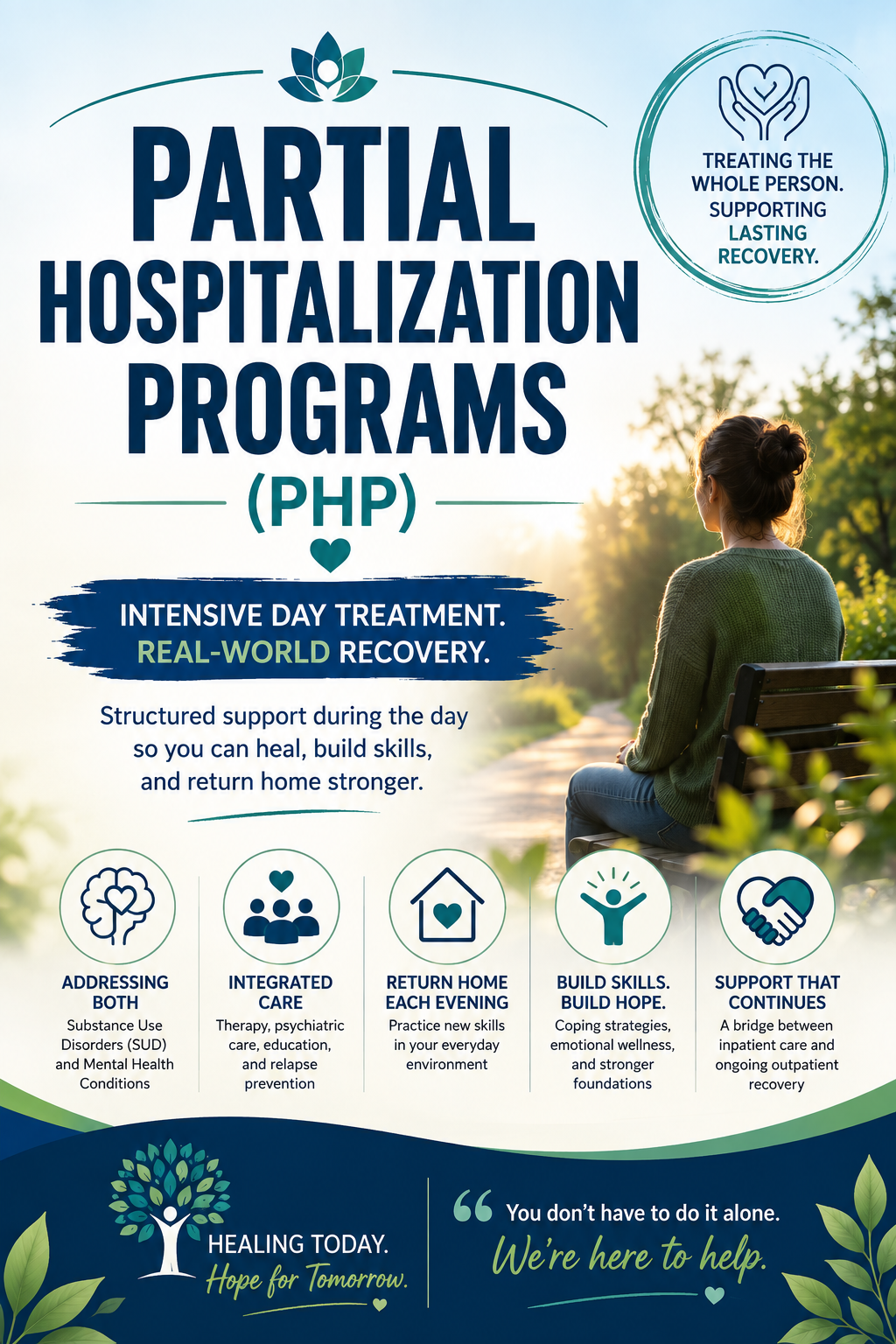
Partial Hospitalization Programs (PHPs) provide an important level of care for individuals managing substance use disorders (SUDs) and co-occurring mental health conditions. These programs offer intensive, structured treatment during the day while generally allowing participants to return home or to supportive housing in the evening. PHPs can combine addiction treatment, individual and group therapy, psychiatric care, medication management, relapse-prevention education, and coping-skills development within a coordinated treatment plan. By addressing substance use and mental health symptoms together, PHPs can help individuals stabilize their conditions, recognize triggers, develop healthier coping strategies, and prepare for greater independence in recovery. They can also provide an important transition between inpatient or residential treatment and less-intensive outpatient care.
Partial Hospitalization Programs for Managing SUD and Mental Health Disorders
A Partial Hospitalization Program (PHP) is a highly structured form of outpatient treatment designed for people who need substantially more support than traditional weekly therapy but do not require 24-hour inpatient hospitalization. PHPs can be particularly valuable for people living with substance use disorders (SUDs) and co-occurring mental health conditions, such as depression, anxiety, PTSD, bipolar disorder, or schizophrenia.
PHPs often involve several hours of treatment per day, multiple days per week, while allowing participants to return home or to supportive housing at night. The linked Muse Treatment article on Partial Hospitalization Programs describes a typical schedule of approximately 5 to 6 hours of structured treatment, 5 days per week.
Why PHPs Are Important for Co-Occurring Disorders
SUD and mental health disorders frequently interact. A person may use alcohol or drugs to cope with depression, anxiety, trauma, hallucinations, insomnia, or emotional distress. At the same time, substance use can trigger or worsen psychiatric symptoms. According to SAMHSA’s information on co-occurring disorders, approximately 21.2 million U.S. adults had both a mental illness and SUD in 2024.
Because these conditions influence one another, treating only the addiction while ignoring the psychiatric disorder—or vice versa—can leave an important driver of recurrence untreated. SAMHSA recommends integrated treatment, in which mental health and substance-use interventions are coordinated around the whole person. Integrated care is associated with improvements in substance use, psychiatric symptoms, functioning, quality of life, and other recovery outcomes.
What Happens in a PHP?
Treatment varies by program and individual needs, but a comprehensive PHP may include psychiatric assessment, medication management, individual and group psychotherapy, addiction counseling, relapse-prevention training, psychoeducation, coping-skills development, family involvement, peer support, case management, and discharge planning.
For SUD specifically, treatment should also incorporate evidence-based interventions appropriate to the substance involved. When indicated, this can include medications for addiction treatment alongside behavioral therapies and recovery support.
The intensity of PHP treatment also provides clinicians with frequent opportunities to evaluate cravings, substance use, mood changes, medication response, sleep, functioning, withdrawal concerns, and recurrence risk. Treatment plans can therefore be adjusted as the person’s condition changes.
PHP as Part of the Continuum of Care
PHP is best understood as a level of care rather than a single therapy. It can serve as a bridge between inpatient/residential treatment and less-intensive outpatient treatment:
Medical detox/inpatient stabilization → Residential treatment when needed → PHP → Intensive outpatient program (IOP) → Standard outpatient treatment → Long-term recovery support
For substance-use treatment, Level 2.5 partial hospitalization programs can also provide enhanced services for people with co-occurring conditions. Such programs should have psychiatric services appropriate to the patient’s mental health condition and timely access to psychiatric care.
PHP may therefore be appropriate when someone is medically and psychiatrically stable enough to remain outside a hospital overnight but still requires frequent clinical monitoring and intensive therapeutic support.
An Important Limitation
PHP is not a substitute for emergency hospitalization, medically supervised withdrawal management, or 24-hour residential care when those services are clinically necessary. Someone experiencing severe or complicated withdrawal, acute psychosis, severe medical instability, imminent danger to themselves or others, or another psychiatric or medical emergency may require a higher level of care before transitioning into PHP.
Ultimately, the strength of PHP for people with SUD and mental health disorders is its ability to provide intensive, integrated treatment without completely removing the individual from everyday life. When appropriately matched to clinical severity, it can help stabilize psychiatric symptoms, strengthen coping and recovery skills, address substance-use triggers, improve medication management, involve families, and prepare the person for progressively less intensive treatment as recovery becomes more stable.
Self-Management Strategies for Using Partial Hospitalization Programs to Manage SUD and Mental Health Disorders
A Partial Hospitalization Program (PHP) provides intensive, structured treatment during the day while generally allowing a person to return home at night. PHPs can be especially useful when substance use disorder (SUD) and a mental health disorder occur together, because both conditions can be addressed within a coordinated treatment plan. SAMHSA emphasizes integrated treatment for co-occurring disorders because addressing both conditions together can improve substance-use, psychiatric, functioning, and quality-of-life outcomes.
Self-Management Strategies
1. Understand your diagnoses. Learn how SUD and the co-occurring mental health condition affect one another. Depression, anxiety, PTSD, bipolar disorder, schizophrenia, and other conditions may influence substance use, while alcohol or drugs can worsen psychiatric symptoms. Understanding this relationship can make triggers and warning signs easier to recognize.
2. Participate consistently in the PHP. Treat attendance as an essential part of recovery. PHPs typically provide substantially more treatment contact than routine outpatient appointments; programs may include individual therapy, group treatment, coping-skills education, and coordinated care.
3. Track symptoms, cravings, and triggers. Keep a simple daily record of mood, anxiety, sleep, cravings, substance-use thoughts, medication effects, and situations that trigger distress. Bring this information to treatment so the clinical team can identify patterns and modify the treatment plan when appropriate.
4. Practice coping skills outside treatment. PHP should extend beyond the hours spent at the facility. Practice techniques learned in therapy—such as grounding, mindfulness, emotional regulation, problem-solving, healthy distraction, and craving-management strategies—when real-life stressors occur.
5. Follow the medication plan carefully. Take prescribed psychiatric or SUD medications as directed and discuss side effects, missed doses, cravings, or concerns with the treatment team rather than changing medications independently. This is particularly important with co-occurring disorders because medication interactions and substance use can complicate treatment.
6. Establish a structured daily routine. Create predictable times for waking, meals, PHP attendance, medication, physical activity, relaxation, and sleep. Structure can reduce unplanned periods when boredom, isolation, stress, or cravings become harder to manage.
7. Develop a personal trigger plan. Identify people, places, emotions, situations, and environmental cues associated with substance use or worsening psychiatric symptoms. For each major trigger, identify a healthier response—for example, contacting a supportive person, leaving a high-risk environment, attending a recovery meeting, or using a coping skill.
8. Build a recovery support network. Identify several people who can provide different types of support, such as family members, trusted friends, therapists, peer-support specialists, sponsors, or recovery groups. Recovery should not depend on a single person.
9. Protect sleep and physical health. Regular sleep, nutritious meals, hydration, exercise, and appropriate medical care support emotional regulation and recovery. Significant changes in sleep, appetite, energy, or functioning should also be discussed with the treatment team because they may indicate worsening psychiatric symptoms.
10. Create an early-warning system. Learn your personal signs that recovery is becoming unstable. Examples might include increasing cravings, skipping treatment, stopping medication, isolating, worsening depression or anxiety, returning to substance-using environments, or thinking that occasional substance use is manageable. Recognizing changes early creates an opportunity to intervene before a larger crisis develops.
11. Be transparent with the treatment team. If substance use occurs, cravings intensify, medications are not being taken, or psychiatric symptoms worsen, tell the clinical team. This information helps clinicians determine whether the current treatment plan remains appropriate.
12. Prepare for life after PHP. PHP is usually one part of a larger continuum of care rather than the endpoint of recovery. Before discharge, develop a continuing-care plan that may include an intensive outpatient program, individual therapy, psychiatric follow-up, medications for SUD when indicated, peer recovery support, family involvement, and routine outpatient care. SAMHSA notes that people may need more than one type of treatment and that the intensity of care should match individual needs.
Key Takeaway
Successful self-management in PHP means turning treatment into daily habits. The individual learns to monitor symptoms, recognize triggers, manage cravings, take medications safely, use coping strategies, maintain healthy routines, seek support early, and communicate openly with clinicians. For someone experiencing both SUD and a mental health disorder, the goal is not simply abstinence or psychiatric symptom control in isolation—it is learning how to manage both conditions together as part of long-term recovery.
Family Support Strategies for Partial Hospitalization Programs Managing SUD and Mental Health Disorders
Family involvement can be an important part of a Partial Hospitalization Program (PHP) for someone experiencing both a substance use disorder (SUD) and a mental health disorder. PHPs provide intensive daytime treatment while allowing patients to remain connected with their home environment. Some programs incorporate family therapy and family education alongside individual therapy, group therapy, psychiatric services, and treatment for co-occurring disorders.
1. Learn About Both Disorders
Family members should educate themselves about SUD and the co-occurring psychiatric condition rather than viewing them as unrelated problems. Substance use can worsen psychiatric symptoms, while mental health symptoms may contribute to substance use as a coping mechanism. SAMHSA recommends integrated approaches that address both conditions together.
2. Understand the Purpose of PHP
Families should understand that PHP is more intensive than routine outpatient treatment but generally does not require an overnight stay. The linked Muse Treatment PHP overview describes PHP as approximately five to six hours of structured treatment five days per week. The exact schedule and services vary by program.
Understanding this structure can help families recognize that PHP is active treatment, not simply daytime supervision.
3. Participate in Family Education and Therapy
When the patient agrees and the program offers it, family members can participate in family therapy, psychoeducation, or treatment-planning sessions. SAMHSA identifies family involvement as one factor to consider when evaluating the quality of behavioral health treatment.
These sessions can help families improve communication, understand symptoms, recognize triggers, establish appropriate boundaries, and learn how to respond to setbacks.
4. Support Treatment Without Controlling It
Family members can encourage attendance, adherence to prescribed medication, participation in therapy, healthy routines, and follow-up appointments. However, recovery ultimately requires the patient’s participation.
A useful distinction is support versus control. Supporting treatment might mean providing transportation or encouragement. Trying to monitor every movement, argument, medication, or decision can increase family conflict and may undermine the person’s developing independence.
5. Create a Recovery-Supportive Home
Because PHP participants commonly return home after treatment, the home environment matters. Families can work with the treatment team to identify appropriate changes, such as reducing exposure to alcohol or drugs, limiting contact with high-risk situations, supporting regular sleep and meals, and creating predictable daily routines.
The goal is not to make the household perfect. It is to make recovery safer and easier to practice outside treatment hours.
6. Learn the Person’s Warning Signs
Families can learn to recognize changes that may indicate increasing risk, such as escalating cravings, withdrawal from others, missing PHP sessions, major sleep changes, medication problems, increasing substance-related behaviors, severe mood changes, paranoia, agitation, or deterioration in daily functioning. Symptoms differ considerably depending on the individual and diagnosis.
Families should ask the treatment team what specific warning signs require contacting the PHP and what symptoms require emergency evaluation.
7. Develop a Family Crisis Plan
Before a crisis occurs, the family and treatment team should establish a plan identifying whom to contact, where medications and important information are kept, what constitutes an emergency, and when a higher level of care may be necessary.
PHP is not appropriate for every situation. Severe intoxication or withdrawal, serious medical instability, or an acute psychiatric crisis may require emergency or inpatient treatment rather than continuing routine PHP attendance.
8. Use Healthy Communication
Families can practice calm, specific, non-stigmatizing communication. Instead of labeling someone as irresponsible or manipulative, describe the behavior of concern and its effect.
For example, saying, “I’ve noticed you’ve missed two treatment days and haven’t been sleeping. I’m concerned and think we should contact your treatment team,” focuses on observable changes and an appropriate next step.
9. Establish Healthy Boundaries
Supporting recovery does not mean protecting someone from every consequence of substance use or psychiatric symptoms. Families may need boundaries concerning money, substances in the home, transportation, aggression, childcare, medication safety, or other household responsibilities.
Ideally, significant boundaries should be discussed with the treatment team so they support the person’s treatment plan rather than unintentionally working against it.
10. Prepare for the Transition After PHP
PHP is generally one stage within a longer treatment process. Families should participate, when appropriate, in discharge planning and understand what comes next—such as an intensive outpatient program, outpatient psychotherapy, psychiatric follow-up, medications for SUD when indicated, primary care, peer recovery services, or community support.
SAMHSA emphasizes integrated treatment for co-occurring disorders because coordinated mental health and substance-use interventions are associated with better psychiatric symptoms, functioning, quality of life, treatment success, and other outcomes.
11. Take Care of the Family, Too
Family members also need support. Living alongside addiction and serious mental health symptoms can create chronic stress, fear, anger, exhaustion, and disrupted family relationships. Counseling, family support groups, education, adequate sleep, exercise, social connections, and maintaining personal activities can help relatives preserve their own well-being.
Key Takeaway
The family’s role in PHP is not to become the patient’s therapist or treatment monitor. Instead, families can become informed partners in recovery by learning about both disorders, participating in treatment when appropriate, creating a supportive home environment, establishing healthy boundaries, recognizing warning signs, preparing for crises, and supporting continued care after PHP.
For co-occurring SUD and mental health disorders, one of the most important lessons for families is that both conditions need attention. Treating addiction while ignoring psychiatric symptoms—or addressing mental health while overlooking substance use—can leave important contributors to recurrence untreated.
Community Resource Strategies for Partial Hospitalization Programs Managing SUD and Mental Health Disorders
Community resources can strengthen a Partial Hospitalization Program (PHP) by extending treatment beyond the hours a person spends in the program. For individuals managing both substance use disorder (SUD) and a mental health disorder, community-based services can address treatment continuity, housing, transportation, peer support, medical care, employment, family needs, and other factors that influence long-term recovery. SAMHSA specifically identifies healthcare professionals, community-based programs, and recovery supports as components of SUD treatment and recovery.
1. Connect With Community Behavioral Health Services
Community mental health centers and behavioral health organizations can provide psychiatric care, counseling, medication management, case management, and SUD services after PHP hours or following discharge. Ideally, services should address both mental health and substance use needs, rather than treating each condition in isolation.
SAMHSA’s treatment locator can help individuals and families find state-licensed providers specializing in mental health and substance use treatment.
FindTreatment.gov Treatment Locator
2. Incorporate Peer Recovery Support
Peer recovery specialists and community recovery organizations can complement clinical PHP services. People with lived recovery experience can provide encouragement, practical guidance, accountability, and assistance navigating community resources.
Peer support can be especially useful during the transition from PHP to less-intensive outpatient treatment, when the individual has fewer hours of structured clinical care.
3. Utilize Community Recovery Groups
Community-based recovery groups can provide social connection and continuing support outside PHP. Depending on personal preferences, this may include 12-step programs, secular recovery organizations, faith-based recovery programs, or groups specifically addressing co-occurring disorders.
PHP staff can help patients determine which community support approach best fits their treatment goals, rather than assuming a single model works for everyone.
4. Coordinate Primary and Behavioral Healthcare
People with SUD and psychiatric disorders may also experience chronic medical conditions that require ongoing treatment. PHP case managers can help connect individuals with primary-care clinicians, pharmacies, specialty services, and community health centers.
Coordination becomes particularly important when multiple clinicians prescribe medications or when medications are being used to treat opioid or alcohol use disorders.
5. Address Housing and Basic Needs
Recovery can become significantly more difficult when someone lacks stable housing, transportation, food, or financial resources. PHP social workers and case managers can connect patients with community programs addressing these needs.
Housing programs, food assistance, transportation programs, vocational rehabilitation, employment services, and legal assistance may therefore function as important components of a broader recovery plan—not simply as unrelated social services.
6. Develop Community Crisis Resources
Patients and families should know where to obtain help when symptoms escalate outside PHP operating hours. Crisis planning can include local crisis stabilization services, mobile crisis teams where available, emergency departments, and other community crisis programs.
In the United States, SAMHSA identifies 988 as an option for people experiencing mental health, substance-use, or emotional crises; emergencies involving immediate danger or a medical emergency require emergency medical assistance.
7. Connect Families With Community Support
Family members may also benefit from education, counseling, and peer-support programs. Community organizations can teach relatives about addiction, psychiatric symptoms, healthy communication, boundaries, crisis recognition, and ways to support recovery without taking responsibility for the person’s treatment.
Family support is particularly valuable when the person returns home every evening after participating in PHP.
8. Use Community Case Management
A community case manager or care coordinator can help connect the different pieces of treatment. For example, the person might simultaneously receive psychiatric medication management, SUD treatment, primary care, housing assistance, and peer recovery services.
Care coordination can help prevent a common problem in behavioral healthcare: multiple services operating independently rather than functioning as a single recovery system.
9. Plan the Transition From PHP Early
Community-resource planning should begin before PHP discharge, not on the final treatment day. The patient and treatment team should identify the next level of behavioral healthcare, psychiatric follow-up, medication providers, recovery meetings, peer services, primary care, and social-support resources.
SAMHSA’s treatment locators include resources for mental health and SUD treatment, opioid treatment programs, and programs for early serious mental illness.
10. Reduce Barriers to Community Treatment
Simply giving someone a list of resources may not be enough. Programs should identify practical barriers such as insurance coverage, cost, transportation, childcare, work schedules, language, disability accommodations, and appointment availability.
Whenever possible, PHP case managers can help patients make appointments and establish connections before discharge, creating a smoother transition into community care.
Key Takeaway
A Partial Hospitalization Program should not operate as an isolated treatment experience. Effective management of co-occurring SUD and mental health disorders requires a community network surrounding the individual. PHPs can serve as the clinical hub, while outpatient clinicians, community mental health centers, primary care, peer recovery programs, family supports, housing services, social-service agencies, and crisis resources provide the infrastructure necessary for sustained recovery.
For people who are unsure where to begin, SAMHSA’s National Helpline provides free, confidential, 24-hour information and referrals to local treatment facilities, support groups, and community organizations.
Frequently Asked Questions
Here are some common questions:
1. What is a Partial Hospitalization Program (PHP)?
A PHP is an intensive, structured treatment program for people who need more support than traditional outpatient care but generally do not require 24-hour hospitalization. Participants attend treatment during the day and typically return home or to supportive housing afterward.
2. Can PHP treat both substance use and mental health disorders?
Yes. Some PHPs specialize in co-occurring disorders, meaning they address substance use disorder (SUD) and mental health conditions at the same time. Integrated treatment is particularly important because substance use can worsen psychiatric symptoms, while untreated mental health symptoms can contribute to continued substance use.
3. What mental health conditions may be treated in a PHP?
Depending on the program, PHPs may treat conditions such as depression, anxiety disorders, PTSD, bipolar disorder, and other psychiatric conditions occurring alongside SUD. People with severe or unstable symptoms may require a higher level of care first.
4. How many hours a day does PHP treatment involve?
Schedules vary. The linked Muse Treatment PHP overview describes PHP treatment as approximately five to six hours per day, five days per week. Other programs may use different schedules.
5. What happens during a typical day in PHP?
Treatment may include individual and group therapy, psychiatric evaluation, medication management, addiction counseling, psychoeducation, coping-skills training, relapse-prevention planning, peer support, family involvement, and case management. The exact combination depends on individual needs and the services offered by the program.
6. Is PHP the same as inpatient or residential treatment?
No. In inpatient or residential treatment, individuals generally remain at the treatment facility around the clock. PHP provides intensive daytime services while allowing clinically appropriate participants to leave after programming.
7. How is PHP different from an Intensive Outpatient Program (IOP)?
PHP generally provides more treatment hours and greater clinical structure than IOP. A person may transition from inpatient or residential treatment to PHP, then to IOP and standard outpatient treatment as greater stability and independence are achieved.
8. Can medications be used during PHP treatment?
Yes, when clinically appropriate. Psychiatric medications may be used to manage mental health conditions, and evidence-based medications may be offered for certain SUDs. Medication decisions should be individualized and managed by qualified healthcare professionals.
9. Does PHP provide medical detoxification?
Not necessarily. Someone at risk for severe or complicated withdrawal may require medically supervised withdrawal management or hospitalization before entering PHP. The appropriate level of care should be determined through clinical assessment.
10. Who may benefit from PHP?
PHP may be considered for someone who needs frequent therapeutic and psychiatric support but is sufficiently medically and psychiatrically stable to remain outside a hospital overnight. It can also provide a transition from inpatient or residential treatment into community-based recovery.
11. What role does the family have in PHP?
When appropriate and with the patient’s consent, families may participate in education, counseling, discharge planning, or family therapy. Families can learn about SUD, psychiatric symptoms, communication, healthy boundaries, warning signs, and ways to create a recovery-supportive home.
12. What happens if symptoms worsen while attending PHP?
The treatment team should reassess the person’s condition. Increasing substance use, severe withdrawal, significant psychiatric deterioration, inability to function safely, or other acute concerns may indicate that a different or higher level of care is necessary.
13. How long does someone stay in PHP?
There is no universal duration. The length of treatment depends on clinical severity, progress, safety, insurance considerations, available resources, and the individual’s continuing care needs.
14. What happens after completing PHP?
Discharge planning may include IOP, outpatient psychotherapy, psychiatric care, medications, primary care, peer recovery services, family support, community programs, and recovery groups. Continuing care is important because recovery from SUD and many mental health disorders requires ongoing management.
15. Does completing PHP guarantee that someone will not relapse?
No. PHP can reduce risks by strengthening coping skills, treating psychiatric symptoms, addressing triggers, and establishing recovery supports, but no treatment can guarantee that substance use will never recur. A return to substance use should prompt reassessment and treatment adjustment rather than being viewed simply as treatment failure.
16. How can someone determine whether PHP is the right level of care?
A comprehensive assessment by qualified addiction and mental health professionals is the best approach. Clinicians consider substance use, withdrawal risk, psychiatric symptoms, physical health, safety, home environment, functioning, previous treatment, and available support before recommending an appropriate level of care.
Conclusion
Partial Hospitalization Programs can serve as a valuable bridge in the continuum of care for people experiencing SUD and mental health disorders. Their structured approach provides intensive clinical support while giving individuals opportunities to practice recovery skills in their everyday environments. Successful treatment extends beyond attending the program; it involves medication adherence when prescribed, healthy routines, family and peer support, community resources, relapse-prevention planning, and continued behavioral healthcare. Because every person’s clinical needs and level of risk differ, PHP should be selected through an individualized assessment and followed by an appropriate continuing care plan. When comprehensive treatment, personal participation, family support, and community resources work together, PHP can help establish a stronger foundation for psychiatric stability, sustained recovery, and improved quality of life.
Video: Is Inpatient Too Much? Try PHP #mentalhealth