Have you ever walked away from a painful relationship, determined to make better choices, only to find yourself attracted to someone who reminds you of your previous partner? Although the person may be different, the relationship follows a familiar cycle of intense attraction, overlooked warning signs, emotional ups and downs, disappointment, conflict, and heartbreak.
Repeatedly dating the same unhealthy type does not mean someone intentionally seeks harmful relationships. Romantic choices may be shaped by attachment patterns, childhood experiences, self-esteem, loneliness, past trauma, family dynamics, and personal beliefs about love and relationships.
Recognizing these patterns is the first step toward breaking unhealthy relationship cycles, establishing stronger boundaries, and making conscious choices that lead to healthier, more fulfilling relationships.
Why Familiar Can Feel Like Love
Human beings naturally become comfortable with what feels familiar.
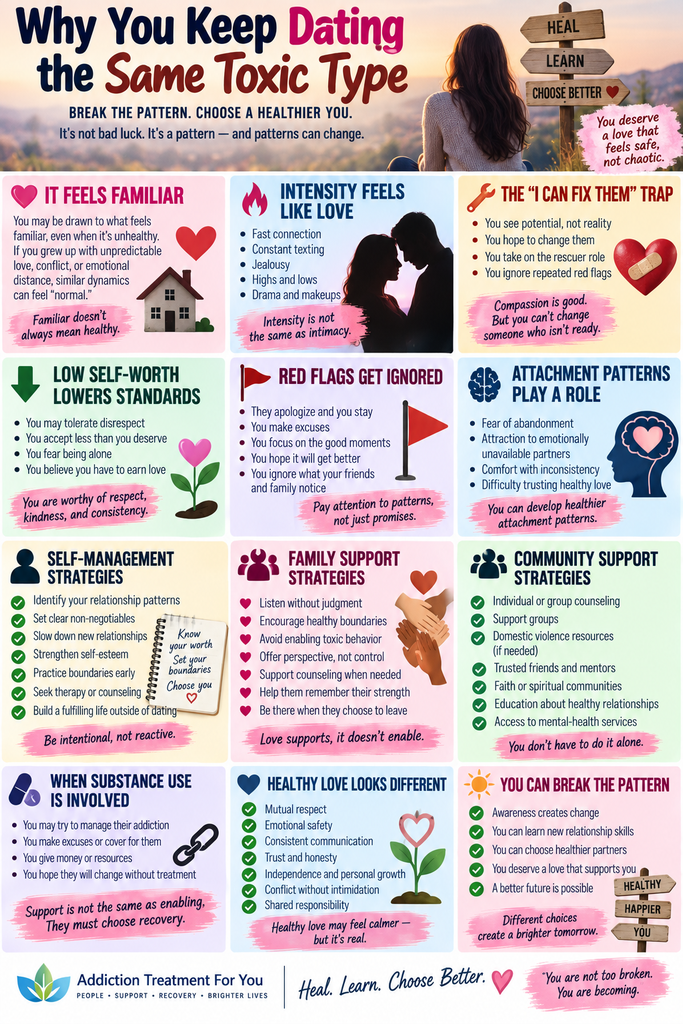
If someone grew up around unpredictable affection, frequent conflict, emotional distance, criticism, or inconsistent attention, similar relationship dynamics may feel recognizable later in life. Familiarity does not necessarily mean the relationship is healthy.
Someone may think:
- “This chemistry is incredible.”
- “I can change them.”
- “They just need someone who understands them.”
- “Relationships are supposed to be difficult.”
- “If I love them enough, they’ll eventually treat me better.”
- “Being alone would be worse.”
- “Maybe I’m expecting too much.”
Over time, these beliefs can keep someone invested in relationships that repeatedly cause emotional distress.
Intensity Is Not the Same as Intimacy
One reason unhealthy relationships can initially feel attractive is intensity.
Constant texting, rapid declarations of love, dramatic arguments, jealousy, breakups followed by passionate reunions, and emotional highs and lows can create powerful experiences.
But intensity should not automatically be interpreted as emotional closeness.
Healthy intimacy usually develops through consistency, trust, communication, respect, vulnerability, and time.
A calmer relationship may initially seem less exciting to someone accustomed to instability. Learning to tolerate healthy predictability can therefore become part of breaking an unhealthy dating pattern.
Attachment Patterns Can Influence Relationships
Attachment experiences can affect how adults approach closeness, rejection, independence, and emotional security.
Someone who fears abandonment may become strongly attached to emotionally unavailable partners. Another person may repeatedly choose distant partners because deep emotional intimacy feels uncomfortable.
Attachment patterns are not permanent identities. They are frameworks that can help people understand behaviors and develop healthier ways of relating.
The goal is not to label yourself. The goal is to recognize patterns.
The “I Can Fix Them” Trap
Some people repeatedly become involved with partners they believe they can rescue.
They may be attracted to someone struggling with addiction, anger, instability, financial problems, repeated infidelity, or emotional unavailability.
Compassion is valuable, but it does not require taking responsibility for another adult’s recovery.
A healthier question is not:
“Can I save this person?”
It is:
“Is this person currently capable of participating in the kind of relationship I want?”
People can change, but lasting change requires their participation.
Low Self-Worth Can Lower Relationship Standards
How people view themselves can influence what they tolerate.
Someone who believes they are difficult to love may accept behavior they would immediately recognize as unacceptable if it were directed at a friend.
They might tolerate:
- Repeated dishonesty
- Disrespect
- Controlling behavior
- Constant criticism
- Emotional manipulation
- Broken promises
- Extreme jealousy
- Boundary violations
- Repeated substance-related crises
- Chronic instability
Developing self-respect does not mean expecting perfection. It means recognizing that love does not require repeatedly sacrificing emotional safety.
Why Red Flags Get Ignored
Red flags are sometimes visible early in relationships but become minimized because attraction is strong.
People may explain them away:
“They’ve had a difficult life.”
“They’re only jealous because they care.”
“They apologized.”
“They promised it won’t happen again.”
“They’re different when we’re alone.”
One isolated mistake does not necessarily define someone. The important question is whether there is a repeated pattern.
Pay attention to consistency between words and behavior.
Self-Management Strategies for Breaking the Pattern
Changing relationship patterns begins with understanding your own choices rather than focusing exclusively on identifying “bad people.”
Helpful self-management strategies include:
- Identify your relationship history. Write down similarities among previous partners and relationships.
- Define your non-negotiables. Decide which behaviors you will not accept before becoming emotionally invested.
- Slow down new relationships. Give someone’s behavior time to match their promises.
- Notice your strongest attractions. Ask what specifically feels exciting and whether it resembles previous unhealthy dynamics.
- Practice boundaries early. Small boundaries can reveal whether someone respects your needs.
- Strengthen self-esteem outside relationships. Develop friendships, interests, goals, and routines that are independent of romantic validation.
- Learn to tolerate healthy stability. Calm relationships may initially feel unfamiliar without being boring.
- Avoid the rescuer role. Support is different from assuming responsibility for another person’s life.
- Consider counseling. Therapy can help identify attachment patterns, trauma responses, beliefs, and relationship habits.
- Give yourself permission to leave. You do not need to prove that someone is a terrible person before deciding that a relationship is unhealthy for you.
Family Support Strategies
Families often recognize unhealthy relationship patterns before the person involved is ready to acknowledge them.
However, repeatedly criticizing someone’s partner can sometimes cause defensiveness and isolation.
Families can provide healthier support by:
- Listening without immediately saying, “I told you so.”
- Asking questions rather than issuing demands.
- Helping the person recognize recurring patterns.
- Reinforcing healthy boundaries.
- Avoiding financial or emotional enabling that leads to repeated crises.
- Encouraging counseling when appropriate.
- Maintaining connection even when they disagree with relationship choices.
- Reminding the person of their strengths outside the relationship.
- Offering practical help when someone decides to leave.
- Taking threats, stalking, coercive control, or physical violence seriously.
Family members cannot choose someone’s partner for them. They can provide a stable environment in which healthier choices become easier.
Community Support Strategies
Unhealthy relationship patterns can become more difficult to change when someone feels isolated.
Community support provides perspectives outside the relationship.
Helpful resources may include:
- Individual counseling
- Relationship or family counseling when appropriate and safe
- Support groups
- Domestic violence organizations
- Trauma-informed mental-health services
- Peer-support communities
- Faith or spiritual communities, when desired
- Healthy friendships
- Educational programs about boundaries and relationships
- Community mental-health centers
Community support can help someone realize that asking for assistance does not mean they have failed at relationships.
When Substance Use Enters the Relationship
Repeatedly choosing partners with untreated substance-use problems can create another complicated relationship pattern.
Someone may gradually become responsible for managing crises, providing money, making excuses, covering missed responsibilities, or attempting to control another person’s substance use.
Family and romantic support can be valuable during recovery, but one partner cannot recover for another person.
Healthy support may involve encouraging treatment while refusing to participate in behaviors that maintain the problem.
Boundaries Are Not Punishment
People sometimes avoid boundaries because they fear appearing selfish or uncaring.
But boundaries describe what you will do when certain situations occur.
For example:
“If you yell at me, I will end the conversation.”
“I will not give you money to purchase substances.”
“I will not stay in a relationship where I am repeatedly threatened.”
These statements differ from attempts to control another person’s behavior.
Boundaries protect well-being while allowing the other person to remain responsible for their choices.
Stop Falling in Love With Potential
Another common pattern involves becoming attached to who someone could become rather than who they consistently are.
You may see intelligence, kindness, creativity, ambition, or vulnerability and imagine what the relationship would look like if the person’s unhealthy behaviors disappeared.
Potential can be encouraging, but relationships happen in the present.
Ask yourself:
“If nothing about this person changed, would I still choose this relationship?”
That question can reveal whether you love the relationship you actually have or the relationship you hope will eventually exist.
Healthy Love May Feel Different
After repeated unstable relationships, healthy relationships can initially feel unfamiliar.
Healthy relationships usually include:
- Mutual respect
- Emotional safety
- Consistent communication
- Trust
- Individual independence
- Appropriate boundaries
- Shared responsibility
- Conflict without intimidation
- Accountability after mistakes
- Freedom to say no
- Support for personal growth
Healthy relationships still involve disagreements and imperfections. The difference is that problems can be addressed without repeatedly destroying trust or emotional safety.
From Repetition to Awareness
Breaking a relationship pattern does not require you to become suspicious of everyone you date.
It requires becoming more observant.
Instead of asking only:
“Do they like me?”
Ask:
“Do I like who I become around them?”
Instead of:
“Do we have chemistry?”
Ask:
“Do we have compatibility, respect, and emotional safety?”
Instead of:
“Will they choose me?”
Ask:
“Am I choosing a relationship that is healthy for me?”
These questions shift dating from seeking approval toward making intentional decisions.
Conclusion
Repeatedly dating the same unhealthy type does not mean you are destined to repeat the same relationship forever. Patterns become easier to change once they become visible.
Self-management involves understanding your triggers, attachment patterns, boundaries, and beliefs about relationships. Families can provide connection and perspective without taking control. Communities can offer counseling, education, peer support, and safety resources when relationships become harmful.
The goal is not to become perfect at identifying “toxic people.” It is to become better at recognizing healthy behavior, trusting consistent evidence, setting boundaries, and choosing relationships that support your well-being.
Sometimes the biggest change in a relationship is not finding a completely different type of person.
It is becoming a healthier version of yourself who no longer mistakes familiar dysfunction for love.
Frequently Asked Questions
Here are some common questions:
1. Why do I keep dating the same toxic type of person?
People sometimes repeat relationship patterns because certain personalities or relationship dynamics feel familiar. Past relationships, attachment experiences, self-esteem, loneliness, fear of abandonment, and expectations about love can influence whom someone finds attractive.
The important point is that a repeated pattern is not a permanent destiny. Once you recognize the pattern, you can begin making more intentional choices.
2. Does repeatedly choosing unhealthy partners mean something is wrong with me?
No. Repeated relationship patterns are better viewed as behaviors and expectations that can be examined and changed rather than evidence that something is fundamentally wrong with you.
Instead of asking, “What’s wrong with me?” consider asking:
- What qualities repeatedly attract me?
- What warning signs do I overlook?
- What behaviors do I tolerate?
- What am I afraid will happen if I leave?
- What would a healthier relationship look like?
These questions encourage self-awareness rather than self-blame.
3. Can childhood experiences affect adult dating choices?
They can. Early experiences with caregivers may influence expectations about closeness, trust, rejection, and emotional security. However, childhood experiences are only part of the picture. Later relationships and life experiences can also influence how people relate to partners.
Understanding your history can help explain a pattern without requiring you to remain trapped by it.
4. What does attachment style have to do with dating?
Attachment describes patterns involving emotional closeness, trust, security, anxiety, and avoidance in relationships.
Someone with higher attachment anxiety may worry intensely about rejection or abandonment. Someone with higher attachment avoidance may become uncomfortable with dependence or emotional closeness.
Attachment styles should not become permanent labels. Relationship experiences can influence attachment, and people can develop greater security over time.
5. Why does an emotionally unavailable person sometimes feel so attractive?
Uncertainty can produce powerful emotional reactions. When attention is inconsistent, someone may spend considerable time wondering when affection will return.
For a person accustomed to unpredictable relationships, emotional inconsistency can also feel familiar.
Strong attraction therefore does not automatically mean someone is compatible with you.
6. Why do I confuse intensity with love?
An intense relationship may involve constant messaging, rapid commitment, jealousy, dramatic arguments, breakups, reunions, and powerful emotional highs and lows.
Those experiences can feel exciting, but intensity and intimacy are different.
Healthy intimacy usually develops through trust, respect, vulnerability, consistency, communication, and time.
7. Why does a healthy relationship sometimes feel boring?
If someone has become accustomed to unpredictable relationships, consistency may initially feel unfamiliar.
A partner who communicates clearly, respects boundaries, and behaves predictably may not produce the emotional roller coaster associated with previous relationships.
Calm does not necessarily mean there is no chemistry.
Sometimes calm means there is emotional safety.
8. Why do I ignore obvious red flags?
People may minimize warning signs because they are strongly attracted to someone, fear loneliness, hope the person will change, or have already become emotionally invested.
Common rationalizations include:
- “They had a difficult childhood.”
- “They’re just jealous because they love me.”
- “They promised it won’t happen again.”
- “Nobody is perfect.”
- “I can help them change.”
- “Things are wonderful when they’re in a good mood.”
Compassion for someone’s circumstances does not require accepting repeated harmful behavior.
9. What are common relationship red flags?
A single disagreement does not make someone toxic. Look for repeated patterns such as:
- Controlling behavior
- Extreme jealousy
- Repeated dishonesty
- Humiliation or constant criticism
- Disrespect for boundaries
- Isolation from friends or family
- Threats or intimidation
- Monitoring your phone or whereabouts
- Repeated manipulation
- Refusing responsibility for harmful behavior
- Making you afraid to disagree
Repeated coercion, threats, stalking, or violence should be taken particularly seriously.
10. What does a healthy relationship look like?
Healthy relationships generally include:
- Mutual respect
- Honest communication
- Healthy boundaries
- Emotional and physical safety
- Trust
- Individual independence
- Support for each other’s goals
- Ability to disagree without intimidation
- Accountability after mistakes
- Freedom to maintain friendships and interests
- Respect for privacy and consent
Healthy relationships are not conflict-free. The difference is how conflict is handled.
11. Why do I keep trying to fix or rescue my partners?
Helping others can provide a sense of purpose and connection. Problems develop when helping becomes taking responsibility for another adult’s life.
You may repeatedly think:
“If I love them enough, they’ll change.”
But another person’s recovery, emotional growth, or behavioral change requires their participation.
You can support someone without becoming responsible for saving them.
12. Can low self-esteem affect whom I date?
Yes. Someone who doubts their worth may tolerate behavior they would immediately recognize as unacceptable if it were directed at a friend.
Strengthening self-esteem can help you recognize that being in a relationship is not automatically better than being single.
A useful question is:
“Would I want someone I love to accept this behavior?”
If the answer is no, consider why you are accepting it yourself.
13. How can I break the pattern?
Begin by slowing down and becoming curious about your choices.
Helpful self-management strategies include:
- Review similarities among previous relationships.
- Identify your non-negotiable boundaries.
- Write down early warning signs you previously ignored.
- Slow down emotional commitment in new relationships.
- Pay attention to behavior rather than promises.
- Develop friendships and interests outside dating.
- Strengthen self-esteem.
- Learn about healthy relationships.
- Consider individual counseling.
- Practice leaving situations that repeatedly violate your boundaries.
The objective is not to become suspicious of everyone. It is to become more intentional.
14. How can my family support me?
Family members can help by listening without humiliation or “I told you so” comments.
Helpful family support can include:
- Listening without excessive judgment
- Encouraging healthy boundaries
- Pointing out patterns respectfully
- Avoiding financial or emotional enabling
- Encouraging counseling
- Maintaining connection
- Supporting independence
- Providing practical assistance when someone chooses to leave
- Taking safety concerns seriously
Families can provide perspective, but ultimately adults must make their own relationship decisions.
15. What community resources can help?
Depending on the situation, helpful resources may include:
- Individual therapy
- Trauma-informed counseling
- Support groups
- Community mental-health programs
- Domestic-violence organizations
- Trusted friends or mentors
- Family counseling
- Faith or spiritual communities, when desired
- Relationship education programs
Community support becomes particularly important when an unhealthy relationship has caused isolation.
16. What if I repeatedly date people with addiction problems?
Supporting someone with a substance use disorder is different from becoming responsible for that person’s recovery.
Warning signs of an unhealthy dynamic may include repeatedly giving money, covering up consequences, making excuses, managing crises, or sacrificing your own well-being while waiting for the person to change.
You can encourage treatment and recovery while maintaining boundaries.
You cannot recover for another person.
17. Are boundaries selfish?
No. Healthy boundaries communicate what you need to feel respected and safe.
For example:
“I will end the conversation if I’m being yelled at.”
“I won’t give you money to purchase substances.”
“I need time with my friends and family.”
A boundary focuses on what you will do rather than attempting to control another person’s behavior.
18. Should I stay because my partner has the potential to change?
Potential should not be confused with present behavior.
Ask yourself:
“If this person remained exactly as they are today, would I still want this relationship?”
If the relationship works only in an imagined future where the other person becomes completely different, you may be attached more strongly to potential than reality.
19. Can therapy help change unhealthy dating patterns?
Yes. Counseling can help people explore attachment patterns, self-esteem, previous relationship experiences, trauma, boundary difficulties, fear of abandonment, and beliefs about love.
Therapy is not about having someone choose your partner. It can help you understand why you make certain choices and how to make different ones.
20. Can attachment patterns change?
Yes. Attachment is not necessarily fixed throughout adulthood. Ongoing relationships and experiences can influence how secure someone feels with others.
Developing self-awareness, experiencing healthier relationships, improving communication, and receiving appropriate psychological support may all contribute to greater relationship security.
21. When does a “toxic relationship” become an abusive relationship?
A difficult relationship and an abusive relationship are not necessarily the same.
Abuse can involve patterns of power and control, including physical violence, sexual coercion, threats, intimidation, stalking, isolation, financial control, or other behaviors designed to restrict another person’s independence.
If you are afraid of how your partner will react when you express a boundary, that deserves serious attention.
22. What is the biggest lesson about repeatedly dating the same toxic type?
The goal is not simply to become better at identifying “toxic people.”
It is to become better at identifying healthy relationships.
Instead of asking:
“Do they want me?”
Ask:
“Is this relationship good for me?”
Instead of asking:
“Can I change them?”
Ask:
“Do their current actions match the relationship I want?”
Instead of asking:
“Why does this keep happening to me?”
Ask:
“What pattern can I recognize and change?”
Breaking unhealthy relationship cycles begins when attraction is no longer the only qualification for partnership.
You can choose chemistry and compatibility, attraction and respect, closeness and boundaries. Healthy love does not require giving up yourself to keep someone else.
Video: Why your ‘type’ is actually keeping you single #dating #toxic #advice