The Biogenesis doping scandal became one of the most significant performance-enhancing drug controversies in Major League Baseball history. The scandal centered on Biogenesis of America, a South Florida anti-aging clinic connected to professional baseball players and prohibited performance-enhancing substances. The investigation ultimately implicated numerous players and raised difficult questions about competitive pressure, secrecy, personal responsibility, health, and the culture surrounding elite sports.
Unlike a story centered on one athlete, Biogenesis involved a network of people and players. Among the most prominent were Alex Rodriguez, Ryan Braun, and Nelson Cruz.
The scandal provides an important lesson for addiction and behavioral-health education. Performance-enhancing drug use is not automatically addiction. However, the psychological processes surrounding risky drug use—pressure, secrecy, rationalization, fear of failure, and difficulty accepting consequences—can provide valuable lessons about healthier decision-making.
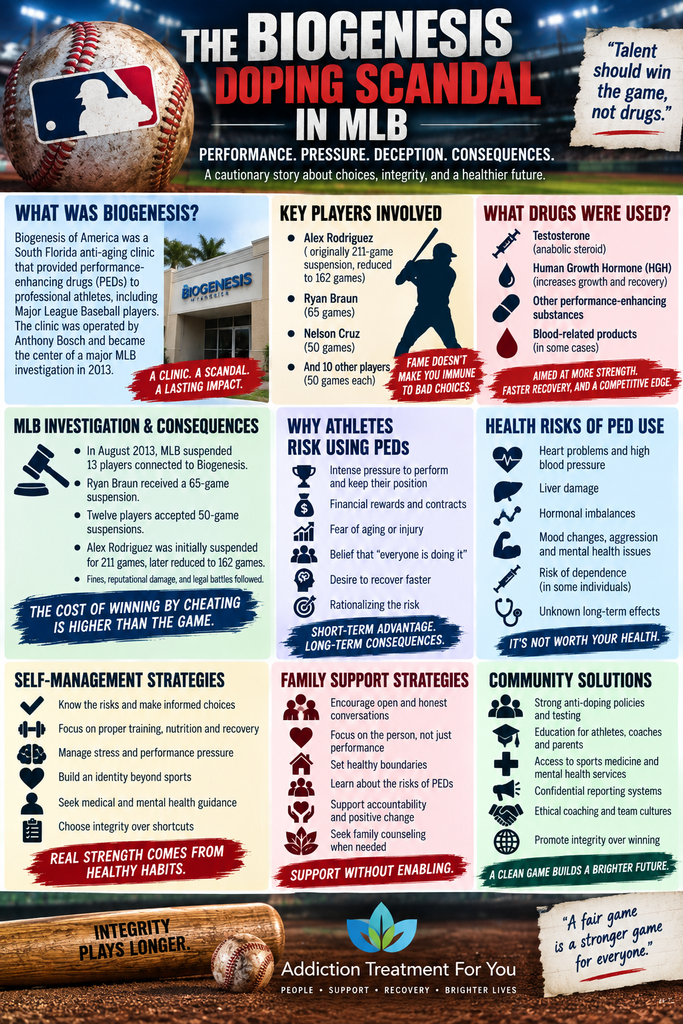
What Was the Biogenesis Scandal?
Biogenesis of America was a South Florida clinic operated by Anthony Bosch. Documents connected to the clinic linked professional baseball players to performance-enhancing substances. Major League Baseball launched an extensive investigation that ultimately led to significant disciplinary action.
In August 2013, MLB announced suspensions for 13 players connected to its Biogenesis investigation. This came shortly after Braun had separately accepted a 65-game suspension. Twelve of the players disciplined in August accepted 50-game suspensions. Rodriguez initially received the most severe punishment—a 211-game suspension—which he appealed.
An arbitrator later reduced Rodriguez’s punishment to a 162-game suspension covering the entire 2014 regular season plus postseason. He eventually withdrew his lawsuits against MLB and the MLB Players Association and served the suspension.
What Performance-Enhancing Drugs Were Involved?
The Biogenesis controversy was not simply a “steroid scandal.”
MLB stated that Rodriguez’s discipline involved the use and possession of multiple prohibited performance-enhancing substances, including testosterone and human growth hormone (HGH). Documents associated with the clinic also described various performance-enhancing products and methods.
Performance-enhancing substances may be used in an attempt to:
- Increase muscle strength or mass
- Improve physical recovery
- Increase endurance
- Maintain performance during a demanding season
- Recover more rapidly from injuries
- Extend an athletic career
The potential competitive benefits do not eliminate the medical, ethical, or professional risks.
Why Would Elite Athletes Risk Everything?
From the outside, it can be difficult to understand why someone earning millions of dollars and competing at the highest level would risk a career by using prohibited substances.
But elite athletes can experience enormous pressure.
A professional athlete may worry about declining performance, injuries, losing a starting position, aging, contract negotiations, or being replaced by younger competitors.
Psychological rationalizations can gradually develop:
- “I need this to stay competitive.”
- “Everyone else has an advantage.”
- “I can’t lose my career.”
- “I’m only doing this temporarily.”
- “I need to recover faster.”
- “I won’t get caught.”
- “I’ve worked too hard to stop now.”
Understanding these thought patterns does not excuse doping. It helps explain how otherwise successful individuals can begin making increasingly risky decisions.
Ryan Braun and Accountability
Braun became the first major player suspended as the Biogenesis investigation intensified. In July 2013, MLB suspended him without pay for the remaining 65 games of the season and postseason. He acknowledged making mistakes and accepting the consequences.
Braun later acknowledged using a cream and lozenge during his recovery from a calf injury and said that he deserved his suspension.
His case demonstrates an important behavioral principle: denial may temporarily protect someone’s reputation, but accountability is necessary to begin rebuilding trust.
Alex Rodriguez and the Consequences of Secrecy
Rodriguez’s case became particularly controversial. MLB said his discipline was based not only on prohibited performance-enhancing substances but also on conduct intended to obstruct its investigation.
His original 211-game suspension was eventually reduced to 162 games by an arbitrator. Rodriguez later stopped pursuing litigation and served the 2014 suspension.
The episode demonstrates how secrecy can magnify an original problem.
When someone begins hiding risky behavior, they may eventually expend enormous emotional energy protecting the secret. Relationships can be damaged not only by the original behavior but also by repeated deception.
Self-Management Strategies
Athletes and other high-performing individuals can develop healthier ways of responding to pressure before risky behaviors become normalized.
Helpful self-management strategies include:
- Identify personal values. Decide whether health, honesty, and long-term well-being are more important than immediate success.
- Recognize rationalization. Challenge thoughts such as “everyone does it” or “I have no choice.”
- Address fear of failure. Losing a position, competition, or contract can be painful without determining someone’s worth.
- Seek medical guidance. Injuries, fatigue, and performance concerns should be evaluated by qualified professionals.
- Protect mental health. Therapy or sports psychology can help athletes manage perfectionism, anxiety, and performance pressure.
- Develop healthy recovery habits. Sleep, nutrition, rehabilitation, and appropriate training are essential.
- Know what enters your body. Athletes should understand medications and supplements and verify whether they comply with applicable anti-doping regulations.
- Build an identity outside sports. Family, education, hobbies, relationships, and community involvement can provide purpose beyond athletic performance.
- Ask for help early. Problems are often easier to address before secrecy and consequences accumulate.
Family Support Strategies
Performance pressure does not affect only athletes. Families can become emotionally and financially invested in someone’s athletic success.
Family support should therefore emphasize the person’s wellbeing rather than simply performance.
Families can:
- Encourage honest conversations about pressure and expectations.
- Avoid making athletic achievement the person’s entire identity.
- Discuss concerns about behavioral or physical changes.
- Encourage professional medical and psychological evaluation.
- Learn about performance-enhancing drugs and their risks.
- Avoid helping conceal prohibited behavior.
- Establish appropriate boundaries.
- Support healthy training and recovery practices.
- Encourage accountability when harmful choices occur.
- Participate in family counseling when trust has been seriously damaged.
Family members should remember that supporting someone and holding them accountable are not opposites.
Community Support Strategies
The Biogenesis scandal also demonstrated that preventing performance-enhancing drug use cannot depend entirely on individual athletes.
Sports organizations, schools, coaches, medical professionals, and communities all influence the environment in which athletes make decisions.
Helpful community strategies include:
- Strong anti-doping policies and testing
- Education about steroids, HGH, and other performance-enhancing substances
- Confidential reporting systems
- Protection for people who report misconduct
- Access to qualified sports medicine professionals
- Mental-health and sports psychology services
- Coaches who value health and integrity
- Education for parents of young athletes
- Clear consequences for prohibited drug use
- Rehabilitation and support after disciplinary action
- Career-transition programs for aging or injured athletes
During the Biogenesis controversy, numerous MLB players publicly emphasized the importance of maintaining a clean and level playing field.
Accountability Without Permanent Shame
One of the most useful lessons from the Biogenesis scandal is the distinction between accountability and permanent shame.
Accountability means:
“I made a harmful decision. I accept responsibility and need to change.”
Shame says:
“I made a harmful decision, therefore I am permanently a bad person.”
Professional consequences may be necessary. Trust may also take significant time to rebuild. But meaningful behavioral change becomes more possible when people accept responsibility and develop healthier ways of living.
Is Performance-Enhancing Drug Use an Addiction?
Not necessarily.
Using steroids, testosterone, HGH, or another prohibited performance-enhancing substance does not automatically mean someone has a substance use disorder. Addiction is a clinical condition involving patterns such as impaired control, continued use despite significant harm, and other diagnostic features.
Some people can develop problematic or compulsive patterns involving anabolic-androgenic steroids, but individual athletes should not be diagnosed simply because they were involved in a doping scandal.
For that reason, the Biogenesis scandal is best described as a performance-enhancing drug and doping scandal, not an “addiction scandal.”
What Can We Learn From Biogenesis?
Perhaps the greatest lesson from Biogenesis is that unhealthy behavior can become easier to justify when people believe that success depends on it.
The scandal teaches us that:
- Success does not guarantee healthy decision-making.
- Competitive environments can normalize risky behavior.
- Fear of losing status can influence judgment.
- Secrecy can magnify the consequences of an original mistake.
- Families should support people rather than only their achievements.
- Organizations have a responsibility to promote ethical environments.
- Accountability is essential for rebuilding trust.
- Mental health and medical support should be available before a crisis develops.
Conclusion
The Biogenesis scandal was much more than a story about baseball players getting suspended. It exposed the complicated relationship between competitive pressure, performance-enhancing drugs, secrecy, organizational culture, and personal responsibility.
For athletes, the lesson is to choose long-term health and integrity over short-term advantages. For families, it is to encourage achievement without making performance the measure of someone’s worth. For communities and sports organizations, the goal is to create environments where athletes can ask for help without believing their careers depend on dangerous shortcuts.
The strongest response to performance-enhancing drug use combines prevention, education, medical care, mental-health support, accountability, and cultural change.
Winning may create a record. Integrity determines what that record ultimately means.
Frequently Asked Questions
Here are some common questions:
1. What was the Biogenesis doping scandal?
The Biogenesis scandal was a major performance-enhancing drug controversy in Major League Baseball that became public in 2013. It centered on Biogenesis of America, a South Florida anti-aging clinic operated by Anthony Bosch that was accused of supplying professional baseball players with prohibited performance-enhancing substances. MLB ultimately disciplined numerous players following its investigation.
2. Who operated the Biogenesis clinic?
Anthony Bosch operated Biogenesis of America. MLB alleged that Bosch and associates were involved in providing players with performance-enhancing substances that violated baseball’s Joint Drug Prevention and Treatment Program.
3. Which MLB players were involved in the scandal?
The investigation resulted in disciplinary action against numerous players. Prominent names included Alex Rodriguez, Ryan Braun, and Nelson Cruz. Other suspended players included Jhonny Peralta, Everth Cabrera, Francisco Cervelli, Antonio Bastardo, Jesus Montero, and several others.
Importantly, simply appearing in reports or clinic records did not establish wrongdoing for every person mentioned. MLB specifically said its investigation found no drug-program violations by Gio Gonzalez or Danny Valencia.
4. What performance-enhancing drugs were connected to Biogenesis?
The substances associated with the investigation included testosterone and human growth hormone (HGH), among other performance-enhancing substances. MLB’s lawsuit against people connected with the clinic also alleged the provision of human chorionic gonadotropin (hCG).
5. Were these substances all steroids?
No. Testosterone is an anabolic-androgenic steroid, but HGH is a peptide hormone rather than an anabolic steroid. Therefore, describing Biogenesis simply as a “steroid scandal” leaves out important parts of the case.
6. Why might professional athletes use performance-enhancing drugs?
Athletes may face intense pressure to maintain strength, recover from injuries, secure contracts, compete with younger players, or prolong their careers. Some may also rationalize PED use because they believe competitors are doing the same thing.
These pressures can help explain risky decisions, but they do not excuse violations of anti-doping rules.
7. How many players were suspended in August 2013?
MLB announced discipline against 13 players on August 5, 2013. Twelve accepted 50-game suspensions. Rodriguez received a much longer suspension and appealed. Several other players connected to Biogenesis had already served suspensions and did not receive additional discipline.
8. What happened to Ryan Braun?
Braun accepted a 65-game suspension in July 2013 covering the remainder of the regular season and any postseason games. He acknowledged making mistakes and accepted the consequences.
9. What happened to Alex Rodriguez?
Rodriguez initially received a 211-game suspension. MLB said his discipline involved multiple prohibited performance-enhancing substances, including testosterone and HGH, as well as conduct intended to obstruct its investigation.
After arbitration, the punishment was reduced to 162 games, covering the entire 2014 regular season and postseason. Rodriguez subsequently withdrew his lawsuits and served the suspension.
10. What happened to Nelson Cruz?
Cruz accepted a 50-game suspension in August 2013. He expressed regret about his decision and accepted responsibility rather than appealing the punishment.
11. Did all of these players fail drug tests?
No. One reason Biogenesis became such an important case was that disciplinary evidence did not depend exclusively on positive drug tests. MLB’s investigation incorporated other evidence concerning players’ connections with the clinic and prohibited substances. Rodriguez, for example, had not failed an MLB drug test connected with the case.
12. Was the Biogenesis scandal an addiction scandal?
Not necessarily. Performance-enhancing drug use and addiction are not interchangeable terms.
An athlete can violate a drug policy without meeting the diagnostic criteria for a substance use disorder. Some people can develop problematic or dependent patterns involving anabolic-androgenic steroids, but individual Biogenesis players should not automatically be labeled “addicted” simply because they were disciplined for PED violations.
13. What self-management strategies can athletes learn from Biogenesis?
Athletes can protect themselves by:
- Recognizing performance pressure and fear of failure.
- Challenging thoughts such as “everyone is doing it.”
- Learning the risks of performance-enhancing substances.
- Consulting qualified sports-medicine professionals.
- Checking medications and supplements against applicable rules.
- Using healthy training, nutrition, sleep and recovery practices.
- Seeking counseling for anxiety, perfectionism, or performance pressure.
- Developing an identity outside athletics.
- Choosing long-term health and integrity over short-term advantages.
- Asking for help before secrecy becomes part of the problem.
14. How can families help?
Families can encourage honest conversations about performance pressure while avoiding the message that winning determines someone’s value. They can learn about PED risks, encourage medical and psychological support, recognize concerning behavioral changes, and maintain healthy boundaries.
Support should not become enabling. Protecting an athlete from the consequences of prohibited behavior can undermine accountability.
15. How can sports organizations and communities prevent PED use?
Communities can combine enforcement with prevention through strong drug-testing programs, education for athletes and parents, qualified medical care, mental-health resources, ethical coaching, confidential reporting mechanisms, and clear consequences for violations.
The objective is not simply catching athletes who cheat. A healthier sports culture reduces the pressures and opportunities that make dangerous shortcuts attractive.
16. Why is accountability important after a doping violation?
Accountability allows someone to acknowledge a harmful choice and determine what needs to change. Denial and secrecy can create additional damage to relationships and trust.
Accountability also differs from permanent shame. Someone can accept legitimate consequences while still working toward healthier behavior and rebuilding relationships.
17. What did the scandal teach MLB about drug enforcement?
Biogenesis demonstrated that anti-doping enforcement could involve evidence beyond a traditional positive test. MLB’s investigation led to substantial discipline and reinforced the league’s position that maintaining fairness and a level playing field required active enforcement against performance-enhancing drugs.
18. What is the biggest lesson from the Biogenesis scandal?
The scandal demonstrates how pressure, opportunity, rationalization, and secrecy can combine to produce harmful decisions—even among extremely successful people.
For athletes, the lesson is to protect health and integrity before performance pressure becomes overwhelming. For families, it is to support the person rather than only the athlete. For communities and professional organizations, it is to create environments where ethical behavior, mental health, and long-term well-being are valued alongside achievement.
The lasting message is simple: performance may determine the scoreboard, but integrity determines the legacy.
Video: Why Players Risked Everything for This Clinic 💊 #mlb #baseball #biogenesis