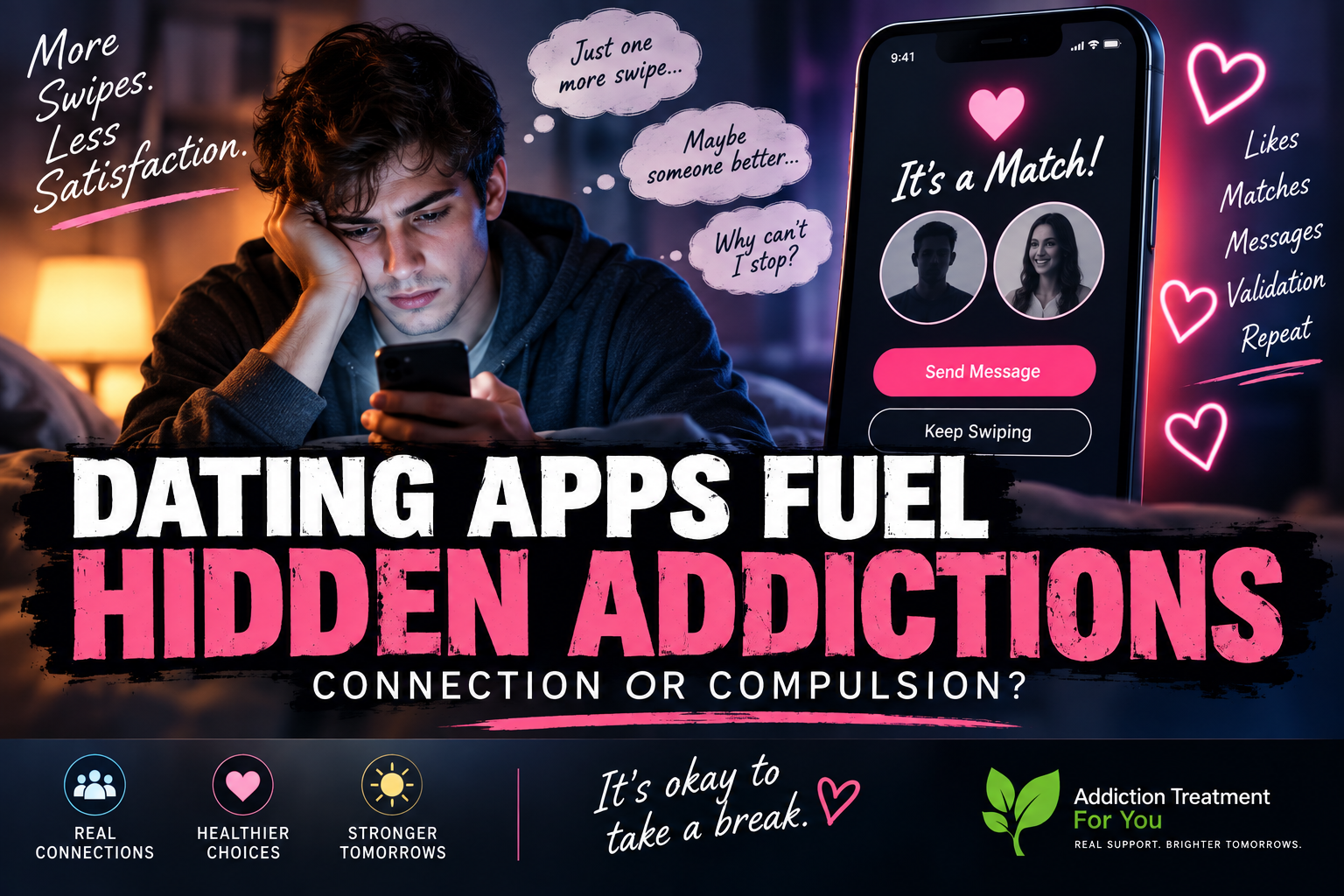
Dating apps have transformed how people meet, flirt, form relationships, and search for companionship. With a smartphone and a few swipes, someone can encounter dozens of potential partners within minutes. For many people, these apps are simply useful tools. For others, however, checking profiles, chasing matches, waiting for messages, and seeking validation can develop into a difficult-to-control behavioral pattern.
Calling every frequent user “addicted” would be misleading. Compulsive dating-app use is not currently recognized as a standalone substance use disorder, and frequent use alone does not establish an addiction. Nevertheless, some people experience behaviors resembling other problematic forms of digital engagement: loss of control, preoccupation, repeated checking, emotional dependence on feedback, and continued use despite negative consequences.
Understanding these patterns can help people develop healthier relationships with both technology and dating.
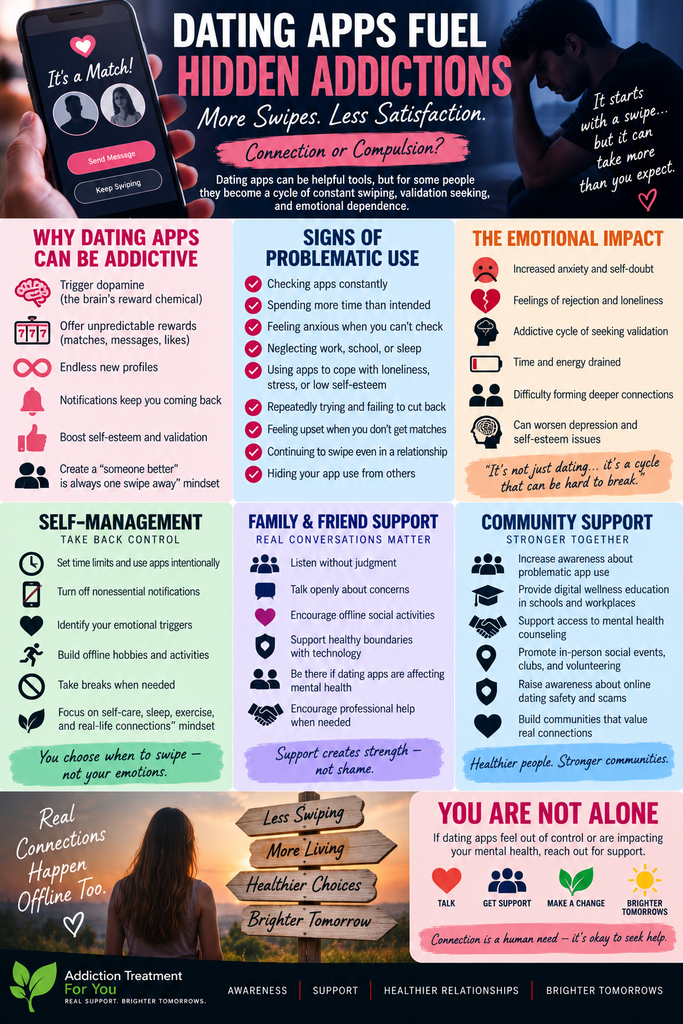
Why Dating Apps Can Be Difficult to Put Down
Dating apps offer something especially powerful: unpredictable rewards. You never know when the next swipe will produce a match, a message, a compliment, or a promising connection.
That uncertainty can encourage repeated checking. A person may think, Maybe the next profile will be the one.
Features that can encourage prolonged engagement include:
- Rapid swiping through potential matches.
- Notifications announcing likes or messages.
- Unpredictable matches and responses.
- Visible signs of popularity or attention.
- An apparently endless supply of new profiles.
- Easy access whenever someone feels lonely or bored.
These features do not automatically cause addiction. However, they can reinforce repetitive behavior, particularly among people who use the app to manage difficult emotions.
The Validation Cycle
Sometimes the strongest reward is not finding a relationship—it is discovering that someone finds you attractive.
A match can briefly increase confidence. A message may provide reassurance. Being ignored or rejected, however, can produce disappointment and self-doubt.
The person may then return to the app seeking another match to feel better.
A cycle can develop:
Loneliness or insecurity → Open the app → Swipe → Receive attention → Temporary relief → Attention fades → Check again.
Over time, dating may shift from seeking meaningful connection to repeatedly seeking emotional reassurance.
When Swiping Becomes Emotional Coping
People naturally seek connection when they feel lonely. Problems can arise when dating apps become the primary way to escape uncomfortable emotions.
Someone might open an app whenever experiencing:
- Loneliness
- Boredom
- Anxiety
- Rejection
- Low self-esteem
- Stress
- Relationship conflict
- Fear of missing out
- Sadness
- A need for reassurance
The behavior may provide short-term relief without addressing the underlying emotion.
This resembles patterns seen in many compulsive behaviors: feeling uncomfortable, performing the behavior, experiencing temporary relief, and repeating it when discomfort returns.
Signs Dating-App Use May Be Becoming Unhealthy
There is no single number of daily swipes that defines problematic use. The more important questions involve control and consequences.
Warning signs may include:
- Checking dating apps immediately after waking or during the night.
- Spending much longer on the apps than intended.
- Repeatedly trying and failing to reduce use.
- Feeling anxious when unable to check matches.
- Using several dating apps simultaneously for constant stimulation.
- Neglecting sleep, work, school, exercise, or responsibilities.
- Constantly checking for new messages during conversations with other people.
- Feeling worthless when matches or responses decrease.
- Returning to swiping immediately after rejection.
- Continuing to search for alternatives even while developing a meaningful relationship.
- Hiding the amount of time spent using dating apps.
The central warning sign is not simply frequent use. It is difficult to control the behavior despite meaningful negative consequences.
The “Someone Better Is One Swipe Away” Problem
Having many potential choices can create another psychological challenge.
When new profiles are constantly available, people may begin to view relationships through an endless-upgrade mentality. A promising person may seem less appealing because another possibility is always waiting.
Thoughts may become:
Maybe someone more attractive is next.
Maybe someone more interesting will message me tomorrow.
Why commit when I can keep looking?
Dating apps do not inevitably create this mindset, but constant exposure to alternatives may make it harder for some people to slow down and develop a deeper connection with one person.
Dating Apps and Self-Esteem
Repeated rejection can be emotionally difficult.
Not receiving matches does not objectively measure attractiveness or personal worth. Dating-app outcomes can be influenced by photographs, algorithms, geography, demographics, preferences, activity levels, and many other factors.
Nevertheless, people may internalize the experience.
They may begin thinking:
Why doesn’t anyone want me?
What’s wrong with me?
I need more matches to prove I’m attractive.
When self-worth becomes dependent on digital attention, the app can gain enormous emotional power.
Dating Apps and Other Hidden Compulsive Behaviors
Problematic dating-app use can sometimes overlap with other concerns. Depending on the individual, repeated swiping may accompany compulsive social-media use, pornography use, risky sexual behavior, excessive spending on premium app features, or problematic alcohol or drug use during dates.
One behavior does not automatically cause another.
Instead, several behaviors may sometimes serve the same underlying purpose: escaping loneliness, regulating emotions, reducing anxiety, seeking excitement, or obtaining validation.
This is why treatment should address the person rather than simply removing an app.
Self-Management Strategies for Healthier Dating-App Use
Deleting every dating app is not necessary for everyone. The goal can be to regain control over how, when, and why the technology is used.
Try these strategies:
- Set specific dating-app times. Check profiles once or twice during planned periods rather than continuously.
- Turn off unnecessary notifications. Reduce cues that encourage automatic checking.
- Avoid using apps in bed. Protect sleep from late-night swiping and messaging.
- Identify emotional triggers. Notice whether loneliness, boredom, rejection, or anxiety automatically draws you to the app.
- Pause before opening it. Ask, “Am I looking for connection, or am I trying to change how I feel?”
- Set time limits. Decide how long you will swipe before starting.
- Take scheduled breaks. A weekend or week away can reveal how strongly the behavior has become habitual.
- Build offline connections. Spend time with friends and family, in clubs, on hobbies, through volunteering, or in community activities.
- Protect your self-esteem. Do not use matches as a scoreboard for personal worth.
- Consider counseling. Therapy may help when compulsive use is connected with loneliness, anxiety, depression, trauma, or self-esteem difficulties.
Family and Friend Support Strategies
Compulsive digital behavior can be difficult for loved ones to understand because there may be no visible substance involved.
Helpful support can include:
- Listen without mocking the person’s dating experiences.
- Avoid labels such as “desperate” or “addicted.”
- Encourage face-to-face activities and friendships.
- Invite the person into activities that do not revolve around phones.
- Discuss concerning behavioral changes calmly.
- Encourage healthier sleep and technology boundaries.
- Support counseling when emotional distress becomes significant.
- Take threats of self-harm following rejection seriously.
Loved ones should focus on consequences and well-being rather than simply counting screen hours.
Community Support Strategies
Healthier digital behavior also requires environments that promote genuine connection.
Communities can help through:
- Mental health education about problematic technology use.
- Affordable counseling and behavioral-health services.
- Social groups that encourage face-to-face interaction.
- Recreation programs, clubs, volunteering, and community events.
- Education about online dating safety and consent.
- Support groups addressing loneliness and social isolation.
- Digital-wellness education in schools and workplaces.
- Greater awareness of scams, coercion, harassment, and exploitation in online dating.
Community connection can provide something an algorithm cannot fully replace: belonging that is not dependent on receiving a match.
When Should Someone Seek Professional Help?
Consider speaking with a mental health professional when dating-app use becomes difficult to control or significantly interferes with everyday life.
Professional support may be particularly useful when someone:
- Repeatedly fails to cut back.
- Loses significant sleep because of app use.
- Experiences severe anxiety or depression related to matches and rejection.
- Engages in increasingly risky behavior.
- Neglects responsibilities or important relationships.
- Depends on digital attention for self-worth.
- Uses dating apps primarily to escape emotional distress.
- Experiences compulsive sexual behavior alongside app use.
A clinician can also evaluate whether another condition—such as anxiety, depression, ADHD, trauma-related difficulties, or another behavioral problem—is contributing to the pattern.
From Endless Swiping to Intentional Connection
Dating apps themselves are neither inherently healthy nor inherently harmful. The important question is how they are used and what role they play in someone’s emotional life.
A dating app should ideally help someone pursue connection. It should not determine their self-worth, dominate their attention, repeatedly interfere with sleep, or become their only method of coping with loneliness and rejection.
If every uncomfortable feeling leads to another swipe, the solution may not be finding a better match. It may involve learning to tolerate difficult emotions, strengthening offline relationships, rebuilding self-esteem, and using technology more intentionally.
The goal isn’t necessarily to stop dating online. It is to make sure you are choosing when to swipe—instead of feeling like you have to.
Frequently Asked Questions
Here are some common questions:
1. Can dating apps actually become addictive?
Dating apps can become compulsive or problematic for some people. Repeated swiping, checking matches, seeking messages, and looking for validation can become difficult to control. However, problematic dating-app use is not currently recognized as a standalone substance use disorder, so the word “addiction” should be used carefully.
2. Why can dating apps be so difficult to stop using?
Dating apps provide unpredictable rewards. You do not know when the next swipe will result in a match or message. That uncertainty can encourage people to keep checking because the next rewarding interaction might be only one swipe away.
3. Do dating apps release dopamine?
Rewarding experiences, such as receiving attention or anticipating a match, can engage the brain’s reward systems, including dopamine signaling. However, saying that every match creates a specific “dopamine hit” oversimplifies a much more complicated neurological process.
4. What are signs of problematic dating-app use?
Possible warning signs include:
- Checking apps repeatedly throughout the day.
- Spending longer swiping than intended.
- Losing sleep because of dating apps.
- Feeling unable to reduce use.
- Neglecting work, school, hobbies, or relationships.
- Constantly seeking matches for reassurance.
- Feeling distressed when unable to check the app.
- Hiding the amount of time spent online.
- Continuing despite obvious negative consequences.
5. Is using several dating apps a sign of addiction?
Not necessarily. Someone may use several apps simply to increase their chances of meeting compatible people. It becomes more concerning when the person feels unable to stop, spends excessive time checking them, or experiences significant harm as a result of the behavior.
6. Can dating apps affect self-esteem?
Yes. Some people begin to tie their self-worth to the number of matches, likes, or messages they receive. Rejection, ghosting, or few matches may contribute to insecurity or self-doubt, particularly when someone already struggles with self-esteem.
7. Why do some people constantly check for new matches?
Checking may become habitual because matches and messages are unpredictable. People may also check when they feel lonely, bored, anxious, rejected, or insecure. The app can gradually become a method of emotional regulation rather than simply a tool for meeting people.
8. Can dating apps make loneliness worse?
They can for some people. Dating apps may create opportunities for genuine connection, but repeated rejection, superficial interactions, ghosting, or compulsive checking can sometimes intensify loneliness rather than relieve it.
9. Can someone become addicted to receiving matches rather than dating?
Some people can develop a strong pattern of validation-seeking in which obtaining matches becomes more important than meeting potential partners. The temporary confidence produced by attention may encourage repeated swiping whenever self-esteem falls.
10. What is the dating-app validation cycle?
A common pattern may look like this:
Loneliness or insecurity → Swiping → Match or message → Temporary validation → Reward fades → More checking and swiping.
Recognizing the cycle can help someone determine whether they are pursuing genuine relationships or repeatedly seeking emotional reassurance.
11. Can dating apps affect existing relationships?
Potentially. Secretive app use, repeatedly searching for alternatives, emotional involvement with other people, or continuing to swipe after agreeing to exclusivity can create conflict and damage trust. Couples should clearly communicate their expectations regarding dating app use.
12. How can someone reduce compulsive dating-app use?
Helpful self-management strategies include:
- Turn off unnecessary notifications.
- Establish specific times for checking apps.
- Set daily screen-time limits.
- Avoid swiping immediately after waking or before sleeping.
- Keep phones away from the bed.
- Take regular app-free days.
- Identify emotional triggers for swiping.
- Develop offline hobbies and friendships.
- Avoid using matches as a measurement of personal worth.
- Seek counseling if cutting back repeatedly fails.
13. Should I delete my dating apps completely?
Not necessarily. For some people, setting healthier boundaries is sufficient. Others may benefit from temporarily deleting the apps to interrupt a compulsive pattern and evaluate how they feel without constant access.
14. How can family and friends help?
Loved ones can:
- Listen without judgment.
- Encourage offline social activities.
- Avoid mocking someone’s dating experiences.
- Discuss concerning changes in behavior.
- Support healthy technology boundaries.
- Encourage hobbies and face-to-face relationships.
- Recommend professional support when use significantly affects mental health.
Support should focus on the person’s well-being rather than shaming them for using dating apps.
15. How can communities encourage healthier digital relationships?
Communities can provide digital wellness education, affordable mental health services, clubs, volunteer opportunities, recreational programs, social events, and education on online dating safety. Creating opportunities for face-to-face connection may also reduce social isolation.
16. Can dating apps contribute to anxiety or depression?
For some users, repeated rejection, comparison, ghosting, harassment, or compulsive checking may contribute to emotional distress. However, dating apps are not necessarily the sole cause. Existing anxiety, depression, loneliness, or low self-esteem can also influence how someone experiences online dating.
17. Can dating apps lead to other compulsive behaviors?
Problematic dating-app use can sometimes coexist with excessive social-media use, compulsive sexual behavior, pornography use, excessive spending on premium features, or substance use surrounding dates. These relationships vary considerably among individuals and should not be assumed automatically.
18. When should someone seek professional help?
Consider talking with a mental health professional when dating-app use becomes difficult to control, repeatedly interferes with sleep or responsibilities, contributes to severe emotional distress, damages relationships, encourages risky behavior, or becomes the person’s primary method of coping with loneliness or anxiety.
19. Does needing help mean someone has to stop dating?
No. The objective is not necessarily to eliminate online dating. Counseling can help someone establish healthier boundaries, understand emotional triggers, improve self-esteem, tolerate rejection, and develop more intentional approaches to relationships.
20. What is the biggest lesson about dating apps and hidden addictions?
The key question is not simply “How many hours am I using the app?” Instead, ask:
“Am I choosing to use this app, or do I feel compelled to keep checking it even when it is hurting me?”
Dating apps can help people find meaningful relationships, but matches should never become a measurement of personal worth. Healthy dating means maintaining control over technology while continuing to invest in sleep, responsibilities, friendships, emotional health, and real-world connection.
Video: The secret reason you’re addicted to dating apps #datingtips #relatable