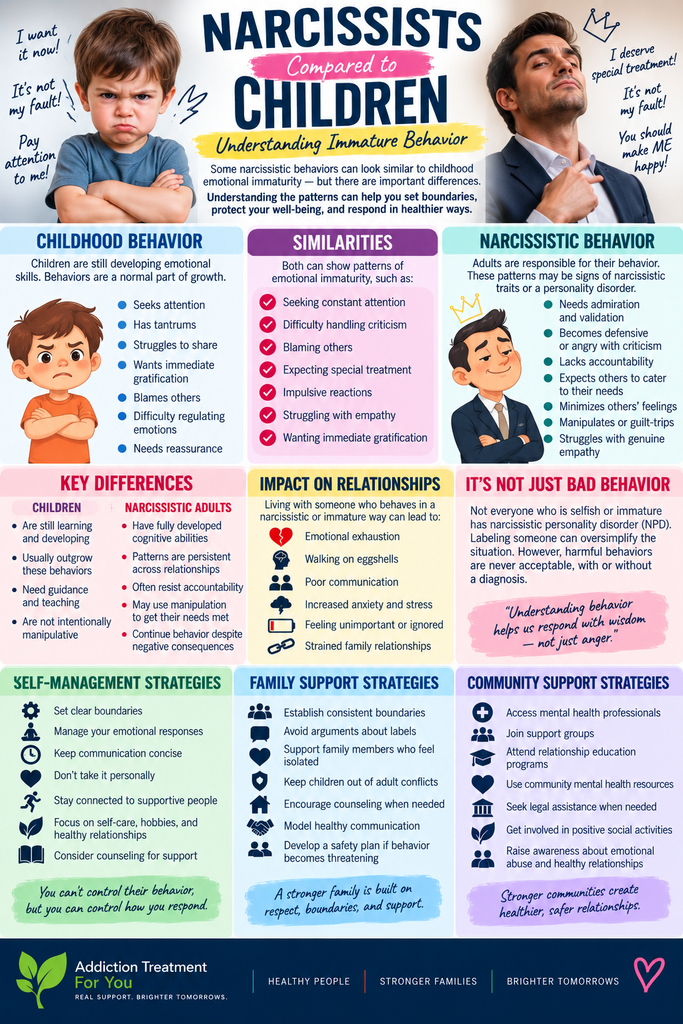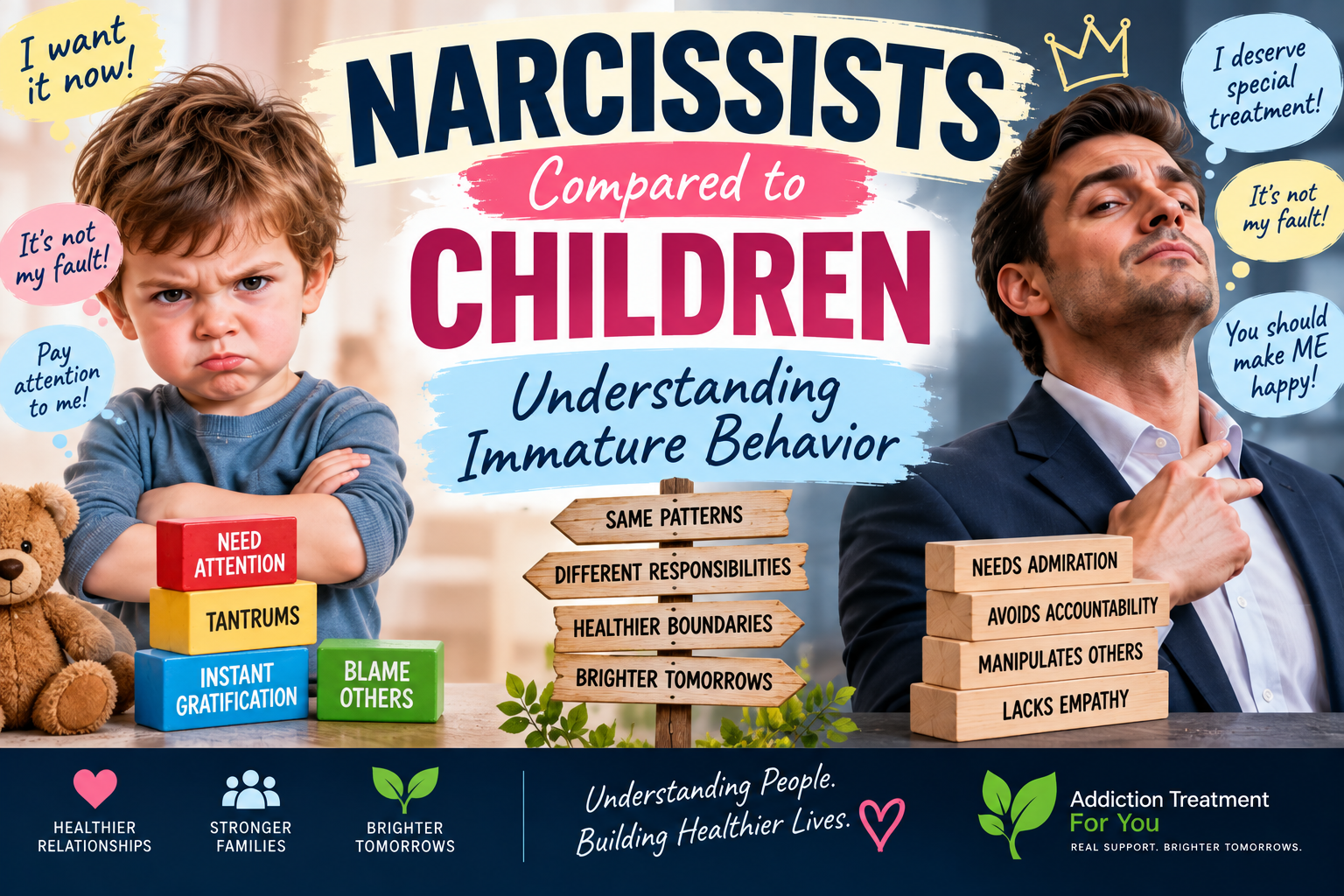
People sometimes describe a narcissistic adult as “acting like a child.” They may be referring to behaviors such as demanding attention, reacting intensely to criticism, blaming others, struggling to apologize, or expecting immediate gratification. Although the comparison can help explain certain patterns of emotional immaturity, it should not be taken literally.
Children are still developing emotional regulation, empathy, perspective-taking, and impulse control. Adults are responsible for their behavior. In addition, having narcissistic traits does not automatically mean someone has narcissistic personality disorder (NPD). NPD is a mental health condition that requires evaluation by a qualified professional.
Understanding the difference can help families move away from name-calling and toward recognizing unhealthy behaviors, establishing boundaries, and protecting their own emotional well-being.
Why Are Narcissistic Behaviors Sometimes Compared to Childhood Behavior?
Young children naturally view much of the world through the lens of their immediate needs. They may become upset when they do not get what they want, struggle to understand another person’s perspective, or need reassurance and attention.
Healthy development usually brings greater abilities to delay gratification, tolerate frustration, accept responsibility, regulate emotions, and consider how actions affect other people.
Some emotionally immature adults may continue displaying difficulties in these areas.
Examples can include:
- Needing excessive attention or reassurance.
- Becoming highly defensive when criticized.
- Expecting other people to accommodate their needs.
- Blaming others for mistakes.
- Having difficulty accepting “no.”
- Reacting strongly when they do not receive recognition.
- Struggling to acknowledge another person’s perspective.
- Seeking admiration or validation.
- Avoiding genuine accountability.
The important distinction is that these behaviors can occur for many reasons. They do not independently diagnose narcissism or NPD.
Tantrums vs. Adult Emotional Reactions
A child might cry, yell, or stomp when disappointed because emotional regulation skills are still developing.
An emotionally immature adult obviously does not need to throw a literal tantrum to display a similar pattern. The adult version might involve yelling, prolonged arguments, insults, the silent treatment, dramatic withdrawal, or attempts to make another person feel guilty.
The underlying issue may be difficulty tolerating frustration.
For the person on the receiving end, the temptation is often to surrender simply to restore peace. Unfortunately, repeatedly changing reasonable boundaries because someone becomes angry can reinforce an unhealthy relationship pattern.
“It’s Never My Fault”
Children sometimes blame siblings, classmates, or circumstances when something goes wrong. Learning responsibility is part of development.
Adults who consistently externalize blame can create enormous stress in relationships.
You may hear statements such as:
“You made me angry.”
“If you hadn’t done that, I wouldn’t have reacted this way.”
“Everyone is against me.”
“You’re too sensitive.”
Instead of debating endlessly about who is the “bad person,” focus on behavior.
A healthier question is:
What happened, who is responsible for which actions, and what needs to change?
The Need to Be the Center of Attention
Young children often naturally seek attention from caregivers. Adults generally learn that relationships require sharing emotional space.
Some people with strong narcissistic traits may become uncomfortable when another person’s accomplishments, problems, or needs receive attention.
They may:
- Redirect conversations toward themselves.
- Minimize someone else’s accomplishments.
- Become competitive over attention.
- Interrupt frequently.
- Seek repeated praise.
- Become resentful when another person is celebrated.
This can leave partners and relatives feeling as though their experiences never receive equal importance.
Difficulty Handling Criticism
Most people dislike criticism. The difference is what happens afterward.
Emotionally mature adults can eventually consider whether feedback contains useful information. Someone with pronounced narcissistic or emotionally immature patterns may experience even mild criticism as humiliation or rejection.
Responses can include:
- Immediate defensiveness.
- Counterattacking.
- Denying obvious behavior.
- Changing the subject.
- Blaming the person giving feedback.
- Withdrawing from communication.
- Trying to discredit the critic.
Families may eventually become afraid to raise concerns because every disagreement creates another conflict.
Empathy and Perspective-Taking
Children gradually develop more sophisticated abilities to understand other people’s feelings and viewpoints.
Some adults may have difficulty consistently demonstrating empathy, particularly when another person’s needs conflict with their own.
This does not necessarily mean they are incapable of understanding emotions. Sometimes a person can intellectually recognize another person’s feelings but still prioritize protecting their own self-image.
For loved ones, this distinction matters because repeatedly explaining your pain does not guarantee that someone’s behavior will change.
Emotional Immaturity Is Not the Same as NPD
This distinction is essential.
Someone can be selfish, defensive, manipulative, emotionally immature, arrogant, or inconsiderate without having narcissistic personality disorder.
Likewise, casually labeling an ex-partner, parent, coworker, or spouse a “narcissist” can oversimplify complicated relationship dynamics.
A professional diagnosis considers persistent patterns across multiple situations and evaluates alternative explanations.
You do not need to diagnose another person before deciding that a behavior is unacceptable.
Self-Management Strategies When Dealing With Immature Behavior
If someone repeatedly behaves in emotionally immature or narcissistic ways, your first responsibility is managing your own responses, not trying to control theirs.
Helpful strategies include:
- Identify specific behaviors. Focus on what the person does rather than arguing over labels.
- Set clear boundaries. Decide what behavior you will and will not participate in.
- Keep communication concise. Long explanations may create additional opportunities for circular arguments.
- Avoid competing for the last word. Ending an unproductive conversation can be healthier than winning it.
- Manage your emotional reactions. Pause before responding to provocative comments.
- Keep realistic expectations. Do not base your emotional stability on another person’s willingness to change.
- Maintain outside relationships. Stay connected with supportive friends and relatives.
- Protect your independence. Preserve appropriate financial, social, and emotional autonomy.
- Document serious behavior when necessary. This can be particularly important in workplace, legal, custody, or safety situations.
- Seek professional counseling. Therapy can help clarify boundaries and relationship patterns.
Family Support Strategies
Living with chronic emotional immaturity can affect an entire family system. Relatives may begin walking on eggshells, avoiding disagreements, or changing their behavior to prevent another person’s reaction.
Families can respond by:
- Establishing consistent household boundaries.
- Refusing to participate in insults or intimidation.
- Avoiding arguments about labels and diagnoses.
- Supporting family members who feel isolated.
- Teaching children that adults are responsible for their own emotions.
- Avoiding asking children to mediate adult conflicts.
- Encouraging individual or family counseling when appropriate.
- Developing a safety plan if behavior becomes threatening.
- Maintaining healthy relationships outside the immediate conflict.
Children especially should not be expected to manage a parent’s emotional state.
Community Support Strategies
People dealing with difficult relationships often become isolated. Community resources can provide perspective and practical assistance.
Helpful resources may include:
- Licensed mental health professionals.
- Individual psychotherapy.
- Couples counseling when appropriate and safe.
- Family therapy.
- Community mental health centers.
- Relationship education programs.
- Parenting programs focused on healthy emotional development.
- Support groups for people experiencing unhealthy relationships.
- Domestic violence resources when intimidation, coercion, or abuse is present.
- Legal assistance when safety, finances, housing, or custody issues arise.
Community education should emphasize that mental health diagnoses never excuse abuse.
Stop Trying to “Parent” Another Adult
When someone behaves immaturely, loved ones may gradually assume a parental role.
They remind, rescue, apologize for, organize, soothe, financially support, or repeatedly clean up the consequences of the person’s behavior.
This creates an unhealthy adult-to-child dynamic.
Compassion does not require taking responsibility for another capable adult’s decisions.
Instead of repeatedly rescuing someone, allow appropriate consequences while maintaining your own boundaries.
Can Emotionally Immature People Change?
Yes, people can change—but change requires participation.
Meaningful improvement generally involves recognizing problematic behavior, accepting responsibility, tolerating uncomfortable feedback, practicing emotional regulation, developing empathy, and consistently behaving differently.
Psychotherapy may help people examine long-standing interpersonal patterns.
However, family members cannot force insight.
Promises such as “I’ll change” are less informative than sustained behavioral changes over time.
When the Behavior Becomes Abuse
Emotional immaturity and abuse are not interchangeable.
However, behaviors such as intimidation, threats, coercive control, stalking, financial control, physical violence, sexual coercion, or deliberate isolation deserve serious attention regardless of whether the person has a personality disorder.
In those circumstances, the priority should shift from trying to understand the person’s psychology to protecting safety and obtaining appropriate professional assistance.
Understanding Without Excusing
Comparing certain narcissistic behaviors with childhood emotional patterns can make difficult relationship dynamics easier to understand. Both may involve frustration intolerance, attention seeking, defensiveness, or difficulty seeing another person’s perspective.
But there is an important difference: children are learning these skills. Adults remain responsible for how they treat other people.
Understanding why someone behaves a certain way can create compassion, but compassion does not require accepting repeated disrespect, manipulation, intimidation, or emotional harm.
You do not have to diagnose someone before establishing a boundary.
You do not have to win every argument before walking away from an unhealthy conversation.
And you do not have to become another adult’s parent in order to prove that you care.
Healthy relationships require more than love. They require accountability, empathy, respect, boundaries, and the willingness to grow.
Frequently Asked Questions
Here are some common questions:
1. Why are narcissistic adults sometimes compared to children?
The comparison usually refers to behaviors that can appear emotionally immature, such as demanding attention, expecting immediate gratification, blaming others, reacting strongly to criticism, or struggling to consider another person’s perspective. However, adults and children should not literally be treated as psychologically equivalent.
2. Are narcissists emotionally immature?
Some people with pronounced narcissistic traits may demonstrate emotional immaturity, particularly when dealing with criticism, disappointment, accountability, or threats to their self-image. Emotional immaturity alone, however, does not establish narcissistic personality disorder (NPD).
3. What behaviors can narcissistic adults and young children appear to share?
Possible similarities include:
- Seeking frequent attention.
- Difficulty accepting “no.”
- Wanting immediate gratification.
- Blaming others.
- Becoming upset when expectations are not met.
- Difficulty tolerating criticism.
- Seeking reassurance or validation.
- Struggling with perspective-taking.
The reasons behind these behaviors can be very different.
4. What is the biggest difference between a child and an emotionally immature adult?
Children are still developing emotional regulation, empathy, impulse control, and perspective-taking. Adults have greater responsibility for learning to manage their behavior and for how their actions affect other people.
5. Is throwing an adult “tantrum” a sign of narcissism?
Not necessarily. Yelling, withdrawing, becoming defensive, or reacting dramatically to frustration can reflect emotional dysregulation, but many psychological and situational factors can contribute. One behavior cannot diagnose narcissism or NPD.
6. Why do some narcissistic people react badly to criticism?
Criticism may be experienced as a threat to self-image. Instead of considering the feedback, someone may become defensive, angry, dismissive, or counterattack. Understanding this possibility does not mean family members must tolerate verbal abuse or intimidation.
7. Why do narcissistic adults sometimes blame other people?
Externalizing responsibility can protect someone from uncomfortable emotions such as embarrassment, shame, inadequacy, or failure. Chronic blame-shifting can nevertheless make healthy communication extremely difficult.
8. Do narcissistic people lack empathy?
NPD is associated with impaired empathy, but empathy is complex and can vary between individuals and circumstances. It is more accurate to examine someone’s repeated behavior than assume that every person displaying narcissistic traits is completely incapable of empathy.
9. Is selfishness the same as narcissistic personality disorder?
No. Everyone behaves selfishly occasionally. NPD involves a persistent pattern of traits and interpersonal difficulties and should be diagnosed by a qualified mental health professional.
10. Can emotional immaturity be mistaken for narcissism?
Yes. Defensiveness, poor communication, insecurity, impulsivity, difficulty regulating emotions, or selfish behavior can sometimes be casually labeled “narcissistic.” Other psychological conditions, learned behaviors, stress, trauma histories, or relationship dynamics may also contribute.
11. How should I communicate with an emotionally immature person?
Try to keep communication calm, direct, and focused on specific behavior. Avoid lengthy circular arguments.
For example, instead of debating whether someone is a narcissist, focus on the boundary: “I am willing to discuss this, but I will end the conversation if I am being insulted.”
12. What self-management strategies can help?
Helpful strategies include:
- Identify behaviors rather than concentrating on labels.
- Establish clear boundaries.
- Manage your own emotional responses.
- Avoid endless arguments.
- Keep expectations realistic.
- Maintain friendships and outside interests.
- Protect appropriate independence.
- Practice stress-management and self-care.
- Seek counseling when the relationship causes significant distress.
The objective is not controlling the other person. It is controlling your own participation in unhealthy patterns.
13. How can families establish healthier boundaries?
Families can clearly communicate which behaviors are unacceptable and consistently follow through with reasonable consequences. Boundaries work best when they describe what you will do, rather than attempting to control another adult.
14. Should family members keep trying to explain how hurt they feel?
Healthy communication is important, but repeatedly explaining the same pain does not guarantee behavioral change. When someone consistently ignores reasonable concerns, boundaries and actions may become more effective than increasingly lengthy explanations.
15. Should families “parent” an emotionally immature adult?
Generally, capable adults should be allowed to take responsibility for their own decisions. Constantly rescuing, making excuses, managing responsibilities, or preventing reasonable consequences can create an unhealthy parent-child dynamic within an adult relationship.
16. Can narcissistic or emotionally immature behavior change?
People can change, particularly when they recognize a problem and genuinely participate in the process. Meaningful change usually involves accountability, emotional regulation, empathy, communication skills, and consistent behavioral improvement over time. Psychotherapy may help some individuals.
17. How can family members support change without enabling?
Families can encourage counseling, recognize genuine improvement, maintain consistent boundaries, and avoid repeatedly protecting someone from the consequences of harmful behavior. Support does not require accepting mistreatment.
18. What community resources can help families?
Resources may include:
- Licensed mental health professionals.
- Individual psychotherapy.
- Family therapy.
- Couples counseling when appropriate and safe.
- Community mental health centers.
- Relationship education programs.
- Support groups.
- Domestic violence services when abuse or coercive control is present.
- Legal assistance when safety, custody, housing, or financial concerns arise.
19. When does immature behavior become emotional abuse?
Emotional immaturity and abuse are not the same thing. However, repeated threats, intimidation, humiliation, coercive control, stalking, isolation, financial control, or other patterns designed to dominate another person may indicate abuse and deserve professional attention.
20. Do I need to know whether someone is a narcissist before setting boundaries?
No. You do not need a psychiatric diagnosis to recognize that certain behavior is harmful.
You can establish boundaries because someone repeatedly insults you, intimidates you, violates your privacy, manipulates conversations, or refuses to respect reasonable limits—regardless of what diagnosis they may or may not have.
Video: Why they can’t take accountability #emotionalimmaturity #growth