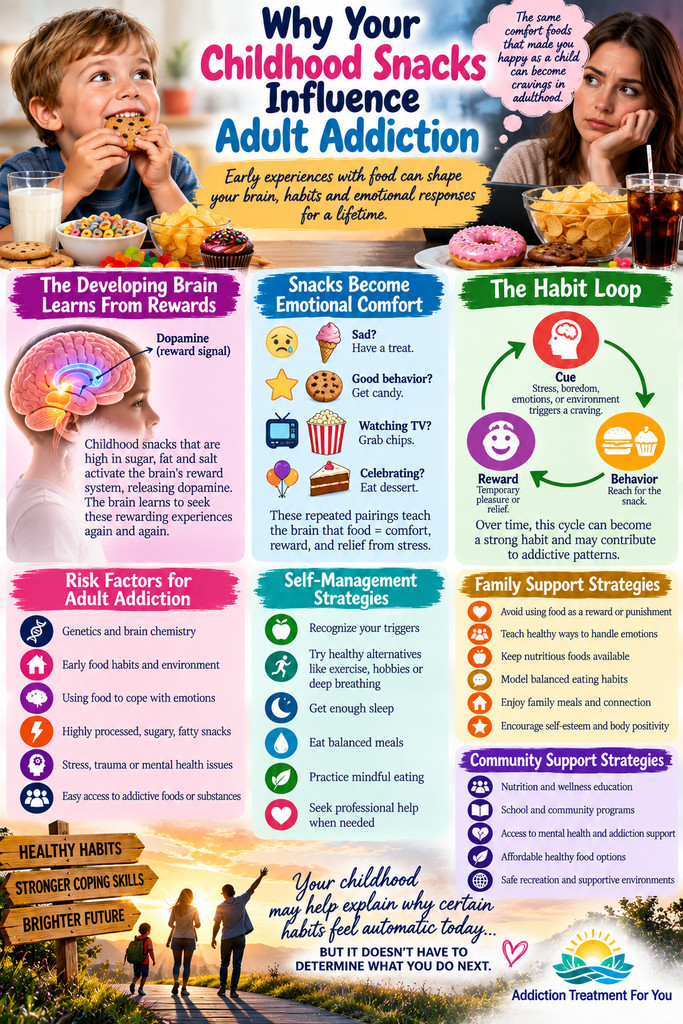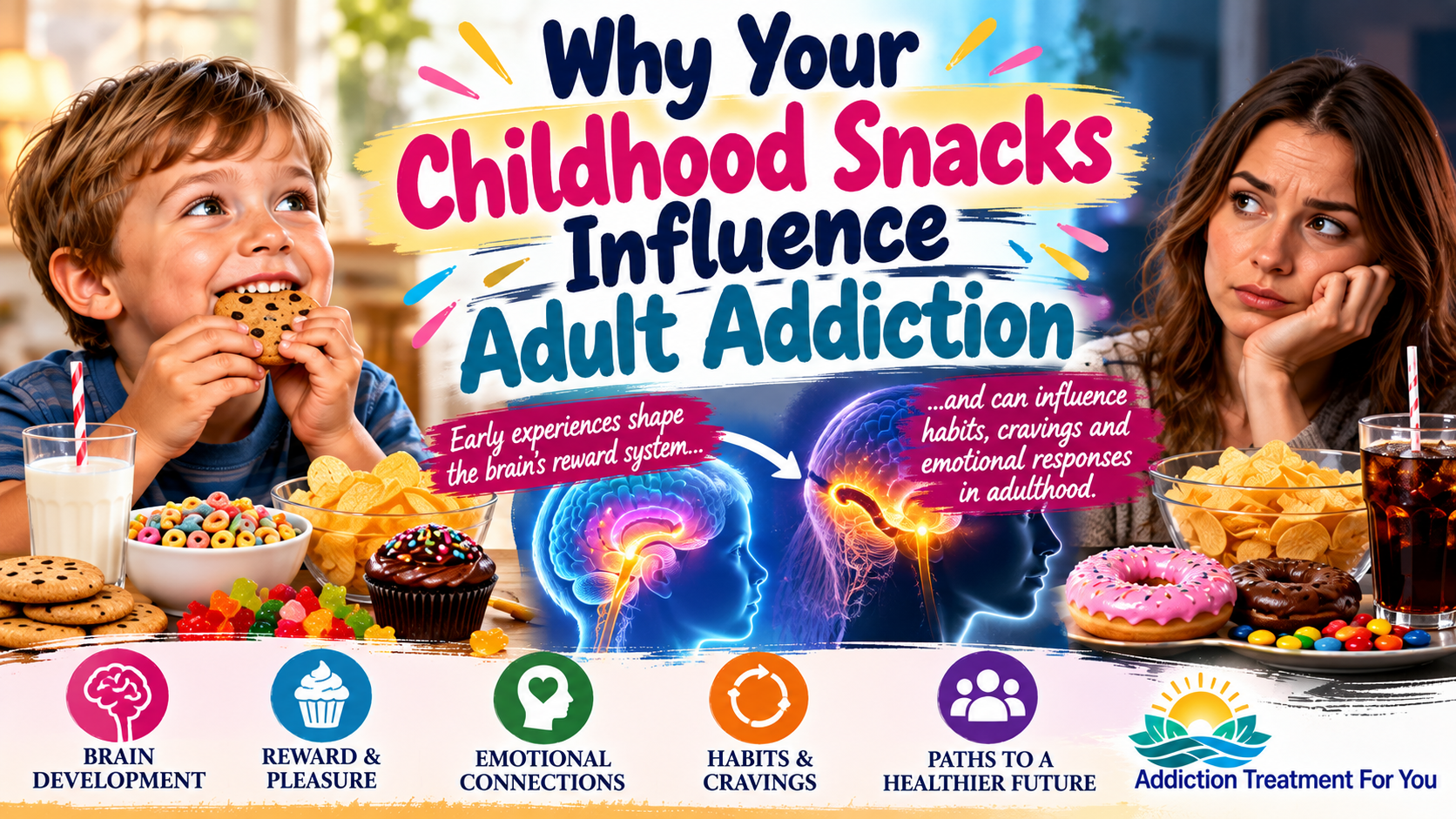
The foods we enjoyed as children often become connected to memories, emotions, and comfort. An after-school cookie, candy for good behavior, chips during television time, or ice cream after a difficult day may seem like simple childhood experiences. Yet repeated patterns can teach the developing brain to associate certain foods with pleasure, reward, comfort, and relief from stress or difficult emotions.
This does not mean that childhood eating habits directly cause addiction in adulthood. Addiction is a complex condition influenced by genetics, brain development, environment, trauma, mental health, substance exposure, and social experiences. However, early relationships with food can shape reward-seeking behaviors and emotional coping patterns that may continue into adulthood and influence how we respond to cravings, stress, and other rewarding experiences.
The Childhood Brain Learns From Rewards
Children’s brains are continually learning which behaviors produce rewarding experiences. Highly palatable foods—particularly combinations of sugar, refined carbohydrates, fat, and salt—can activate brain systems involved in motivation and reward.
Dopamine is part of this process. It does not simply create pleasure; it helps the brain learn which experiences are important enough to seek again.
Imagine that a child receives candy every time they behave well. Eventually, candy becomes more than food. It can become associated with achievement and reward.
If ice cream is repeatedly offered whenever the child is upset, another association may develop:
Distress → comforting food → temporary relief.
These learned patterns can persist long after childhood.
When Food Becomes Emotional Comfort
Food has an important social and emotional role. Birthday cake represents celebration. Popcorn may remind us of family movie nights. A grandmother’s cookies may evoke feelings of love and security.
Those connections are not inherently unhealthy.
Problems can develop when eating becomes someone’s primary method for regulating difficult emotions.
A child who consistently receives food when sad, lonely, anxious, or bored may gradually learn:
- “Food makes uncomfortable feelings disappear.”
- “I deserve something sweet when I’ve had a difficult day.”
- “Eating helps when I’m stressed.”
- “Celebrating means eating.”
- “Being bored means finding something to snack on.”
As an adult, the person may automatically reach for food during emotional distress without consciously understanding why.
Are Sugar and Processed Foods Actually Addictive?
Researchers continue to debate whether particular foods should be considered addictive in exactly the same way as substances such as nicotine, alcohol, or opioids.
Highly processed foods can produce strong cravings and repetitive consumption in some individuals, and research has identified similarities between compulsive eating and some features of substance-related disorders. However, “food addiction” is not currently a standalone diagnosis in the DSM-5-TR.
This distinction matters.
Enjoying chocolate or craving potato chips does not mean someone has an addiction. The concern increases when eating becomes difficult to control, continues despite significant consequences, and repeatedly interferes with physical or emotional well-being.
Childhood Habits Can Become Adult Automatic Behaviors
Habits become powerful because the brain learns to perform them with less conscious effort.
Consider a child who comes home from school every afternoon, turns on the television, and opens a bag of chips. After hundreds of repetitions, the environment itself may become a cue for eating.
Years later, the adult sits down to watch television and suddenly wants a snack—even without physical hunger.
The pattern may follow a simple cycle:
Cue → craving → behavior → reward.
Similar learning mechanisms can contribute to many repetitive behaviors, including substance use, gambling, gaming, shopping, and compulsive social-media use.
Understanding the pattern gives someone an opportunity to interrupt it.
Childhood Food Restriction Can Matter Too
Early food experiences aren’t limited to unrestricted access to snacks.
Extremely restrictive environments may also influence someone’s relationship with food.
Labeling foods as completely “good” or “bad,” using dessert as a prize, forcing children to finish everything on their plates, or severely restricting desirable foods can sometimes increase their emotional importance.
Children benefit from learning how to recognize hunger, fullness, enjoyment, and moderation rather than viewing food exclusively through punishment and reward.
Self-Management Strategies
Changing lifelong habits usually requires more than willpower. The first step is understanding what triggers the behavior.
Helpful strategies include:
- Identify emotional triggers. Before reaching for a snack, ask whether you are physically hungry or feeling stressed, bored, sad, lonely, or anxious.
- Keep a trigger journal. Record what happened immediately before strong cravings appeared.
- Pause before acting. Give yourself several minutes before automatically responding to a craving.
- Build alternative rewards. Walking, music, hobbies, exercise, calling someone, or spending time outdoors can provide other forms of emotional relief.
- Avoid extreme restriction. Completely banning favorite foods can sometimes intensify preoccupation with them.
- Eat regular balanced meals. Significant hunger can make highly rewarding foods much harder to resist.
- Protect sleep. Poor sleep can influence appetite, impulse control, and food choices.
- Practice mindful eating. Slow down and notice taste, texture, hunger, fullness, and emotional state.
- Seek professional help when necessary. Persistent binge eating, severe restriction, purging, or significant distress deserves professional assessment.
The objective is not to eliminate pleasure from eating. It is to develop more than one way to experience comfort and reward.
Family Support Strategies
Families strongly influence children’s earliest relationships with food. Parents and caregivers therefore have an opportunity to teach healthy coping skills without turning meals into constant battles.
Helpful family approaches include:
- Avoid routinely using candy or dessert as payment for good behavior.
- Teach children that emotions are normal and can be managed in different ways.
- Offer comfort through conversation, affection, play, and connection—not exclusively through food.
- Model balanced eating rather than extreme dieting.
- Avoid criticizing children’s bodies or weight.
- Encourage children to recognize hunger and fullness.
- Keep nutritious foods accessible while allowing reasonable flexibility around treats.
- Create enjoyable family meals when possible.
- Talk about advertising and how companies design foods and marketing to attract attention.
- Avoid shaming someone who struggles with eating or substance use.
For adults trying to change longstanding patterns, family members can help by asking, “What support would be useful?” rather than policing every food choice.
The Connection With Substance Addiction
Someone who learned to use food for emotional regulation will not necessarily develop alcohol or drug addiction.
However, the broader coping pattern deserves attention.
If a person learns early in life that uncomfortable emotions must be escaped immediately, they may become vulnerable to using other rewarding behaviors for relief.
As they grow older, those behaviors could involve food, gaming, shopping, gambling, alcohol, nicotine, or other substances.
The common denominator is not the specific reward.
It is the learned cycle:
Emotional discomfort → immediate reward → temporary relief → repeated behavior.
Effective prevention therefore involves teaching children how to tolerate and regulate difficult emotions—not simply removing particular snacks.
Community Support Strategies
Healthy habits are easier to develop when communities support them.
Useful resources may include:
- Registered dietitians
- Primary-care professionals
- Mental-health counselors
- Eating-disorder specialists
- Addiction-treatment professionals
- School nutrition and wellness programs
- Parenting education programs
- Community recreation programs
- Peer-support groups
- Affordable access to nutritious foods
Schools can also teach children about emotional regulation, nutrition, advertising literacy, stress management, and healthy coping skills.
Communities should avoid framing nutrition solely as a matter of personal responsibility. Food affordability, neighborhood resources, marketing, family income, stress, and access to healthcare all influence eating behavior.
Breaking the Cycle Without Blaming Parents
Understanding childhood influences should not become an exercise in blaming parents.
Many caregivers offered cookies, candy, soda, or chips because those foods were affordable, convenient, culturally familiar, or simply something their children enjoyed. Most were not thinking about dopamine pathways or future behavioral patterns.
The useful question is not:
“Who caused this?”
It is:
“What did my brain learn, and what can I teach it now?”
That change in perspective turns childhood experiences into information rather than destiny.
Building New Reward Pathways
The adult brain can still learn.
Someone who automatically eats when stressed can gradually build another sequence:
Stress → recognize emotion → pause → choose coping strategy → experience relief.
Over time, walking, exercising, talking with a friend, creating something, practicing relaxation, or participating in meaningful activities can become additional sources of reward.
The old pathway may not disappear immediately. New behaviors become easier through repetition.
Conclusion
Your favorite childhood snacks probably did not determine whether you would develop an addiction. But childhood experiences can teach the brain what feels rewarding, how to find comfort, and what to do when difficult emotions appear.
Those lessons sometimes follow us into adulthood.
The encouraging part is that learned behaviors can change. Self-management can help identify triggers and create healthier reward patterns. Family support can teach children multiple ways to handle emotions. Community resources can provide nutrition education, mental-health care, and addiction support when behaviors become difficult to control.
Your childhood may help explain why certain habits feel automatic today—but it does not have to determine what you do next.
Frequently Asked Questions
Here are some common questions:
1. Can childhood snacks actually cause addiction in adulthood?
No. Eating candy, cookies, chips, or other highly palatable foods during childhood does not mean a person will develop an addiction later in life. Addiction is influenced by many interacting factors, including genetics, brain development, mental health, trauma, environment, social influences, and exposure to addictive substances. Childhood eating patterns may influence how we learn about rewards and coping.
2. Why can childhood food habits remain powerful in adulthood?
Childhood is a major period of learning and brain development. When certain foods repeatedly accompany comfort, celebration, boredom, or stress relief, the brain can form strong associations between those situations and eating. Years later, similar emotions or environments may automatically trigger cravings.
3. What does dopamine have to do with childhood snacks?
Dopamine is an important chemical messenger involved in motivation, learning, and reward. When something rewarding happens, dopamine-related pathways help the brain remember the experience and encourage behaviors that lead to that reward again.
This does not mean that every dopamine-producing activity is addictive. Dopamine is part of normal activities such as eating, exercising, learning, socializing, and listening to music.
4. Why are sugary, salty, and fatty foods so appealing?
Highly palatable foods can strongly engage the brain’s reward and motivation systems. Food manufacturers may also combine refined carbohydrates, fat, salt, flavors, and textures in ways that make foods particularly enjoyable and easy to consume.
Enjoying these foods does not automatically indicate addiction.
5. Can using candy as a reward affect a child’s relationship with food?
Potentially. If candy or dessert is repeatedly used as a reward for good behavior, children may learn that these foods have special emotional value.
For example:
Good behavior → candy → pleasure → desire to repeat the experience.
Occasionally rewarding a child with a treat is unlikely to cause addiction. The concern is developing a consistent pattern in which food becomes the primary source of reward or emotional comfort.
6. Can childhood snacks become comfort foods?
Yes. Foods can become strongly connected with memories and emotions. Cookies may remind someone of a grandparent, ice cream may represent celebrations, and popcorn may evoke family movie nights.
These associations are normal. They become potentially problematic when food becomes someone’s primary method of managing stress, sadness, loneliness, anger, or anxiety.
7. What is emotional eating?
Emotional eating involves eating in response to emotions rather than primarily because of physical hunger. Stress, boredom, sadness, loneliness, anxiety, and even happiness can trigger eating.
Occasional emotional eating is common. Concern increases when the behavior feels uncontrollable, causes significant distress, or repeatedly interferes with health and everyday functioning.
8. Can childhood emotional eating lead to substance addiction?
Not directly. A child who uses food for comfort is not destined to develop alcohol or drug addiction.
However, learning to immediately escape uncomfortable emotions through rewarding behaviors may become a broader coping pattern. This makes teaching children multiple ways to manage emotions valuable for overall psychological health.
9. What is the habit loop?
A habit can be understood through three basic components:
Cue → Behavior → Reward
For example, someone may experience stress, eat something sweet, and temporarily feel better. If this sequence occurs repeatedly, stress itself may eventually trigger an automatic desire for that food.
Recognizing the cue provides an opportunity to change the behavior.
10. Is sugar addictive like nicotine or opioids?
The comparison is controversial. Research shows that highly rewarding foods can produce cravings and repetitive eating behaviors, but sugar is not classified as an addictive substance in the same way as nicotine, alcohol, or opioids.
The term “food addiction” is also not currently a standalone DSM-5-TR diagnosis. Researchers continue investigating addiction-like eating patterns and their relationship to highly processed foods.
11. Does restricting sweets during childhood prevent future problems?
Not necessarily. Extreme restriction may sometimes make forbidden foods even more desirable. A more balanced approach can help children learn moderation, recognize hunger and fullness, and understand that treats do not need to be either forbidden or constantly available.
12. What self-management strategies can help adults change childhood eating habits?
Helpful strategies include:
- Identify emotional and environmental triggers.
- Notice the difference between physical hunger and emotional urges.
- Keep regular meal and sleep schedules.
- Practice mindful eating.
- Develop alternative rewards such as exercise, music, hobbies, or social connection.
- Pause before automatically responding to cravings.
- Avoid extreme dieting and repeated cycles of restriction and overeating.
- Seek professional support when eating feels uncontrollable or causes significant distress.
The objective is not necessarily eliminating favorite foods. It is developing additional ways to experience comfort and reward.
13. How can parents encourage healthier relationships with food?
Parents can provide balanced meals and snacks while avoiding excessive attention to weight or appearance. Children can also learn to manage emotions through conversation, play, physical activity, relaxation, creativity, and supportive relationships—not only through food.
14. Should parents stop giving children treats?
No. Treats can be part of a balanced relationship with food. The issue is not an occasional cookie, birthday cake, or ice cream outing.
The goal is to avoid making highly rewarding foods the only way children experience celebration, comfort, or praise.
15. How can families support adults who struggle with emotional eating?
Family members can listen without judgment, avoid criticizing someone’s body or food choices, encourage healthy routines, participate in enjoyable activities that do not revolve around food, and support professional care when appropriate.
Food policing and shame can increase distress rather than solve the underlying problem.
16. What community resources can help?
Depending on the problem, useful resources may include registered dietitians, primary-care professionals, therapists, eating-disorder specialists, addiction professionals, community mental-health centers, and peer-support programs.
Schools and community organizations can also help by teaching children nutrition, emotional regulation, stress management, and healthy coping skills.
17. When should someone seek professional help?
Professional evaluation is appropriate when eating behaviors involve recurrent loss of control, binge eating, severe restriction, purging, significant weight or health changes, intense guilt or shame, or substantial interference with everyday life.
Similar help should be sought when alcohol, drugs, gambling, or another rewarding behavior becomes difficult to control despite harmful consequences.
18. Are parents responsible if an adult develops unhealthy eating habits?
It is rarely that simple. Parents influence children’s eating environments, but adult behavior results from many biological, psychological, social, cultural, and environmental factors.
Understanding childhood experiences should focus on identifying patterns rather than assigning blame.
19. Can adults change habits that began during childhood?
Yes. The brain can keep learning throughout life. Repeatedly practicing a different response can gradually establish new habits.
Instead of:
Stress → snack → temporary relief
someone might develop:
Stress → recognize the feeling → pause → walk, talk, breathe, or use another coping strategy → relief.
The goal is not perfection. It is increasing the number of healthy choices available when uncomfortable emotions appear.
20. What is the most important lesson about childhood snacks and adult addiction?
Childhood experiences can influence behavior without determining the future. Early food experiences may teach the brain associations involving comfort, reward, and emotional relief, but they are only one part of a much larger picture.
Self-management can help adults recognize and change learned patterns. Families can teach children healthier ways to regulate emotions. Community and professional support can address eating problems, mental-health concerns, and substance use when additional help is needed.
Your childhood can help explain a habit without becoming an excuse—or a prediction—for what happens next.
Video: Why you can’t stop eating these childhood snacks #food #cravings #nostalgia