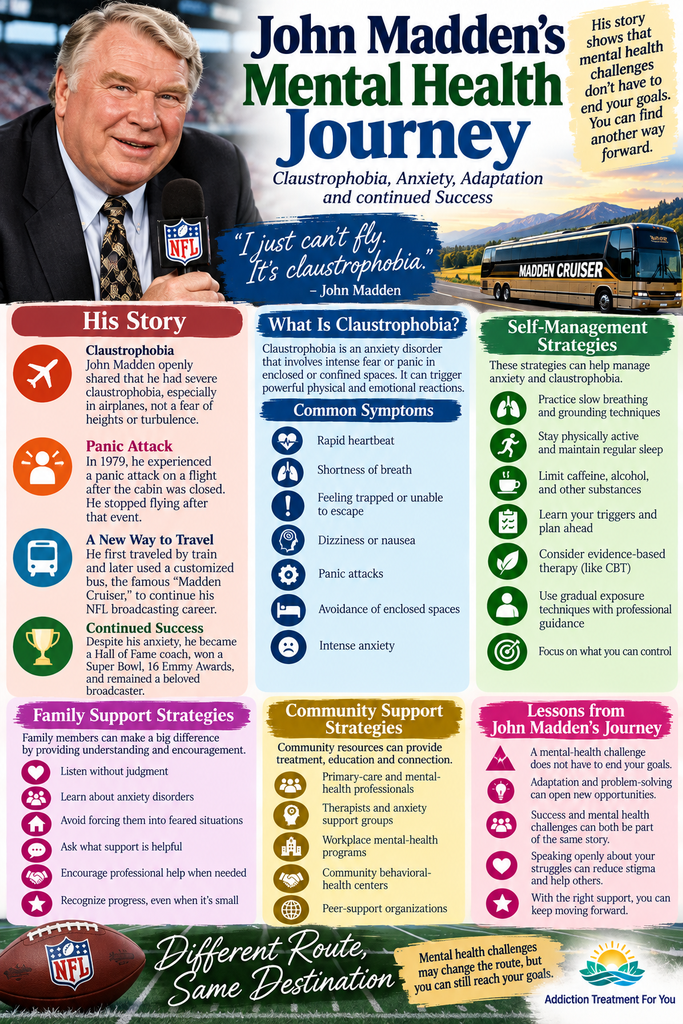
John Madden was one of the most recognizable figures in American football. He achieved extraordinary success as an NFL coach, broadcaster, and the namesake of the Madden NFL video-game franchise. Behind his energetic public personality, however, Madden openly discussed a significant struggle with claustrophobia that affected his ability to fly and required him to restructure an important part of his professional life.
It is important not to assign Madden mental-health diagnoses that he did not publicly report. Available accounts document claustrophobia, severe anxiety surrounding enclosed spaces, and a panic attack during a flight. His experience provides a useful example of how a mental-health challenge can affect daily functioning while a person continues pursuing a successful career.
John Madden’s Struggle With Claustrophobia
Madden repeatedly explained that his difficulty with airplanes stemmed primarily from claustrophobia rather than a fear of heights or turbulence. In a 1987 interview, he openly discussed his claustrophobia and explained that it affected not only flying but also other situations involving enclosed spaces.
Madden had friends who died in the 1960 plane crash involving the Cal Poly football team, an event sometimes cited as the explanation for his refusal to fly. Madden himself said his discomfort with airplanes existed independently of that tragedy and emphasized that claustrophobia was the primary problem.
The problem eventually became impossible for him to ignore.
The Panic Attack That Changed His Travel
Madden continued flying throughout much of his coaching career. But in 1979, while traveling from Tampa, he experienced a panic attack after the airplane cabin was closed. He subsequently stopped flying.
A panic attack can involve intense fear accompanied by physical symptoms such as rapid heartbeat, sweating, trembling, shortness of breath, chest discomfort, dizziness, nausea, or a feeling of losing control.
For someone with claustrophobia, being somewhere where immediate escape seems impossible can become a powerful trigger.
Madden’s experience illustrates that anxiety disorders and phobias can create very real limitations—even for someone who appears confident, accomplished, and comfortable in highly stressful professional environments.
Self-Management: Finding Another Way Forward
One of the most interesting parts of Madden’s story is how he adapted his environment around his limitations.
After giving up air travel, he initially traveled by train. He eventually switched to a customized bus that became known as the Madden Cruiser. The bus let him keep traveling across the country to broadcast NFL games without flying.
Madden even described train travel as psychologically beneficial because it forced him to slow down, rest, read, interact with people, and spend time away from the constant demands of work.
For people experiencing anxiety, panic, or phobias, useful self-management strategies can include:
- Identifying situations that trigger intense anxiety.
- Learning slow-breathing and grounding techniques.
- Recognizing early physical symptoms of panic.
- Maintaining regular sleep and physical activity.
- Reducing excessive caffeine, alcohol, or other substances that may intensify anxiety.
- Learning about how anxiety and the body’s fight-or-flight response work.
- Discussing persistent symptoms with a mental-health professional.
- Developing a plan for managing stressful situations before they occur.
- Considering evidence-based treatment rather than allowing anxiety to progressively restrict everyday life.
Madden’s solution allowed him to continue working, but complete avoidance is not necessarily the preferred clinical treatment for a phobia. Treatments such as cognitive behavioral therapy and appropriately supervised exposure therapy can help some people gradually reduce phobic anxiety.
Turning a Limitation Into an Adaptation
The Madden Cruiser eventually became almost as recognizable as Madden himself.
Beginning in 1987, Madden traveled extensively by customized bus. It offered greater flexibility than train travel, letting him stop when he wanted, change routes, and control his environment.
Rather than ending his broadcasting career because he could no longer tolerate flying, Madden found a practical alternative.
The unexpected consequence was that traveling by road let him experience parts of America he might never have seen otherwise. He stopped in communities, interacted with fans, attended events, and experienced the country between NFL cities.
This does not mean that anxiety itself was beneficial. Instead, it demonstrates how adaptation and problem-solving can preserve quality of life when a mental-health challenge creates genuine limitations.
Family Support Strategies
Family members can play an important role when someone experiences claustrophobia, panic attacks, or another anxiety disorder. The objective should not be to ridicule the fear or simply tell someone that there is nothing to worry about.
Helpful family approaches include:
- Listen without criticizing or embarrassing the person.
- Recognize that panic’s physical symptoms can feel extremely real.
- Learn about anxiety disorders and specific phobias.
- Ask what helps during periods of intense anxiety.
- Encourage professional treatment when anxiety interferes with everyday activities.
- Avoid forcing someone into a feared situation without appropriate preparation.
- Support gradual progress rather than expecting immediate change.
- Recognize accomplishments that occur despite anxiety.
Families should also be careful not to unintentionally reinforce increasingly restrictive avoidance. A mental-health professional can help determine the appropriate balance between providing support and encouraging treatment.
Community Support Strategies
Community resources can help people understand that anxiety disorders are health conditions rather than character weaknesses.
Support may come from:
- Primary-care professionals
- Psychologists and licensed therapists
- Psychiatrists
- Cognitive behavioral therapy programs
- Anxiety and panic support groups
- Workplace mental-health programs
- Community behavioral-health centers
- Peer-support organizations
Employers can also make a difference. Reasonable flexibility and open communication may help individuals remain productive while receiving treatment or managing symptoms.
Madden’s career demonstrates the potential value of environmental flexibility. His broadcasting responsibilities required extensive travel, but alternative transportation allowed him to keep working for decades.
Success Does Not Eliminate Mental-Health Challenges
Madden coached the Oakland Raiders to a Super Bowl championship and later became one of America’s most influential sports broadcasters. He won 16 Emmy Awards as a sports analyst/personality and broadcast NFL games for decades.
Yet professional success did not make him immune to anxiety.
That distinction matters because people sometimes assume that someone who is successful, wealthy, outgoing, or confident cannot have a significant mental-health struggle.
Mental-health conditions do not always look the way people expect.
Someone may comfortably speak before millions of television viewers while experiencing intense anxiety inside an airplane. Another person may function effectively at work while struggling with panic attacks in specific environments.
What John Madden’s Experience Can Teach Us
Madden did not allow his inability to tolerate flying to completely end the career he loved. Instead, he changed how he traveled.
The Madden Cruiser became a practical accommodation and eventually an iconic part of his public identity. His story demonstrates that acknowledging a limitation does not necessarily mean abandoning important goals.
For people experiencing anxiety or phobias, however, professional treatment can provide additional options beyond avoidance. Modern evidence-based therapies can help people understand anxiety, gradually confront feared situations, and reduce the degree to which fear controls their decisions.
Conclusion
John Madden’s mental-health story is primarily one of claustrophobia, panic, adaptation, and continued functioning. He openly acknowledged his claustrophobia, stopped flying after experiencing severe anxiety, and found alternative ways to meet the extraordinary travel demands of an NFL broadcasting career.
His experience offers a broader lesson: self-management can help people recognize triggers and develop coping strategies, families can provide understanding without judgment, and community and professional resources can offer effective treatment.
A mental-health challenge may require someone to change the route they take toward a goal. John Madden’s journey shows that changing the route does not necessarily mean giving up the destination.
Frequently Asked Questions
Here are some common questions:
1. Did John Madden have mental health issues?
John Madden publicly discussed claustrophobia and panic associated with enclosed spaces, particularly airplanes. He described himself as claustrophobic and said his difficulty flying was not primarily about heights or turbulence.
2. Was John Madden afraid of flying?
Madden stopped flying, but he made an important distinction: he said the underlying problem was claustrophobia. Being enclosed inside an airplane and unable to leave triggered intense anxiety.
3. Did John Madden experience panic attacks?
Yes. Accounts of Madden’s travel history describe claustrophobic panic episodes while flying. In 1979, he experienced a panic attack on a flight after the cabin door was closed, and he subsequently stopped flying altogether.
4. What is claustrophobia?
Claustrophobia is an intense fear of confined or enclosed spaces. Situations such as airplanes, elevators, tunnels, crowded rooms, or other places where escape feels difficult can trigger significant anxiety in some people.
5. What symptoms can occur with claustrophobia?
Symptoms can resemble those of a panic attack and may include:
- Rapid heartbeat
- Shortness of breath
- Sweating or trembling
- Dizziness
- Chest discomfort
- Nausea
- Feeling trapped
- An overwhelming urge to escape
- Fear of losing control
The severity varies considerably from person to person.
6. Did the Cal Poly plane crash cause Madden’s fear?
Madden lost friends in the 1960 Cal Poly football-team plane crash, and the tragedy has often been connected to his avoidance of airplanes. However, Madden himself said that wasn’t the cause, explaining that he already disliked flying and that his claustrophobia worsened over time.
7. When did John Madden stop flying?
Madden’s last airplane trip occurred in 1979. After experiencing severe anxiety and panic during the trip, he decided not to fly again.
8. How did Madden continue traveling for his broadcasting career?
He initially traveled extensively by train. Later, he used a customized motor coach that became famous as the Madden Cruiser. The bus let him travel across the country for broadcasting assignments without flying.
9. Why was the Madden Cruiser helpful?
The bus gave Madden greater control over his surroundings and schedule. Unlike train travel, he could change routes, stop when necessary, and travel on his own schedule.
10. Was avoiding airplanes a treatment for his claustrophobia?
Not necessarily. Madden developed a practical accommodation that allowed him to continue his career, but avoidance is different from treating a phobia. For people whose phobias significantly interfere with life, professional treatments such as cognitive behavioral therapy and appropriately supervised exposure-based therapy may help.
11. What self-management strategies may help someone with claustrophobia?
Learning personal triggers is an important starting point. Slow breathing, grounding exercises, regular physical activity, adequate sleep, and planning ahead for potentially stressful situations may help manage anxiety. People should consider professional treatment when avoidance begins significantly restricting work, relationships, or everyday activities.
12. How can family members support someone with claustrophobia?
Family members can listen without judgment and recognize that the fear feels real even when the situation appears safe to someone else. Helpful approaches include:
- Avoiding ridicule or criticism
- Learning about anxiety and phobias
- Asking what helps during anxious situations
- Supporting gradual progress
- Encouraging professional treatment when appropriate
- Avoiding unexpectedly forcing the person into a feared situation
Support should encourage recovery while respecting the individual’s limits.
13. How can community resources help?
Primary-care professionals, psychologists, psychiatrists, therapists, and community behavioral-health programs can help people evaluate anxiety symptoms and determine whether treatment is necessary. Anxiety support groups may also help individuals recognize that they are not alone.
14. Did claustrophobia prevent Madden from having a successful career?
No. Madden adapted his travel arrangements and continued a highly successful broadcasting career. His inability to tolerate air travel required substantial logistical changes, but the Madden Cruiser allowed him to continue traveling to NFL games around the country.
15. Can someone be confident and successful while experiencing significant anxiety?
Absolutely. Anxiety can be highly situation-specific. Someone may function comfortably in a stadium, workplace, or television studio while experiencing overwhelming anxiety in another environment. Madden’s public confidence and professional accomplishments did not prevent him from experiencing claustrophobia.
16. Can claustrophobia be treated?
Yes. Specific phobias can often be treated. Cognitive behavioral approaches may help people understand their anxiety responses, challenge unhelpful beliefs, and gradually encounter feared situations under appropriate guidance.
17. What can we learn from John Madden’s experience?
Madden’s story illustrates the difference between a person’s mental-health challenge and their overall abilities. He acknowledged a significant limitation, reorganized how he traveled, and continued pursuing his career.
His experience also highlights three useful areas of support: self-management can help identify triggers and control anxiety responses, family support can provide understanding without judgment, and community and professional resources can provide evidence-based treatment.
Sometimes managing a mental-health challenge means finding a different route toward the same destination.
Video: He refused to get on a plane ✈️ #johnmadden #nfl #fear