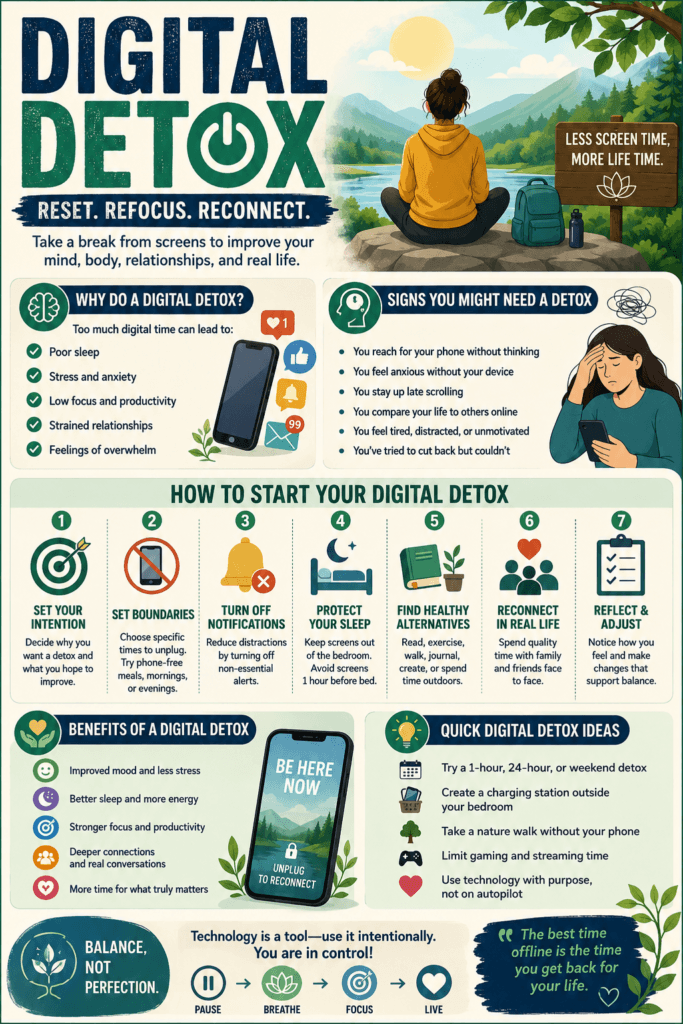
Technology has become an essential part of modern life, providing convenient access to communication, education, employment, entertainment, healthcare, and social connection. However, constant notifications, social media, gaming, streaming, and endless scrolling can make it difficult for some people to disconnect and use technology intentionally. A digital detox is a planned period of reducing or temporarily stepping away from unnecessary digital activities to evaluate technology habits and restore healthier boundaries. Rather than treating all screen use as harmful, a digital detox focuses on recognizing triggers, reducing automatic checking, improving sleep and concentration, strengthening relationships, and replacing excessive screen time with meaningful offline activities. Understanding digital detox strategies can help individuals regain greater control over when, why, and how they engage with technology.
Digital Detox: Reducing Unhealthy Technology Use
A digital detox is an intentional period of reducing or temporarily avoiding certain digital activities—such as social media, gaming, online shopping, streaming, news feeds, or unnecessary smartphone use—to regain control over technology habits. A digital detox does not necessarily require eliminating technology completely. The goal is usually to develop a healthier and more intentional relationship with digital devices.
Why Can Digital Technology Become Difficult to Control?
Many digital platforms provide rapid and unpredictable rewards. Notifications, likes, messages, new videos, game achievements, and constantly refreshed content can repeatedly capture attention and reinforce checking behaviors.
Features such as infinite scrolling, autoplay, personalized recommendations, push notifications, and variable rewards can make it difficult to disengage. Over time, someone may automatically reach for a phone whenever they feel bored, stressed, lonely, anxious, or uncomfortable.
This can create a behavioral cycle:
Trigger → Check Device → Temporary Reward/Relief → Repeat → Habit Strengthens
Not everyone who spends significant time online has an addiction. The more important question is whether technology use is becoming difficult to control and interfering with everyday functioning.
Signs You May Benefit From a Digital Detox
Potential warning signs include constantly checking your phone without a clear reason, feeling uncomfortable when separated from it, staying online longer than intended, losing sleep due to screen use, repeatedly checking notifications, neglecting exercise or responsibilities, and choosing online activities over important relationships.
Another important warning sign is failed attempts to cut back despite recognizing that technology use is causing problems.
Mental Health and Digital Overload
Excessive or poorly controlled digital use may contribute to sleep disruption, reduced concentration, stress, sedentary behavior, and relationship difficulties. However, the relationship between screen use and mental health is complex. Technology can also provide education, social connection, entertainment, access to healthcare, and emotional support.
For this reason, the objective should not automatically be “screens are bad.” Instead, ask:
Is technology supporting my life—or interfering with it?
What Does a Digital Detox Look Like?
A digital detox can be customized rather than all-or-nothing. Someone might establish phone-free meals, temporarily remove social media apps, disable unnecessary notifications, avoid recreational screen time before bedtime, stop taking the phone into the bedroom, schedule specific times to check messages, or designate certain hours as technology-free.
For some people, a digital reset may be more realistic than complete abstinence.
Replace Rather Than Simply Remove
Removing a digital habit creates empty time, and that time needs somewhere to go. Replacement activities can include exercise, reading, cooking, gardening, hobbies, outdoor activities, face-to-face conversations, volunteering, meditation, or simply tolerating short periods of boredom.
This changes the process from:
“I can’t use my phone.”
to:
“I’m choosing something more valuable right now.”
Digital Detox and Behavioral Addiction
A digital detox can be useful when addressing problematic social-media use, gaming, pornography, online shopping, gambling, or other compulsive digital behaviors. However, some activities require more than a general reduction in screen time.
For example, online gambling disorder or severe gaming problems may require targeted behavioral-health treatment rather than simply putting the phone away for a weekend.
Sleep Is an Important Target
One of the most practical areas for change is nighttime technology use. Keeping devices out of the bedroom, establishing a consistent bedtime routine, and reducing stimulating digital activities before sleep can help separate the bedroom from the cycle of notifications, scrolling, and entertainment.
When Professional Help May Be Appropriate
Consider professional evaluation when digital behavior repeatedly interferes with work, school, relationships, sleep, finances, or emotional health—or when repeated attempts to reduce the behavior are unsuccessful.
Treatment may focus on the underlying problem rather than technology itself. Stress, anxiety, depression, loneliness, ADHD symptoms, substance use, gambling, or other concerns can sometimes contribute to excessive digital engagement.
Key Message
A successful digital detox is not about declaring technology the enemy. Technology is a tool, and complete avoidance is neither necessary nor realistic for most people.
A healthier goal is:
Notice the Trigger → Interrupt Automatic Checking → Set Boundaries → Replace the Habit → Reconnect Offline → Use Technology Intentionally
The best digital detox is therefore not simply spending a few days away from your phone. It is about developing habits that help you decide when technology deserves your attention—rather than letting it decide for you.
Self-Management Strategies for a Digital Detox
A digital detox is most effective when it focuses on intentional technology use rather than complete avoidance. Self-management strategies can help identify unhealthy digital habits, reduce automatic checking, improve sleep and concentration, and create healthier boundaries with smartphones, social media, gaming, streaming, and other online activities.
- Track your screen time. Review how much time you spend on different apps and websites. Look for patterns such as late-night scrolling, repeated checking, or spending significantly longer online than intended.
- Identify your digital triggers. Notice what makes you reach for your device. Common triggers include boredom, stress, loneliness, anxiety, procrastination, notifications, and fear of missing out.
- Set realistic limits. Rather than immediately eliminating technology, establish achievable boundaries—for example, limiting recreational screen time or scheduling specific periods for social media.
- Create phone-free zones. Keep devices away from the dining table, family activities, meetings, exercise sessions, and other situations where you want to be fully present.
- Protect your bedroom. Consider charging your phone outside the bedroom or keeping it away from the bed. Reducing nighttime scrolling can support healthier sleep routines.
- Turn off unnecessary notifications. Notifications can repeatedly interrupt attention and trigger automatic checking. Keep alerts that are genuinely important and disable unnecessary promotional and social-media notifications.
- Remove high-trigger apps. Temporarily deleting or logging out of apps that are particularly difficult to control can create an additional barrier between an urge and the behavior.
- Use scheduled checking periods. Instead of responding to every notification immediately, establish specific times to check email, social media, news, or messages.
- Practice the “pause before opening” technique. Before opening an app, ask yourself: “Why am I opening this?” If there is no clear purpose, consider putting the device down.
- Replace rather than simply remove. Fill reduced screen time with exercise, reading, hobbies, cooking, outdoor activities, face-to-face conversations, volunteering, meditation, or another meaningful activity.
- Practice tolerating boredom. Not every quiet moment needs digital stimulation. Waiting in line, drinking coffee, or taking a short break without reaching for a phone can gradually weaken automatic checking habits.
- Avoid multitasking with multiple screens. Watching television while simultaneously scrolling through a phone can increase digital stimulation and make sustained attention more difficult. Practice focusing on one activity at a time.
- Schedule regular digital breaks. Consider a technology-free hour, evening, morning, or portion of the weekend. Start with manageable periods and gradually increase them if helpful.
- Monitor how you feel. Ask whether your digital habits leave you feeling relaxed, informed, connected, anxious, exhausted, distracted, or dissatisfied. Screen time alone does not tell the entire story.
- Create an emergency exception. A digital detox should not interfere with necessary communication, healthcare, employment, navigation, or emergency access. Establish clear exceptions rather than treating the detox as absolute abstinence.
- Seek professional support when necessary. If gaming, gambling, social media, online shopping, pornography, or another digital behavior is causing significant impairment and repeated attempts to cut back have failed, a behavioral-health assessment may be appropriate.
A Simple Digital Detox Cycle
Recognize the Trigger → Pause → Decide Whether the Screen Is Necessary → Choose an Alternative → Return to Technology Intentionally
The goal is not necessarily less technology at all costs. It is greater control over when, why, and how technology is used. A successful digital detox helps transform screen use from an automatic habit into a conscious choice.
Family Support Strategies for a Digital Detox
Families can make a digital detox more successful by creating a supportive environment in which technology is used intentionally rather than automatically. The goal should not be to portray phones, gaming, social media, or other technology as inherently harmful. Instead, families can work together to identify when digital habits interfere with sleep, relationships, responsibilities, physical activity, or emotional well-being.
- Learn about digital habits together. Discuss how notifications, infinite scrolling, autoplay, gaming rewards, and personalized recommendations can encourage prolonged engagement. Understanding these features can reduce blame and promote healthier conversations.
- Avoid shaming or labeling. Statements such as “You’re addicted to your phone” can create defensiveness. Focus instead on observable behaviors, such as staying online until early morning or repeatedly missing family activities.
- Create a family digital plan. Establish realistic expectations for recreational screen use, gaming, social media, homework, work, and communication. Rules should be clear and appropriate for each person’s age and responsibilities.
- Establish device-free family zones. Consider keeping phones away during meals, family conversations, outings, and other activities where personal interaction is the priority.
- Protect family sleep routines. Encourage everyone to reduce unnecessary nighttime screen use and, when practical, keep devices out of the bedroom.
- Model healthy technology use. Adults can demonstrate the same behaviors expected from children and teenagers. Family rules are more credible when everyone participates.
- Turn off unnecessary notifications. Help family members identify alerts that repeatedly interrupt conversations, studying, sleep, or other important activities.
- Plan offline activities together. Replace some screen time with walks, exercise, cooking, gardening, board games, hobbies, volunteering, or other shared experiences.
- Respect necessary technology use. School, employment, healthcare, navigation, communication, and other responsibilities may require screen use. A digital detox should distinguish necessary technology from recreational or compulsive use.
- Discuss social media realistically. Talk about comparison, fear of missing out, advertising, influencers, and curated online identities without assuming that every social-media experience is harmful.
- Avoid using technology exclusively as a reward or punishment. Constantly making screen access the ultimate reward can unintentionally increase its perceived value. Encourage multiple sources of enjoyment and accomplishment.
- Encourage open conversations about online experiences. Children and teenagers should feel comfortable discussing cyberbullying, inappropriate content, online pressure, gambling-like features, or uncomfortable interactions without immediately fearing punishment.
- Watch for significant behavioral changes. Severe sleep disruption, declining performance, social withdrawal, financial problems, persistent conflict, or repeated inability to reduce a particular digital behavior may indicate that additional support is needed.
- Celebrate progress rather than perfection. A successful digital detox does not require eliminating every unnecessary screen. Recognize improvements such as better sleep, fewer interruptions, increased physical activity, or more family interaction.
- Seek professional support when needed. If gaming, gambling, social media, online shopping, pornography, or another digital behavior becomes difficult to control and causes significant impairment, a behavioral-health professional can help identify underlying problems and appropriate interventions.
Family Digital Detox Formula
Communicate → Set Boundaries → Model Healthy Use → Create Offline Alternatives → Reconnect → Review Progress
A family digital detox works best when it becomes a shared lifestyle adjustment rather than punishment for one person. The objective is not simply to count fewer screen hours. It is to help family members protect sleep, strengthen relationships, maintain responsibilities, and develop the ability to decide when technology deserves their attention and when real life deserves it more.
Community Resource Strategies to Understand Digital Detox
Community resources can help people develop healthier relationships with smartphones, social media, gaming, streaming, and other digital technologies. A digital detox should not necessarily mean eliminating technology. Community strategies are most effective when they promote digital literacy, healthy boundaries, sleep, social connection, physical activity, and early intervention for problematic digital behaviors.
- Provide digital wellness education. Schools, libraries, community centers, healthcare organizations, and workplaces can offer workshops explaining screen habits, notifications, infinite scrolling, social-media algorithms, gaming rewards, and other features that encourage prolonged engagement.
- Develop school-based digital wellness programs. Schools can teach students about balanced technology use, cyberbullying, online safety, social-media pressure, sleep hygiene, and strategies for managing recreational screen time.
- Offer parent and caregiver education. Community organizations can help families establish realistic technology boundaries, recognize problematic behaviors, use parental controls appropriately, and communicate with children about online experiences without relying solely on punishment.
- Promote technology-free community activities. Recreation centers, parks, libraries, faith communities, and nonprofit organizations can offer sports, arts, gardening, reading groups, volunteer opportunities, and social events that encourage face-to-face interaction.
- Create digital wellness campaigns. Public-health programs can promote simple challenges such as device-free meals, notification-free evenings, outdoor activities, or scheduled social-media breaks.
- Support mental-health services. Counseling and behavioral-health programs can help individuals whose technology use is associated with anxiety, depression, loneliness, stress, sleep problems, or difficulty controlling specific online behaviors.
- Provide targeted resources for behavioral addictions. Online gambling and problematic gaming may require specialized assessment and treatment rather than a general digital detox. Communities should maintain referral pathways to appropriate professionals and programs.
- Encourage healthcare screening. Primary-care and behavioral-health professionals can ask about sleep, gaming, social media, online gambling, and other digital habits when they appear to interfere with daily functioning.
- Promote healthy sleep education. Community health programs can explain how late-night digital activity may interfere with sleep routines and encourage consistent bedtimes and reduced recreational screen use around bedtime.
- Improve digital literacy among older adults. Libraries and senior programs can provide education about social media, online scams, misinformation, privacy, and healthy technology habits while preserving the benefits of digital connection.
- Encourage workplace digital boundaries. Employers can establish reasonable expectations regarding after-hours email, messaging, virtual meetings, and availability to reduce unnecessary digital overload.
- Create peer-support opportunities. Support groups and wellness programs can provide accountability for people attempting to reduce problematic gaming, social-media use, online shopping, gambling, or other compulsive digital behaviors.
- Promote accessible recreational opportunities. Affordable sports, exercise programs, arts programs, outdoor recreation, and community events provide meaningful alternatives to excessive recreational screen use.
- Address social isolation. Because some people use technology to cope with loneliness, community programs should create opportunities for genuine social connection rather than simply telling individuals to spend less time online.
- Evaluate progress rather than demanding abstinence. Communities should promote healthier outcomes—such as improved sleep, stronger relationships, greater physical activity, better concentration, and increased control—rather than assuming that zero recreational screen time is the ideal goal.
Building a Digital-Wellness Community
A comprehensive community approach can follow this pathway:
Education → Digital Literacy → Healthy Boundaries → Offline Activities → Social Connection → Mental-Health Support → Specialized Treatment When Needed
The goal of a community digital detox is not to make people anti-technology. Digital tools provide important benefits for education, employment, healthcare, communication, and social connection. Instead, communities can help people develop the skills and resources needed to make technology a purposeful tool rather than an automatic habit controlling their attention.
Frequently Asked Questions
Here are some common questions:
1. What is a digital detox?
A digital detox is an intentional period of reducing or temporarily stepping away from unnecessary technology use, such as social media, gaming, streaming, or recreational smartphone use. The goal is to regain control over digital habits and create a healthier balance.
2. Does a digital detox mean completely giving up technology?
No. Most people need technology for work, school, healthcare, communication, and everyday responsibilities. A digital detox usually focuses on reducing unnecessary or compulsive use rather than eliminating technology entirely.
3. How do I know if I need a digital detox?
Possible signs include constantly checking your phone, staying online longer than intended, losing sleep from scrolling or gaming, feeling anxious when without your device, neglecting responsibilities, or repeatedly trying and failing to reduce your screen time.
4. Is excessive screen use an addiction?
Not necessarily. Spending many hours on a device does not automatically indicate addiction. Greater concern exists when a specific digital behavior becomes difficult to control and continues despite significant problems with relationships, work, school, sleep, finances, or emotional well-being.
5. Why is it so difficult to put my phone down?
Notifications, social feedback, personalized recommendations, infinite scrolling, autoplay, and unpredictable rewards can repeatedly capture attention. These features can reinforce automatic checking habits.
6. How long should a digital detox last?
There is no universal duration. Someone might begin with a screen-free meal, one hour each evening, a full evening, or a weekend. Sustainable boundaries are generally more important than completing a specific number of detox days.
7. What should I do during a digital detox?
Replace recreational screen time with meaningful alternatives such as exercise, reading, cooking, gardening, hobbies, outdoor activities, meditation, volunteering, or spending face-to-face time with family and friends.
8. Can a digital detox improve sleep?
It may help, particularly when excessive nighttime technology use delays bedtime or keeps someone mentally stimulated. Establishing a consistent nighttime routine and reducing unnecessary device use around bedtime can support healthier sleep habits.
9. Can digital detoxing improve concentration?
Reducing frequent notifications and interruptions can create longer periods of uninterrupted attention. Scheduled checking periods and disabling nonessential alerts can be particularly useful.
10. What are good digital boundaries for families?
Families can establish device-free meals, screen-free family activities, nighttime boundaries, and agreed-upon recreational screen periods. Adults should model the behaviors they expect from children.
11. Should I delete social media completely?
Not necessarily. Some people benefit from temporarily deleting high-trigger apps, while others can establish healthier limits. The appropriate strategy depends on how the platform affects your behavior and well-being.
12. What is a “phone-free zone”?
It is a location or situation where recreational phone use is intentionally limited, such as the dining table, bedroom, family activities, meetings, or exercise sessions.
13. What if I feel uncomfortable without my phone?
Some discomfort can occur when changing a well-established habit. Identify what you are feeling—such as boredom, fear of missing out, loneliness, or stress—and practice responding with an alternative activity rather than automatically checking your device.
14. Is a digital detox helpful for social-media addiction?
Reducing access can help interrupt compulsive patterns, but severe or persistent problems may require more than a temporary detox. Behavioral health support may be appropriate when social media use causes significant impairment.
15. Can a digital detox treat gaming or online gambling addiction?
A general digital detox may reduce access temporarily, but serious gaming problems or gambling disorder may require specialized assessment and treatment. Simply reducing overall screen time may not address the underlying behavioral addiction.
16. Should children and teenagers participate in a digital detox?
They can benefit from balanced technology routines, but expectations should be developmentally appropriate and take into account schoolwork, friendships, and family communication. A collaborative family approach is generally preferable to suddenly confiscating devices as punishment.
17. How can I make a digital detox easier?
Turn off unnecessary notifications, move distracting apps off the home screen, set specific times to check, keep devices out of the bedroom, plan offline activities, and tell family or friends about your goals.
18. What happens after the detox ends?
Returning immediately to previous habits can eliminate much of the benefit. Instead, identify which changes improved your life and convert them into long-term boundaries.
19. When should I seek professional help?
Consider professional support when a digital behavior repeatedly interferes with sleep, relationships, work, school, finances, or emotional health—or when multiple attempts to regain control have been unsuccessful.
20. What is the main goal of a digital detox?
The goal is not simply fewer hours on a screen. It is greater control over your attention and behavior.
Conclusion
A successful digital detox is not about completely eliminating technology but about developing a healthier and more purposeful relationship with it. Setting screen boundaries, reducing unnecessary notifications, creating device-free spaces, protecting sleep, participating in offline activities, and monitoring emotional triggers can help interrupt unhealthy digital habits. Families, schools, workplaces, healthcare professionals, and community organizations can reinforce these changes by promoting digital literacy and providing opportunities for meaningful social connection. When technology use becomes difficult to control or significantly interferes with relationships, responsibilities, sleep, finances, or emotional well-being, professional support may also be appropriate. Ultimately, the goal of a digital detox is simple: use technology as a tool that supports your life rather than allowing it to control your attention, time, and priorities.
Video: Don’t Let Screens Steal Your Life #DigitalDependence #AddictionRecovery