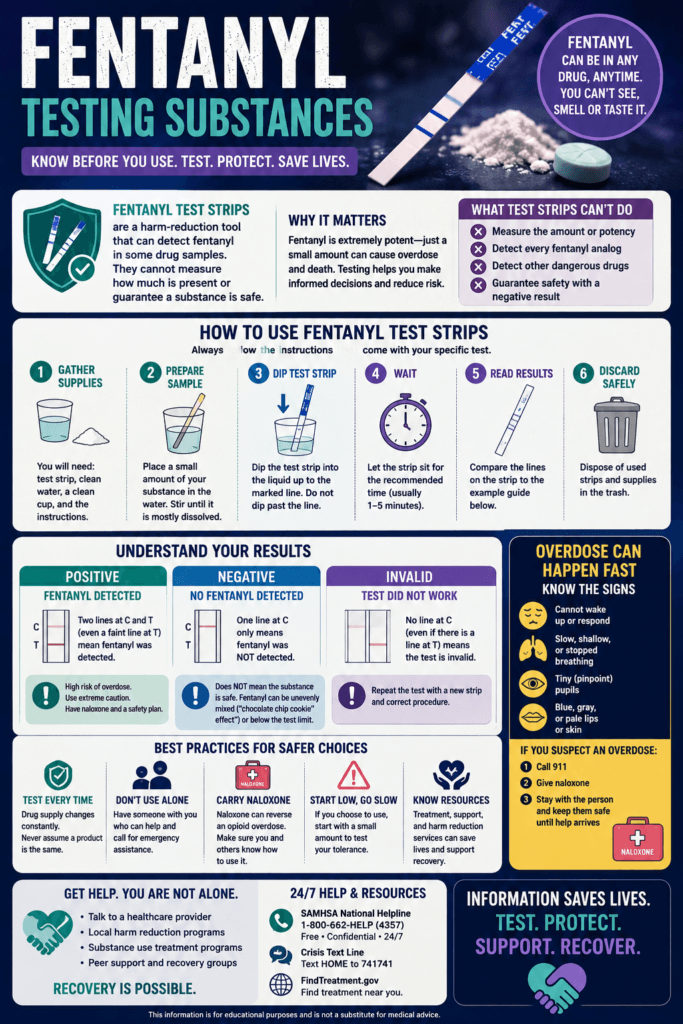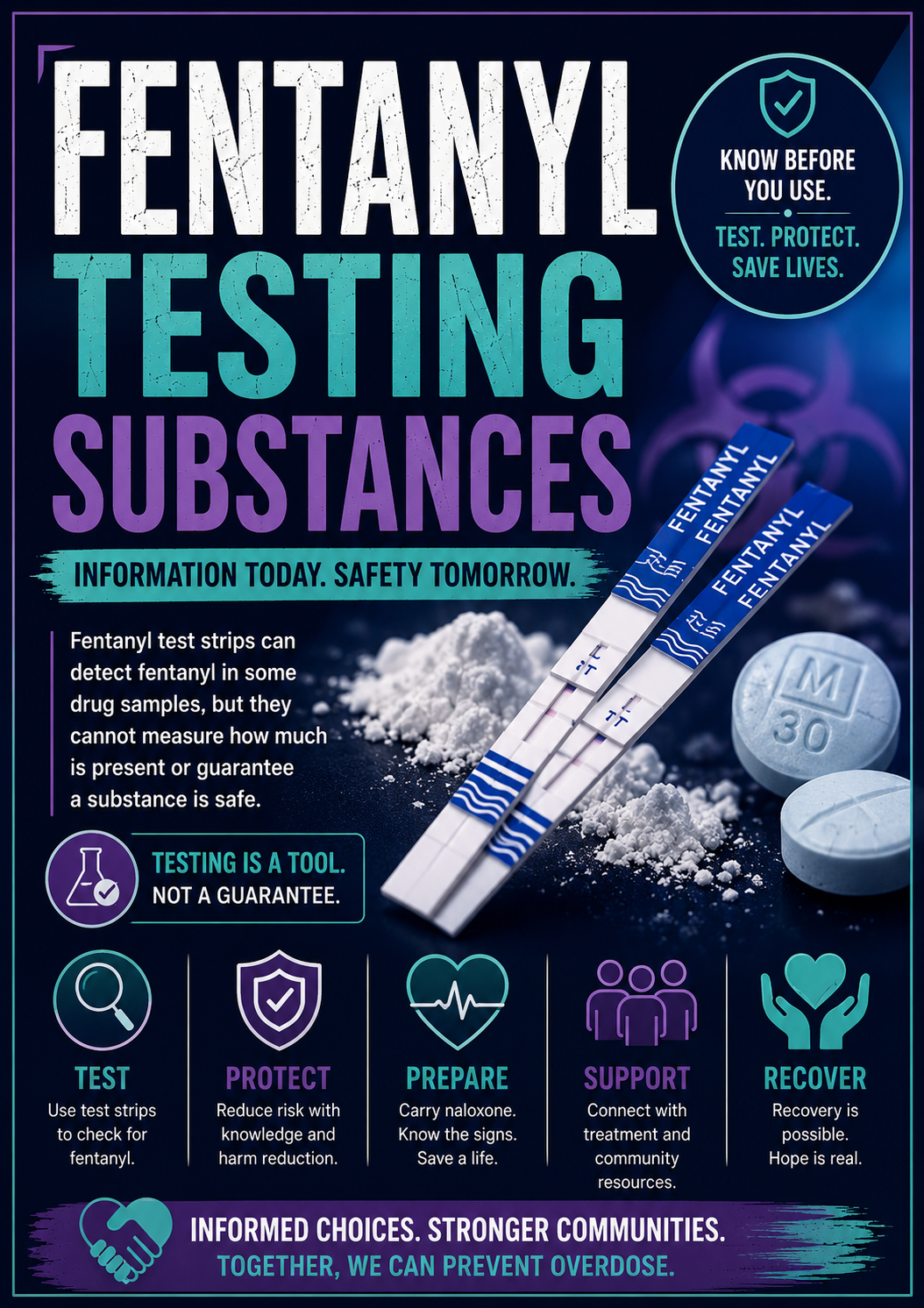
Fentanyl testing has become an important harm-reduction strategy as illicitly manufactured fentanyl continues to appear in the unregulated drug supply, including counterfeit pills and substances sold as heroin, cocaine, or methamphetamine. Because fentanyl cannot reliably be identified by appearance, smell, or taste, fentanyl test strips can provide potentially lifesaving information by detecting fentanyl in some drug samples. However, these tests have important limitations: they generally cannot determine how much fentanyl is present, measure its potency, identify every dangerous contaminant, or guarantee that a substance is safe after a negative result. Understanding both the benefits and limitations of fentanyl testing allows individuals, families, healthcare professionals, and communities to use it appropriately as one component of a broader overdose-prevention strategy.
Fentanyl Testing of Substances
Fentanyl testing is a harm-reduction strategy used to detect whether fentanyl may be present in a drug before it is consumed. This has become increasingly important because illicitly manufactured fentanyl can appear in heroin, counterfeit pills, cocaine, methamphetamine, and other unregulated substances—sometimes without the person knowing it is present.
What Are Fentanyl Test Strips?
Fentanyl test strips (FTS) are small test strips originally developed for urine testing but now commonly used in harm-reduction settings to detect fentanyl in drug samples. According to the CDC, fentanyl test strips can detect fentanyl in different types of drugs and can help people make more informed decisions about their risk.
A small sample of the substance is dissolved in water according to the specific test manufacturer’s instructions, and the strip is used to determine whether fentanyl is detected. Because instructions and dilution requirements can differ, the directions supplied with the particular test should be followed carefully.
Why Is Testing Important?
Illicit fentanyl is extremely potent. Someone may believe they purchased a prescription opioid or another substance when the product actually contains fentanyl. Counterfeit pills can be particularly deceptive because they may resemble legitimate medications.
Testing provides information that cannot reliably be obtained by looking at, smelling, or tasting a substance.
What Does a Positive Result Mean?
A positive fentanyl test indicates that fentanyl was detected in the tested sample. It does not tell the person how much fentanyl is present, how potent the substance is, or whether other dangerous substances are present.
A positive result therefore signals significant overdose risk rather than providing a measurement of safety.
What Does a Negative Result Mean?
This is an equally important limitation. A negative test does not guarantee that a drug is fentanyl-free or safe.
Fentanyl may not be distributed evenly throughout a batch—a phenomenon sometimes described as the “chocolate chip cookie effect.” One portion may contain fentanyl while another portion has little or none. Testing errors, fentanyl analogs, sample preparation, and limitations of individual test products can also affect results.
Therefore:
Negative test ≠ safe drug
What Fentanyl Test Strips Cannot Tell You
FTS generally cannot determine the amount or concentration of fentanyl, predict whether a dose will cause an overdose, identify every fentanyl analog, or detect all other dangerous contaminants.
For example, xylazine (“tranq”) is not fentanyl and requires different testing methods. A fentanyl test cannot be assumed to identify xylazine.
Testing as Part of Harm Reduction
Testing is most effective when combined with other overdose-prevention measures. People who may be exposed to opioids should have naloxone available, understand overdose warning signs, avoid mixing opioids with alcohol or other sedating substances, and avoid using alone.
Naloxone can temporarily reverse an opioid overdose involving fentanyl. If an overdose is suspected, naloxone should be administered and emergency medical assistance obtained.
Fentanyl Testing and Addiction Treatment
Drug checking is not a substitute for treatment of substance use disorder. Instead, it can serve as a bridge to healthcare by keeping people alive and connecting them with treatment opportunities.
For people with opioid use disorder, evidence-based medications including buprenorphine and methadone can substantially reduce opioid-related risks and support long-term recovery.
Role of Families and Communities
Families can learn about fentanyl test strips without assuming that providing harm-reduction information encourages drug use. Community organizations, syringe service programs, health departments, treatment centers, and other harm-reduction programs may distribute test strips and naloxone while connecting individuals to medical and addiction services.
The National Institute on Drug Abuse (NIDA) provides additional education about fentanyl and overdose prevention.
Key Message
Fentanyl testing should be viewed as risk reduction—not a guarantee of safety. Test strips can provide potentially lifesaving information about whether fentanyl is detected, but they cannot determine potency or guarantee that an unregulated substance is safe.
The strongest approach combines drug checking + naloxone + overdose education + avoiding dangerous drug combinations + access to evidence-based addiction treatment.
Self-Management Strategies for Fentanyl Testing of Substances
Fentanyl testing is a harm-reduction strategy, not a guarantee that an illicit substance is safe. Self-management involves understanding what fentanyl test strips can and cannot tell you, preparing for possible opioid exposure, and using testing as one part of a broader overdose-prevention and recovery plan.
- Understand the purpose of fentanyl testing. Fentanyl test strips can indicate whether fentanyl is detected in a tested sample. They generally cannot determine the amount or potency of fentanyl present.
- Follow the specific test instructions. Test-strip procedures and recommended dilution can vary by product. Carefully follow the manufacturer’s directions because incorrect preparation can affect results.
- Never assume a negative result means “safe.” A negative test cannot guarantee that the entire supply is fentanyl-free. Fentanyl may be unevenly distributed, and testing has limitations.
- Take a positive result seriously. If fentanyl is detected, recognize that the substance carries opioid-overdose risk. A test cannot tell you whether the amount present will cause an overdose.
- Do not rely on appearance, smell, or taste. Fentanyl contamination cannot reliably be identified by examining a powder or pill. Counterfeit pills can closely resemble legitimate prescription medications.
- Keep naloxone available. Anyone who may be exposed to illicit opioids or counterfeit pills should consider having naloxone readily available and ensuring people nearby know how to administer it.
- Avoid using substances alone. When opioid exposure is possible, having another person present who can recognize an overdose, administer naloxone, and obtain emergency assistance can reduce the risk of a fatal outcome.
- Avoid combining depressants. Mixing opioids with alcohol, benzodiazepines, or other sedating substances can increase the risk of profound sedation and respiratory depression.
- Learn the signs of opioid overdose. Warning signs include inability to wake, very slow or stopped breathing, choking or gurgling sounds, pinpoint pupils, and blue, gray, or pale lips or skin. Suspected opioid overdose requires immediate action.
- Remember that fentanyl testing does not identify everything. A fentanyl test should not be assumed to detect xylazine, every fentanyl analog, or other potentially dangerous contaminants.
- Develop an overdose-response plan. Know where naloxone is stored, how to administer it, how to contact emergency services, and what to do while waiting for help.
- Use testing as a bridge to treatment. If fentanyl exposure is occurring repeatedly, consider discussing substance use with an addiction-medicine or behavioral-health professional. For opioid use disorder, medications such as buprenorphine and methadone are evidence-based treatment options.
Key Self-Management Message
Think of fentanyl testing as one layer of protection rather than a safety certificate. A useful harm-reduction approach combines:
Testing → Recognizing Risk → Naloxone Access → Overdose Education → Avoiding Dangerous Combinations → Professional Treatment and Support
The safest interpretation of any fentanyl test is that a positive result identifies danger, while a negative result does not eliminate danger. This understanding can help people make better-informed decisions while maintaining a pathway toward treatment and recovery.
Family Support Strategies for Fentanyl Testing of Substances
Families can play an important role in reducing the risk of fentanyl overdose. Fentanyl test strips are a harm-reduction tool that can detect fentanyl in some drug samples, but they cannot determine how much fentanyl is present or guarantee that a substance is safe. Family support should combine education, overdose preparedness, open communication, appropriate boundaries, and encouragement toward treatment.
- Learn what fentanyl test strips do. Families should understand that test strips can indicate whether fentanyl is detected in a tested sample. They are a risk-reduction tool rather than proof that a substance is safe.
- Understand the limitations of negative results. A negative test does not guarantee that the entire drug supply is fentanyl-free. Fentanyl can be unevenly distributed, and individual tests have limitations.
- Avoid judgment when discussing testing. Conversations based on shame or punishment may make a person more likely to hide substance use. Discuss fentanyl testing as part of preventing overdose while continuing to encourage treatment.
- Keep naloxone readily available. Family members should know where naloxone is stored and learn how to administer it. Naloxone can temporarily reverse an opioid overdose, including one involving fentanyl.
- Develop a family overdose-response plan. Decide ahead of time who will administer naloxone, who will contact emergency services, and how family members will respond if someone becomes unresponsive or stops breathing normally.
- Recognize overdose warning signs. Inability to wake, very slow or stopped breathing, choking or gurgling sounds, pinpoint pupils, and blue, gray, or unusually pale lips or skin can indicate an opioid overdose.
- Take suspected overdose seriously. Administer naloxone when opioid overdose is suspected and obtain emergency medical assistance. Additional naloxone doses may sometimes be needed while emergency help is on the way.
- Do not assume counterfeit pills are legitimate medications. Pills obtained outside licensed pharmacies may contain illicitly manufactured fentanyl even when they resemble prescription medications.
- Understand that fentanyl testing does not detect every danger. A fentanyl test should not be assumed to identify xylazine or every other contaminant that may be present in the illicit drug supply.
- Support harm reduction without abandoning recovery goals. Providing naloxone or information about fentanyl testing does not prevent families from encouraging abstinence or treatment. Harm reduction focuses on keeping the person alive and connected to opportunities for recovery.
- Encourage evidence-based treatment. If the individual has opioid use disorder, help them connect with qualified healthcare professionals. Medications such as buprenorphine and methadone are evidence-based treatments for opioid use disorder.
- Maintain healthy family boundaries. Supporting safety does not require providing money for drugs, hiding consequences, or tolerating harmful behavior. Families can offer transportation to appointments, emotional support, treatment information, and overdose-prevention resources while maintaining appropriate limits.
- Seek support for the family. Addiction affects the entire household. Counseling, family therapy, peer-support programs, and addiction education can help relatives manage fear, stress, communication difficulties, and boundaries.
Key Message for Families
Families should view fentanyl testing as one component of a larger safety strategy:
Education + Fentanyl Testing + Naloxone + Overdose Response + Healthy Boundaries + Addiction Treatment
A fentanyl test strip cannot make an illicit substance safe, but accurate information and overdose preparedness can save a life. Keeping someone alive and connected to compassionate, evidence-based care preserves the opportunity for treatment and long-term recovery.
Community Resource Strategies for Fentanyl Testing of Substances
Community resources can play an important role in helping people understand fentanyl testing and reduce overdose deaths. Fentanyl test strips are harm-reduction tools that can help identify fentanyl in some drug samples, but they cannot determine the amount or potency present and cannot guarantee that a substance is safe. Effective community strategies should combine drug-checking education with naloxone access, overdose-response training, healthcare, and evidence-based addiction treatment.
- Expand fentanyl test-strip education. Health departments, community health centers, treatment programs, colleges, shelters, and outreach organizations can teach people how fentanyl test strips work, how to interpret results, and why negative results do not guarantee safety.
- Increase access to fentanyl test strips. Harm-reduction programs and other community organizations can make test strips easier to obtain, particularly in populations experiencing high rates of opioid overdose.
- Pair test strips with naloxone. Whenever possible, fentanyl-testing programs should also provide naloxone and education about recognizing and responding to opioid overdose. Testing identifies potential risk; naloxone provides an emergency intervention when opioid overdose occurs.
- Offer overdose-response training. Community members, families, first responders, shelter employees, educators, and service providers can learn how to recognize an opioid overdose, administer naloxone, contact emergency services, and provide appropriate assistance until help arrives.
- Support comprehensive drug-checking services. Where available, community programs can provide more advanced drug-checking technologies that identify a wider range of substances. Fentanyl test strips alone should not be expected to detect every contaminant.
- Educate about counterfeit pills. Prevention campaigns should emphasize that pills obtained outside licensed pharmacies may contain illicitly manufactured fentanyl even when they resemble legitimate prescription medications.
- Strengthen harm-reduction programs. Syringe-service programs and outreach organizations can provide fentanyl test strips, naloxone, safer-use education, infectious-disease prevention services, and referrals to healthcare and addiction treatment.
- Improve access to opioid use disorder treatment. Communities should maintain pathways to evidence-based treatment, including buprenorphine and methadone, behavioral healthcare, peer support, and continuing recovery services.
- Use mobile outreach. Mobile health units, street-medicine teams, and peer outreach workers can bring fentanyl education, test strips, naloxone, and treatment referrals to people who may not regularly access traditional healthcare settings.
- Educate healthcare professionals. Physicians, physician assistants, nurses, pharmacists, behavioral-health professionals, and emergency clinicians can explain fentanyl-testing limitations and incorporate overdose-prevention education into patient encounters.
- Address stigma. Community messaging should emphasize that distributing test strips and naloxone is intended to prevent death and maintain connection with healthcare—not to imply that illicit drug use is safe.
- Monitor local overdose trends. Public-health agencies can use toxicology, emergency-department, and overdose-surveillance information to identify changes in the local drug supply and communicate emerging risks to healthcare professionals and community organizations.
- Build partnerships. Hospitals, addiction-treatment programs, pharmacies, public-health departments, recovery organizations, shelters, and harm-reduction services can establish referral networks so people move more easily from overdose prevention into treatment.
Building a Community Safety Network
An effective community approach creates a continuum:
Drug Checking → Risk Education → Naloxone Access → Overdose Response → Healthcare → Addiction Treatment → Recovery Support
The goal of fentanyl testing is not to declare an illicit substance safe. Instead, it provides another opportunity to recognize risk, prevent overdose, and connect people with care. When communities combine fentanyl testing with naloxone, accurate education, compassionate outreach, and evidence-based treatment, harm reduction can become an important entry point into longer-term recovery.
Frequently Asked Questions
Here are some common questions:
1. What is fentanyl testing?
Fentanyl testing is a harm-reduction strategy used to determine whether fentanyl may be present in a drug sample. Fentanyl test strips are one commonly used drug-checking tool.
2. Why is fentanyl testing important?
Illicitly manufactured fentanyl can be present in counterfeit pills and other unregulated drugs without a person’s knowledge. Because fentanyl is extremely potent, unexpected exposure can substantially increase overdose risk.
3. What are fentanyl test strips?
Fentanyl test strips are inexpensive testing tools that can detect fentanyl in many drug samples. They provide information about possible exposure but do not make a substance safe.
4. Can fentanyl be identified by looking at a drug?
No. You generally cannot reliably see, smell, or taste fentanyl in a substance. Counterfeit pills can also closely resemble legitimate prescription medications.
5. What does a positive fentanyl test mean?
A positive result means the test detected fentanyl in the tested sample. It should be considered an indication of significant opioid-overdose risk.
6. Does a positive test show how much fentanyl is present?
No. Standard fentanyl test strips do not measure the concentration or potency of fentanyl. A positive result cannot predict exactly how dangerous a particular exposure will be.
7. Does a negative test mean the substance is safe?
No. A negative result does not guarantee that a substance is fentanyl-free or safe. Sampling problems, test limitations, and uneven distribution of fentanyl can contribute to false reassurance.
8. Can fentanyl be distributed unevenly within a drug supply?
Yes. Fentanyl may not be evenly distributed throughout an unregulated product. A tested portion may therefore differ from another portion of the same supply.
9. Can fentanyl test strips detect every fentanyl analog?
Not necessarily. Test performance varies, and individual strips may not reliably identify every fentanyl-related compound. Follow the manufacturer’s instructions and understand the limitations of the particular test.
10. Can fentanyl test strips detect xylazine (“tranq”)?
Fentanyl test strips should not be relied upon to detect xylazine. Xylazine is a different substance and requires appropriate drug-checking methods.
11. Can fentanyl test strips detect every dangerous drug or contaminant?
No. A fentanyl test is designed to look for fentanyl-related substances, not to provide a complete analysis of everything contained in an illicit drug.
12. Why is naloxone still important when testing is available?
Testing cannot eliminate overdose risk. Naloxone can temporarily reverse an opioid overdose involving fentanyl, making it an essential component of overdose preparedness.
13. What are common signs of a fentanyl or opioid overdose?
Signs can include inability to wake, very slow or stopped breathing, choking or gurgling sounds, pinpoint pupils, and blue, gray, or unusually pale lips or skin.
14. What should someone do if an opioid overdose is suspected?
Administer naloxone if available, contact emergency medical services, follow dispatcher instructions, and remain with the person until help arrives.
15. Can naloxone harm someone if fentanyl is not actually present?
Naloxone generally has no effect on someone who does not have opioids in their system. When opioid overdose is suspected, the potential benefit of administering naloxone is substantial.
16. Where can people obtain fentanyl test strips?
Availability varies by location. Public health departments, harm-reduction organizations, syringe service programs, community health programs, and some pharmacies or treatment organizations may provide them.
17. Does providing fentanyl test strips encourage substance use?
Fentanyl testing is a harm-reduction intervention intended to reduce preventable overdose and connect people with healthcare and treatment opportunities. It should complement—not replace—prevention and addiction treatment.
18. Should fentanyl testing be used instead of addiction treatment?
No. Testing addresses immediate overdose risk but does not treat substance use disorder. People with opioid use disorder can benefit from comprehensive treatment, including evidence-based medications such as buprenorphine and methadone.
19. How can families support fentanyl testing and overdose prevention?
Families can learn about test-strip limitations, keep naloxone accessible, recognize overdose symptoms, communicate without stigma, encourage treatment, and develop an emergency response plan.
20. What is the most important thing to remember about fentanyl testing?
Testing is a tool—not a guarantee. A positive result warns that fentanyl was detected, while a negative result does not prove that an unregulated substance is safe.
Conclusion
Fentanyl testing can reduce uncertainty and increase awareness of overdose risk, but no test result should be considered a guarantee of safety. A positive result indicates that fentanyl has been detected, while a negative result cannot completely rule out fentanyl or other potentially dangerous substances. For this reason, fentanyl testing is most effective when combined with naloxone availability, overdose-response education, avoidance of dangerous drug combinations, community harm-reduction services, and access to evidence-based addiction treatment. Families and communities can strengthen these efforts by providing accurate, stigma-free information and making prevention and treatment resources easier to access. Ultimately, fentanyl testing is not about making illicit drug use safe—it is about reducing preventable deaths, keeping people connected to care, and preserving the opportunity for treatment and recovery.
Video: Protect Yourself from Fentanyl #FentanylTestStrips #Naloxone