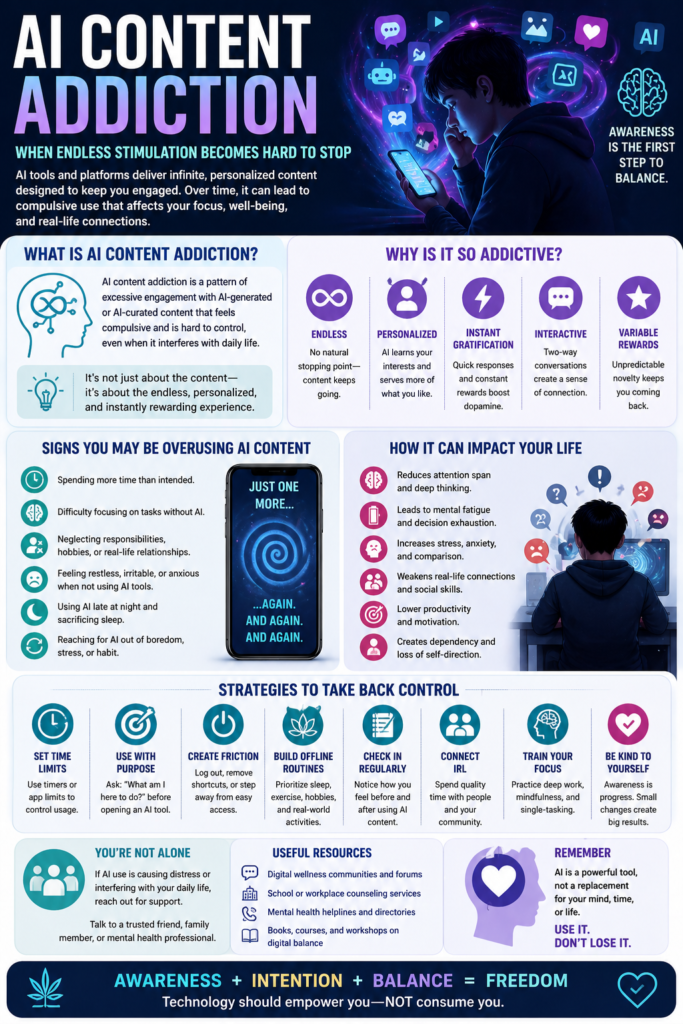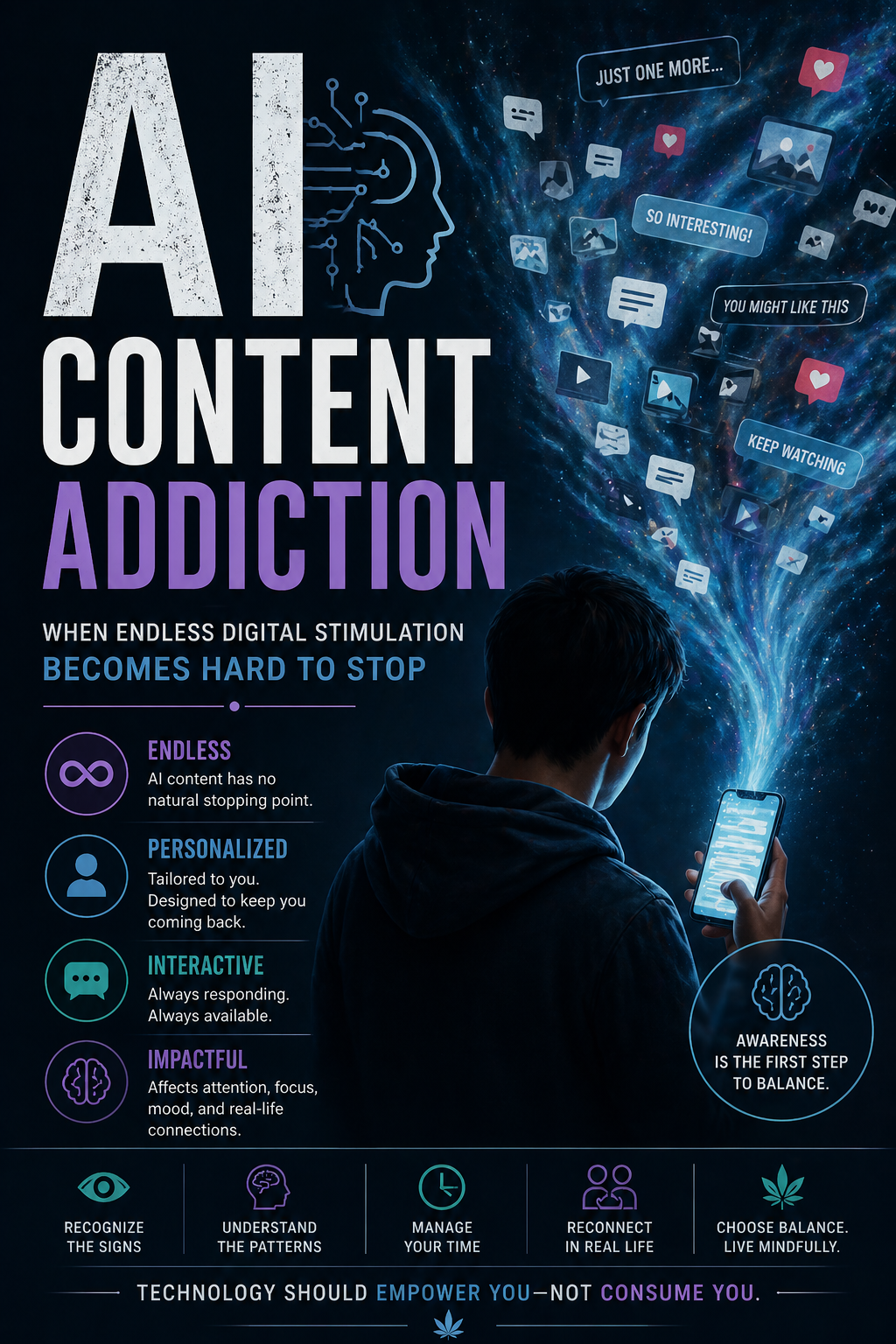
AI content addiction refers to a growing pattern of compulsive engagement with endlessly generated, personalized digital content enabled by advances in artificial intelligence. Unlike traditional media, AI-driven platforms provide instant responses, continuous interaction, and tailored outputs, removing natural stopping points that once limited consumption. This creates an environment in which users can become increasingly immersed, often without realizing how much time or attention they are spending. As a result, concerns are emerging about how this constant engagement may affect attention, decision-making, and overall well-being, making it an important topic in the evolving landscape of digital behavior.
AI Content Addiction: When Endless Digital Stimulation Becomes Hard to Stop
The rise of always-available content
We are living in an era where content is no longer just consumed—it is continuously generated, personalized, and instantly accessible. From social media feeds to AI-generated text, images, and videos, digital platforms are designed to keep attention engaged. While these tools offer convenience and creativity, they also introduce a new challenge: the potential for compulsive overconsumption.
AI content, in particular, can create a loop where users are constantly drawn back for more—more answers, more entertainment, more stimulation—without natural stopping points.
What is AI content addiction?
AI content addiction refers to a pattern of compulsive engagement with AI-generated material, where use becomes difficult to control and begins to interfere with daily life. Unlike traditional media, AI content is:
- Endless (no clear endpoint)
- Personalized (tailored to your interests instantly)
- Interactive (responds to you in real time)
This combination can make it especially engaging—and harder to disengage from.
Why it’s so easy to overconsume
AI-driven platforms tap into core psychological mechanisms:
- Instant gratification: Immediate responses reduce patience and increase reliance
- Variable reward: Not every interaction is equally satisfying, which keeps users coming back
- Low effort, high stimulation: No barriers to entry, making repeated use effortless
Over time, this can shift behavior from intentional use → automatic habit.
Signs of problematic use
While not formally classified like traditional addictions, patterns may resemble behavioral overuse:
- Spending more time than intended on AI platforms
- Difficulty stopping or taking breaks
- Using AI content to escape boredom, stress, or emotions
- Reduced focus on offline responsibilities or relationships
- Feeling mentally “overloaded” but continuing to engage
These signs suggest a need to re-evaluate usage patterns.
The impact on attention and cognition
Excessive AI content consumption may affect:
- Attention span (preference for quick, high-stimulation input)
- Decision-making (outsourcing thinking to AI tools)
- Creativity (relying on generated ideas rather than internal processes)
While AI can enhance productivity, overreliance may reduce active cognitive engagement.
Self-awareness: the first step
Understanding your own patterns is key:
- When do you use AI the most?
- What need is it fulfilling (information, distraction, validation)?
- Do you feel better or worse after extended use?
This shifts the focus from “AI is the problem” to “how am I interacting with it?”
Strategies for balanced use
To maintain control:
- Set time boundaries for AI use
- Use AI with a clear purpose, not just a habit
- Take intentional breaks from screens
- Engage in offline activities that require focus and creativity
The goal is not to eliminate AI—but to use it deliberately, not automatically.
A broader perspective
AI content isn’t inherently harmful—it’s a powerful tool. The challenge lies in how it interacts with human attention, reward systems, and modern digital environments.
As technology becomes more immersive, the responsibility shifts toward developing digital self-regulation skills.
Final thought
AI content addiction reflects a larger shift in how we engage with information and stimulation. The issue isn’t just the technology—it’s the frictionless, endless nature of access.
By becoming more aware of usage patterns and setting intentional limits, individuals can move from passive consumption to active, controlled engagement—preserving both productivity and well-being in an AI-driven world.
Managing AI Content Use: Self-Management Strategies for Digital Balance
Understanding the challenge
The rise of AI-generated content has created a new kind of engagement—instant, personalized, and endless. While useful, this environment can lead to patterns of overuse that feel automatic rather than intentional. What’s often called AI content addiction is less about the technology itself and more about how easily it fits into—and reinforces—habit loops.
Self-management is not about eliminating AI use. It’s about learning to use it with awareness, control, and purpose.
1. Track your usage patterns
Start by observing:
- How often do you engage with AI tools
- When you tend to use them (e.g., boredom, stress, procrastination)
- How long do sessions last
You may discover:
- Frequent short check-ins that add up
- Use during moments of low energy or avoidance
Awareness turns invisible habits into visible patterns you can adjust.
2. Identify your “why.”
AI content often fills a need. Ask:
- Am I using this for productivity, curiosity, or escape?
- What feeling am I trying to create or avoid?
Common drivers:
- Boredom → stimulation
- Stress → distraction
- Uncertainty → quick answers
Understanding the “why” helps you address the root, not just the behavior.
3. Create intentional use boundaries
Without limits, AI use can become continuous.
Try:
- Setting time blocks (e.g., 20–30 minutes per session)
- Defining purpose before opening (What am I here to do?)
- Avoiding use during certain times (e.g., before bed)
Boundaries create structure where none naturally exists.
4. Introduce friction to break automatic use
AI tools are designed to be frictionless—so you need to add some back.
Examples:
- Log out after use
- Remove quick-access shortcuts
- Keep devices out of reach during focused work
Small barriers interrupt the autopilot cycle.
5. Practice “pause before prompt.”
Before engaging, take a moment:
- What am I about to ask or do?
- Do I actually need this right now?
This brief pause shifts behavior from impulse → intention.
6. Balance consumption with creation
Overuse often comes from passive engagement.
Rebalance by:
- Writing your own ideas before asking AI
- Solving problems independently first
- Using AI as a tool, not a replacement
This strengthens cognitive engagement and autonomy.
7. Monitor cognitive and emotional effects
After using AI, check in:
- Do I feel clearer or more overloaded?
- More productive or more distracted?
- More confident or more dependent?
Patterns here guide whether your use is helpful or excessive.
8. Replace—not just remove—the habit
If you reduce AI use, fill that space intentionally:
- Reading, journaling, or creative work
- Physical activity or offline hobbies
- Focused, uninterrupted tasks
Without replacement, habits tend to return automatically.
9. Set “offline anchors.”
Create parts of your day that are AI-free:
- Morning routine
- Meals
- Pre-sleep wind-down
These anchors protect attention and mental reset time.
10. Know when to reassess
It may be time to adjust if you notice:
- Loss of control over time spent
- Reduced focus without AI
- Avoidance of responsibilities
- Dependence on basic thinking tasks
These are signals to recalibrate—not criticize yourself.
Final thought
AI content isn’t inherently addictive—it’s highly efficient at capturing attention. The key is not avoidance, but intentional engagement.
Self-management means:
- Noticing patterns
- Setting boundaries
- Reclaiming attention
When you shift from automatic use to deliberate use, AI becomes what it’s meant to be: a powerful tool—not a constant pull on your attention.
Supporting Healthy AI Use: Family Strategies to Understand AI Content Addiction
A new digital challenge for families
AI-generated content is changing how people interact with information, entertainment, and even decision-making. Unlike traditional media, AI tools are interactive, personalized, and endlessly available, which can make them highly engaging—and sometimes difficult to step away from.
For families, this creates a new kind of concern: not just screen time, but how and why someone is using AI. Understanding these patterns is essential for offering meaningful support rather than reacting with confusion or frustration.
1. Understand the behavior before reacting
Before addressing concerns, take time to learn:
- What AI tools is your loved one using
- How they’re using them (learning, entertainment, problem-solving)
- When use tends to increase (late at night, during stress, boredom)
This helps shift the conversation from “this is a problem” → “let’s understand what’s happening.”
2. Recognize what makes AI especially engaging
AI content is different from typical screen use because it is:
- Instantly responsive
- Highly personalized
- Endless (no natural stopping point)
This means overuse is often less about lack of discipline and more about how the technology is designed. Recognizing this reduces blame and improves empathy.
3. Focus on patterns, not just time
Instead of asking “How long are you using AI?”, look at:
- Is use interfering with sleep, responsibilities, or relationships?
- Is it replacing real-world activities?
- Is it being used to cope with stress or avoid tasks?
These patterns are more meaningful than total hours alone.
4. Keep communication open and curious
How you approach the topic matters.
Try:
- “What do you like about using AI tools?”
- “Do you feel like it helps you or sometimes pulls you in too much?”
Avoid:
- Immediate criticism (“You’re on it too much”)
- Dismissing its value
Curiosity encourages honest conversation rather than defensiveness.
5. Set shared expectations—not strict control
Rather than imposing rules, collaborate on boundaries:
- AI-free times (meals, before bed)
- Purpose-based use (using AI for specific tasks rather than browsing)
- Balance with offline activities
Shared agreements are more effective than rigid restrictions.
6. Encourage balance, not elimination
AI tools can be useful and productive. The goal isn’t to remove them entirely but to:
- Maintain variety in daily activities
- Encourage hobbies, social interaction, and offline engagement
- Reinforce that AI is a tool—not a default activity
7. Watch for warning signs
Be attentive to changes such as:
- Difficulty stopping or taking breaks
- Irritability when not using AI tools
- Decline in focus, motivation, or responsibilities
- Over-reliance on AI for thinking or decision-making
These may signal problematic patterns that need attention.
8. Model healthy digital behavior
Family behavior sets the tone.
Consider:
- Demonstrating intentional tech use
- Taking breaks from devices yourself
- Showing how to use AI purposefully (not passively)
Modeling is often more powerful than instruction.
9. Support underlying needs
AI overuse often meets a need:
- Boredom → stimulation
- Stress → distraction
- Uncertainty → quick answers
Helping address these needs directly (through conversation, support, or structure) reduces reliance on constant digital engagement.
10. Take care of the relationship first
It’s easy to let concern turn into conflict.
Prioritize:
- Connection over control
- Understanding of enforcement
- Consistency over intensity
A strong relationship creates the foundation for influence and support.
Final thought
AI content addiction isn’t just about technology—it’s about attention, behavior, and human needs interacting with powerful tools.
As a family member, your role isn’t to eliminate AI use, but to:
- Stay informed
- Stay engaged
- Stay supportive
That balanced approach helps your loved one develop healthy, intentional habits in a world where digital engagement is only going to grow.
Building Community Awareness: Resource Strategies to Address AI Content Addiction
Why communities need to pay attention
AI-generated content is rapidly reshaping how people learn, communicate, and spend their time. Unlike traditional media, it is interactive, personalized, and endlessly available, making it highly engaging—and sometimes difficult to disengage from.
While individuals and families play a role in managing use, communities are essential in creating awareness, education, and support systems that help people navigate this new digital environment. Without community-level strategies, patterns of overuse can go unrecognized and unsupported.
1. Expand public education on AI use
Most communities have digital literacy programs—but few address AI specifically.
Effective education should include:
- How AI content differs from traditional media
- The concept of endless, personalized engagement loops
- Risks of overuse, including attention fatigue and reduced focus
Clear, accessible education helps people move from passive use → informed engagement.
2. Integrate AI awareness into schools and youth programs
Young people are often the earliest and most frequent adopters.
Community strategies can include:
- Teaching students how AI tools work—and their limitations
- Encouraging critical thinking over reliance
- Discussing healthy boundaries and screen habits
This builds early awareness and self-regulation skills.
3. Train community professionals
Many providers (teachers, counselors, healthcare workers) are not yet equipped to recognize AI-related overuse.
Communities can:
- Offer training on behavioral patterns linked to AI engagement
- Help professionals distinguish between productive use and compulsive use
- Provide guidance on how to talk about AI without stigma
This creates a network of informed first responders.
4. Promote digital wellness initiatives
Communities can normalize balanced technology use by:
- Hosting workshops on attention management and digital habits
- Encouraging “offline time” initiatives
- Providing tools for tracking and managing screen use
These initiatives shift the conversation from restriction → well-being and balance.
5. Provide accessible support resources
People rarely seek help if they don’t recognize a problem.
Communities should offer:
- Anonymous self-assessment tools
- Counseling or coaching focused on digital habits
- Support groups addressing technology overuse
Early access to support helps prevent escalation.
6. Encourage balanced messaging—not fear-based narratives
Overly negative messaging can lead to disengagement or denial.
More effective approaches:
- Acknowledge the benefits of AI tools
- Emphasize responsible and intentional use
- Focus on patterns of behavior rather than labeling users
Balanced messaging builds trust and openness.
7. Create spaces for discussion and reflection
AI is evolving quickly, and people need places to process its impact.
Communities can:
- Host forums or discussion groups
- Encourage dialogue between different age groups
- Provide platforms for sharing experiences
This fosters collective understanding, not isolated concern.
8. Monitor trends and adapt strategies
AI use is changing rapidly, and community responses must keep up.
Key actions:
- Track local patterns of technology use
- Update educational materials regularly
- Collaborate with researchers and digital health experts
Flexibility ensures strategies remain relevant and effective.
Final thought
AI content addiction isn’t just an individual issue—it’s a community-level challenge shaped by technology, behavior, and environment.
Strong community strategies focus on:
- Awareness
- Education
- Accessibility
- Balance
By creating informed, supportive environments, communities can help individuals move from automatic consumption to intentional use, ensuring that AI remains a tool for growth rather than a source of overwhelm.
Frequently Asked Questions
Here are some common questions:
1. What is AI content addiction?
AI content addiction refers to compulsive or excessive use of AI-generated content, where engagement becomes difficult to control and starts interfering with daily life, focus, or responsibilities.
2. Why is AI content so addictive?
AI content is designed to be:
- Instant (immediate responses)
- Personalized (tailored to your interests)
- Endless (no natural stopping point)
These features create a loop that encourages continuous engagement.
3. Is AI content addiction a real diagnosis?
Currently, it is not a formal medical diagnosis, but it shares similarities with behavioral addictions like:
- Internet addiction
- Social media overuse
Researchers are still studying its long-term impact.
4. What are common signs of AI overuse?
- Spending more time than intended using AI tools
- Difficulty stopping or taking breaks
- Using AI to escape stress or boredom
- Reduced focus on offline tasks or relationships
- Feeling mentally overloaded but continuing to engage
5. How is AI content different from social media addiction?
AI content is:
- Interactive (responds directly to you)
- Highly adaptive (adjusts to your preferences instantly)
This makes it feel more engaging and personalized, which can deepen the habit loop.
6. Can AI use affect attention span?
Yes, excessive use may:
- Reduce tolerance for slower tasks
- Increase preference for quick, high-stimulation input
- Make sustained focus more difficult
7. Does using AI reduce critical thinking?
It can, if overused. Relying heavily on AI for answers may:
- Limit independent problem-solving
- Reduce active cognitive engagement
Balanced use (thinking first, then using AI) helps prevent this.
8. Who is most at risk?
People who:
- Spend a lot of time online
- Use AI for multiple purposes (work, entertainment, social)
- Experience high stress or boredom
- Prefer quick answers over longer processes
9. How can someone manage their AI use?
Helpful strategies include:
- Setting time limits
- Using AI with a specific purpose
- Taking regular offline breaks
- Monitoring how use affects mood and productivity
10. When does AI use become a problem?
It becomes concerning when it:
- Interferes with responsibilities
- Replaces real-world interaction
- Feels difficult to control
- Negatively impacts mental well-being
11. Can AI content addiction affect mental health?
Potential effects include:
- Increased distraction and mental fatigue
- Reduced motivation for offline activities
- Dependence on external input for decisions
12. Is it necessary to stop using AI completely?
No. The goal is not elimination, but balanced and intentional use. AI can be highly beneficial when used as a tool rather than a constant source of stimulation.
Conclusion
Understanding AI content addiction requires moving beyond the idea of technology as inherently harmful and instead examining how design, accessibility, and human behavior interact. While AI tools offer significant benefits in productivity, creativity, and learning, their capacity for continuous engagement can also encourage overuse if left unexamined. Addressing this issue involves promoting awareness, intentional use, and balanced digital habits at both the individual and societal levels. By recognizing the patterns that drive excessive engagement, people can better harness AI as a valuable resource—while maintaining control over their time, focus, and mental well-being.
Video: This is Why You Can’t Stop #aiaddiction #psychology