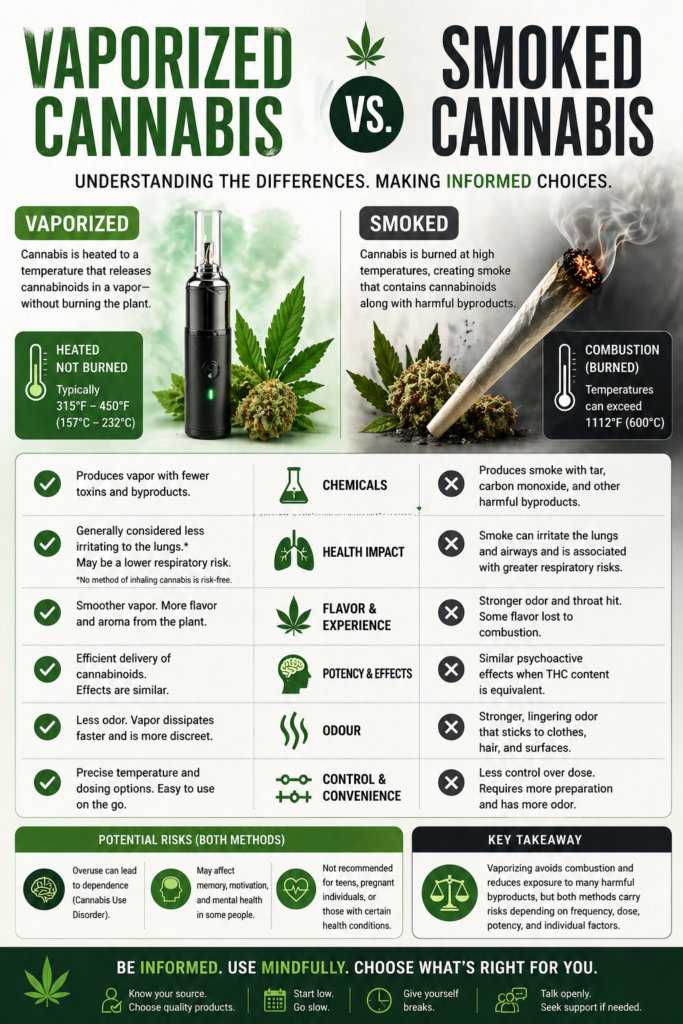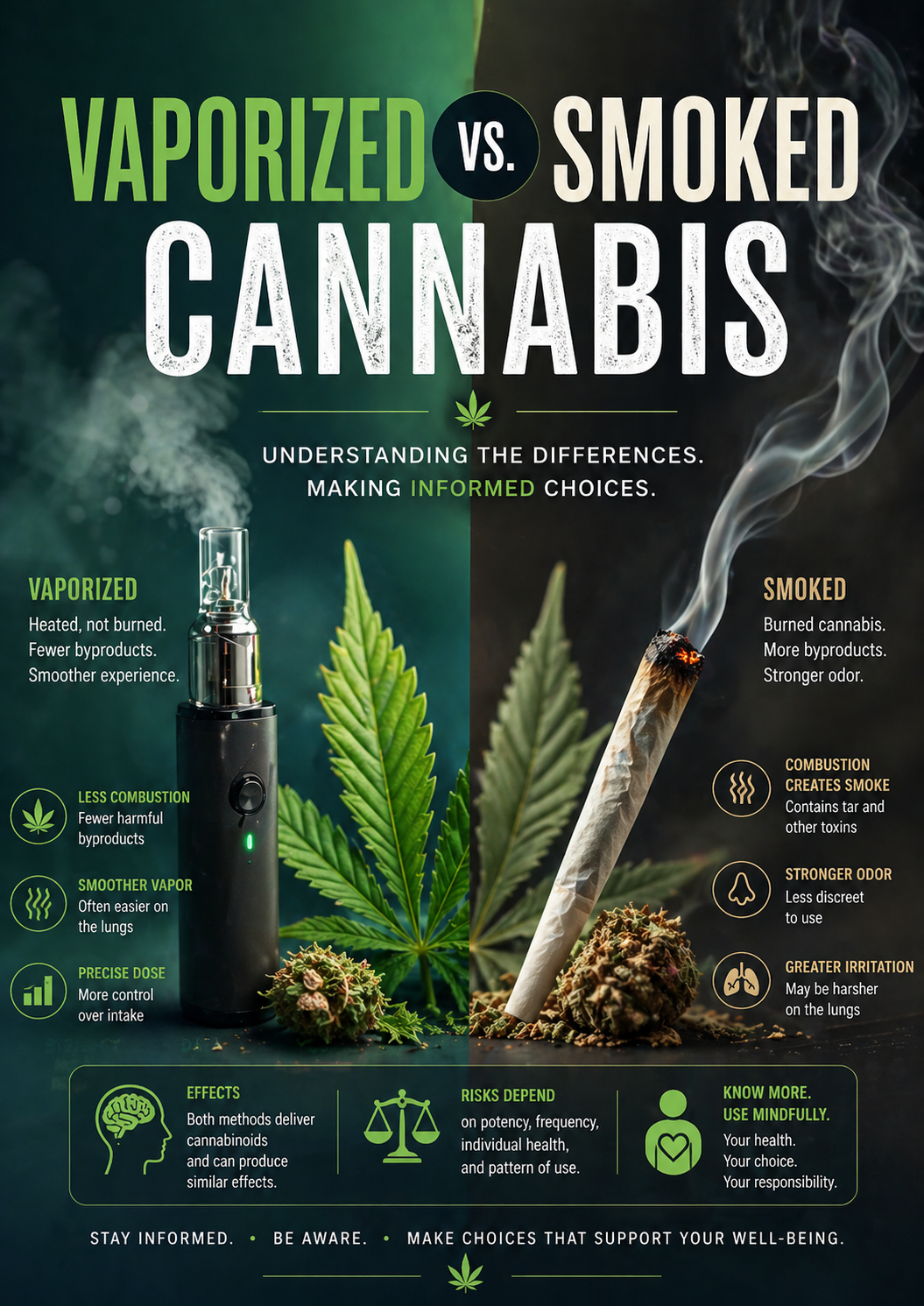
The way cannabis is consumed has evolved significantly, with vaporization emerging as a popular alternative to traditional smoking. While both methods deliver cannabinoids rapidly through inhalation, they differ in how cannabis is heated, the substances produced, and the patterns of use they encourage. Smoking involves combustion, which generates smoke containing toxins like tar and carbon monoxide, whereas vaporization heats cannabis at lower temperatures, producing an aerosol with fewer combustion byproducts. These differences have led to shifting perceptions of safety and have influenced how individuals engage with cannabis, including risks related to frequency of use and the development of Cannabis Use Disorder.
Vaporized vs. Smoked Cannabis: Understanding the Differences in Delivery, Effects, and Risk
A changing landscape of cannabis use
As cannabis products evolve, so do the ways people consume them. While smoking has long been the traditional method, vaporization—or “vaping”—has become increasingly popular. Both involve inhalation, but they differ in how cannabis is heated, what compounds are produced, and how those compounds affect the body. Understanding these differences is key to making informed decisions about use and health.
How the methods differ
Smoked cannabis involves burning plant material, typically in joints, pipes, or bongs. Combustion occurs at high temperatures, producing smoke that contains:
- Cannabinoids (like THC and CBD)
- Tar and carbon monoxide
- Various combustion byproducts
Vaporized cannabis, on the other hand, heats cannabis to a lower temperature without burning it. This creates an aerosol (vapor) that contains:
- Cannabinoids
- Fewer combustion-related toxins
- More controlled chemical composition (depending on the device)
Differences in effects and onset
Both methods deliver cannabinoids quickly to the lungs, resulting in a rapid onset of effects (within minutes). However:
- Vaping may feel smoother and less harsh, making it easier to inhale more deeply
- Smoking often produces a stronger sensory experience (taste, smell, throat hit)
- Dosing can be inconsistent with both, but vaping devices may allow more precise control
Despite these differences, the psychoactive effects are broadly similar, especially when THC content is comparable.
Health considerations
One of the main reasons people switch to vaping is the perception of reduced harm. While it’s true that vaporization avoids combustion, that doesn’t mean it’s risk-free.
Smoking risks:
- Exposure to tar and carcinogens
- Lung irritation and chronic respiratory symptoms
- Long-term pulmonary effects
Vaping risks:
- Potential exposure to additives or contaminants (especially in illicit products)
- Risk of lung injury associated with certain vape formulations
- Higher likelihood of frequent use due to convenience and subtlety
Both methods can contribute to Cannabis Use Disorder, particularly with high-THC products and frequent use.
Behavioral and usage patterns
Vaping has changed how people use cannabis:
- Easier to use discreetly and more frequently
- Less odor, leading to reduced social barriers
- Increased potential for habitual or continuous use
Smoking, while more noticeable, may naturally limit frequency due to:
- Preparation time
- Stronger smell
- Social context
These differences can influence the risk of dependence and overall consumption levels.
Which is “safer”?
There’s no simple answer.
- Vaping may reduce exposure to combustion-related toxins
- But it introduces new risks, especially with poorly regulated products
- Both methods carry risks related to THC exposure, dependence, and mental health effects
“Safer” depends on:
- Product quality
- Frequency of use
- Individual health factors
A broader perspective
The comparison between vaporized and smoked cannabis isn’t just about chemistry—it’s about behavior, access, and perception of risk. As cannabis becomes more normalized and technologically advanced, patterns of use are shifting in ways that can both reduce and increase harm.
Conclusion
Vaporization and smoking represent two different pathways to the same endpoint: delivering cannabinoids to the brain. While vaping may reduce certain physical toxins, it can also increase frequency and ease of use, which carries its own risks.
Understanding these trade-offs allows individuals, clinicians, and communities to move beyond simple “better vs. worse” thinking—and toward more nuanced, informed decision-making about cannabis use.
Understanding Vaporized vs. Smoked Cannabis: Self-Management Strategies for Informed Use
Why self-management matters here
As cannabis use evolves, many people are choosing between smoking and vaping without fully understanding how each method affects dose, frequency, and overall risk. While both deliver similar psychoactive effects, they differ in how easily use becomes habitual, how the body responds, and how exposure accumulates over time.
Self-management isn’t about judgment—it’s about awareness, control, and making intentional choices.
1. Track how you use—not just how much
Start by observing:
- Method (smoking vs. vaping)
- Frequency (times per day/week)
- Context (social, stress, boredom, sleep)
You may notice:
- Vaping tends to lead to more frequent, smaller uses
- Smoking is often more situational or intentional
Understanding your pattern is the first step toward control.
2. Pay attention to “invisible use” with vaping
Vaping can be subtle and easy to repeat:
- No strong smell
- Minimal setup
- Quick access
This can lead to:
- Unintentional overuse
- Continuous or background consumption
Strategy:
- Set clear limits (e.g., number of sessions per day)
- Avoid carrying devices everywhere if it increases automatic use
3. Learn your dose-response patterns
Both methods deliver THC quickly, but your experience may differ:
- Do you feel effects after a few inhalations—or keep going?
- Do you chase a certain feeling or use automatically?
Try:
- Pausing after initial use to assess effects before continuing
- Spacing sessions to avoid stacking doses
This reduces the risk of overconsumption.
4. Identify your triggers and routines
Ask yourself:
- When do I feel the urge to use?
- Is it tied to stress, sleep, social settings, or habit?
Common patterns:
- Vaping during idle moments
- Smoking in social or end-of-day routines
Once identified, you can:
- Replace or delay the behavior
- Introduce alternative coping strategies
5. Watch for signs of increasing dependence
Be aware of patterns associated with Cannabis Use Disorder:
- Using more frequently than intended
- Difficulty cutting back
- Using to manage mood or stress consistently
- Prioritizing use over responsibilities
Early recognition allows for course correction before escalation.
6. Adjust your environment to support control
Small changes can reduce automatic use:
- Keep cannabis out of immediate reach
- Avoid using in every setting (e.g., not in bed or while working)
- Create designated times or places for use
The environment often drives behavior more than intention.
7. Be mindful of product differences
Not all cannabis products are equal:
- Vape cartridges may contain highly concentrated THC
- Smoking flower may involve more variable dosing
Higher potency increases:
- Risk of overuse
- Potential for anxiety or unwanted effects
Choose products intentionally, not just based on convenience.
8. Balance perceived “safety” with actual behavior
Vaping is often seen as “safer” because it avoids combustion—but:
- It may encourage more frequent use
- It can still contribute to dependence and health risks
Ask:
- Am I using more because it feels safer?
- Has my pattern changed since switching methods?
9. Set personal boundaries and goals
Examples:
- Limiting use to certain days
- Avoiding use before specific activities (work, driving, sleep)
- Taking tolerance breaks
Clear boundaries turn use from automatic → intentional.
10. Know when to reassess
If you notice:
- Increasing frequency
- Loss of control over use
- Negative effects on mood, sleep, or functioning
It may be time to:
- Reduce or pause use
- Seek professional guidance if needed
Conclusion
The difference between vaporized and smoked cannabis isn’t just about chemistry—it’s about behavioral patterns, accessibility, and self-awareness.
Self-management means:
- Understanding your habits
- Monitoring your responses
- Making deliberate adjustments
When you approach cannabis use with awareness instead of autopilot, you gain something more important than preference—you gain control.
Supporting Informed Cannabis Use: Family Strategies for Understanding Vaporized vs. Smoked Cannabis
Why families need to understand the difference
Cannabis use today looks very different from how it did even a decade ago. With the rise of vaping devices alongside traditional smoking, families are often unsure what these methods mean, how they differ, and what risks they carry.
Understanding the distinction between vaporized and smoked cannabis helps families move beyond assumptions and respond with clarity, awareness, and effective support—especially when concerns about overuse or dependence arise.
1. Learn the basics without jumping to conclusions
Start with a shared understanding:
- Smoking = burning cannabis → produces smoke with toxins (tar, carbon monoxide)
- Vaping = heating cannabis → produces vapor with fewer combustion byproducts
However, “less smoke” does not automatically mean low risk. Both methods can contribute to Cannabis Use Disorder, especially with frequent or high-potency use.
2. Recognize how vaping changes behavior
Families often underestimate vaping because it’s:
- More discreet (less smell)
- Easier to use frequently
- Portable and quick
This can lead to:
- More frequent, less noticeable use
- “Background” or habitual consumption
Understanding this helps families focus not just on what is used but also on how often and in what patterns.
3. Watch for meaningful patterns, not isolated use
Instead of reacting to a single instance, look for trends:
- Increasing frequency of use
- Using alone vs. socially
- Using in response to stress, sleep, or mood
These patterns matter more than the method itself and give insight into risk level and intent.
4. Keep communication open and non-judgmental
How you talk about cannabis matters more than how much you know.
Try:
- “I’m curious how vaping feels different for you than smoking.”
- “Have you noticed any changes in how often you use?”
Avoid:
- Immediate criticism or assumptions
- Overgeneralizing (“all vaping is bad”)
Open dialogue increases the chance your loved one will actually share their experience.
5. Understand potency and product differences
Vape products often contain:
- Higher THC concentrations
- More consistent dosing—but also easier overuse
Smoking flower may:
- Deliver less concentrated THC
- Require more deliberate use
Families should be aware that vaping can quietly increase total THC exposure, even if it appears “lighter.”
6. Support healthy boundaries without controlling behavior
You can’t control someone’s choices—but you can shape the environment.
Helpful approaches:
- Encourage limits on frequency or setting
- Support non-use times (e.g., before school/work)
- Reinforce balance with other activities
Avoid:
- Monitoring or policing constantly
- Trying to eliminate use through force alone
Focus on guidance, not surveillance.
7. Know the signs of concern
Be alert for:
- Increased tolerance (needing more to feel effects)
- Irritability or mood changes when not using
- Decline in responsibilities or motivation
- Using cannabis to cope with emotions consistently
These may signal movement toward problematic use, regardless of method.
8. Address misconceptions about “safer” use
A common belief is that vaping is harmless compared to smoking.
A more accurate message:
- Vaping may reduce some physical toxins
- But it can increase frequency, convenience, and dependence risk
Helping your loved one think critically about this trade-off is more effective than simply labeling one method as “good” or “bad.”
9. Take care of your own perspective
It’s easy for families to become reactive or anxious.
Ground yourself by:
- Learning from reliable sources
- Separating facts from assumptions
- Focusing on long-term patterns rather than isolated moments
A calm, informed approach makes you a more effective support system.
Conclusion
The difference between vaporized and smoked cannabis isn’t just technical—it’s behavioral and contextual. Vaping may look less harmful on the surface, but it can quietly reshape how often and why someone uses cannabis.
As a family member, your role isn’t to control the method—it’s to:
- Stay informed
- Stay observant
- Stay connected
That combination creates the best chance for healthy conversations, informed choices, and early intervention when needed.
Community Approaches to Cannabis Use: Resource Strategies for Understanding Vaporized vs. Smoked Cannabis
Why this distinction matters at the community level
Cannabis use is no longer a one-size-fits-all behavior. With the rise of vaping alongside traditional smoking, communities are facing new patterns of use, new risks, and new misconceptions. While smoking cannabis has long been visible and socially recognized, vaporized cannabis is often more discreet, changing how, where, and how often people use.
Understanding these differences helps communities move toward informed education, prevention, and support systems, rather than outdated or overly generalized messaging.
1. Expand public education beyond “just say no.”
Modern cannabis education needs nuance.
Community strategies should include:
- Explaining how vaping differs from smoking (combustion vs. vaporization)
- Addressing myths like “vaping is harmless.”
- Highlighting how frequency and potency affect risk
Clear, balanced education helps individuals make informed choices, not just reactive ones.
2. Address shifting patterns of use
Vaping has introduced new behavioral trends:
- More frequent, low-visibility use
- Use in places where smoking wouldn’t occur
- Increased normalization among younger populations
Community programs should adapt by:
- Recognizing subtle signs of use, not just obvious ones
- Updating screening questions in schools and clinics
- Training staff to understand evolving consumption habits
3. Integrate harm reduction into community messaging
Not everyone will choose abstinence, so communities benefit from risk-reduction approaches:
- Educating about dose awareness and THC potency
- Warning against combining cannabis with other substances
- Encouraging breaks and moderation
Both smoking and vaping can contribute to Cannabis Use Disorder, especially with high-frequency use. Harm reduction helps reduce escalation.
4. Strengthen school and youth-focused programs
Young people are often at the center of changing cannabis trends.
Effective strategies include:
- Teaching the differences between vape products and plant cannabis
- Discussing how vaping can lead to habitual use without awareness
- Creating safe spaces for questions without punishment
Education should focus on understanding behavior, not just enforcing rules.
5. Equip healthcare and community providers
Clinicians, counselors, and outreach workers need updated knowledge.
Communities can:
- Train providers on vaping-specific risks and patterns
- Encourage routine screening for the method of use, not just the use itself
- Provide resources for early intervention
This ensures people receive relevant, current guidance.
6. Improve accessibility of support resources
Many individuals don’t seek help because they don’t recognize a problem.
Communities should offer:
- Easy-to-find local and online support services
- Anonymous screening tools
- Early intervention programs for mild-to-moderate concerns
Reducing barriers makes it easier to address issues before they escalate.
7. Counter stigma while maintaining awareness
Overly harsh messaging can push people away from support.
Balanced messaging should:
- Avoid labeling all cannabis use as the same
- Focus on patterns, impact, and risk
- Encourage honest conversations
When stigma is reduced, people are more likely to engage with resources.
8. Monitor trends and adapt policies
Cannabis use is evolving rapidly, especially with technology.
Communities should:
- Track local trends in vaping vs. smoking
- Adjust policies based on real usage patterns
- Collaborate with public health, schools, and healthcare systems
Flexible, data-informed approaches are more effective than static policies.
Conclusion
The shift from smoked to vaporized cannabis isn’t just a technological change—it’s a behavioral and cultural shift that affects how people use, perceive, and manage risk.
Strong community strategies don’t rely on outdated assumptions. They:
- Educate with nuance
- Adapt to changing patterns
- Provide accessible support
- Promote informed decision-making
By doing so, communities can better navigate the complexities of modern cannabis use and support healthier outcomes for individuals and populations alike.
Frequently Asked Questions
Here are some common questions:
1. What’s the main difference between vaporizing and smoking cannabis?
- Smoking burns cannabis, producing smoke with cannabinoids and harmful byproducts.
- Vaporizing heats cannabis without burning it, creating a vapor with fewer combustion-related toxins.
2. Is vaping cannabis safer than smoking?
Vaping may reduce exposure to tar and carbon monoxide, but it is not risk-free. It can still:
- Irritate the lungs
- Expose users to additives (especially in vape cartridges)
- Increase frequency of use
3. Do both methods produce the same effects?
Yes, both deliver cannabinoids like THC quickly through the lungs, leading to a rapid onset of effects. The intensity depends more on:
- THC concentration
- Amount used
- Individual tolerance
4. Does vaping lead to more frequent use?
Often, yes. Vaping is:
- More discreet
- Easier to use repeatedly
- Less harsh
This can lead to more frequent or continuous use, sometimes without noticing.
5. Which method is worse for lung health?
- Smoking is generally associated with more respiratory irritation due to combustion
- Vaping may reduce some of that exposure, but it still carries lung and airway risks
Neither method is completely safe for lung health.
6. What increases the risk of overuse?
Risk factors include:
- High-THC products (common in vape cartridges)
- Frequent or daily use
- Used to cope with stress or emotions
Both methods can contribute to Cannabis Use Disorder.
7. Is dosing more controlled with vaping?
Vaping devices may allow more precise control, but in practice:
- People may take more frequent puffs
- It’s easy to lose track of total intake
So control depends more on user behavior than the device itself.
8. Why does smoking feel harsher than vaping?
Smoking involves combustion, which produces:
- Hot smoke
- Irritating chemicals
Vapor is typically cooler and smoother, making it feel less harsh on the throat and lungs.
9. Are vape products always safe?
No. Risks include:
- Unregulated or illicit products
- Contaminants or additives
- Variable THC concentrations
Product quality matters significantly.
10. Does one method smell more than the other?
- Smoking produces a strong, lingering odor
- Vaping produces a lighter, less persistent smell
This difference contributes to vaping being more discreet.
11. Can switching to vaping reduce harm?
It may reduce exposure to some harmful byproducts of smoke, but:
- It may increase the frequency of use
- It does not eliminate risks
Harm depends on the overall pattern of use, not just the method.
12. When should someone be concerned about their cannabis use?
Warning signs include:
- Using more often than intended
- Difficulty cutting back
- Relying on cannabis for mood or stress
- Impact on daily functioning
These may indicate problematic use, regardless of method.
Conclusion
Understanding the distinctions between vaporized and smoked cannabis requires looking beyond simple comparisons of “safer” versus “riskier.” While vaporization may reduce exposure to certain harmful compounds, it can also increase convenience and frequency of use, introducing different behavioral risks. Ultimately, the impact of either method depends on factors such as potency, frequency, and individual patterns of use. By recognizing both the physiological and behavioral dimensions of cannabis consumption, individuals and communities can make more informed decisions that balance perceived benefits with potential risks.
Video: Smoke Inhalation vs Vapor: What Actually Happens Inside Your Body #health #cannabis