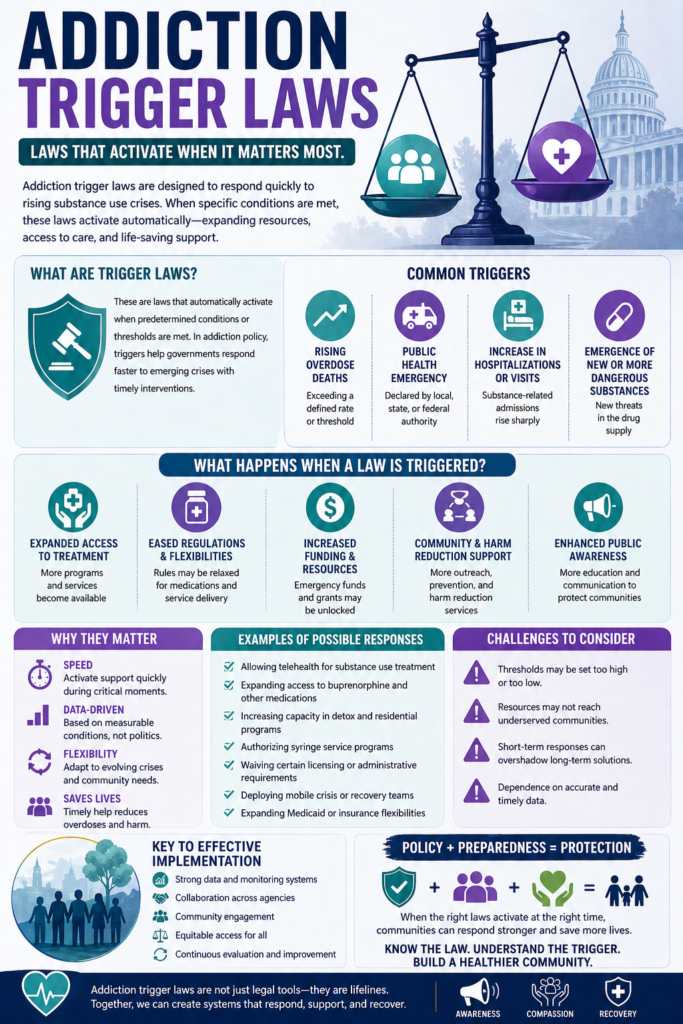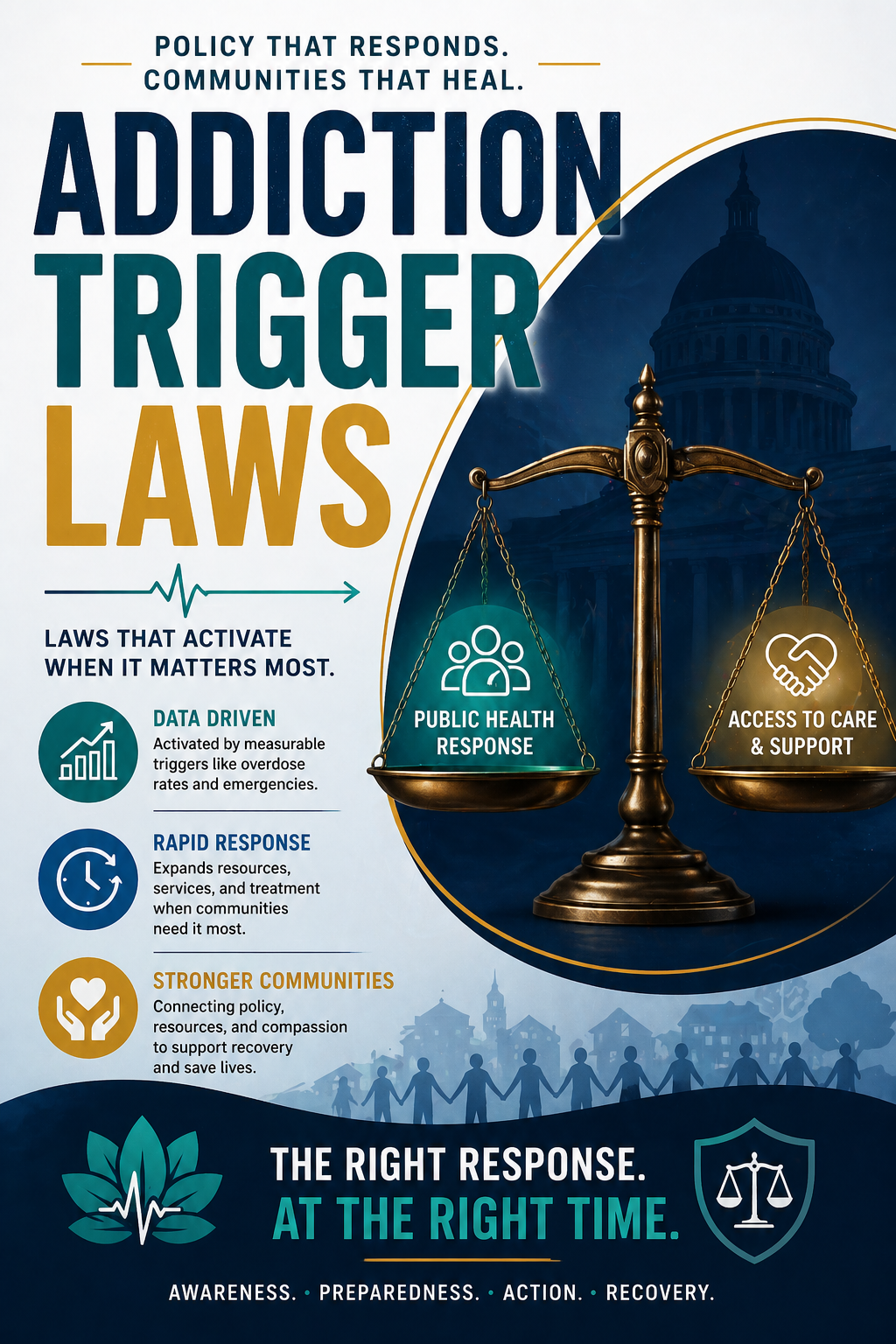
Addiction trigger laws are a form of adaptive public policy designed to respond quickly to changing conditions in substance use and public health. These laws are structured to activate automatically when specific thresholds are met, such as rising overdose rates, increased hospitalizations, or the declaration of a public health emergency. In the context of addiction, trigger laws aim to bridge the gap between emerging crises and timely intervention by enabling rapid expansion of resources, treatment access, and harm reduction measures. As substance use patterns continue to evolve, these policies reflect a growing emphasis on data-driven, responsive governance.
Understanding what “trigger laws” mean in addiction policy
In public policy, trigger laws are statutes that automatically activate when specific conditions are met—for example, when overdose rates rise, a public health emergency is declared, or new federal guidelines are issued. When applied to addiction, these laws create a responsive legal framework that can shift quickly as substance use patterns change.
Rather than relying on slow legislative processes, addiction-related trigger laws allow governments to adapt in real time, aligning legal responses with emerging crises such as opioid surges, synthetic drug outbreaks, or increases in overdose deaths.
Why trigger laws are used in addiction contexts
Substance use trends can change rapidly, often outpacing traditional policy responses. Trigger laws aim to:
- Accelerate intervention during public health emergencies
- Enable rapid deployment of resources (treatment, harm reduction, funding)
- Adjust regulations based on data thresholds (e.g., overdose rates)
- Provide legal flexibility in uncertain or evolving situations
This approach reflects a shift toward data-driven and adaptive governance in addiction policy.
Common examples of addiction trigger mechanisms
Trigger laws in addiction policy may activate when:
- Overdose deaths exceed a defined threshold
- A state or federal public health emergency is declared
- New substances (e.g., synthetic opioids) emerge in the drug supply
- Healthcare systems report spikes in substance-related admissions
Once triggered, these laws can:
- Expand access to treatment services
- Loosen restrictions on medications (like buprenorphine)
- Increase funding for community programs
- Authorize emergency harm reduction measures
Benefits of trigger-based approaches
1. Speed and responsiveness
Policies can take effect immediately when needed, rather than waiting months or years.
2. Data-driven decision-making
Activation is based on measurable indicators, not just political timing.
3. Flexibility
Laws can adapt to different substances and evolving patterns of use.
Limitations and concerns
Despite their advantages, trigger laws raise important questions:
- Threshold design: What level of crisis justifies activation?
- Equity: Do all communities benefit equally from triggered policies?
- Sustainability: Are these short-term responses replacing long-term solutions?
- Over-reliance on crisis: Do systems wait for things to get worse before acting?
There is also a risk that reactive policies may lag behind prevention efforts, focusing more on response than early intervention.
The role of public health and community systems
Trigger laws are most effective when paired with:
- Strong surveillance systems (accurate, real-time data)
- Coordinated healthcare and community resources
- Public education and harm reduction strategies
Without these supports, even well-designed laws may fail to translate into meaningful outcomes on the ground.
A broader shift in addiction policy
The rise of trigger laws reflects a larger transition in how addiction is addressed:
- From static laws → adaptive frameworks
- From delayed response → real-time intervention
- From generalized policy → targeted action based on need
This aligns with modern public health approaches that prioritize responsiveness and precision.
Final thought
Addiction trigger laws represent an effort to bring speed, flexibility, and data-driven logic into a field where timing can be the difference between prevention and crisis. While they are not a complete solution, they offer a powerful tool for responding to rapidly changing substance use landscapes.
The challenge moving forward is to balance reactive capacity with proactive strategy—ensuring that trigger laws don’t just respond to addiction crises, but also contribute to long-term prevention, treatment, and recovery systems.
Understanding Addiction Trigger Laws: Self-Management Strategies for Informed Awareness
Why self-management matters in policy understanding
Addiction policy—especially concepts like trigger laws—can feel abstract, technical, and disconnected from everyday life. But these laws directly influence access to treatment, emergency responses, and public health resources.
Self-management in this context means learning to interpret, track, and apply policy knowledge to make informed decisions, advocate effectively, and understand how systems respond to addiction-related issues.
1. Start with the core concept
Before diving into complexity, ground yourself in the basics:
- A trigger law = a policy that activates when specific conditions are met
- In addiction, triggers often relate to overdose rates, public health emergencies, or system strain
Ask yourself:
- What event causes this law to activate?
- What changes once it’s activated?
This builds a clear mental framework.
2. Translate policy into real-world impact
Policies only matter if you understand their effects.
Practice asking:
- How does this law affect treatment access?
- Does it change the availability of medications or services?
- Who benefits most—and who might be left out?
This shifts your thinking from abstract → practical application.
3. Track local and state-level policies
Addiction laws vary widely by location.
Self-management strategy:
- Follow updates from local health departments
- Monitor state legislation related to substance use
- Pay attention to public health emergency declarations
This helps you stay aware of what applies in your specific context.
4. Break down complex language
Legal and policy language can be difficult.
Try:
- Rewriting definitions in your own words
- Identifying key terms (e.g., “threshold,” “activation,” “emergency authority”)
- Summarizing policies in 2–3 sentences
Simplifying information improves retention and understanding.
5. Identify your role in the system
Understanding policy isn’t just academic.
Ask:
- How does this affect me, my work, or my community?
- Can I use this knowledge to support others?
- Does this influence how I access or recommend services?
This connects knowledge to action and relevance.
6. Develop critical thinking about policy effectiveness
Not all trigger laws work equally well.
Evaluate:
- Are the activation thresholds too high or too low?
- Does the response happen quickly enough?
- Are resources actually reaching the people in need?
This builds policy literacy, not just awareness.
7. Stay aware of emotional reactions
Addiction policy can be tied to strong opinions and experiences.
Notice:
- Frustration with system delays
- Hope around new interventions
- Confusion about conflicting information
Self-management includes regulating reactions so you can stay clear, objective, and informed.
8. Use structured information sources
Avoid relying on scattered or unclear information.
Instead:
- Use official public health websites
- Review summaries from trusted policy or healthcare organizations
- Cross-check major claims
Reliable sources support an accurate understanding.
9. Apply knowledge to decision-making
Once you understand trigger laws, use that knowledge:
- Anticipate when services may expand or change
- Advocate for timely interventions
- Guide others toward available resources
This turns knowledge into practical benefit.
10. Revisit and update your understanding
Policy is not static.
Regularly:
- Recheck laws and updates
- Adjust your understanding as new data emerges
- Stay flexible in how you interpret changes
Self-management here means continuous learning, not one-time knowledge.
Final thought
Understanding addiction trigger laws isn’t just about memorizing legal definitions—it’s about seeing how systems respond to real-world problems in real time.
Self-management in this area means:
- Breaking down complex ideas
- Staying informed
- Thinking critically
- Applying knowledge meaningfully
When you approach policy with clarity and intention, it becomes less overwhelming—and far more useful in navigating and improving the systems around addiction and public health.
Supporting Understanding at Home: Family Strategies for Navigating Addiction Trigger Laws
Why families should understand addiction policy
Addiction doesn’t exist in isolation—it is shaped by healthcare systems, laws, and public health responses. Trigger laws, which activate when certain conditions are met (like rising overdose rates or emergency declarations), can directly affect treatment access, emergency services, and available support.
For families, understanding these laws isn’t about becoming legal experts—it’s about gaining enough awareness to navigate systems, advocate effectively, and support loved ones during critical moments.
1. Start with a simple, shared understanding
Families can begin by learning together:
- A trigger law activates automatically when a specific condition occurs
- In addiction, this often means expanded services during a crisis
Keep it simple:
- “When things get worse, certain laws turn on to increase help.”
Shared understanding reduces confusion and builds a common language for discussion.
2. Focus on what changes when laws are triggered
Instead of getting lost in legal details, ask:
- Does this increase access to treatment programs?
- Are medications more available?
- Have emergency services been expanded?
Understanding outcomes helps families connect policy → real-life impact.
3. Stay aware of local resources and updates
Trigger laws vary by state and community.
Families can:
- Follow updates from local health departments
- Keep a list of treatment centers, hotlines, and emergency services
- Pay attention to announcements during public health crises
This ensures you know when help becomes more available.
4. Use policy knowledge to advocate effectively
When families understand how systems work, they can:
- Ask better questions in healthcare settings
- Request services that may be newly available
- Push for timely referrals or interventions
Advocacy becomes more effective when it’s informed and specific.
5. Communicate without overwhelming each other
Policy discussions can feel heavy or confusing.
Helpful approach:
- Share information in small, manageable pieces
- Focus on relevance (“This could help us access treatment faster”)
- Avoid overloading with technical language
The goal is clarity—not complexity.
6. Recognize emotional reactions to system issues
Families may feel:
- Frustration with delays or barriers
- Hope that when new policies expand access
- Confusion about changing rules
Acknowledging these reactions helps maintain emotional balance and constructive communication.
7. Prepare for crisis situations
Trigger laws often activate during emergencies.
Families can plan:
- What to do if a public health emergency is declared
- Where to go for immediate help
- How to access newly available services quickly
Preparation reduces uncertainty during high-stress moments.
8. Balance system knowledge with personal support
Policies are important—but they don’t replace human connection.
Families should:
- Continue offering emotional support
- Encourage treatment and recovery efforts
- Focus on relationships, not just systems
Think of policy as a tool, not the center of support.
9. Avoid misinformation and assumptions
Policy information can be misunderstood or misrepresented.
Families should:
- Use reliable sources (official health agencies, clinicians)
- Verify major claims
- Avoid relying solely on social media or secondhand information
Accurate knowledge prevents missed opportunities or false expectations.
10. Revisit and update understanding together
Laws and policies evolve.
Make it a habit to:
- Recheck updates periodically
- Discuss changes as a family
- Adjust plans based on new information
This keeps your understanding current and useful.
Final thought
Addiction trigger laws may seem distant from everyday life, but they directly influence when and how help becomes available. For families, understanding these systems creates an important advantage—not just in knowledge, but in timing, access, and advocacy.
Your role isn’t to master policy—it’s to:
- Stay informed
- Stay prepared
- Stay connected
That combination helps families navigate both the human and systemic sides of addiction with greater clarity and confidence.
Strengthening Public Response: Community Resource Strategies for Understanding Addiction Trigger Laws
Why communities need to understand trigger laws
Addiction is not just an individual or family issue—it is deeply connected to public systems, policies, and resource allocation. Trigger laws, which activate automatically when certain conditions are met (such as rising overdose rates or public health emergencies), are designed to help communities respond quickly and adaptively to substance use crises.
However, these laws are only effective if communities understand how they work and how to translate policy into real-world action. Without that connection, resources may exist—but remain underused or misunderstood.
1. Build community-wide awareness of trigger laws
Most people are unfamiliar with how these laws function.
Communities can:
- Develop educational campaigns explaining trigger laws in simple terms
- Use public forums, social media, and local events to share information
- Translate legal language into clear, practical messaging
Awareness is the first step toward effective utilization of resources.
2. Connect policy to available services
Trigger laws often expand access to:
- Addiction treatment programs
- Emergency response services
- Harm reduction initiatives
- Medication-assisted treatment
Communities should create:
- Resource maps or directories showing what becomes available when laws are activated
- Clear guidance on how to access these services
This ensures policy changes lead to real, usable support.
3. Strengthen coordination across systems
Trigger laws are most effective when systems work together.
Key connections include:
- Public health departments
- Hospitals and emergency services
- Addiction treatment providers
- Community organizations
Coordinated systems can respond more quickly and ensure resources are distributed where they are needed most.
4. Train community leaders and professionals
Local leaders often act as first points of contact.
Training should focus on:
- Recognizing when a trigger law has been activated
- Understanding what services are expanded
- Communicating this information clearly to the public
This creates a network of informed community responders.
5. Improve accessibility and visibility of resources
Even when services expand, barriers can remain.
Communities can:
- Simplify access points (hotlines, centralized websites)
- Provide multilingual and culturally appropriate materials
- Ensure outreach reaches high-risk or underserved populations
Accessibility determines whether resources are actually used.
6. Monitor local data and trends
Trigger laws rely on data—but communities can also use data proactively.
Strategies include:
- Tracking overdose rates and service utilization
- Identifying high-need areas
- Adjusting outreach and resource allocation accordingly
Data-informed communities are better equipped to anticipate and respond.
7. Promote balanced, stigma-free communication
Public messaging matters.
Effective communication:
- Avoids blaming individuals
- Focuses on health and support
- Encourages people to seek help without fear
Reducing stigma increases engagement with available services.
8. Encourage community participation and feedback
Policies work best when communities are involved.
Communities can:
- Host forums for feedback on resource effectiveness
- Involve individuals with lived experience
- Adjust strategies based on real-world input
This ensures responses remain relevant and responsive.
9. Bridge short-term response with long-term planning
Trigger laws often address immediate crises—but communities need sustainability.
Balance:
- Emergency response systems
- Long-term prevention and recovery programs
This creates a continuum of care, not just a reactive system.
Final thought
Addiction trigger laws are powerful tools—but they don’t operate in isolation. Their success depends on how well communities understand, communicate, and activate the resources they unlock.
Strong community strategies focus on:
- Awareness
- Coordination
- Accessibility
- Adaptability
When these elements come together, trigger laws become more than policy—they become practical pathways to support, intervention, and recovery within the community.
Frequently Asked Questions
Here are some common questions:
1. What are addiction trigger laws?
Addiction trigger laws are policies that automatically activate when specific conditions or thresholds are met, such as rising overdose deaths, public health emergencies, or surges in hospitalizations. These laws enable faster access to resources, treatment, and support during times of crisis.
2. What triggers these laws to activate?
Common triggers for addiction-related laws include:
- Rising overdose deaths (exceeding a defined threshold)
- Public health emergencies (declared by local, state, or federal authorities)
- Increase in hospitalizations or medical visits related to substance use
- Emergence of new or more dangerous substances in the drug supply
These triggers allow immediate action to address the emerging crisis.
3. What happens when a trigger law is activated?
When a trigger law is activated, it typically leads to:
- Expanded access to treatment (more programs and services)
- Eased regulations for treatment (relaxed rules for medications and service delivery)
- Increased funding and resources for addiction services
- Enhanced community and harm reduction support (more outreach and education)
- Public awareness campaigns to inform and protect communities
4. How do trigger laws help in addiction crises?
Trigger laws enable a rapid response to addiction-related crises, including:
- Faster access to care during critical moments
- Expanded resources when communities are in urgent need
- More flexible regulations to get medications and support to those who need them quickly
- Increased awareness to prevent further harm
5. How are trigger laws data-driven?
Trigger laws are often activated based on measurable indicators, such as:
- Overdose rates
- Emergency room visits
- Public health statistics related to substance use
- Surges in hospitalizations or treatment requests
These data points help ensure that resources are deployed where they are needed most.
6. What are the challenges associated with trigger laws?
While trigger laws can be highly effective, they also face challenges:
- Thresholds may be set too high or too low, which can delay response or lead to unnecessary action
- Resources may not reach underserved communities, leaving some groups without adequate support
- Short-term responses may overshadow long-term solutions, which could lead to insufficient ongoing care
- These laws also depend on accurate and timely data to ensure an effective response
7. How do trigger laws benefit communities?
By enabling timely interventions, trigger laws can:
- Help prevent overdose deaths by quickly increasing the availability of life-saving treatments
- Offer swift access to harm reduction programs, like syringe exchanges or medication-assisted treatment
- Provide flexible resources that allow communities to act quickly and adapt to new challenges
8. What is the role of public health in addiction trigger laws?
Public health agencies play a critical role in determining when conditions are met to activate a trigger law. They also help:
- Coordinate services and resources during emergencies
- Monitor data for emerging trends (e.g., new drugs or patterns of use)
- Ensure that resources are deployed equitably across communities
9. How can the public stay informed about trigger laws?
Public awareness is vital to ensure that trigger laws are understood and utilized effectively:
- Local health departments often provide updates when a trigger law is activated
- News outlets and community organizations can share information on new services or resources
- Public meetings or forums may be held to discuss changes in addiction-related policies
10. How do addiction trigger laws help reduce harm?
Trigger laws help reduce harm by ensuring that:
- More people access treatment services when they are most needed
- Harm reduction programs (such as naloxone distribution) are more widely available
- Prevention programs can be expanded quickly to reduce long-term addiction impacts
11. Can addiction-triggered laws be adjusted or changed?
Yes, trigger laws can be updated or refined based on:
- New data and evolving substance use trends
- Community feedback and challenges faced during activation
- Political and legal considerations (to ensure they remain effective and equitable)
This adaptability ensures that the laws remain relevant and responsive.
Conclusion
Understanding addiction trigger laws highlights the importance of flexibility and responsiveness in addressing complex public health challenges. While these laws can significantly improve the speed and scale of interventions, their effectiveness depends on accurate data, coordinated systems, and equitable implementation. Trigger laws are not a complete solution, but rather one component of a broader strategy that includes prevention, treatment, and long-term recovery support. By combining reactive policy mechanisms with proactive planning, communities and policymakers can create more resilient and effective responses to addiction-related crises.
Video: These Addiction Laws Are Changing Everything #legalanalysis #substanceabuse #fyp