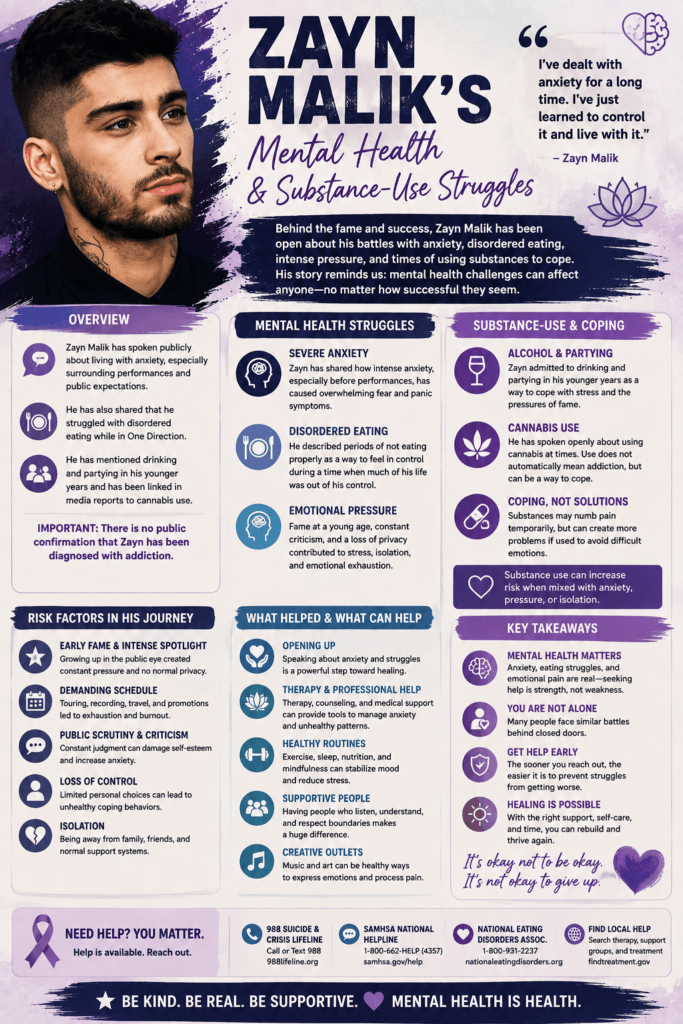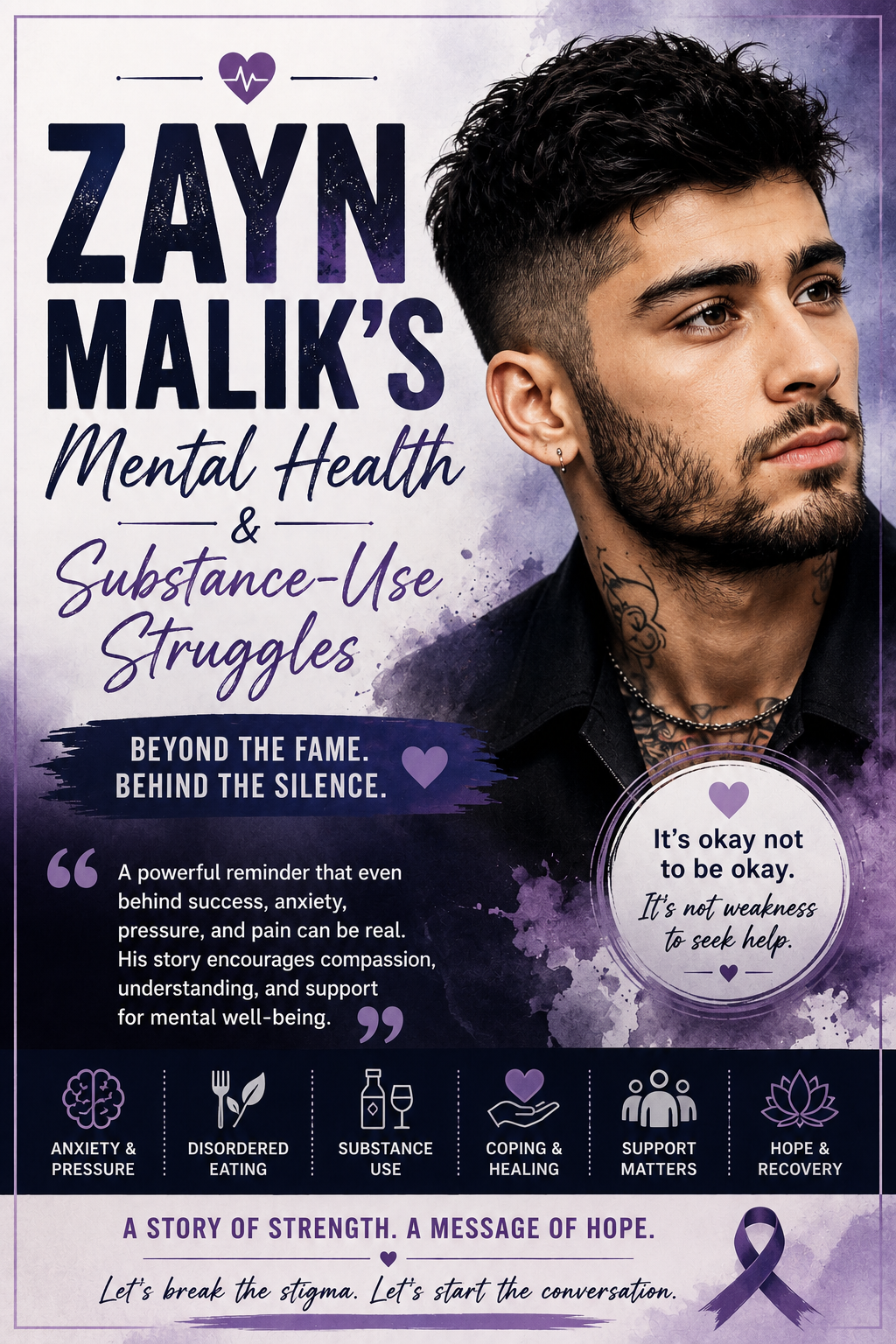
Zayn Malik, internationally known as a former member of One Direction and a successful solo artist, has spoken publicly about significant mental health challenges, particularly anxiety and periods of disordered eating. His experiences developed within an environment of intense fame, demanding schedules, public scrutiny, performance pressure, and limited personal control. Malik has also discussed alcohol and other substance use in certain contexts, although publicly available information does not establish that he has been clinically diagnosed with a substance use disorder. His story provides an important opportunity to explore how anxiety, stress, unhealthy coping behaviors, disrupted eating, and substance use can intersect while reminding us that professional success does not protect someone from psychological distress.
Zayn Malik’s Mental Health and Reported Substance-Use Struggles
Zayn Malik has spoken publicly about significant anxiety and disordered eating, particularly during and after his years with One Direction. His experiences provide an educational example of how intense professional pressure, loss of control, public scrutiny, isolation, and unhealthy coping behaviors can interact with mental well-being.
An important distinction is necessary, however: while Malik has discussed drinking and partying when he was younger and there have been media reports about drug use, reliable public evidence does not establish that he has been diagnosed with a substance use disorder or addiction. It is therefore more accurate to discuss his documented mental-health struggles and substance use without labeling him as having an addiction unless he has personally confirmed such a diagnosis.
Severe Anxiety and Performance Pressure
One of Malik’s most openly discussed challenges has been anxiety, particularly surrounding live performances. After leaving One Direction and beginning his solo career, anxiety became severe enough that he canceled performances. He publicly explained that anxiety associated with major solo appearances could become overwhelming.
Performance anxiety can involve racing thoughts, fear of failure, physical tension, rapid heartbeat, nausea, difficulty concentrating, and avoidance. For performers working in front of thousands of people—and potentially millions more through television and social media—the pressure can become particularly intense.
Malik’s openness helped demonstrate that outward confidence or professional success does not necessarily reflect what someone is experiencing psychologically.
Disordered Eating and the Need for Control
Malik has also discussed a period of seriously disrupted eating while he was a member of One Direction. In his 2016 autobiography, he initially described what he experienced as an eating disorder. In a subsequent interview, however, he clarified that he had never received a formal eating-disorder diagnosis.
He later described the behavior as being closely connected to control. While much of his life as a member of an enormously successful band was tightly scheduled and controlled by others, deciding whether to eat represented something he could control himself.
This illustrates an important mental-health concept: problematic eating behaviors are not always simply about appearance or weight. For some individuals, food restriction or other behaviors may become connected with anxiety, stress, perfectionism, emotional regulation, or attempts to regain a sense of control.
Fame, Workload and Loss of Normalcy
One Direction achieved enormous international success while its members were still very young. Malik described an extremely demanding schedule involving touring, recording, traveling, promotional appearances, and other professional obligations.
He reported that during this period he sometimes became so busy that he lost track of eating. He also described being young, going out, drinking, and partying as part of the circumstances surrounding that period.
His experience demonstrates why environment matters in mental health. Chronic stress combined with inadequate sleep, inconsistent nutrition, constant travel, limited privacy, and enormous professional expectations can make healthy coping considerably more difficult.
What About Addiction and Drug Use?
This part of Malik’s story requires careful wording.
There have been reports and public discussion concerning his substance use, including cannabis, and Malik has spoken about drinking and partying during his younger years. However, substance use is not automatically the same as addiction.
A substance use disorder involves a clinically significant pattern of impaired control, continued use despite consequences, cravings, tolerance or withdrawal in some cases, and disruption of important areas of functioning. Based on the reliable sources available, it would be inappropriate to diagnose Malik with addiction from media reports alone.
For addiction education, his experience can instead be used to discuss an important question: When does substance use become an unhealthy coping mechanism?
People experiencing anxiety or overwhelming stress sometimes turn to alcohol or other substances because they temporarily reduce uncomfortable feelings. Unfortunately, repeated reliance on substances for emotional relief can increase the risk of developing problematic use.
Stepping Away From One Direction
Malik left One Direction in 2015. Although many factors surrounded that decision, he subsequently spoke openly about the enormous psychological pressures associated with his experiences.
Leaving an overwhelming environment can sometimes be an important form of self-preservation. However, changing environments does not automatically resolve anxiety or other psychological difficulties. Recovery may also require healthier routines, supportive relationships, professional treatment when appropriate, and learning more effective ways of responding to stress.
Challenging Mental-Health Stigma
One of the most valuable aspects of Malik’s story is his willingness to discuss experiences that are often hidden.
Male mental health problems can be particularly difficult to acknowledge because cultural expectations sometimes encourage men to suppress vulnerability or appear constantly confident. A successful male performer publicly discussing anxiety and problematic eating can challenge these stereotypes.
His experiences reinforce the message that mental-health difficulties are not signs of professional incompetence or personal weakness.
Lessons From Zayn Malik’s Experience
Malik’s story demonstrates how fame, chronic occupational stress, anxiety, disrupted eating, lack of personal control, and unhealthy coping behaviors can overlap. It also shows why we should avoid diagnosing celebrities based on headlines or assuming that substance use automatically means addiction.
For mental-health and addiction education, perhaps the most important lesson is that outward success can conceal significant internal distress. Recognizing symptoms, talking openly about mental health, establishing boundaries, developing healthier coping strategies, and seeking professional help when necessary can prevent problems from becoming more severe.
Malik’s willingness to discuss anxiety and disordered eating has helped bring attention to experiences that many people—especially young adults and men—may otherwise feel pressured to hide
Self-Management Strategies to Understand Zayn Malik’s Mental Health and Substance-Use Struggles
Zayn Malik has publicly discussed significant anxiety and disordered eating, as well as alcohol and other substance use in some contexts. However, publicly available information does not establish a clinical diagnosis of addiction, so his experience is best used to explore mental health, stress, coping, and substance-use risk without diagnosing him.
- Recognize anxiety symptoms early. Pay attention to persistent worry, racing thoughts, avoidance, physical tension, sleep difficulties, panic symptoms, or fear surrounding work and social situations. Early recognition can make symptoms easier to address.
- Identify personal triggers. Malik has discussed the pressures associated with performing and fame. Individuals can identify their own triggers—such as work demands, criticism, social situations, relationship problems, or major transitions—and plan healthier responses before becoming overwhelmed.
- Separate substance use from healthy coping. Alcohol or other substances may temporarily reduce anxiety but can become an unhealthy coping strategy. Ask yourself, “Am I using this substance primarily because I don’t want to feel what I’m feeling?” Repeated emotional reliance on substances deserves attention.
- Understand the difference between substance use and addiction. Using a substance does not automatically mean someone has a substance use disorder. Warning signs include increasing loss of control, cravings, unsuccessful attempts to cut down, neglecting responsibilities, and continuing use despite significant consequences.
- Develop non-substance coping strategies. Exercise, breathing exercises, mindfulness, music, hobbies, journaling, spending time outdoors, and supportive relationships can offer healthier ways to respond to stress.
- Create a structured daily routine. Regular sleep, nutritious meals, hydration, physical activity, work boundaries, and relaxation periods can stabilize physical and emotional functioning. Structure becomes particularly important during periods of intense occupational stress.
- Pay attention to eating behaviors. Malik has discussed periods of disordered eating and feeling that food was one area of his life he could control. Restriction, bingeing, purging, obsessive food rules, or significant changes in eating patterns should be taken seriously and evaluated by a professional.
- Focus on what you can realistically control. Trying to control every external situation can intensify anxiety. Instead, concentrate on manageable areas such as personal boundaries, sleep, nutrition, coping strategies, relationships, and decisions about seeking help.
- Set boundaries around overwhelming environments. Malik’s experience illustrates how relentless schedules and public expectations can affect well-being. Taking appropriate breaks, limiting unnecessary commitments, and protecting personal time can reduce chronic stress.
- Limit harmful social media exposure. Constant criticism, comparison, and online attention can intensify anxiety and negative self-perception. Establishing specific periods away from social media can help create psychological distance from external judgment.
- Avoid self-diagnosing—or diagnosing others. Anxiety, eating disorders, and substance use disorders require careful clinical assessment. Celebrity experiences can provide useful educational examples, but media reports cannot substitute for professional diagnosis.
- Seek professional support when symptoms interfere with life. Persistent anxiety, significant changes in eating, escalating substance use, or difficulty functioning should prompt evaluation by an appropriate healthcare or mental-health professional. Treatment may include psychotherapy, medication when clinically appropriate, nutritional support, substance-use treatment, or combinations of these approaches.
Key Takeaway
Zayn Malik’s publicly discussed experiences demonstrate how anxiety, occupational pressure, loss of control, disrupted eating, and potentially unhealthy coping behaviors can overlap. Effective self-management means recognizing warning signs, understanding personal triggers, developing healthier coping mechanisms, maintaining boundaries and routines, and seeking professional assistance when symptoms become difficult to manage.
His experience also provides an important addiction-education lesson: mental illness and substance use may coexist, but substance use alone should not automatically be labeled addiction. Accurate understanding reduces stigma while encouraging people who are struggling to seek appropriate help.
Family Support Strategies to Understand Zayn Malik’s Mental Health and Substance-Use Struggles
The experiences publicly discussed by Zayn Malik can help families understand how anxiety, intense pressure, disordered eating, isolation, and substance use may overlap. Malik has openly discussed anxiety and unhealthy eating patterns, but it is important not to diagnose him with addiction based solely on reports of substance use. Families can use his story to better recognize distress and provide appropriate support.
- Learn about anxiety and mental health. Families should understand that anxiety can cause emotional and physical symptoms, including excessive worry, avoidance, irritability, sleep problems, difficulty concentrating, rapid heartbeat, and panic. Severe anxiety can interfere significantly with everyday functioning.
- Listen without immediately trying to fix the problem. When someone discusses anxiety or emotional distress, family members can provide a safe environment for conversation. Statements such as “I’m here to listen” can be more helpful than minimizing the experience or immediately offering solutions.
- Avoid judgment and criticism. Telling someone to “just relax,” “get over it,” or “be grateful” can increase shame. Fame, financial security, or professional success does not protect a person from mental-health difficulties.
- Recognize changes in eating behaviors. Malik has publicly discussed periods of severely disrupted eating. Families should pay attention to significant food restriction, skipping meals, rapid weight changes, obsessive food behaviors, or using eating as a means of gaining emotional control.
- Understand the connection between stress and control. People living in highly stressful environments may attempt to regain control through food, substances, isolation, or rigid routines. Families can help identify healthier areas where the person can exercise appropriate choice and independence.
- Watch for unhealthy substance use. Alcohol or other substances can sometimes become methods of coping with anxiety or emotional distress. Increasing frequency, secrecy, loss of control, neglect of responsibilities, or continued use despite consequences should prompt concern and professional assessment.
- Do not automatically label substance use as addiction. Substance use and substance use disorder are not interchangeable. Families should focus on observable behaviors and consequences rather than assigning diagnoses themselves.
- Encourage healthy routines. Regular meals, adequate sleep, exercise, relaxation, hobbies, and predictable daily routines can support mental well-being. Family members can participate in healthy activities without making them feel like demands.
- Respect personal boundaries. Supporting someone does not mean monitoring every decision. People experiencing anxiety may benefit from privacy, independence, and control over appropriate aspects of their lives. Families should balance concern with respect for autonomy.
- Encourage professional treatment. Persistent anxiety, disordered eating, depression, or problematic substance use may require professional evaluation. Families can help identify therapists, physicians, eating-disorder specialists, or addiction professionals and offer practical assistance with accessing care.
- Know when symptoms require urgent attention. Severe intoxication, inability to stay safe, medical complications from eating behaviors, extreme confusion, or suicidal statements require immediate professional intervention rather than relying solely on family support.
- Take care of the family’s well-being. Supporting someone experiencing significant mental-health or substance-use difficulties can become exhausting. Family counseling, support groups, personal boundaries, adequate rest, and maintaining one’s own relationships and activities can help prevent caregiver burnout.
Family Takeaway
Zayn Malik’s experiences illustrate an important principle: outward success does not necessarily reflect internal emotional well-being. Someone can appear talented, successful, and financially secure while experiencing serious anxiety or unhealthy coping behaviors.
Families are most helpful when they listen without judgment, recognize behavioral changes, respect boundaries, encourage healthy coping, avoid unsupported diagnoses, and connect the person with professional care when needed. Family members cannot eliminate another person’s anxiety or control their substance use, but a supportive and informed family environment can make asking for help and engaging in treatment considerably easier.
Community Resource Strategies to Understand Zayn Malik’s Mental Health and Substance-Use Struggles
The experiences publicly discussed by Zayn Malik can help communities understand how anxiety, intense occupational pressure, disordered eating, isolation, and substance use may interact. Malik has publicly discussed anxiety and problematic eating, but available information should not be used to clinically diagnose him with addiction. His experiences can instead provide a starting point for broader mental-health and substance-use education.
- Expand mental-health education. Schools, colleges, workplaces, healthcare organizations, and community centers can provide programs explaining anxiety, panic symptoms, eating disorders, depression, and substance-use disorders. Education helps people recognize warning signs before problems become severe.
- Increase access to mental-health screening. Primary-care offices, community health centers, schools, and behavioral-health programs can provide confidential screening for anxiety, depression, disordered eating, and problematic substance use, followed by appropriate referrals.
- Create resources specifically for young adults. Malik became internationally famous at a young age. Colleges, youth organizations, workplaces, and community programs can address the unique pressures young adults face related to identity, relationships, career expectations, social media, and exposure to substances.
- Provide anxiety-management programs. Community organizations can offer stress-management workshops, mindfulness programs, counseling, support groups, and education about evidence-based treatments such as cognitive behavioral therapy.
- Improve eating-disorder awareness. Malik’s disclosures about disrupted eating provide an opportunity to emphasize that eating disorders and disordered eating can affect men as well as women. Community programs should challenge stereotypes that may prevent men from recognizing symptoms or seeking treatment.
- Integrate mental-health and substance-use services. Anxiety and problematic substance use can occur together. Behavioral-health programs should screen for both and provide coordinated treatment rather than treating each issue completely separately.
- Offer peer-support resources. Peer programs can reduce isolation and provide connections with people who have experienced similar difficulties. Communities can offer both professional and peer-led options, allowing individuals to choose approaches that meet their needs.
- Improve substance-use education. Programs should explain the difference between experimentation, substance use, problematic use, and substance use disorder. This prevents unnecessary labeling while helping people recognize warning signs such as cravings, loss of control, increasing use, and continued use despite harmful consequences.
- Address social-media and performance pressures. Schools and community organizations can teach digital wellness, healthy social-media boundaries, coping with criticism, and realistic expectations about appearance and success. These skills can be particularly valuable for adolescents and young adults.
- Promote resources for men’s mental health. Cultural expectations can discourage men from expressing anxiety, discussing eating problems, or seeking psychological treatment. Community campaigns can normalize vulnerability and encourage men to seek help without viewing treatment as weakness.
- Support families and caregivers. Community behavioral-health organizations can provide family education about communication, boundaries, anxiety symptoms, disordered eating, substance-use warning signs, and when professional intervention is necessary.
- Promote reliable national resources. In the United States, communities can direct individuals and families to SAMHSA for mental health and substance use information and treatment resources, NIMH for evidence-based mental health education, and NEDA for eating disorder information and support.
Community Takeaway
Zayn Malik’s publicly discussed experiences can help communities recognize that mental health difficulties can exist behind an outward appearance of talent, success, wealth, and confidence. Effective community strategies should combine early screening, mental health education, eating disorder awareness, substance use prevention, accessible professional treatment, family education, and peer support.
His experience also provides an important lesson about responsible mental health education: we can discuss someone’s publicly acknowledged struggles without assigning diagnoses that have not been established. Reducing stigma while maintaining clinical accuracy creates a healthier environment in which people experiencing anxiety, disordered eating, or problematic substance use are more likely to seek help.
Frequently Asked Questions
Here are some common questions:
1. What mental-health struggles has Zayn Malik publicly discussed?
Zayn Malik has publicly discussed significant anxiety, particularly surrounding performances, as well as periods of disordered eating. His openness has helped draw attention to the fact that mental-health difficulties can affect people regardless of fame, talent, or financial success.
2. Has Zayn Malik experienced performance anxiety?
Yes. Malik has described anxiety surrounding live solo performances, and anxiety contributed to cancellations of some appearances. Performance anxiety can produce intense fear, racing thoughts, nausea, rapid heartbeat, panic symptoms, and avoidance.
3. Did Zayn Malik have an eating disorder?
Malik has described periods when he was eating very little while in One Direction and initially referred to his experience as an eating disorder. He later clarified that he had not received a formal eating-disorder diagnosis. His experience is therefore more accurately discussed as publicly reported disordered eating rather than assigning him a specific diagnosis.
4. Why did control become important in his eating behavior?
Malik has described feeling that much of his life during his period of intense fame was controlled by schedules and professional demands. Eating was one area in which he felt he could exercise control. This illustrates how disordered eating can sometimes relate to stress and control rather than simply body image.
5. Did fame contribute to his mental-health difficulties?
Malik has described pressures associated with becoming internationally famous at a young age. Touring, recording, media attention, public criticism, demanding schedules, and limited privacy can create significant psychological stress.
6. Has Zayn Malik been diagnosed with addiction?
There is no reliable public confirmation that Malik has been clinically diagnosed with a substance use disorder. Although he has discussed drinking and there has been public discussion of other substance use, substance use by itself does not establish addiction.
7. What is the difference between substance use and addiction?
Substance use describes consuming alcohol or another drug. A substance use disorder involves a problematic pattern that may include impaired control, cravings, continued use despite significant consequences, neglect of responsibilities, risky use, tolerance, or withdrawal. A qualified healthcare professional should make the diagnosis.
8. Can people use substances to cope with anxiety?
Yes. Some people use alcohol or other substances because they temporarily decrease anxiety or emotional discomfort. This is sometimes called self-medication. Although temporary relief may occur, repeated reliance on substances for emotional regulation can increase the risk of harmful use and may worsen mental-health symptoms over time.
9. Can anxiety and substance use occur together?
Yes. Anxiety disorders and substance use disorders can coexist. When both are present, effective treatment generally requires assessment of both conditions rather than assuming that treating one will automatically resolve the other.
10. What can young adults learn from Malik’s experiences?
His experiences demonstrate the importance of recognizing stress, establishing healthy boundaries, maintaining adequate nutrition and sleep, talking about emotional difficulties, avoiding reliance on substances as coping mechanisms, and seeking professional assistance when symptoms interfere with everyday life.
11. What can families do to support someone experiencing similar difficulties?
Families can listen without judgment, take symptoms seriously, encourage healthy routines, avoid criticizing eating or appearance, watch for escalating substance use, respect reasonable boundaries, and encourage professional mental-health care when appropriate.
12. Why is Zayn Malik’s openness about anxiety important for men’s mental health?
Men can experience significant cultural pressure to appear strong, independent, and emotionally unaffected. A prominent male artist discussing anxiety can help challenge the idea that experiencing psychological distress or seeking help represents weakness.
13. What treatment can help someone experiencing severe anxiety?
Treatment depends on the individual but may include psychotherapy—particularly approaches such as cognitive behavioral therapy—stress-management techniques, lifestyle changes, and medication when clinically appropriate. Severe or persistent symptoms should be evaluated by a healthcare professional.
14. What help is available for disordered eating?
Treatment may involve medical evaluation, psychotherapy, nutritional counseling, and specialized eating-disorder care. Early intervention is important because restrictive eating and other disordered behaviors can eventually cause significant physical and psychological complications.
15. What is the main lesson from Zayn Malik’s experiences?
His story demonstrates that outward success does not guarantee internal well-being. Anxiety, unhealthy eating behaviors, stress, and substance use deserve compassionate attention rather than judgment. It also reminds us to distinguish documented experiences from speculation and not diagnose someone simply because they are a public figure.
Conclusion
Zayn Malik’s experiences demonstrate the importance of recognizing mental-health difficulties early and responding with compassion rather than judgment. His openness about anxiety and disordered eating has helped challenge stereotypes, particularly the misconception that successful young men should simply hide or overcome emotional distress on their own. His story also highlights the importance of distinguishing substance use from a clinically diagnosed addiction and avoiding assumptions based on celebrity reports. Healthy coping strategies, supportive relationships, appropriate boundaries, and professional mental-health care can help individuals manage overwhelming stress and regain stability. Ultimately, Malik’s experiences remind us that asking for help is compatible with strength, success, and personal growth, and that mental well-being deserves the same attention and care as physical health.
Video: The Truth Behind Zayn’s Anxiety: What We Didn’t See 👀 #MentalHealth #Zayn