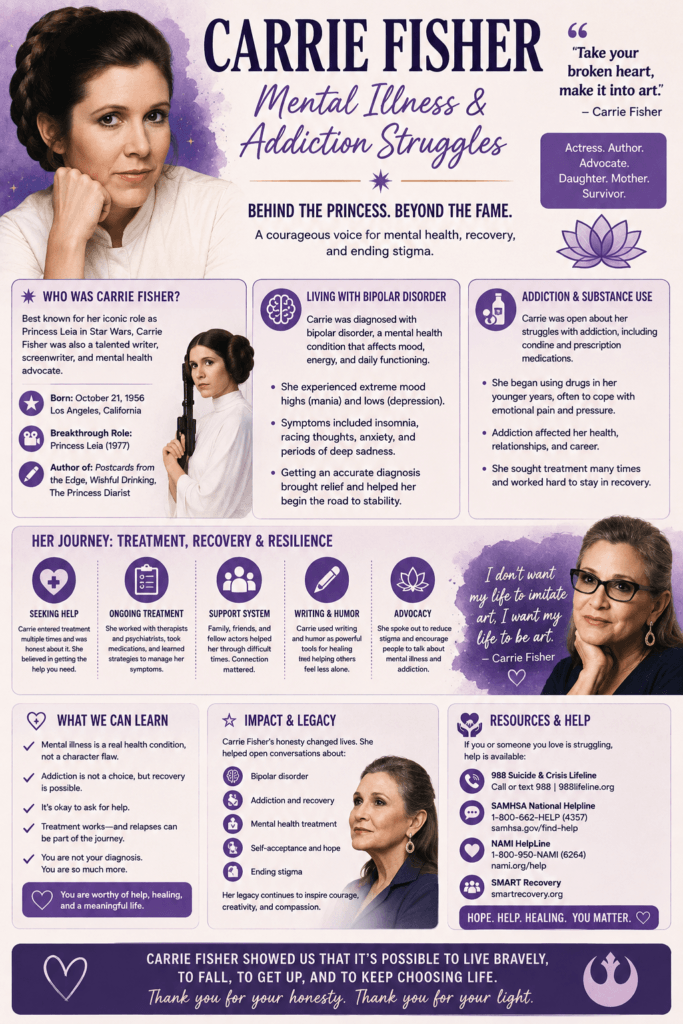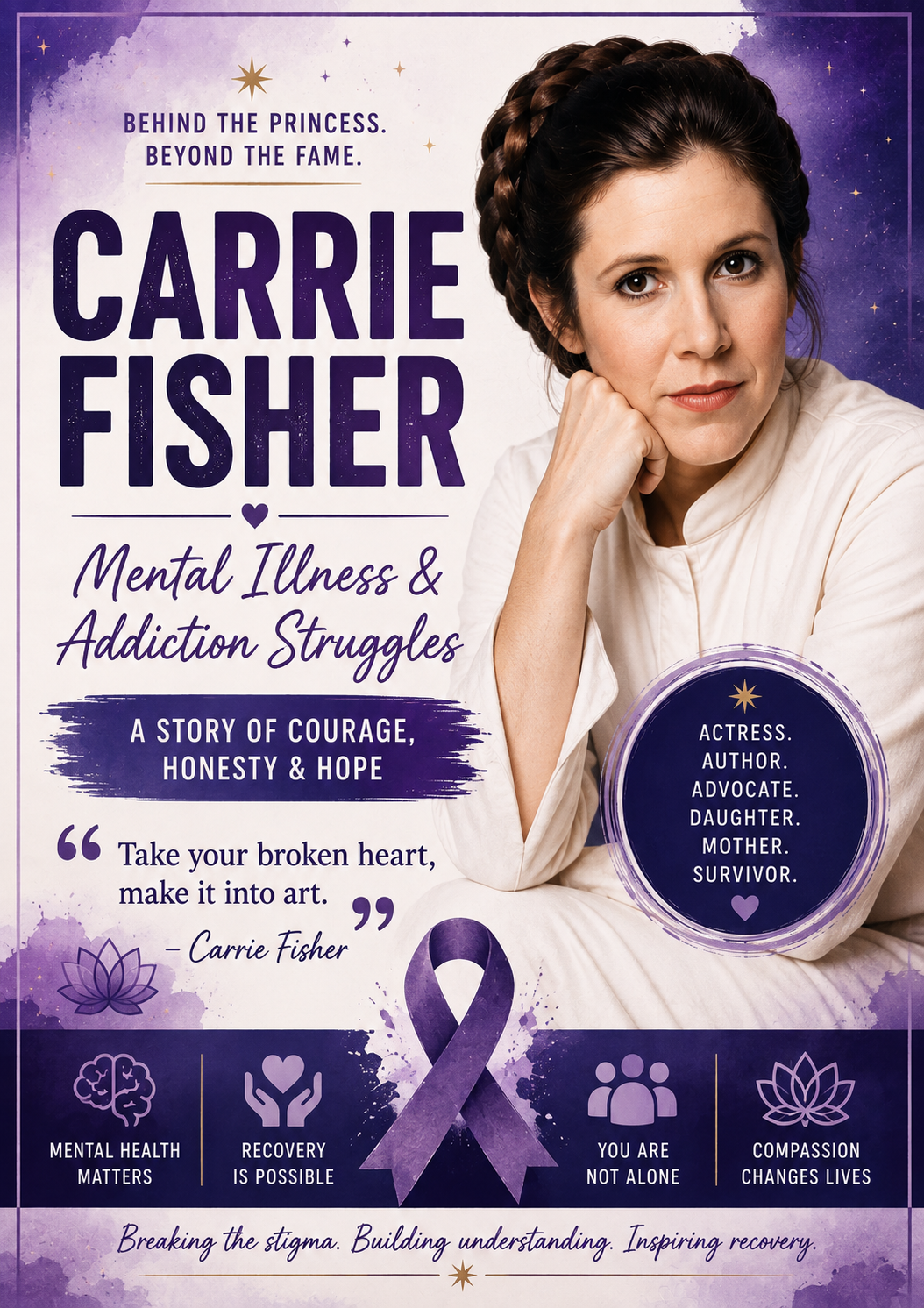
Carrie Fisher was an accomplished actress, writer, and mental-health advocate who became internationally recognized for portraying Princess Leia in Star Wars. Behind her successful career, Fisher openly experienced significant challenges with bipolar disorder and substance addiction, including problems involving cocaine and prescription medications. Rather than hiding these struggles, she eventually spoke candidly about her diagnosis, substance use, psychiatric treatment, and recovery. Her experiences provide an important opportunity to understand how mental illness and addiction can coexist, how substances may sometimes be used in attempts to cope with emotional distress, and why integrated treatment is important for people with co-occurring disorders. Fisher’s openness also challenged the stigma that often prevents individuals and families from discussing mental illness and addiction or seeking appropriate help.
Carrie Fisher’s Mental Illness and Addiction Struggles
Carrie Fisher was an acclaimed actress, writer, and mental-health advocate best known for portraying Princess Leia in Star Wars. Behind her successful career, Fisher lived with bipolar disorder and substance addiction, experiences she discussed unusually openly. Rather than hiding these challenges, she eventually used her public platform to reduce stigma surrounding mental illness and addiction.
Bipolar Disorder
Fisher was diagnosed with bipolar disorder, a mental illness characterized by significant changes in mood, energy, activity, concentration, and functioning. Bipolar disorder can involve episodes of mania or hypomania and depression, although symptoms vary substantially among individuals.
Fisher initially struggled to accept her diagnosis. She later spoke candidly about experiencing manic and depressive symptoms and receiving psychiatric treatment. Her willingness to publicly identify herself as having bipolar disorder was particularly significant during a period when serious mental illness was frequently misunderstood and stigmatized.
Substance Use and Addiction
Unlike situations where celebrity addiction is based primarily on media speculation, Fisher herself spoke extensively about her problems with drugs and addiction. She described using substances including cocaine and prescription medications, and she discussed periods of heavy substance use during her younger years.
Fisher also described using drugs partly in relation to her emotional experiences. This illustrates the concept of self-medication, in which someone uses alcohol or drugs in an attempt to manage distressing psychological symptoms. Substances may provide temporary relief but can ultimately worsen mood instability, sleep, judgment, physical health, and overall functioning.
Mental illness does not automatically cause addiction, but having certain psychiatric conditions can increase vulnerability to substance misuse. When a mental-health disorder and substance use disorder occur together, clinicians often refer to them as co-occurring disorders.
Fame and Early Exposure to Hollywood
Fisher grew up surrounded by celebrity culture as the daughter of actress Debbie Reynolds and singer Eddie Fisher. She became internationally famous while still in her early twenties after appearing as Princess Leia.
Sudden fame brought professional opportunities but also intense scrutiny, demanding schedules, expectations about appearance, and loss of privacy. These factors did not cause Fisher’s bipolar disorder or addiction, but chronic stress can complicate the management of existing mental-health and substance-use problems.
Treatment and Recovery
Fisher’s recovery was not presented as a simple, perfect journey. She underwent various forms of psychiatric and addiction treatment over the years and openly discussed the continuing work required to manage her mental health.
Her experience illustrates an important principle: recovery does not necessarily mean that a chronic mental illness disappears. Someone with bipolar disorder may continue managing the condition through medication, psychotherapy, lifestyle strategies, monitoring symptoms, and professional care while simultaneously working to maintain recovery from substance addiction.
Fisher also underwent electroconvulsive therapy (ECT) and discussed the treatment publicly. ECT remains an established medical treatment that may be used for certain severe psychiatric conditions, particularly when other approaches have not provided adequate improvement.
Humor as a Coping Strategy
One of Fisher’s distinctive approaches to discussing mental illness was humor. Through interviews, books, and performances, she often talked about painful experiences with remarkable wit.
Humor can sometimes provide psychological distance from difficult experiences and help people communicate subjects that otherwise feel overwhelming. However, humor should complement rather than replace appropriate professional treatment when serious mental illness or addiction is present.
Becoming a Mental-Health Advocate
Fisher transformed her personal experiences into advocacy. She publicly discussed bipolar disorder at a time when many celebrities avoided acknowledging psychiatric diagnoses.
Her message challenged the idea that mental illness should be hidden. She encouraged people to accept treatment and refused to allow psychiatric illness to erase her identity as an actress, writer, mother, and creative individual.
The National Alliance on Mental Illness recognized Fisher for her mental-health advocacy, and her openness continues to be cited in conversations about reducing psychiatric stigma. National Alliance on Mental Illness (NAMI)
Addiction, Relapse and Long-Term Management
Fisher’s experience also illustrates why addiction is often understood as a chronic, relapsing condition rather than a problem solved solely through willpower.
Recovery can require repeated treatment, changes in environment, social support, management of psychiatric symptoms, and continued attention to triggers. A recurrence of substance use does not erase previous recovery progress, but it does indicate that treatment and safety plans may need reassessment.
For people with co-occurring bipolar disorder and substance use disorder, integrated treatment is particularly important. Treating addiction without addressing significant mood symptoms—or treating bipolar disorder while ignoring problematic substance use—can make stabilization more difficult.
Her Death and an Important Caution
Fisher died in December 2016 after suffering a medical emergency during a flight. The Los Angeles County medical examiner ultimately described sleep apnea and other factors in connection with her death and reported multiple substances detected by toxicology. However, the report did not establish a single definitive manner in which the detected substances contributed to her death.
For this reason, it is inaccurate to reduce Fisher’s death simply to a “drug overdose.” Her medical history and death were more complicated than that.
What Carrie Fisher’s Story Teaches Us
Carrie Fisher’s life provides several important lessons about mental health and addiction. A person can live with serious mental illness while remaining creative, productive, humorous, and professionally accomplished. Mental illness and addiction may occur together, making coordinated treatment especially important. Recovery may also involve setbacks and continued management rather than a single moment when someone becomes permanently “cured.”
Perhaps Fisher’s greatest contribution to mental-health education was her refusal to be ashamed. By openly discussing bipolar disorder, addiction, psychiatric treatment, and recovery, she helped make conversations about these conditions more acceptable.
Her experience ultimately demonstrates that a psychiatric diagnosis is part of someone’s health history—not the entirety of their identity. Appropriate treatment, self-awareness, social support, and compassionate communities can help people living with mental illness and addiction pursue meaningful and productive lives.
Self-Management Strategies to Understand Carrie Fisher’s Mental Illness and Addiction Struggles
The experiences of Carrie Fisher provide an important example of managing bipolar disorder and substance addiction as co-occurring conditions. Fisher openly discussed both conditions, allowing her experiences to illustrate why long-term recovery often involves managing mental health and substance use together.
- Understand the connection between mental illness and addiction. Bipolar disorder and substance use disorder can occur together. Alcohol or drugs may initially seem to relieve depression, anxiety, agitation, or emotional discomfort, but they can eventually worsen mood instability and interfere with treatment.
- Learn personal warning signs. Recognizing early symptoms of depression, mania, hypomania, or escalating substance use can allow intervention before a crisis develops. Changes in sleep, energy, judgment, spending, irritability, impulsivity, isolation, or substance cravings deserve attention.
- Track mood and behavior patterns. A daily journal or mood-tracking system can document sleep, mood, energy, medication adherence, substance cravings, stressors, and significant behavioral changes. Patterns can provide useful information for both the individual and healthcare professionals.
- Maintain consistent psychiatric treatment. Bipolar disorder generally requires ongoing management. Medication should be taken as prescribed, and concerns about effectiveness or side effects should be discussed with the prescribing clinician rather than stopping psychiatric medication abruptly.
- Avoid self-medicating emotional symptoms. Fisher spoke openly about drug use in the context of her emotional experiences. Using alcohol or drugs to escape depression, anxiety, insomnia, or mood instability can reinforce an unhealthy coping cycle and complicate psychiatric treatment.
- Protect sleep. Sleep disruption can be particularly important in bipolar disorder. Maintaining consistent bedtime and waking schedules, limiting unnecessary nighttime stimulation, and discussing persistent insomnia with a healthcare professional can support mood stability.
- Identify addiction triggers. Stress, loneliness, interpersonal conflict, exposure to substances, emotional distress, and certain social environments may increase cravings. Identifying triggers allows a person to develop alternative responses before cravings become overwhelming.
- Develop healthier coping strategies. Exercise, mindfulness, creative activities, writing, relaxation techniques, hobbies, supportive relationships, and structured routines can provide alternatives to substance use. Fisher herself frequently used writing and humor to communicate and process difficult experiences.
- Create a relapse-prevention plan. Recovery plans can identify personal triggers, early warning signs, coping strategies, supportive contacts, treatment providers, and specific steps to take if substance use returns. A recurrence should prompt reassessment rather than abandonment of treatment.
- Build a reliable support network. Trusted family members, friends, therapists, psychiatrists, addiction professionals, and peer-support communities can provide different forms of assistance. Isolation can make both mood symptoms and addiction more difficult to manage.
- Treat both conditions simultaneously. When mental illness and addiction coexist, addressing only one condition may leave the other untreated. Integrated treatment can coordinate psychiatric care, addiction treatment, psychotherapy, medication management, and recovery support.
- Reduce shame through education. Fisher became known for openly discussing bipolar disorder and addiction rather than allowing stigma to silence her. Learning that these are legitimate health conditions can make it easier to acknowledge symptoms and seek appropriate treatment.
- Separate identity from diagnosis. A person is more than bipolar disorder, addiction, or any other diagnosis. Maintaining meaningful relationships, creative activities, employment, education, volunteering, and personal goals can strengthen an identity beyond illness.
- Know when self-management is not enough. Self-management complements professional treatment; it does not replace it. Severe mania, psychosis, dangerous intoxication, significant withdrawal, inability to function safely, or thoughts of self-harm require prompt professional evaluation.
Key Takeaway
Carrie Fisher’s experiences demonstrate that recovery from addiction while living with a serious mental-health condition may require ongoing treatment rather than a one-time solution. Effective self-management includes monitoring mood, protecting sleep, taking medications appropriately, recognizing triggers, avoiding self-medication, maintaining recovery supports, and asking for professional assistance when symptoms change.
Perhaps the strongest lesson from Fisher’s openness is that managing mental illness and addiction does not require hiding them in shame. People can acknowledge serious health challenges while continuing to pursue creativity, relationships, purpose, and a meaningful life.
Family Support Strategies to Understand Carrie Fisher’s Mental Illness and Addiction Struggles
The experiences of Carrie Fisher can help families understand the challenges of supporting someone living with bipolar disorder and substance addiction at the same time. Fisher spoke publicly about both conditions, demonstrating why families need compassion, education, boundaries, and professional support when mental illness and addiction coexist.
- Learn about co-occurring disorders. Families should understand that bipolar disorder and substance use disorder can occur simultaneously. Substance use may worsen mood instability, while untreated psychiatric symptoms can make substance use more difficult to control. Both conditions deserve appropriate treatment.
- Learn the signs of bipolar episodes. Family members can become familiar with changes associated with mania, hypomania, and depression. Warning signs may include dramatically reduced need for sleep, unusually high energy, rapid speech, impulsivity, irritability, risky behavior, hopelessness, withdrawal, or significant changes in daily functioning.
- Recognize substance-use warning signs. Increasing intoxication, secrecy, cravings, unexplained medication use, declining responsibilities, financial problems, or continued substance use despite consequences can indicate that additional intervention is needed.
- Communicate without shame. Avoid statements such as “Why can’t you just stop?” or “You’re ruining everyone’s life.” Instead, focus on observable behaviors and concern: “I’ve noticed you haven’t been sleeping and you’re drinking more than usual. I’m worried about you.”
- Avoid blaming every behavior on mental illness. A person with bipolar disorder still has an individual personality, preferences, strengths, and responsibilities. Families should avoid interpreting every disagreement or emotional reaction as a psychiatric symptom.
- Do not encourage self-medication. Alcohol or drugs may temporarily seem to relieve depression, anxiety, insomnia, or agitation but can ultimately destabilize mood and complicate psychiatric treatment. Families should encourage professional evaluation instead of relying on substances to manage symptoms.
- Support medication adherence without becoming controlling. Family members can provide reminders, transportation, or help organizing appointments when welcomed. However, medication decisions should remain between the individual and qualified healthcare professionals.
- Encourage integrated treatment. When bipolar disorder and addiction coexist, coordinated treatment is particularly valuable. Psychiatric care, addiction treatment, psychotherapy, medication management, and peer support may need to work together rather than functioning as completely separate services.
- Help identify early warning signs. Families often notice behavioral changes before the individual recognizes them. Developing a shared plan for what to do when sleep decreases dramatically, mood changes, cravings increase, or substance use returns can help prevent escalation.
- Establish compassionate boundaries. Supporting someone does not require accepting unsafe behavior. Families can refuse to provide money for substances, tolerate violence, conceal serious consequences, or repeatedly assume responsibilities that belong to the individual.
- Prepare for possible recurrence of symptoms or substance use. Both bipolar disorder and addiction can require long-term management. A recurrence should be taken seriously and used as a signal to reassess treatment, rather than automatically viewed as proof that recovery has failed.
- Encourage healthy routines. Consistent sleep, regular meals, physical activity, medical appointments, meaningful activities, and supportive social connections can contribute to stability. Families can participate without making recovery feel like constant surveillance.
- Preserve the person’s identity beyond illness. Fisher was not simply “a bipolar person” or “an addict.” She was also an actress, writer, mother, advocate, friend, and creative individual. Families should recognize talents, interests, achievements, relationships, and goals beyond diagnoses.
- Take care of the family too. Living alongside serious mental illness and addiction can create fear, exhaustion, anger, and caregiver burnout. Family therapy, individual counseling, education, and organizations such as NAMI and Al-Anon Family Groups can provide additional support.
- Have a crisis plan. Families should know whom to contact if severe mania, psychosis, dangerous intoxication, overdose, serious withdrawal, or suicidal behavior occurs. A written crisis plan developed with treatment professionals can clarify medications, providers, emergency contacts, preferred facilities, and appropriate actions.
Family Takeaway
Carrie Fisher’s experiences demonstrate that families supporting someone with both mental illness and addiction need to balance compassion with boundaries. Families cannot personally cure bipolar disorder, control another person’s substance use, or guarantee recovery. They can, however, recognize warning signs, encourage integrated professional treatment, reduce stigma, respond appropriately to crises, and create an environment that supports recovery.
Fisher’s openness also offers families an important reminder: a diagnosis should never become a person’s entire identity. Supporting recovery means helping someone manage illness while continuing to recognize the creativity, relationships, abilities, dignity, and purpose that make up the rest of their life.
Community Resource Strategies to Understand Carrie Fisher’s Mental Illness and Addiction Struggles
The experiences of Carrie Fisher provide communities with an opportunity to understand bipolar disorder, addiction, co-occurring disorders, recovery, and mental-health stigma. Because Fisher publicly discussed both her bipolar disorder and substance addiction, her experiences can be used responsibly to educate communities about the importance of treating mental health and substance use together.
- Provide education about co-occurring disorders. Community health centers, colleges, libraries, workplaces, and behavioral-health organizations can explain how mental illnesses such as bipolar disorder may coexist with substance use disorders. Education should emphasize that one condition does not automatically cause the other.
- Increase access to integrated treatment. People experiencing both addiction and serious mental illness benefit from services that address both conditions. Communities should strengthen connections among psychiatric providers, addiction specialists, primary-care clinicians, therapists, and peer recovery programs.
- Offer accessible mental-health screening. Primary-care practices, community clinics, schools, and behavioral-health programs can provide screening for depression, bipolar symptoms, substance misuse, and other behavioral-health concerns, followed by appropriate assessment and referral.
- Promote addiction treatment resources. Communities should make information about outpatient programs, residential treatment when appropriate, medications for substance use disorders, counseling, recovery housing, and peer-support services easy to find.
- Develop peer-support programs. People living with mental illness or addiction may benefit from connecting with others who have similar experiences. Peer recovery specialists can provide encouragement, practical guidance, and examples of meaningful life in recovery.
- Provide family education and support. Family members may need help understanding mood episodes, addiction, medication management, relapse warning signs, communication, boundaries, and crisis response. Community mental-health organizations can offer workshops, family therapy, and support groups.
- Reduce mental-health stigma. Fisher’s willingness to speak openly about bipolar disorder demonstrates how public conversations can challenge stereotypes. Community campaigns can emphasize that psychiatric illness is a health issue and that receiving treatment should not be a source of shame.
- Challenge addiction stigma as well. Terms that reduce individuals to their illness can discourage treatment. Community programs should use person-centered language and emphasize that people experiencing substance use disorders deserve evidence-based healthcare and dignity.
- Educate communities about bipolar disorder. Workshops can explain mania, hypomania, depression, sleep disturbances, impulsivity, and changes in functioning while emphasizing that diagnosis requires professional assessment.
- Improve crisis-response education. Community members can learn how to recognize severe mania, psychosis, suicidal behavior, dangerous intoxication, and overdose. Crisis planning can help families know when routine support is no longer sufficient, and emergency evaluation is necessary.
- Support creative approaches to recovery. Fisher frequently used writing and humor when discussing difficult experiences. Art programs, writing groups, music programs, theater, and other creative activities can complement—not replace—professional treatment while helping people develop a sense of connection and purpose.
- Create recovery-friendly environments. Stable housing, employment assistance, transportation, education, social connections, and opportunities for meaningful activity can contribute to long-term recovery. Treatment alone may be insufficient when basic social needs remain unmet.
- Connect people with reliable national organizations. In the United States, SAMHSA provides information about mental health and substance-use services, while NAMI offers education and support related to mental illness. Depression and Bipolar Support Alliance (DBSA) provides resources and peer support specifically related to mood disorders.
- Educate healthcare professionals about integrated care. Continuing education can help clinicians recognize when psychiatric symptoms and substance use are interacting. Coordinated treatment can reduce situations in which one condition is addressed while another significant problem remains untreated.
- Use celebrity stories responsibly. Fisher’s experiences can make mental-health education relatable, but community programs should distinguish between what she publicly disclosed and speculation about her private medical history. Her story should illustrate broader health principles rather than sensationalize illness or addiction.
Community Takeaway
Carrie Fisher’s experiences demonstrate why communities need a coordinated system of mental-health care, addiction treatment, family education, peer support, crisis services, and stigma reduction. People experiencing both serious mental illness and substance addiction should not have to navigate completely separate systems to receive appropriate care.
Perhaps the strongest community lesson from Fisher’s legacy is the importance of making it safe to talk about mental illness and addiction. When communities replace secrecy and judgment with education, accessible treatment, compassion, and meaningful recovery opportunities, individuals and families are more likely to seek assistance before problems become crises.
Frequently Asked Questions
Here are some common questions:
1. What mental illness did Carrie Fisher have?
Carrie Fisher publicly disclosed that she had bipolar disorder. She became well known for speaking candidly about her diagnosis and challenging the stigma surrounding serious mental illness.
2. What is bipolar disorder?
Bipolar disorder is a mental health condition involving episodes of significant changes in mood, energy, activity, and functioning. Depending on the type and individual, episodes may include mania or hypomania and periods of depression.
3. Did Carrie Fisher struggle with addiction?
Yes. Unlike celebrity stories based primarily on speculation, Fisher herself openly discussed her struggles with drug addiction and recovery in interviews, books, and public appearances.
4. What substances did Carrie Fisher use?
Fisher publicly discussed using substances including cocaine and prescription medications. Her experiences demonstrate how problematic substance use can become intertwined with mental-health symptoms and attempts to cope with emotional distress.
5. Did bipolar disorder cause her addiction?
It would be inaccurate to say that bipolar disorder directly caused Fisher’s addiction. Mental illness and substance use disorders can occur together, and symptoms such as depression, agitation, impulsivity, or sleep disturbances may increase vulnerability to substance misuse in some people. Addiction usually develops through multiple biological, psychological, social, and environmental factors.
6. What are co-occurring disorders?
Co-occurring disorders refer to having a mental-health condition and a substance use disorder at the same time. Fisher’s publicly acknowledged bipolar disorder and addiction provide an example of why mental-health and addiction services often need to be coordinated.
7. Did Carrie Fisher use drugs to cope with her mental health?
Fisher discussed substance use in relation to her emotional experiences. Using alcohol or drugs in an attempt to manage psychological symptoms is sometimes described as self-medication. Although substances may temporarily change how someone feels, they can ultimately worsen mood instability, sleep, judgment, and overall functioning.
8. Did Carrie Fisher receive treatment?
Yes. Fisher publicly discussed receiving psychiatric and addiction treatment during her life. Her experiences illustrate that managing co-occurring disorders may require ongoing care rather than a single episode of treatment.
9. Did Carrie Fisher receive electroconvulsive therapy (ECT)?
Yes. Fisher openly discussed receiving electroconvulsive therapy. ECT is an established medical treatment most commonly considered for certain severe psychiatric conditions, particularly severe depression and some other situations when clinically appropriate. It is performed under medical supervision and anesthesia.
10. Was Carrie Fisher completely cured of bipolar disorder?
Bipolar disorder is generally considered a long-term condition that can be effectively managed rather than simply “cured.” Treatment may include medication, psychotherapy, regular sleep, monitoring for mood changes, and ongoing psychiatric care.
11. Can someone recover from addiction while continuing to manage mental illness?
Yes. Recovery is possible, but people with co-occurring conditions may benefit from integrated treatment addressing both mental health and substance use. Recovery can involve professional treatment, medications when appropriate, behavioral therapy, peer support, healthy routines, and relapse-prevention strategies.
12. Did Carrie Fisher experience setbacks in recovery?
Fisher described addiction and recovery as complicated experiences rather than presenting recovery as perfectly linear. Recurrence of substance use can occur and should prompt reassessment of treatment, triggers, supports, and safety rather than being interpreted as proof that recovery is impossible.
13. How did Carrie Fisher cope with her experiences?
In addition to professional treatment, Fisher became known for using writing and humor to discuss painful experiences. Creative expression can be a valuable coping strategy, although it should complement rather than replace professional care for serious mental illness or addiction.
14. Why was Carrie Fisher important to mental-health advocacy?
Fisher discussed bipolar disorder, addiction, psychiatric medications, and treatment at a time when many public figures avoided these subjects. Her openness helped normalize conversations about mental illness and demonstrated that having a psychiatric diagnosis does not eliminate someone’s intelligence, creativity, humor, or professional abilities.
15. Did Carrie Fisher die from a drug overdose?
It is inaccurate to describe her death simply as a confirmed drug overdose. The Los Angeles County medical examiner identified sleep apnea and other factors and reported that multiple substances were detected. The available findings did not establish a single definitive way in which the detected substances contributed to her death.
16. What can families learn from Carrie Fisher’s experiences?
Families can learn the importance of understanding co-occurring disorders, recognizing changes in mood or substance use, encouraging professional treatment, maintaining healthy boundaries, preparing for crises, and supporting the person’s identity beyond their diagnoses.
17. What is the most important lesson from Carrie Fisher’s story?
Her experiences demonstrate that mental illness and addiction can coexist without defining the entirety of someone’s life. People living with serious psychiatric conditions can remain creative, productive, loving, humorous, and purposeful while continuing to manage their health.
Conclusion
Carrie Fisher’s life demonstrates that mental illness and addiction do not erase a person’s creativity, intelligence, accomplishments, or capacity to live a meaningful life. Her experiences with bipolar disorder and substance addiction illustrate that recovery may involve ongoing psychiatric care, addiction treatment, medication management, healthy coping strategies, supportive relationships, and continued awareness of triggers and warning signs. By speaking publicly and often humorously about subjects that many people were afraid to discuss, Fisher became an influential voice for reducing mental-health stigma. Her legacy reminds us that acknowledging mental illness is not something to be ashamed of, addiction deserves compassionate and evidence-based treatment, and people should be recognized for the entirety of their lives rather than defined solely by their diagnoses or struggles.
Video: Carrie Fisher’s Hidden Struggle #bipolarawareness #mentalhealth