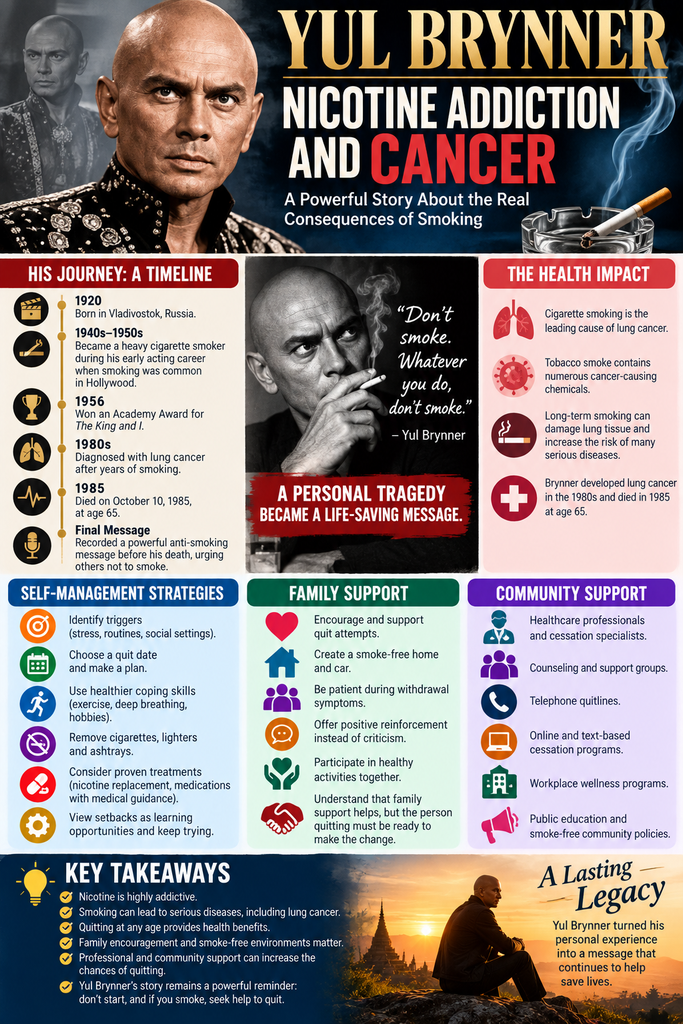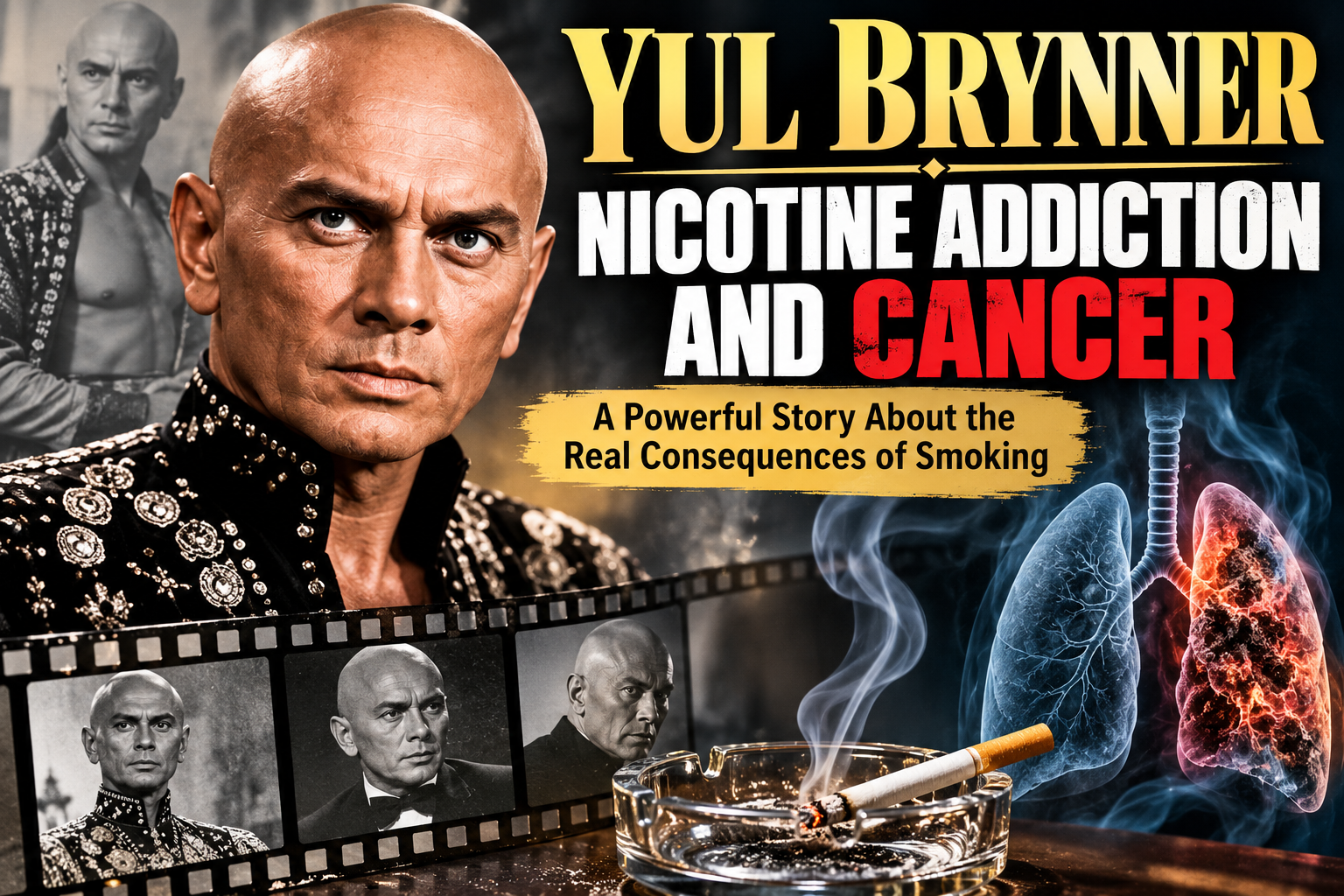
Yul Brynner was one of Hollywood’s most recognizable actors, famous for his commanding presence, distinctive shaved head, and celebrated performance as King Mongkut in The King and I. Away from the stage and screen, however, Brynner had a long history of cigarette smoking. After developing lung cancer, he transformed his experience into a striking warning about tobacco use. His story offers important lessons about nicotine addiction, personal behavior change, family support, prevention, and the role communities can play in helping people quit smoking.
Yul Brynner’s Smoking Journey
Brynner was a longtime cigarette smoker who reportedly smoked heavily for many years before eventually quitting. In the early 1980s, he was diagnosed with lung cancer. He underwent treatment but died from the disease in 1985 at age 65.
Before his death, Brynner recorded an anti-smoking message that was broadcast after he died. In it, he urged people not to smoke. The message became an especially memorable example of a celebrity using personal experience to educate others about tobacco’s health risks.
His experience is also a reminder that nicotine dependence should not simply be viewed as a “bad habit.” Nicotine can produce powerful physical dependence, while routines, emotions, stress, and environmental cues can reinforce continued smoking.
Understanding Nicotine Dependence
Cigarettes deliver nicotine rapidly to the brain. With repeated use, the brain adapts to nicotine exposure, which can lead to dependence. When someone stops smoking, withdrawal symptoms may include irritability, anxiety, difficulty concentrating, sleep problems, restlessness, and strong cravings.
Smoking can also become closely connected with everyday routines. A cigarette might become associated with drinking coffee, finishing a meal, driving, taking a work break, socializing, or coping with stress.
This combination of physical dependence and learned behavior helps explain why quitting can be difficult even when someone understands the health risks.
Self-Management Strategies for Quitting Smoking
Yul Brynner’s experience occurred during an era when smoking was much more culturally normalized than it is today. People attempting to quit now have access to considerably more evidence-based support.
Helpful self-management strategies include:
- Identify smoking triggers. Notice situations, emotions, people, or routines that produce an urge to smoke.
- Develop alternative routines. Walking, drinking water, chewing sugar-free gum, deep breathing, or calling someone can replace familiar smoking rituals.
- Remove smoking cues. Cigarettes, ashtrays, and other reminders can make cravings harder to manage.
- Prepare for cravings. Cravings generally pass. Having a specific plan can make it easier to avoid acting on them.
- Track progress. Recording smoke-free days, money saved, and health improvements can reinforce motivation.
- Consider evidence-based treatment. Counseling and FDA-approved smoking-cessation medications can improve a person’s chances of successfully quitting.
- Learn from setbacks. Smoking a cigarette after attempting to quit does not mean someone has to abandon the entire effort.
Family Support
Family members can have an important role in helping someone stop smoking. Effective support usually involves encouragement rather than criticism, shame, or constant monitoring.
Families can support smoking cessation by:
- Keeping the home and vehicles smoke-free.
- Avoiding smoking around someone who is trying to quit.
- Encouraging professional cessation support.
- Helping the person identify stressful situations that trigger smoking.
- Celebrating progress without expecting perfection.
- Being patient with temporary withdrawal symptoms.
- Participating in healthy activities together.
- Encouraging another quit attempt following a setback.
Family members should also recognize their limits. They can provide encouragement and practical assistance, but the person quitting ultimately needs to participate actively in the process.
Community Support and Smoking Cessation
Quitting does not have to be an individual struggle. Community resources can provide education, professional guidance, accountability, and encouragement.
Community support may include:
- Primary-care physicians and other healthcare professionals.
- Tobacco-cessation counselors and programs.
- Telephone quitlines.
- Individual or group counseling.
- Workplace smoking-cessation programs.
- Online and text-based cessation programs.
- Smoke-free community policies.
- Public education campaigns about tobacco-related disease.
These resources matter because different people need different combinations of behavioral and medical support.
Turning Personal Experience Into Prevention
One of the most powerful parts of Yul Brynner’s story came near the end of his life. Rather than keeping his illness private, he used his fame to deliver an anti-smoking message that could potentially influence others.
His posthumously broadcast message essentially transformed his personal experience into a public-health warning. Instead of glamorizing smoking—a behavior that had once been commonplace in movies and celebrity culture—Brynner became associated with smoking prevention.
That shift demonstrates the influence public figures can have when they speak openly about the consequences of addictive substances.
What Families Can Learn From Yul Brynner’s Story
Brynner’s experience provides lessons that remain relevant decades later:
- Nicotine dependence can be difficult to overcome.
- Understanding health risks does not automatically eliminate addiction.
- Quitting earlier provides important health benefits.
- Professional support can make quitting more manageable.
- Family encouragement can strengthen motivation.
- Creating smoke-free environments reduces triggers and protects others from secondhand smoke.
- A setback does not have to become a permanent return to smoking.
- Personal experiences can become powerful opportunities to educate others.
Prevention Matters
Yul Brynner’s story also demonstrates why preventing tobacco use is so important. The easiest cigarette addiction to overcome is the one that never develops.
Families, schools, healthcare professionals, and communities can help young people understand that nicotine products are addictive rather than harmless recreational products. Prevention efforts are especially relevant today because nicotine exposure is no longer limited to conventional cigarettes; electronic cigarettes and other nicotine products can also lead to dependence.
A Lasting Message
Yul Brynner is remembered for an extraordinary acting career, but his final public-health message became another significant part of his legacy. After experiencing lung cancer following decades of smoking, he used his voice to encourage others not to make the same choice.
His story illustrates three important layers of change. Self-management can help people recognize triggers, develop healthier routines, and persist through cravings. Family support can provide encouragement and a healthier environment without shame or judgment. Community support can provide counseling, medical treatment, quitlines, education, and smoke-free environments.
Most importantly, people who currently smoke should know that quitting remains worthwhile. Nicotine dependence can be powerful, but effective treatments and support are available, and a person’s previous unsuccessful attempts do not determine what happens next.
Frequently Asked Questions and Answers
1. Did Yul Brynner smoke cigarettes?
Yes. Yul Brynner was a longtime cigarette smoker. Smoking was also far more socially accepted during much of his early career than it is today, and Brynner later became a prominent voice warning others about its dangers.
2. Was Yul Brynner addicted to nicotine?
Brynner was a heavy, long-term smoker, and his history is commonly discussed in the context of tobacco and nicotine dependence. Nicotine is highly addictive because it affects the brain’s reward system and can produce cravings and withdrawal symptoms when a person stops using it.
3. What type of cancer did Yul Brynner develop?
Yul Brynner developed lung cancer. He received the diagnosis in the 1980s and underwent treatment before dying on October 10, 1985, at age 65.
4. Was Yul Brynner’s lung cancer related to smoking?
His lung cancer has been widely associated with his long history of cigarette smoking. Cigarette smoking is the leading risk factor for lung cancer, although lung cancer can also occur in people who have never smoked.
5. Did Yul Brynner quit smoking?
Yes. Brynner eventually stopped smoking, but quitting cannot always reverse damage accumulated over many years. Nevertheless, quitting smoking provides health benefits at virtually any age.
6. Did Yul Brynner speak publicly about smoking before he died?
Yes. Brynner recorded a powerful anti-smoking message before his death. It was subsequently broadcast by the American Cancer Society, giving his warning additional impact because audiences knew that he had personally experienced lung cancer.
7. What was Yul Brynner’s famous anti-smoking message?
In his posthumously broadcast message, Brynner strongly urged viewers not to smoke. His straightforward warning became one of the best-known elements of his public-health legacy.
8. Why is nicotine so difficult to quit?
Nicotine changes the brain in ways that reinforce repeated use. People who stop may experience cravings, irritability, restlessness, difficulty concentrating, sleep disturbances, anxiety, or increased appetite. Smoking can also become strongly associated with everyday routines and emotions.
9. What self-management strategies can help someone quit smoking?
A person can identify smoking triggers, establish a quit date, remove cigarettes and smoking supplies, change routines associated with smoking, exercise, practice stress-management techniques, and develop a plan for handling cravings. Evidence-based cessation medications and counseling can also be helpful.
10. How can family members support someone who is quitting nicotine?
Family members can maintain a smoke-free home and vehicle, encourage treatment, participate in healthy activities, recognize progress, and remain patient during withdrawal. Encouragement generally works better than criticism, shame, or repeated lecturing.
11. What community resources can help people quit smoking?
Healthcare professionals, tobacco-cessation counselors, support groups, workplace programs, telephone quitlines, and online or text-based cessation programs can provide assistance. Combining behavioral support with appropriate cessation medication can be particularly effective for many adults.
12. Does returning to smoking mean a quit attempt has failed?
No. Some people make several quit attempts before achieving long-term abstinence. A setback can help identify triggers, adjust the quit plan, and determine whether additional professional or social support is needed.
13. Can quitting smoking still help after someone has smoked for decades?
Yes. Quitting smoking can provide health benefits even after many years of tobacco use. In general, quitting earlier provides greater benefits, but you never need to wait for health problems to take action.
14. What can families learn from Yul Brynner’s cancer experience?
His experience demonstrates that nicotine dependence can have serious long-term consequences. Families can encourage prevention, maintain smoke-free environments, support loved ones who want to quit, and seek professional assistance rather than treating nicotine dependence simply as a lack of willpower.
15. What is the most important lesson from Yul Brynner’s story?
Perhaps the strongest lesson is the importance of acting before tobacco-related damage becomes severe. Brynner turned his experience with smoking and lung cancer into a warning for others. His story reinforces the value of prevention, early smoking cessation, family encouragement, professional treatment, and community support in addressing nicotine addiction.
Video: