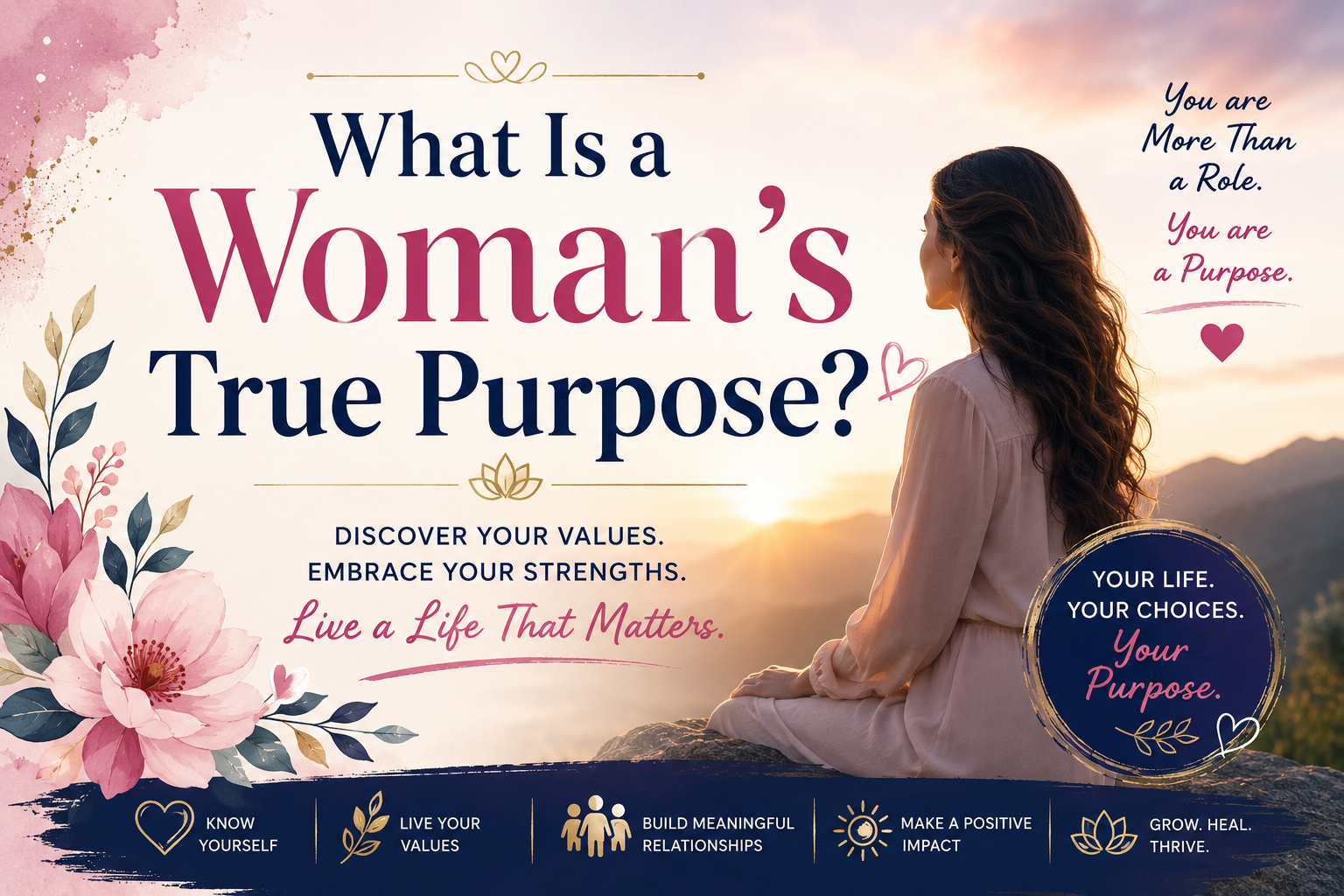
Women may find meaning and fulfillment in many different areas of life, including family, relationships, faith, education, career, creativity, service, and personal growth. There is no single role or expectation that defines a woman’s purpose. Instead, purpose develops through understanding her values, recognizing what gives her life meaning, and making choices that reflect who she is and who she hopes to become.
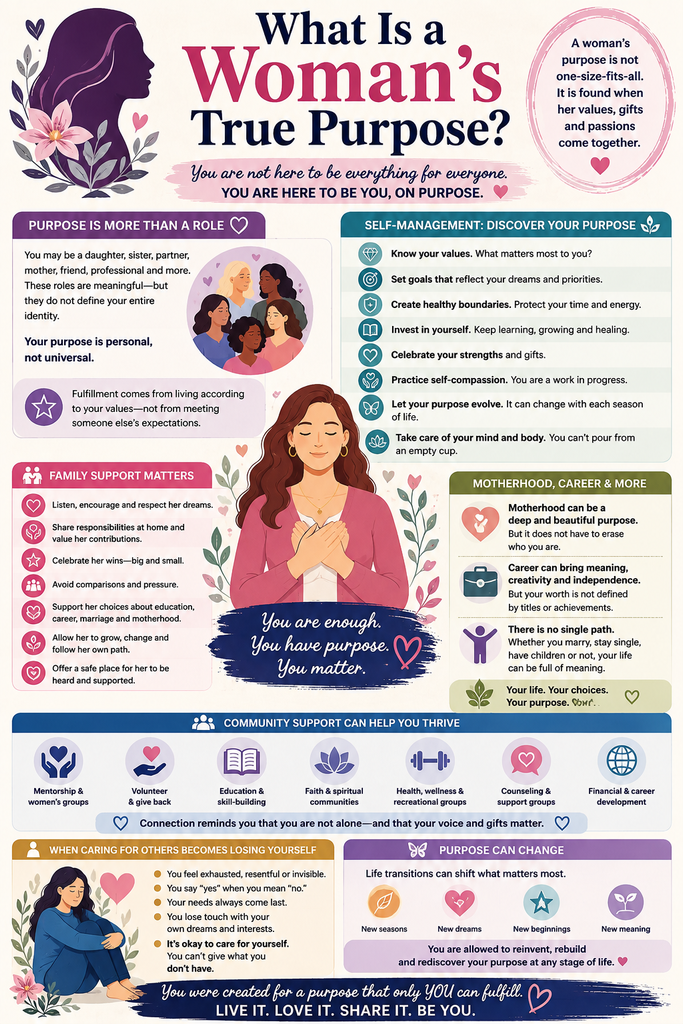
Purpose Is More Than a Role
Women often carry several roles simultaneously: daughter, sister, partner, mother, grandmother, friend, caregiver, student, employee, professional, or community member. These roles can provide tremendous meaning, but they are parts of a person’s identity rather than the entirety of it.
A woman may love caring for her family while also wanting personal goals. Another may find meaning primarily through motherhood. Someone else may choose not to marry or have children and build a fulfilling life through relationships, career, creativity, service, or other pursuits.
There is no single correct formula.
Purpose becomes healthier when it reflects authentic values rather than constant pressure to meet someone else’s expectations.
Self-Management Strategies: Discovering Your Own Purpose
Finding purpose often begins with understanding yourself. It requires identifying what matters to you rather than automatically following cultural expectations or comparing your life to other people’s.
Helpful strategies include:
- Identify your values. Ask yourself what matters most: family, compassion, creativity, independence, faith, learning, service, adventure, stability, leadership, or something else.
- Separate identity from approval. Your worth does not need to depend entirely on whether other people approve of your decisions.
- Create personal goals. Develop goals related to relationships, education, finances, health, career, hobbies, spirituality, or personal development.
- Practice healthy boundaries. Saying no can protect the time and emotional energy needed for priorities that genuinely matter.
- Stop measuring yourself against other women. Different circumstances and values naturally produce different life paths.
- Make room for yourself. Caring for others does not require abandoning your own emotional, physical, and personal needs.
- Accept changing priorities. What provides meaning at 25 may look different at 45, 65, or 80.
- Develop self-compassion. Mistakes, disappointments, divorce, career changes, infertility, relationship difficulties, or other unexpected experiences do not make a life meaningless.
- Ask meaningful questions. “What kind of person do I want to become?” can sometimes be more useful than “What am I supposed to accomplish?”
Family Support Strategies
Families can strongly influence how women understand themselves. Healthy families provide encouragement without forcing women into predetermined roles.
Family members can support a woman’s sense of purpose by:
- Listening to her goals without immediately judging them.
- Respecting decisions about education, career, marriage, relationships, and motherhood.
- Sharing household and caregiving responsibilities fairly.
- Encouraging interests and friendships outside family responsibilities.
- Recognizing accomplishments that are meaningful to her.
- Avoiding comparisons with sisters, friends, coworkers, or other women.
- Respecting healthy personal boundaries.
- Supporting education and professional development when these are important to her.
- Allowing her goals and priorities to evolve over time.
- Offering emotional support during major life transitions.
A supportive partner can be particularly important. Healthy relationships should allow both people to grow rather than requiring one person to continually sacrifice their identity for the other.
Motherhood and Purpose
For many women, motherhood is one of life’s deepest sources of meaning. Raising, protecting, teaching, and loving children can create a profound sense of purpose.
However, motherhood does not have to erase individuality.
A mother can deeply love her children while maintaining friendships, pursuing education, building a career, enjoying hobbies, protecting her health, and pursuing her own dreams.
Likewise, women who are not mothers can live deeply purposeful lives. A woman’s value is not determined by whether she has children.
Career and Achievement
Professional success can also provide purpose. Work may allow a woman to solve problems, help others, provide for her family, develop expertise, express creativity, or contribute to society.
But career achievement alone does not define worth either.
Titles, salaries, awards, degrees, and promotions can disappear or change. A sustainable sense of identity often includes qualities that cannot be measured on a résumé: compassion, integrity, resilience, curiosity, generosity, courage, and the quality of relationships.
Community Support Strategies
People often discover meaning through connection. Communities can create opportunities for women to learn, contribute, develop relationships, and explore new possibilities.
Helpful community resources may include:
- Women’s professional and mentoring organizations.
- Volunteer programs and nonprofit organizations.
- Community education and college programs.
- Parenting and caregiver support groups.
- Faith or spiritual communities, when personally meaningful.
- Recreational clubs and fitness groups.
- Libraries and community centers.
- Leadership and professional-development programs.
- Mental health counseling and support groups.
- Domestic violence and relationship-support services when safety or controlling behavior is a concern.
- Financial education and career-development programs.
- Creative groups involving art, music, gardening, writing, or other interests.
Community involvement can remind women that they are not required to discover purpose completely on their own. Relationships and shared experiences often help people recognize strengths they did not previously see in themselves.
When Caring for Others Becomes Losing Yourself
Compassion and caregiving can be meaningful, but problems can arise when a woman believes her only purpose is to meet everyone else’s needs.
She may become exhausted, resentful, emotionally disconnected, or unsure of what she wants outside her responsibilities.
Healthy caregiving includes boundaries.
It is possible to be generous without becoming responsible for everyone’s happiness. It is possible to support a partner without controlling or rescuing them. It is possible to love children deeply while still maintaining an identity beyond parenting.
Self-care is not the opposite of caring for others. Maintaining your own well-being can make sustainable relationships and caregiving possible.
Purpose Can Change
Purpose does not have to be discovered once and followed forever.
Graduation, marriage, motherhood, divorce, career changes, children leaving home, retirement, grief, and aging can all cause people to reconsider what gives their lives meaning.
Instead of viewing these transitions as a loss of purpose, they can sometimes become opportunities to create a new one.
A woman who spent decades raising children might later become a mentor. Someone who retires may volunteer, travel, study, create art, care for grandchildren, or begin an entirely new project. Someone recovering from a difficult relationship may discover strengths and interests that had been neglected for years.
Growth can continue throughout life.
Conclusion: Your Purpose Is Yours to Define
There is no universal answer to the question, “What is a woman’s true purpose?”
A woman’s purpose might involve loving her family, raising children, building a career, serving her community, practicing her faith, creating something meaningful, helping others, learning, leading, exploring, healing, or simply becoming the person she wants to be. Most lives contain several of these purposes rather than only one.
Family and community support can encourage that journey, but ultimately purpose should not be dictated by comparison, stereotypes, or pressure.
A meaningful question may therefore be less about what women are supposed to do and more about what each woman chooses to build:
What matters to me, who do I want to become, and how can I live according to those values?
Purpose is not necessarily something waiting to be found. Sometimes, it is something we create—one meaningful choice at a time.
Frequently Asked Questions
Here are some common questions:
1. What is a woman’s true purpose?
There is no single purpose that applies to every woman. Purpose is personal and may come from relationships, motherhood, career, spirituality, creativity, service, education, personal growth, or other meaningful areas of life.
2. Does a woman need to become a mother to have purpose?
No. Motherhood can be deeply meaningful for many women, but it does not determine a woman’s worth. Women who do not have or choose not to have children can build equally meaningful and fulfilling lives.
3. Can family be a woman’s main purpose?
Yes, if family life genuinely reflects her values and choices. Caring for children, a partner, parents, grandchildren, or other loved ones can provide tremendous meaning. The important distinction is that the role is personally meaningful rather than imposed upon her.
4. Can a career provide purpose?
Absolutely. A career can provide opportunities to help others, create, lead, learn, solve problems, achieve goals, and contribute to society. However, professional achievement is only one possible source of meaning.
5. How can a woman discover her purpose?
She can begin by considering questions such as: What matters most to me? What brings meaning to my life? What are my strengths? Who do I want to help? What kind of person do I want to become? Purpose often becomes clearer through experience rather than appearing all at once.
6. Is purpose the same as success?
No. Success is often measured through accomplishments, income, education, status, or recognition. Purpose is more closely connected to meaning, values, relationships, contribution, and how someone chooses to live.
7. Can a woman have more than one purpose?
Yes. A woman might simultaneously find purpose in motherhood, relationships, work, volunteering, creativity, faith, education, and personal development. Life does not have to revolve around one mission.
8. Can a woman’s purpose change over time?
Yes. Purpose can evolve with different stages of life. Marriage, motherhood, career changes, divorce, grief, children leaving home, retirement, caregiving, or other major transitions may change what feels most meaningful.
9. How do social expectations affect a woman’s sense of purpose?
Cultural and family expectations can influence beliefs about how a woman “should” live. When external expectations outweigh personal values, women may struggle with guilt, comparison, resentment, or uncertainty about their identities.
10. How can women stop comparing their lives with other women?
Recognizing that people have different circumstances, values, opportunities, challenges, and timelines can help. Reducing unhealthy social-media comparison and focusing on personally meaningful goals can also shift attention toward individual growth.
11. Are boundaries important for finding purpose?
Yes. Healthy boundaries protect time, emotional energy, relationships, and personal priorities. A woman can care about others without being responsible for meeting everyone’s needs or expectations.
12. Is prioritizing yourself selfish?
Not necessarily. Caring for physical health, emotional well-being, relationships, interests, and personal goals can support healthier relationships with others. Self-care and caring for others can exist together.
13. What happens when a woman loses herself while caring for others?
Constant caregiving without adequate boundaries or support can contribute to exhaustion, resentment, isolation, or loss of identity. Sharing responsibilities, reconnecting with personal interests, seeking support, and establishing boundaries can help restore balance.
14. How can family members support a woman’s purpose?
Families can listen to her goals, respect her choices, share responsibilities, encourage education or personal development, avoid unnecessary comparisons, and recognize that her priorities may change throughout life.
15. How can a partner support a woman’s personal growth?
A supportive partner respects her individuality, communicates openly, shares responsibilities, encourages her goals, and does not require her to abandon her identity to maintain the relationship.
16. Can being single be a fulfilling life?
Yes. Marriage or romantic partnership is not a requirement for purpose. A single woman can develop meaningful friendships, family relationships, professional accomplishments, community connections, interests, and personal goals.
17. What community resources can help women discover their purpose?
Mentoring programs, women’s organizations, volunteer groups, community centers, educational programs, professional associations, recreational groups, counseling, faith communities when personally meaningful, and support groups can provide connection and opportunities for growth.
18. What if a woman feels like she has no purpose?
Periods of uncertainty are common, particularly during major transitions or losses. Starting with small, meaningful activities—reconnecting with relationships, volunteering, learning something new, pursuing an interest, or talking with a counselor—can help restore a sense of direction.
19. Does purpose have to involve changing the world?
No. Purpose does not have to be dramatic or publicly recognized. Raising a family, being a dependable friend, caring for someone, teaching, creating, mentoring, learning, or bringing kindness into everyday relationships can all be meaningful.
20. What is the most important message about a woman’s purpose?
A woman does not have to fit one predetermined definition of a meaningful life. Her life can include many roles, but those roles do not completely define her. Purpose grows from understanding her values, developing her strengths, building meaningful relationships, contributing in ways that matter to her, and continuing to grow throughout life.
Video: Why There Is No One-Size-Fits-All For Women #womenempowerment #truth #shorts