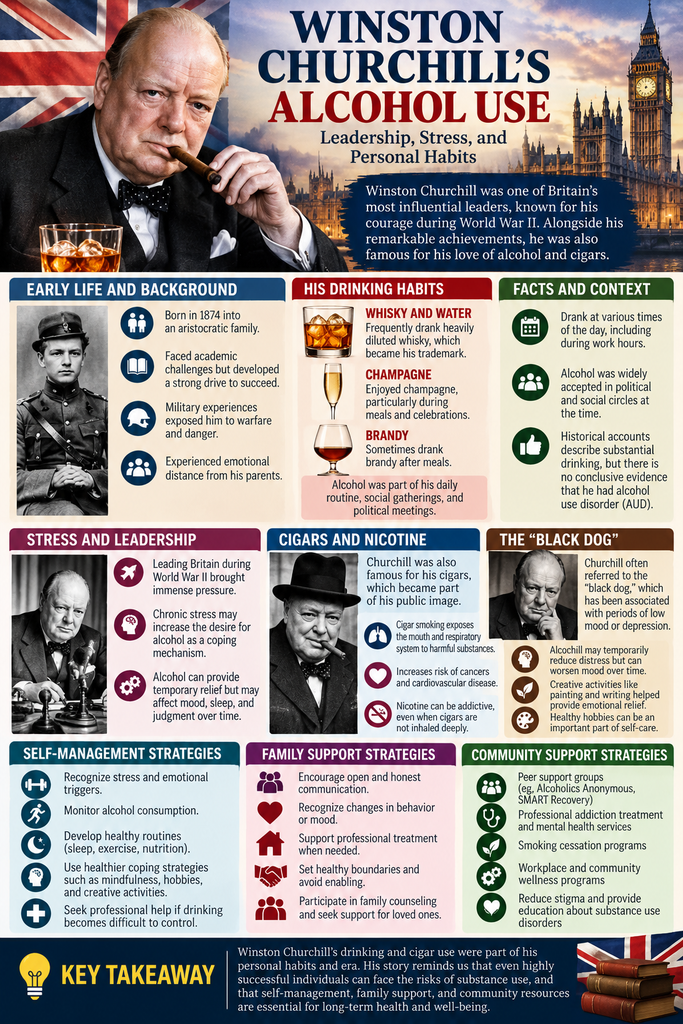
Winston Churchill is remembered as one of Britain’s most influential political leaders, particularly for his leadership during World War II. His determination, powerful speeches, and resilience helped inspire a nation facing extraordinary challenges. However, behind his public achievements was a complex personal life that included frequent alcohol consumption, cigar smoking, and periods of emotional distress.
Historians have widely discussed Churchill’s drinking habits. He regularly consumed alcoholic beverages, including whisky, champagne, and brandy, and became famous for his association with alcohol and cigars. Although his drinking was substantial by modern health standards, there is insufficient evidence to conclusively diagnose Churchill with alcohol use disorder.
His experiences provide an opportunity to explore the relationship between alcohol consumption, emotional stress, leadership responsibilities, and potentially unhealthy coping behaviors. Understanding his life also highlights the importance of self-management, family involvement, and community support in preventing and addressing substance-related problems.
Winston Churchill’s Early Life and Emotional Challenges
Winston Leonard Spencer Churchill was born on November 30, 1874, at Blenheim Palace in Oxfordshire, England. He grew up in an aristocratic family but experienced emotional challenges during childhood.
His father, Lord Randolph Churchill, was a prominent politician, while his mother, Jennie Jerome, was an American socialite. Churchill’s parents were often occupied with social and political responsibilities, and his early emotional support came largely from his nanny, Elizabeth Everest.
Churchill struggled academically in some subjects but developed strong interests in history, literature, military affairs, and public speaking.
Throughout his life, he demonstrated ambition, determination, and a desire for recognition.
Factors that may have influenced Churchill’s emotional well-being
- Limited parental attention: His childhood involved periods of emotional distance from his parents.
- Academic challenges: He experienced difficulties in traditional educational settings.
- Military experiences: His early career exposed him to warfare and dangerous situations.
- Political setbacks: He experienced electoral defeats, public criticism, and professional disappointments.
- Wartime responsibilities: Leading Britain during World War II involved extraordinary pressure.
- Personal losses: Deaths of loved ones and other family difficulties affected his life.
These experiences help explain the pressures Churchill encountered, although they do not establish that he developed an addiction.
Winston Churchill’s Relationship With Alcohol
Churchill’s relationship with alcohol was a recognizable feature of his public image.
Historical accounts describe his consumption of whisky mixed with water, champagne with meals, and brandy on certain occasions.
He was particularly associated with diluted whisky, which he sometimes consumed over extended periods.
His alcohol consumption was influenced by personal habits, social traditions, and the drinking culture of his era.
However, historians have debated whether Churchill’s drinking constituted alcohol dependence or a longstanding pattern of heavy social consumption.
Commonly reported drinking habits
- Whisky and water: Churchill frequently drank heavily diluted whisky.
- Champagne: He enjoyed champagne, particularly during meals and social occasions.
- Brandy: He sometimes consumed brandy after meals.
- Alcohol during working hours: Historical accounts describe drinking at various times of the day.
- Social drinking: Alcohol was part of many political, diplomatic, and personal gatherings.
While these habits would raise health concerns today, frequency of consumption alone does not establish alcohol use disorder.
Churchill’s Cigarette and Cigar Habits: Understanding Nicotine Exposure
Churchill was particularly famous for his cigars, which became an essential part of his public image.
He developed an interest in Cuban cigars early in his military career and continued smoking them for much of his life.
Photographs frequently show Churchill holding a cigar, making it one of his most recognizable personal trademarks.
Although he was often seen smoking, the extent to which he inhaled cigar smoke varied according to historical accounts.
Health concerns associated with cigar smoking
- Exposure to nicotine, which can produce dependence.
- Increased risk of cancers of the mouth, throat, esophagus, and lungs.
- Increased risk of cardiovascular disease.
- Potential damage to oral health and respiratory function.
- Exposure of others to secondhand tobacco smoke.
Even individuals who do not inhale cigar smoke deeply remain exposed to harmful substances through the mouth and surrounding tissues.
Important distinction: Churchill’s frequent cigar smoking is well documented, but the available evidence does not establish a formal diagnosis of nicotine use disorder.
World War II: Leadership Stress and Alcohol Consumption
Churchill became prime minister in May 1940, when Britain faced an immediate threat from Nazi Germany.
His leadership during the Battle of Britain, the Blitz, and subsequent military campaigns required prolonged working hours, difficult decisions, and constant attention to national security.
Historical accounts describe his unusual daily schedule, which included working late into the night, resting during the afternoon, and consuming alcohol during meals and meetings.
Although alcohol was part of his routine, there is no conclusive evidence that it caused specific wartime decisions or prevented him from fulfilling his leadership responsibilities.
How chronic stress can influence substance use
- Stress may increase the desire for temporary relaxation.
- Alcohol can become associated with emotional relief.
- Repeated drinking may reinforce habitual coping behaviors.
- Alcohol can interfere with sleep quality and emotional regulation.
- Heavy consumption can increase cardiovascular and other medical risks.
- Social expectations may normalize potentially harmful drinking habits.
Churchill’s wartime experiences demonstrate why individuals in demanding leadership roles benefit from healthy coping strategies and trusted support systems.
Churchill and the “Black Dog”: Depression and Emotional Distress
Churchill famously used the expression “black dog,” which has often been associated with depression.
However, historians disagree about whether this expression accurately reflects a lifelong clinical depressive disorder. Some accounts suggest episodes of low mood, while others caution against retrospective psychiatric diagnoses.
Churchill experienced political disappointments, personal losses, and periods of emotional strain.
He also found satisfaction in writing, painting, reading, and spending time with family and friends.
These activities may have provided meaningful recreation and emotional relief.
Understanding emotional distress and substance use
- Depression and alcohol misuse can sometimes occur together.
- Alcohol may temporarily reduce distress while worsening mood over time.
- Chronic stress can interfere with emotional regulation.
- Healthy recreational activities may support psychological well-being.
- Professional mental health evaluation is important when symptoms persist.
Churchill’s historical experiences provide an opportunity to discuss mental health without assuming that he had a specific psychiatric or substance use diagnosis.
Self-Management Strategies: Lessons From Churchill’s Lifestyle
Churchill’s demanding schedule, frequent alcohol consumption, and tobacco use illustrate the importance of monitoring personal habits and maintaining physical and emotional health.
Self-management means recognizing potential risks, building healthier routines, and seeking professional guidance when needed.
Practical self-management strategies
- Recognize alcohol-related triggers: Identify stress, frustration, loneliness, or social situations associated with drinking.
- Monitor alcohol consumption: Track drinking frequency, quantity, and related consequences.
- Develop healthier coping mechanisms: Practice exercise, mindfulness, relaxation techniques, or creative hobbies.
- Establish healthy sleep habits: Maintain a consistent sleep routine and reduce alcohol use near bedtime.
- Reduce tobacco exposure: Consider smoking cessation counseling and evidence-based nicotine dependence treatment.
- Maintain balanced nutrition: Support physical health through regular meals and adequate hydration.
- Seek professional assessment: Discuss concerning alcohol or tobacco use with a healthcare professional.
- Consider addiction treatment: Behavioral therapy and medications may help individuals diagnosed with substance use disorders.
For people with physiological alcohol dependence, suddenly stopping alcohol can cause dangerous withdrawal symptoms. Medical supervision may be necessary.
Churchill’s creative interests as examples of healthy coping
Churchill enjoyed painting, writing, and spending time at his country home, Chartwell.
These activities show how creative expression and meaningful recreation can offer alternatives to relying solely on substances for relaxation.
Painting, in particular, was an important personal interest throughout much of his adult life.
Family Support Strategies: The Role of Clementine Churchill
Churchill married Clementine Hozier in 1908. They remained married until his death in 1965.
Clementine was a close confidante who offered emotional support and, at times, candid advice about his behavior and political decisions.
Their relationship shows the value of trusted communication during stressful periods.
However, historical evidence does not establish that Clementine managed a formal addiction recovery program for Churchill.
Family support strategies for alcohol-related concerns
- Encourage honest communication: Discuss drinking patterns and emotional stress without accusations.
- Recognize concerning behaviors: Watch for changes in mood, sleep, responsibilities, or alcohol consumption.
- Provide emotional support: Encourage individuals to express difficulties rather than suppressing their feelings.
- Establish healthy boundaries: Avoid enabling dangerous behavior or accepting mistreatment.
- Encourage professional assistance: Support medical evaluation when alcohol use becomes problematic.
- Promote healthy activities: Encourage hobbies, family gatherings, and recreational activities that don’t revolve around alcohol.
- Consider family counseling: Improve communication and address relationship difficulties.
- Protect caregiver well-being: Encourage family members to seek their own emotional and psychological support.
Family support can improve treatment engagement, but loved ones are not responsible for controlling another person’s drinking.
Community Support Strategies: Building a Recovery Network
Churchill lived during a period when modern addiction treatment and public understanding of substance use disorders were far less developed than they are today.
Alcohol consumption was widely accepted in many political and social settings, and smoking was common.
Today, individuals experiencing problematic alcohol or tobacco use have access to evidence-based treatment and community resources.
Community-based support strategies
- Alcoholics Anonymous (AA): Provides peer support through a 12-step recovery framework.
- SMART Recovery: Offers evidence-informed approaches to managing addictive behaviors.
- Professional addiction treatment: Includes outpatient counseling, medication management, and structured recovery programs.
- Smoking cessation programs: Provide behavioral counseling and medications to help individuals stop using tobacco.
- Mental health services: Address co-occurring depression, anxiety, trauma, and chronic stress.
- Family support groups: Help loved ones develop coping strategies and maintain healthy boundaries.
- Workplace wellness programs: Encourage stress management and confidential access to treatment.
- Community education: Raise awareness of addiction risks and reduce stigma.
Community resources can help individuals seek assistance earlier and maintain recovery over time.
The Difference Between Heavy Drinking and Alcohol Use Disorder
One of the most important lessons from Churchill’s drinking habits is the need to distinguish alcohol consumption from a clinical addiction diagnosis.
Alcohol use disorder involves a problematic pattern of drinking that causes significant impairment or distress.
Common signs of alcohol use disorder
- Difficulty controlling alcohol consumption.
- Drinking more than intended.
- Repeated unsuccessful attempts to reduce drinking.
- Strong cravings for alcohol.
- Continued drinking despite health or relationship problems.
- Neglecting responsibilities because of alcohol.
- Experiencing tolerance or withdrawal symptoms.
Churchill’s frequent drinking is historically documented, but there is insufficient evidence to determine whether he consistently met the diagnostic criteria used today.
Churchill’s Later Years and Health Challenges
After World War II, Churchill remained active in politics and returned as prime minister from 1951 to 1955.
During his later years, he experienced significant health problems, including cerebrovascular disease.
In 1953, while serving his second term as prime minister, Churchill suffered a stroke.
He retired from the premiership in 1955 but remained active in public life.
Churchill died on January 24, 1965, at the age of 90, following another major stroke.
Although alcohol and tobacco use are established risk factors for several medical conditions, it is not possible to determine precisely how much these exposures contributed to Churchill’s individual health problems.
His later life should not be described as a documented addiction recovery journey because reliable evidence of formal addiction treatment or sustained abstinence is lacking.
Lessons From Winston Churchill’s Reported Substance Use
Churchill’s life demonstrates that leadership, achievement, and personal habits can coexist in complicated ways.
His longstanding alcohol consumption and cigar smoking provide an opportunity to examine the risks of normalizing potentially harmful behaviors, particularly among influential public figures.
Important lessons
- Achievement does not eliminate health risks: Successful individuals can engage in behaviors that increase their risk of substance-related harm.
- Cultural acceptance does not guarantee safety: Common drinking and smoking practices may still have serious health consequences.
- Stress management is essential: Healthy coping strategies can reduce reliance on alcohol or tobacco.
- Family relationships provide support: Trusted loved ones can encourage healthier behaviors and professional assistance.
- Community resources improve access to care: Counseling, peer support, and medical treatment can help individuals manage substance use disorders.
- Early intervention matters: Recognizing problematic patterns before severe consequences develop can improve outcomes.
Conclusion: Winston Churchill’s Legacy and the Importance of Healthy Coping
Winston Churchill remains a significant historical figure whose leadership during World War II shaped modern history. Alongside his political accomplishments, his frequent alcohol consumption and cigar smoking have become recognizable aspects of his public image.
Although his drinking habits were substantial, historical evidence does not conclusively establish that he experienced alcohol use disorder. Similarly, his emotional struggles should be understood within their historical context rather than interpreted as confirmed psychiatric diagnoses.
Churchill’s experiences illustrate how demanding responsibilities, social expectations, and personal habits can influence health-related behaviors.
Self-management strategies encourage individuals to recognize unhealthy patterns, develop positive coping skills, and seek professional assistance when needed.
Family support promotes communication, emotional connection, and accountability while respecting personal boundaries.
Community resources provide access to education, evidence-based treatment, and ongoing recovery support.
The broader lesson is that strength and resilience should include caring for one’s physical and emotional health. Recognizing substance-related risks and accepting appropriate support are important steps toward long-term well-being.
Frequently Asked Questions and Answers
Churchill’s Drinking Habits and Historical Background
1. Was Winston Churchill addicted to alcohol?
Churchill regularly consumed alcohol throughout much of his adult life. However, there is insufficient clinical evidence to conclusively diagnose him with alcohol use disorder (AUD). Historians have debated whether his drinking constituted dependence or habitual heavy consumption. Frequent drinking alone does not establish addiction.
2. Was Winston Churchill an alcoholic?
Churchill’s reputation as a heavy drinker has led some observers to describe him as an alcoholic. However, other historians challenge that characterization, noting that popular stories often exaggerate his drinking habits.
A diagnosis of alcohol use disorder requires evidence of impaired control, significant consequences, and other established clinical criteria.
3. What types of alcohol did Winston Churchill drink?
Churchill was particularly associated with several alcoholic beverages:
- Whisky and water: He frequently consumed heavily diluted whisky.
- Champagne: A preferred beverage during meals and celebrations.
- Brandy: Sometimes consumed after meals.
- Other wines: Served during formal dinners and diplomatic occasions.
The precise amount of alcohol he consumed varied and is difficult to establish from historical accounts.
4. Did Winston Churchill drink alcohol every day?
Historical accounts suggest that Churchill consumed alcohol on most days, sometimes beginning with diluted whisky earlier in the day.
However, drinking frequency does not necessarily indicate intoxication or addiction. Alcohol concentration, total quantity consumed, and the consequences of drinking are important considerations.
5. Did Churchill drink alcohol while working?
Yes. Historical accounts describe Churchill drinking diluted whisky and other alcoholic beverages during the day, including at meals and meetings.
Nevertheless, it would be inaccurate to assume that he was continuously intoxicated. His drinking patterns must be considered in their historical and cultural context.
6. Why did Winston Churchill drink so much alcohol?
Churchill’s drinking reflected longstanding personal preferences and the social customs of his era. Alcohol was commonly served during political gatherings, diplomatic events, and formal meals.
Although Churchill experienced significant stress, there is insufficient evidence to determine precisely how much of his drinking was motivated by emotional coping rather than habit, enjoyment, or social convention.
7. Did Winston Churchill’s drinking affect his leadership during World War II?
There is no conclusive evidence establishing that alcohol impaired specific wartime decisions made by Churchill.
Some historical accounts discuss his drinking during meetings and diplomatic events, but his actual level of impairment cannot reliably be reconstructed from these descriptions.
Alcohol can impair judgment and concentration, making heavy consumption a concern for anyone responsible for important decisions.
8. Did Churchill ever try to stop drinking?
There is no well-established public documentation showing that Churchill participated in a structured alcohol cessation program or made a sustained attempt at complete abstinence.
His continued association with alcoholic beverages suggests that drinking remained part of his lifestyle for many years.
9. Did Winston Churchill receive treatment for alcohol addiction?
There is no reliable public documentation confirming that Churchill underwent formal alcohol addiction treatment.
Modern treatment options, including medications for alcohol use disorder and specialized behavioral therapies, were also far less developed during much of his lifetime.
10. Was Churchill’s drinking considered normal during his lifetime?
Alcohol consumption was widely accepted in many British political and social settings during Churchill’s era.
However, social acceptance does not necessarily mean that a behavior is medically safe. Frequent or excessive alcohol consumption can increase the risk of liver disease, cardiovascular complications, cancer, and other health problems.
Alcohol, Mental Health, and Health Consequences
11. Did Churchill suffer from depression, also known as the “black dog”?
Churchill used the expression “black dog” to describe low mood. Some biographers have interpreted this as evidence of depression, but historians and medical researchers disagree about whether he experienced a diagnosable depressive disorder.
The expression alone is insufficient to establish a psychiatric diagnosis.
12. Did Churchill use alcohol to cope with depression?
There is no conclusive evidence that Churchill deliberately used alcohol to treat depression.
Alcohol may temporarily relieve emotional discomfort, but repeated drinking can worsen depressive symptoms, disrupt sleep, and increase the risk of alcohol-related problems.
13. Did Churchill’s alcohol use contribute to his strokes?
Churchill experienced cerebrovascular health problems, including a stroke in 1953 and a major stroke shortly before his death in 1965.
Heavy alcohol consumption is a recognized risk factor for stroke. However, it is not possible to establish how much Churchill’s drinking contributed to his individual medical conditions.
14. Was Winston Churchill also addicted to nicotine?
Churchill was famous for smoking cigars throughout much of his adult life. Cigars contain nicotine, which can cause dependence.
However, his frequent cigar use does not establish that he met clinical criteria for tobacco use disorder. Regardless of dependence, cigar smoking increases the risk of cancer, cardiovascular disease, and other health problems.
15. Did Churchill ever demonstrate that he could abstain from alcohol?
According to the International Churchill Society, Churchill reportedly won a 1936 wager by abstaining from hard spirits for a year. This is one reason some historians question claims that he was unable to control his drinking. The account does not necessarily mean that he abstained from every alcoholic beverage.
16. What is the difference between heavy drinking and alcohol use disorder?
Heavy drinking refers to alcohol consumption at levels associated with increased health risks. Alcohol use disorder is a medical condition involving a problematic pattern of drinking that causes significant impairment or distress.
Diagnosis involves evaluating symptoms such as impaired control, cravings, continued drinking despite consequences, and withdrawal.
Self-Management, Family, and Community Support
17. What self-management strategies can help someone who drinks heavily?
Effective strategies include:
- Recognizing emotional triggers and stressful situations.
- Monitoring alcohol consumption.
- Establishing alcohol-free routines.
- Practicing relaxation techniques and regular exercise.
- Maintaining healthy sleep and nutritional habits.
- Seeking professional evaluation when drinking becomes difficult to control.
- Developing a personalized treatment or recovery plan.
People with physiological alcohol dependence should obtain medical advice before abruptly stopping alcohol because withdrawal can be life-threatening.
18. How can family members help someone struggling with alcohol misuse?
Family members can provide emotional support, encourage honest communication, and help their loved one access professional treatment.
They should also establish healthy boundaries and avoid protecting the individual from the consequences of harmful drinking.
Family counseling and peer support programs can help relatives manage stress and improve communication.
19. What role did Clementine Churchill play in Winston Churchill’s personal life?
Clementine Churchill was an important confidante and source of emotional support throughout their marriage.
She offered advice, encouragement, and constructive criticism during difficult periods. However, there is no established evidence that she managed a formal addiction recovery program for Churchill.
Her relationship with Churchill illustrates the broader importance of trusted family relationships during periods of stress.
20. What community resources are available for alcohol addiction recovery?
Modern recovery resources include:
- Alcoholics Anonymous (AA).
- SMART Recovery.
- Outpatient and residential addiction treatment programs.
- Individual and family counseling.
- Mental health services.
- Primary care and addiction medicine specialists.
- Community wellness and relapse-prevention programs.
Evidence-based treatment may involve behavioral therapies, medications such as naltrexone or acamprosate, and continuing recovery support.
21. Can someone be successful professionally while experiencing alcohol-related problems?
Yes. Professional success does not exclude alcohol use disorder.
Some individuals maintain demanding careers despite harmful drinking patterns. However, occupational performance alone cannot confirm or rule out a substance use disorder.
A clinical assessment considers drinking behaviors, impaired control, consequences, and other diagnostic symptoms.
22. What can modern leaders learn from Churchill’s drinking habits?
Churchill’s life provides an opportunity to examine the importance of healthy coping strategies and responsible alcohol consumption.
Modern leaders can benefit from recognizing occupational stress, maintaining supportive relationships, protecting sleep, and seeking confidential healthcare when needed.
High professional achievement should never be interpreted as protection against alcohol-related health risks.
23. Did Churchill’s hobbies help him manage stress?
Churchill enjoyed painting, writing, reading, and spending time at his country home, Chartwell.
These interests provided recreation and creative expression. Although their precise effects on his mental health cannot be measured, similar activities can support emotional well-being and provide alternatives to drinking for stress relief.
24. Is drinking whisky diluted with water safer than drinking straight whisky?
Diluting whisky with water reduces its alcohol concentration, but it does not reduce the total amount of alcohol consumed if you use the same amount of whisky.
For example, adding water to one measure of whisky changes the drink’s strength but not its total alcohol content.
The quantity of ethanol consumed remains an important determinant of alcohol-related health risks.
25. What is the most important lesson from Winston Churchill’s alcohol use?
Churchill’s life illustrates that frequent alcohol consumption can become normalized through personal habits, social expectations, and cultural traditions.
However, historical drinking patterns should not be confused with a confirmed addiction diagnosis.
The most important lesson is that recognizing alcohol-related risks, developing healthier coping strategies, and maintaining supportive relationships can protect long-term physical and emotional health.
Video: