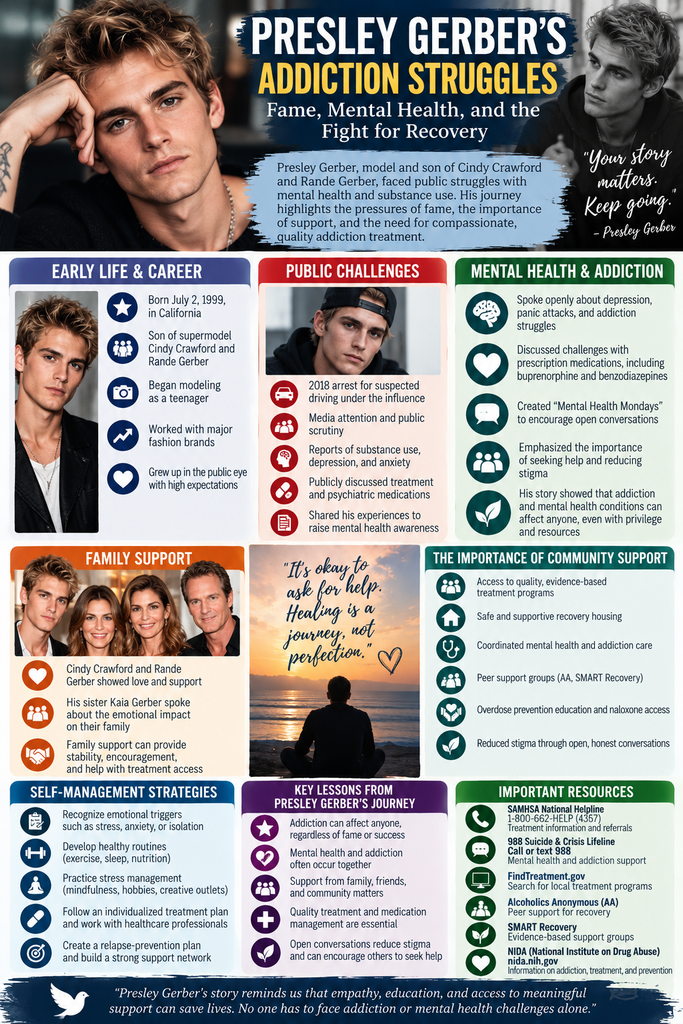
Presley Gerber is an American model and the son of supermodel Cindy Crawford and businessman Rande Gerber. Growing up in a high-profile family, Presley entered the modeling industry at a young age and attracted public attention for his career, appearance, tattoos, and personal life.
Over the years, media coverage has raised questions about his emotional well-being, substance use, and personal challenges. However, public speculation should not be confused with a confirmed diagnosis of addiction. Reports about his behavior do not, by themselves, establish that he has alcohol use disorder, drug addiction, or another substance use disorder.
His experiences provide an opportunity to explore the pressures associated with celebrity culture, the relationship between emotional distress and substance use, and the importance of self-management, family involvement, and community support.
Understanding these issues can help reduce stigma and encourage compassionate, evidence-based approaches to addiction prevention and recovery.
Presley Gerber’s Early Life and Modeling Career
Presley Walker Gerber was born on July 2, 1999, in California. As the son of Cindy Crawford and Rande Gerber, he grew up surrounded by the fashion and entertainment industries.
His younger sister, Kaia Gerber, also became a successful model and actress.
Presley began modeling as a teenager, appearing in fashion campaigns and runway shows for major designers.
Although his family connections created professional opportunities, public recognition also brought attention to his personal choices and appearance.
Challenges that may affect young adults in the public eye
- Public expectations: Pressure to maintain a particular image or professional reputation.
- Social media scrutiny: Exposure to criticism, rumors, and negative commentary.
- Identity development: Navigating independence while being associated with famous family members.
- Career uncertainty: Managing competitive industries and changing professional opportunities.
- Privacy concerns: Having personal experiences discussed publicly.
- Emotional stress: Coping with the demands of adulthood and professional responsibilities.
These are general challenges associated with public life. They should not be interpreted as proof that Presley experienced each one or that they caused substance misuse.
Presley Gerber’s Reported Substance-Related Concerns
Presley has received media attention for personal controversies, including a 2018 arrest on suspicion of driving under the influence.
That incident is relevant to discussions about alcohol-related risk, but an arrest does not establish a diagnosis of alcohol use disorder.
Some entertainment reports have also discussed concerns about his behavior and well-being. Evaluate such reporting carefully, especially when claims rely on unnamed sources or speculation.
Important distinctions when discussing Presley’s experiences
- An alcohol-related legal incident does not automatically establish addiction.
- Unusual behavior or changes in appearance are not reliable indicators of substance use disorder.
- Tattoos, social media posts, and lifestyle choices are not clinical symptoms.
- When reported, family concern does not independently confirm a diagnosis.
- Substance use disorders require assessment using established medical criteria.
There is insufficient verified public information to present Presley Gerber as having a confirmed addiction or a documented addiction recovery journey.
Nevertheless, his public experiences can introduce important conversations about alcohol-related safety, emotional well-being, and the value of early intervention.
Presley Gerber’s Publicly Discussed Addiction and Mental Health Journey
More recent reporting provides important information beyond the earlier controversies. Presley publicly discussed his experiences with addiction, depression, panic attacks, psychiatric medications, and treatment.
In a December 2025 social media video, he described challenges involving several prescribed medications, including buprenorphine and benzodiazepines. These disclosures reflected the complexity of his treatment experiences but do not establish that every medication was being misused.
Presley also created a social media series called Mental Health Mondays, encouraging others to speak openly about emotional struggles and seek support.
Important aspects of his public journey
- He discussed depression and other mental health challenges.
- He spoke about how difficult it is to find effective treatment.
- He encouraged conversations about mental health without shame.
- He shared experiences related to addiction treatment and recovery.
- He emphasized the importance of helping others through his experiences.
His willingness to discuss these subjects helped draw attention to the challenges many young adults encounter when navigating mental health treatment and substance use recovery.
Presley Gerber’s Death and the Importance of Accurate Reporting
On September 20, 2026, Presley Gerber died at age 27 while at a rehabilitation facility in Santa Monica, California.
His death was confirmed through reporting citing the Los Angeles County Medical Examiner. At the time of the initial reports, the official cause of death had not been determined, and an investigation was ongoing.
Reports have discussed a possible overdose, but a suspected cause should not be presented as a confirmed medical finding without final toxicology and medical examiner results.
His death underscores the importance of access to safe treatment environments, appropriate medical supervision, and coordinated care for individuals with complex substance use and mental health needs.
It is equally important to avoid assuming that one particular treatment decision, medication, or family circumstance caused his death.
Understanding the Connection Between Addiction and Mental Health
Substance use disorders and mental health conditions frequently occur together.
Depression, anxiety, panic symptoms, and emotional distress may complicate recovery. Likewise, substance use can worsen psychological symptoms and interfere with treatment.
Individuals experiencing both conditions often benefit from integrated care that addresses substance use and mental health simultaneously.
Common challenges in co-occurring disorders
- Emotional distress that increases the urge to use substances.
- Difficulty distinguishing psychiatric symptoms from medication effects or withdrawal.
- Sleep disturbances and impaired concentration.
- Medication interactions and increased overdose risk.
- Social withdrawal and relationship difficulties.
- Challenges maintaining consistent treatment.
Medications such as buprenorphine can be lifesaving when appropriately prescribed for opioid use disorder. Benzodiazepines may also have legitimate medical uses, but combining them with opioids or alcohol can increase the risk of dangerous sedation and respiratory depression.
Treatment should therefore involve careful medication review, coordination among clinicians, and individualized risk assessment.
Self-Management Strategies: Lessons From Presley’s Experiences
Presley’s public discussions about mental health and recovery highlight the importance of recognizing distress, asking for help, and maintaining ongoing treatment.
Self-management does not mean handling addiction alone. It means actively participating in recovery while receiving appropriate professional and social support.
Practical self-management strategies
- Recognize emotional triggers: Identify stress, grief, anxiety, loneliness, or other experiences associated with substance use.
- Develop a structured routine: Maintain consistent sleep, nutrition, physical activity, and treatment appointments.
- Follow an individualized treatment plan: Work with qualified clinicians to address substance use and mental health conditions.
- Review medications regularly: Discuss side effects, interactions, and treatment concerns with prescribing professionals.
- Avoid abrupt medication discontinuation: Benzodiazepines and some other medications may require medically supervised tapering.
- Build healthy coping skills: Practice mindfulness, exercise, journaling, or creative activities.
- Create a relapse-prevention plan: Identify warning signs, high-risk situations, and trusted support contacts.
- Keep naloxone accessible when opioid exposure is possible: Ensure family members and close contacts know how to recognize and respond to an overdose.
- Seek ongoing support: Participate in counseling, recovery groups, or other appropriate services.
Recovery often requires adjustments to treatment. Difficulty finding the right approach should prompt reassessment and coordinated care rather than shame.
Family Support Strategies: The Role of the Gerber Family
Presley’s family has also been part of public conversations about his struggles.
In a 2026 interview, his sister Kaia Gerber discussed how her brother’s long-term addiction challenges affected their family and how she had sometimes felt pressure to avoid adding to her parents’ concerns. She also expressed pride in his willingness to seek help.
These experiences illustrate how substance use disorders can affect entire families, including siblings who may quietly carry emotional burdens.
Family support strategies
- Practice compassionate communication: Listen without judgment, criticism, or threats.
- Encourage professional treatment: Help loved ones connect with qualified addiction and mental health professionals.
- Learn about addiction: Understand relapse risk, withdrawal, overdose prevention, and treatment options.
- Support medication safety: Encourage coordinated prescribing and awareness of potentially dangerous drug interactions.
- Establish healthy boundaries: Offer support without accepting unsafe or harmful behavior.
- Include siblings and other relatives: Recognize that addiction can affect everyone in the household.
- Participate in family counseling: Address emotional strain, communication problems, and caregiver stress.
- Develop an emergency plan: Know how to respond to overdose symptoms or a mental health crisis.
- Respect privacy: Avoid sharing sensitive personal information without consent.
Family members can play a meaningful role in supporting recovery, but they cannot guarantee another person’s safety or treatment outcome.
Community Support Strategies: Creating Safer Recovery Environments
Presley’s experiences also raise important questions about the availability, quality, and oversight of addiction treatment services.
Following his death, reporting by the Los Angeles Times examined California’s sober-living industry and concerns about regulatory oversight.
A supportive recovery environment should provide appropriate supervision, clear emergency procedures, access to medical services, and continuity of care.
Community-based support strategies
- Evidence-based addiction treatment: Provide access to medications for opioid use disorder, counseling, and coordinated mental health care.
- Peer recovery programs: Encourage participation in SMART Recovery, Narcotics Anonymous, or other supportive groups.
- Qualified recovery housing: Seek residences with transparent policies, appropriate staffing, and established safety procedures.
- Overdose prevention education: Expand access to naloxone and training.
- Integrated mental health services: Address depression, anxiety, trauma, and substance use together.
- Family education programs: Help relatives understand addiction, treatment, and crisis response.
- Continuing care: Support individuals during transitions between inpatient treatment, outpatient care, and independent living.
- Community stigma reduction: Encourage respectful discussion of addiction as a treatable medical condition.
Quality treatment should prioritize patient safety, informed consent, appropriate clinical supervision, and individualized care.
The Risks of Prescription Medication Combinations
Presley’s disclosures about psychiatric medications highlight an important issue in addiction medicine: the need to distinguish medically supervised treatment from medication misuse.
Buprenorphine is an evidence-based medication for opioid use disorder. Benzodiazepines, including alprazolam and diazepam, are sometimes prescribed for anxiety-related conditions.
However, combining benzodiazepines with opioids can increase the risk of respiratory depression, overdose, and death.
Medication safety recommendations
- Review all prescription and nonprescription medications with a qualified clinician.
- Avoid alcohol and other sedating substances when taking medications that cause central nervous system depression.
- Do not change doses or discontinue medications without medical guidance.
- Coordinate treatment among psychiatric, primary care, and addiction specialists.
- Develop an overdose-response plan when opioid exposure is a concern.
The FDA advises that buprenorphine treatment should not automatically be withheld from patients taking benzodiazepines. Instead, clinicians should carefully manage the risks while continuing appropriate treatment for opioid use disorder.
Lessons From Presley Gerber’s Life and Recovery Efforts
Presley’s public experiences demonstrate that substance use and mental health challenges can affect individuals regardless of wealth, family connections, or professional opportunities.
His willingness to discuss difficult personal experiences also illustrates the importance of reducing stigma and encouraging others to seek help.
Important lessons
- Addiction can affect anyone: Financial resources and professional success do not eliminate vulnerability.
- Mental health and addiction are interconnected: Integrated treatment may be necessary when both conditions occur.
- Recovery is individualized: Different people require different combinations of medical care, counseling, and social support.
- Medication safety matters: Coordinated prescribing and monitoring can reduce serious complications.
- Families need support too: Parents, siblings, and other loved ones may experience significant emotional strain.
- Treatment quality is essential: Safe recovery environments and appropriate medical supervision are critical.
- Public awareness can reduce stigma: Open conversations can encourage earlier recognition and treatment.
Conclusion: Remembering Presley Gerber Beyond Addiction
Presley Gerber’s life included modeling, family relationships, personal challenges, and efforts to encourage greater understanding of mental health and addiction.
His public disclosures reflected a willingness to discuss difficult experiences and help others feel less isolated. His death at age 27 is a reminder of the serious risks associated with complex substance use and mental health conditions, although its precise medical cause should not be assumed without definitive findings.
His story also illustrates why recovery requires more than individual determination.
Self-management involves recognizing emotional triggers, participating in treatment, and developing healthier coping strategies.
Family support provides compassion, communication, encouragement, and appropriate boundaries.
Community support offers access to evidence-based treatment, safer recovery environments, overdose prevention, and continuing care.
Remember Presley not only for the challenges he publicly discussed, but also for his efforts to promote mental health awareness.
Frequently Useful Resources
- SAMHSA National Helpline — 1-800-662-HELP (4357), for substance use treatment information and referrals.
- 988 Suicide & Crisis Lifeline — Call or text 988 in the United States for mental health or substance-related crisis support.
- FindTreatment.gov — Search for addiction and mental health treatment facilities.
- National Institute on Drug Abuse — Evidence-based information about addiction, overdose prevention, and treatment.
Frequently Asked Questions and Answers
Presley Gerber’s Personal Struggles
1. Who is Presley Gerber?
Presley Gerber is an American model born on July 2, 1999. He is the son of supermodel Cindy Crawford and businessman Rande Gerber and the older brother of model and actress Kaia Gerber.
He began modeling as a teenager and worked with prominent fashion brands before his personal life drew additional media attention.
2. Did Presley Gerber struggle with addiction?
Presley publicly discussed experiences involving addiction treatment, mental health challenges, and psychiatric medications. His disclosures indicate that substance-related concerns were part of his personal experiences.
However, the precise nature of any substance use disorder, including specific diagnoses and severity, should not be assumed beyond what has been reliably documented.
3. What substances was Presley Gerber reportedly struggling with?
In public discussions, Presley reportedly mentioned medications such as buprenorphine and benzodiazepines.
Buprenorphine is commonly used to treat opioid use disorder, while benzodiazepines are prescribed for certain anxiety and related conditions.
Taking these medications does not automatically indicate misuse or addiction. Their use may reflect legitimate medical treatment, and claims of misuse require reliable evidence.
4. Did Presley Gerber struggle with depression and anxiety?
Presley publicly discussed depression, panic attacks, and other mental health difficulties.
These experiences highlight the importance of professional mental health assessment and individualized treatment, particularly when emotional symptoms occur alongside substance-related concerns.
5. Did growing up in a famous family contribute to Presley’s struggles?
Growing up in a high-profile family can involve public expectations, privacy concerns, and intense social media scrutiny.
However, there is insufficient evidence to conclude that his family’s fame caused his mental health or substance-related difficulties.
Addiction and mental health conditions are influenced by complex combinations of biological, psychological, social, and environmental factors.
6. Did Presley Gerber have legal problems involving alcohol?
Presley was arrested in 2018 on suspicion of driving under the influence.
An alcohol-related arrest raises concerns about impaired driving and public safety, but it does not independently establish alcohol use disorder or another addiction diagnosis.
7. Did Presley Gerber seek professional treatment?
Public reporting has discussed Presley’s involvement with mental health and addiction treatment services.
However, details about his clinical diagnoses, prescribed treatment plans, and medical history remain private unless reliably disclosed.
Seeking treatment is an important step toward addressing substance use and mental health concerns.
8. What was Presley’s “Mental Health Mondays” initiative?
Presley used social media to encourage discussions about emotional struggles and mental health.
His Mental Health Mondays content focused on promoting awareness, reducing stigma, and encouraging people to speak more openly about difficult experiences.
Such conversations can help others recognize that seeking professional support is appropriate and valuable.
Recovery, Family Support, and His Legacy
9. Did Presley Gerber experience a relapse?
According to reporting by People in September 2026, Presley had received addiction-related treatment and reportedly experienced a relapse. However, the complete circumstances of his substance use and treatment history are not publicly documented.
Relapse can occur during recovery and does not mean that previous treatment efforts were meaningless. It can, however, increase overdose risk, particularly when opioid tolerance has decreased.
10. What happened to Presley Gerber in September 2026?
Presley died on September 20, 2026, at age 27, while staying at a recovery residence in Santa Monica, California.
The Los Angeles County Medical Examiner confirmed his death and stated that the cause and manner of death were deferred pending further investigation.
11. Did Presley Gerber die from a drug overdose?
Police investigated his death as a suspected overdose. However, the medical examiner had not established an official cause of death in its September 21 statement.
A suspected overdose should not be presented as a confirmed toxicological finding.
12. How did Presley’s addiction struggles affect his family?
Substance use disorders can create significant emotional challenges for parents, siblings, and other loved ones.
Presley’s sister, Kaia Gerber, publicly discussed the impact of addiction-related challenges on their family. However, people should respect their private experiences and decisions rather than interpreting them as evidence of blame or responsibility.
13. How can families support someone struggling with addiction?
Family members can provide meaningful support through:
- Open, nonjudgmental communication.
- Encouragement to seek professional treatment.
- Education about addiction and overdose prevention.
- Healthy boundaries and realistic expectations.
- Participation in family counseling.
- Emotional support during setbacks.
- Attention to their own mental health and well-being.
Families can encourage recovery, but they cannot guarantee another person’s treatment outcome.
14. What self-management strategies can help someone experiencing addiction?
Self-management strategies include recognizing triggers, establishing healthy routines, attending treatment appointments, and developing coping skills.
Exercise, mindfulness, creative activities, adequate sleep, and supportive relationships may improve emotional well-being.
Individuals should also work with healthcare professionals to develop relapse-prevention plans and address co-occurring mental health conditions.
15. Why is treating addiction and mental health together important?
Substance use disorders frequently coexist with depression, anxiety, trauma-related conditions, and other mental health concerns.
Integrated treatment addresses both conditions through coordinated medical care, behavioral therapy, and appropriate medications.
Treating only one condition may leave important symptoms and recovery needs unaddressed.
16. Can prescription medications contribute to overdose risks?
Yes. Certain medication combinations, particularly opioids and benzodiazepines, can increase the risk of excessive sedation and respiratory depression.
However, medications such as buprenorphine are evidence-based treatments for opioid use disorder and can reduce overdose mortality when appropriately prescribed.
Medication use alone does not establish misuse, and no specific medication should be blamed for Presley’s death without verified medical findings.
17. What role does community support play in addiction recovery?
Community resources can provide access to treatment, peer encouragement, and ongoing care.
Important services include:
- Alcoholics Anonymous and Narcotics Anonymous.
- SMART Recovery.
- Outpatient addiction treatment.
- Integrated mental health services.
- Recovery housing with appropriate safety standards.
- Naloxone distribution and overdose education.
- Family counseling and caregiver support.
Community support is especially important during transitions between treatment settings.
18. Why is choosing a qualified rehabilitation facility important?
Treatment programs differ in staffing, licensing, medical services, and supervision levels.
Families should ask whether a facility provides appropriate clinical assessment, medication management, emergency response procedures, and access to medical care.
Recovery residences are not necessarily equipped to manage acute intoxication or medically complicated withdrawal.
19. What can young adults learn from Presley Gerber’s experiences?
His public discussions emphasize the importance of recognizing emotional distress and seeking help.
Young adults can benefit from understanding that addiction is treatable, recovery may involve setbacks, and asking for professional support is a responsible decision.
His experiences also demonstrate that fame and financial resources do not eliminate the challenges associated with substance use and mental health conditions.
20. What is the most important lesson from Presley Gerber’s story?
Presley’s experiences highlight the importance of compassion, early intervention, individualized treatment, and safe recovery environments.
Addiction recovery requires more than determination. It often involves medical treatment, emotional support, family involvement, and continuing community care.
His willingness to discuss mental health also reinforces the importance of reducing stigma and encouraging honest conversations.
Video: