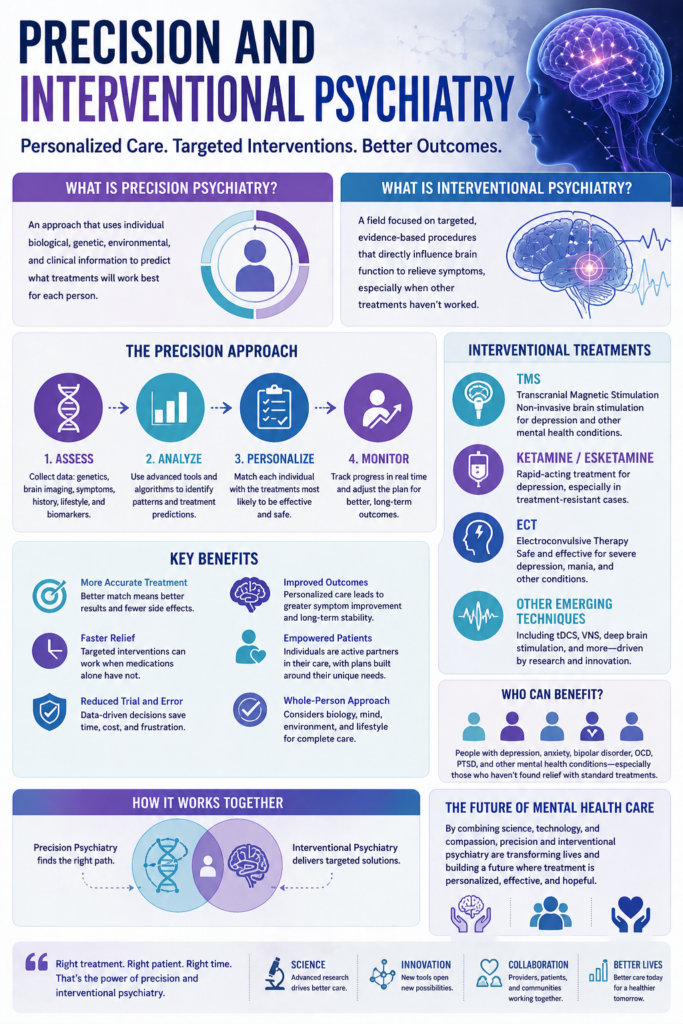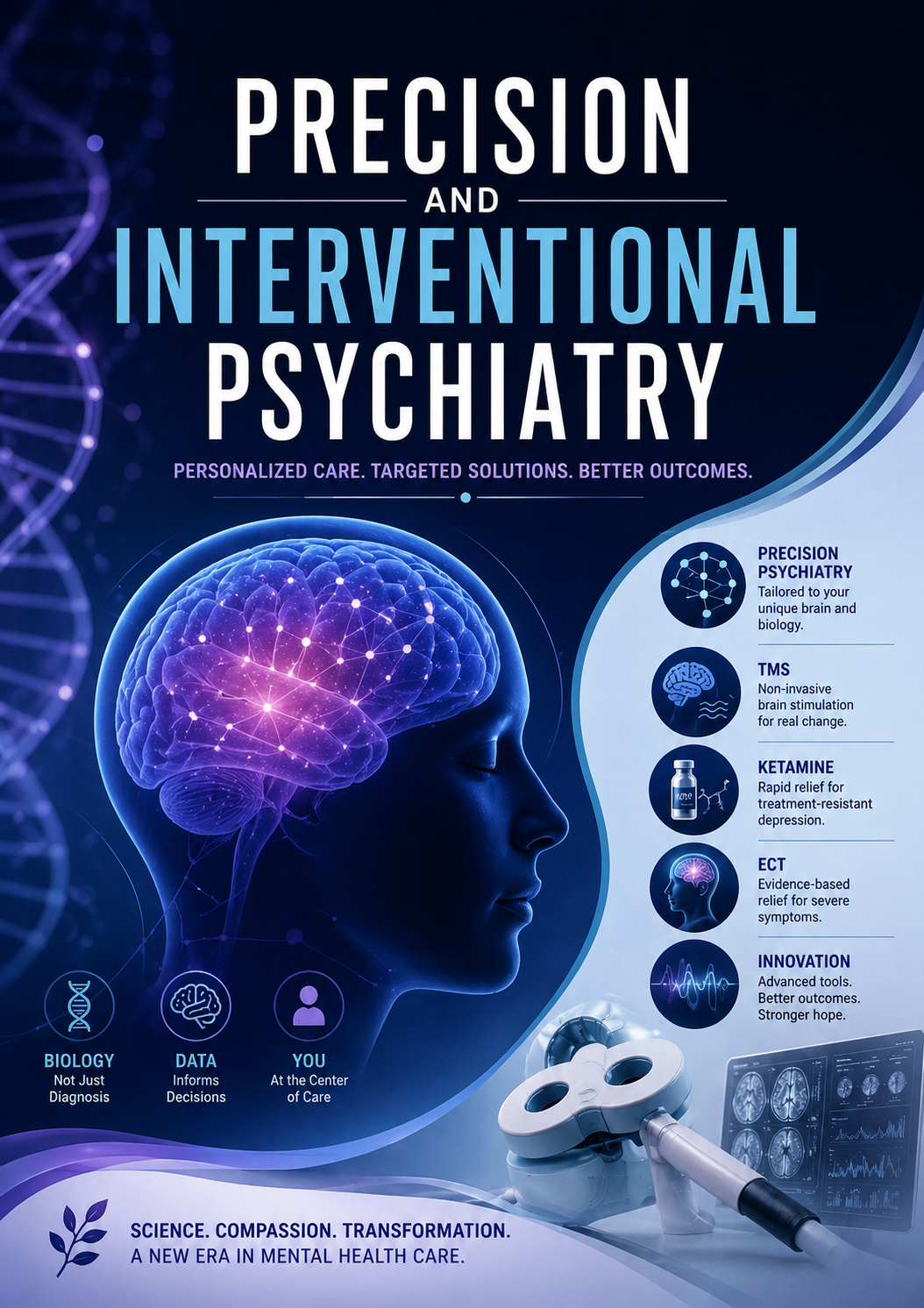
Precision Psychiatry and interventional psychiatry represent a significant shift in how mental health conditions are understood and treated. Moving beyond traditional trial-and-error approaches, these fields emphasize individualized, data-driven care and targeted interventions that directly influence brain function. By integrating advances in neuroscience, biomarkers, and neuromodulation techniques, this model aims to match the right treatment to the right patient at the right time. As a result, it offers new possibilities for improving outcomes, particularly for individuals who have not responded to conventional therapies.
Precision and Interventional Psychiatry: Transforming Mental Health Through Targeted Care
Rethinking how we treat mental illness
For decades, psychiatry has relied heavily on trial-and-error prescribing—finding the “right” medication often meant cycling through options with uncertain results. Precision Psychiatry and interventional psychiatry represent a shift away from that model toward targeted, individualized, and biologically informed care.
Instead of asking “What works for most people?”, this approach asks:
“What will work best for this specific person, based on their brain, biology, and symptoms?”
What is precision psychiatry?
Precision psychiatry aims to tailor treatment using:
- Genetics and biomarkers
- Brain imaging and neurocircuitry insights
- Symptom profiles and behavioral patterns
- Data-driven prediction models
The goal is to move beyond broad diagnostic categories and toward personalized treatment pathways that improve outcomes and reduce unnecessary delays.
What is interventional psychiatry?
Interventional psychiatry focuses on procedure-based treatments that directly target brain function, including:
- Transcranial magnetic stimulation (TMS)
- Electroconvulsive therapy (ECT)
- Ketamine and esketamine therapies
- Emerging neuromodulation techniques
These interventions are often used when traditional treatments are ineffective, offering rapid and sometimes life-saving relief, particularly in severe depression or treatment-resistant conditions.
Why this shift matters
Traditional psychiatric care can be:
- Slow to show results
- Variable in effectiveness
- Frustrating for patients and clinicians alike
Precision and interventional psychiatry address these challenges by:
- Reducing trial-and-error treatment
- Targeting specific brain circuits
- Providing faster symptom relief in some cases
- Improving long-term outcomes through tailored care
The integration of both approaches
The real innovation lies in combining these fields:
- Precision psychiatry identifies who needs what
- Interventional psychiatry delivers how to target it directly
For example, brain imaging may identify a dysfunctional circuit, and a neuromodulation technique can then specifically modulate that circuit.
Ethical and practical considerations
As promising as these approaches are, they raise important questions:
- Access and cost barriers
- Equity in advanced treatments
- Interpretation of complex biological data
- Avoiding over-reliance on technology without holistic care
Balancing innovation with ethical responsibility and accessibility is critical.
The future of mental health care
We are moving toward a model where:
- Treatment is personalized, not generalized
- Interventions are targeted, not diffuse
- Outcomes are measured and optimized continuously
This represents not just a technological shift, but a philosophical one—seeing patients not as diagnoses, but as individual systems with unique needs.
Final thought
Precision and interventional psychiatry are redefining what effective mental health care can look like. By combining biological insight with targeted intervention, they offer a path toward more accurate, efficient, and compassionate treatment.
The future of psychiatry isn’t just about new tools—it’s about using them in the right way, for the right person, at the right time.
Understanding Precision and Interventional Psychiatry: Self-Management Strategies for Informed Engagement
Why self-management matters in this field
As mental health care evolves, Precision Psychiatry and interventional psychiatry are introducing more targeted, data-driven, and procedure-based treatments. While clinicians guide care, patients benefit from actively understanding and engaging with these approaches.
Self-management here doesn’t mean “treating yourself”—it means becoming an informed participant in complex, personalized care.
1. Learn the basics of your treatment model
Start by understanding:
- What makes your treatment “precision-based” (genetics, symptoms, biomarkers)
- Whether you’re being considered for or receiving interventional treatments (e.g., TMS, ketamine)
- What outcomes are being targeted (mood, cognition, functioning)
This helps shift your mindset from passive recipient → active collaborator.
2. Track your symptoms with intention
Precision care depends on good data. You can contribute by monitoring:
- Mood patterns (daily or weekly trends)
- Sleep quality and timing
- Energy, focus, and motivation
- Side effects or unusual changes
Over time, this creates a personal dataset that can guide treatment adjustments.
3. Understand your response patterns
Instead of asking “Is this working?”, ask:
- When do I feel better or worse?
- Are improvements consistent or variable?
- Do certain triggers override treatment effects?
This helps distinguish between:
- Treatment-related changes
- Environmental or behavioral influences
4. Prepare for interventional treatments
If you’re undergoing or considering procedures like TMS or ketamine:
- Learn what the session experience will be like
- Understand expected timelines (some effects are gradual, others rapid)
- Track changes before, during, and after treatment
Preparation reduces uncertainty and helps you interpret your response more accurately.
5. Identify your personal modifiers
Even the most advanced treatments are influenced by everyday factors:
- Sleep disruption
- Stress levels
- Substance use
- Social environment
Self-management involves recognizing how these variables enhance or interfere with treatment effectiveness.
6. Ask better, more precise questions
Engagement improves when questions are specific:
- “What markers are guiding my treatment plan?”
- “How will we measure success?”
- “What alternatives exist if this approach doesn’t work?”
This aligns your understanding with the clinical decision-making process.
7. Balance technology with self-awareness
Precision psychiatry uses data—but your lived experience still matters.
Avoid:
- Over-relying on numbers alone
- Ignoring subjective changes because they’re “not measured.”
The best outcomes come from integrating:
clinical data + personal insight
8. Build a structured routine alongside treatment
Even with advanced interventions, stability matters:
- Consistent sleep-wake cycles
- Regular meals and hydration
- Predictable daily structure
These create a biological baseline that allows treatments to work more effectively.
9. Recognize limits of self-management
Precision and interventional psychiatry can be complex. Seek clarification when:
- You don’t understand your treatment rationale
- You feel overwhelmed by options or data
- Your symptoms change unexpectedly
Self-management includes knowing when to step back and ask for guidance.
Final thought
Precision and interventional psychiatry are redefining mental health care—but they work best when patients are not just recipients, but informed participants.
Self-management in this context is about:
- Awareness
- Tracking
- Communication
- Integration
When you understand both the science and your own experience, you help turn advanced treatment into meaningful, personalized progress.
Supporting a Loved One in Precision and Interventional Psychiatry: Family Strategies for Understanding and Engagement
A new kind of mental health care—what families should know
Modern mental health treatment is evolving beyond traditional therapy and medication trials. Precision Psychiatry and interventional psychiatry focus on personalized, data-informed care and targeted brain-based treatments.
For families, this shift can feel both hopeful and confusing. New terms, technologies, and treatment pathways may be unfamiliar—but your role remains essential in helping your loved one navigate, understand, and stay supported throughout the process.
1. Learn the basics—without needing to be an expert
You don’t need a medical degree, but understanding the framework helps:
- Precision psychiatry = tailored treatment based on individual biology and patterns
- Interventional psychiatry = procedures like TMS, ECT, or ketamine that directly affect brain function
This knowledge helps you move from uncertainty → informed support.
2. Shift from “fixing” to “supporting the process.”
Families often feel pressure to find the “right answer.” In this model, treatment is more dynamic.
Helpful mindset:
- You are not responsible for choosing the treatment
- You are supporting your loved one’s engagement and consistency
Think of yourself as part of the support system, not the decision-maker.
3. Help track patterns (without becoming intrusive)
Precision care relies on patterns over time.
You can support by:
- Noticing changes in mood, sleep, or behavior
- Gently sharing observations (“You seemed more energized this week”)
- Encouraging your loved one to track their own symptoms
Avoid:
- Constant monitoring
- Turning observations into criticism
The goal is shared awareness, not control.
4. Prepare for interventional treatments together
If your loved one is undergoing treatments like TMS or ketamine:
- Learn what sessions involve
- Understand that responses may be gradual or variable
- Expect possible fatigue or emotional shifts during treatment phases
Your presence—whether logistical (rides, scheduling) or emotional—can reduce stress and improve follow-through.
5. Normalize uncertainty and adjustment
Precision psychiatry aims to improve accuracy—but it’s not perfect.
Families should expect:
- Trial adjustments based on response data
- Changes in treatment plans
- Periods where progress feels unclear
Framing this as part of the process helps prevent discouragement or blame.
6. Encourage open, low-pressure communication
Create space for conversation without forcing it:
- “How are you feeling about your treatment lately?”
- “Is there anything that’s been helping or not helping?”
Avoid:
- Overloading with questions
- Interpreting silence as failure
Consistency matters more than intensity.
7. Support stability outside of treatment
Even advanced therapies depend on a stable foundation:
- Regular sleep and daily routines
- Reduced stress where possible
- Encouragement of healthy habits
Families can help maintain an environment where treatment has the best chance to work.
8. Respect autonomy while staying connected
These treatments are personal and sometimes intense.
Balance:
- Respecting your loved one’s independence
- Staying available and involved
Support sounds like:
- “I’m here if you want to talk.”
- “Let me know how I can help.”
Not:
- “You should do this instead.”
9. Take care of your own learning and well-being
This field is evolving quickly. It’s okay not to know everything.
Helpful steps:
- Learn from reliable sources
- Ask clinicians for clarification when needed
- Seek support for yourself if you feel overwhelmed
A well-informed, grounded family member is a stronger support system.
Final thought
Precision and interventional psychiatry are changing how mental health conditions are understood and treated—but they don’t replace the importance of human connection and support.
As a family member, your role is not to master the science, but to:
- Stay informed
- Stay patient
- Stay present
That steady support can make a meaningful difference as your loved one navigates a more personalized and evolving path to recovery.
Building Community Pathways: Resource Strategies in Precision and Interventional Psychiatry
Why community infrastructure matters in modern psychiatry
As mental health care advances, Precision Psychiatry and interventional psychiatry are shifting treatment toward personalized, data-driven, and procedure-based approaches. While these innovations are often discussed in clinical or research settings, their real-world impact depends heavily on community-level access, coordination, and understanding.
Without strong community resources, even the most advanced treatments remain underutilized or inaccessible.
1. Increase awareness beyond specialty centers
Many people are unaware that treatments like TMS, ketamine therapy, or biomarker-informed care even exist.
Community strategies should include:
- Public education campaigns explaining modern psychiatric options
- Outreach through primary care clinics and community health centers
- Clear, stigma-reducing language around advanced treatments
Awareness is the first step toward equitable access.
2. Build referral bridges between providers
Precision and interventional psychiatry often exist in specialized settings, creating gaps in care.
Effective communities:
- Connect primary care, therapists, and specialists
- Establish clear referral pathways for treatment-resistant cases
- Encourage shared care models
This prevents patients from getting “stuck” in systems that don’t offer next-step options.
3. Develop accessible treatment hubs
Access remains uneven due to cost, geography, and availability.
Community-level solutions include:
- Expanding interventional psychiatry services into regional centers
- Supporting telehealth for assessment and follow-up
- Integrating services into existing hospitals or clinics
The goal is to bring advanced care closer to where people live.
4. Train community clinicians in emerging approaches
Not every provider needs to deliver interventional treatments—but they should understand them.
Key strategies:
- Continuing education on precision psychiatry principles
- Training on identifying candidates for advanced interventions
- Basic literacy in interpreting treatment pathways
This creates a workforce that can recognize and refer appropriately.
5. Incorporate data-informed care into everyday settings
Precision psychiatry relies on data—but data collection shouldn’t be limited to research environments.
Communities can support:
- Routine use of symptom tracking tools
- Digital platforms for monitoring treatment response
- Integration of patient-reported outcomes into care decisions
This brings elements of precision care into standard practice.
6. Support patients and families navigating complexity
These treatment models can feel overwhelming.
Community resources should provide:
- Educational materials explaining options in plain language
- Navigation services or care coordinators
- Support groups for individuals undergoing interventional treatments
Guidance reduces confusion and improves treatment engagement.
7. Address equity and access barriers
Advanced psychiatric care risks widening disparities if not implemented thoughtfully.
Communities must consider:
- Insurance coverage and affordability
- Transportation and time barriers
- Cultural competence in care delivery
Equity-focused strategies ensure innovation benefits more than a select few.
8. Encourage collaboration between research and community care
Precision psychiatry evolves rapidly, often within academic settings.
Bridging the gap involves:
- Translating research findings into practical clinical tools
- Community participation in research initiatives
- Feedback loops between patients, clinicians, and researchers
This keeps care current, relevant, and adaptable.
Final thought
Precision and interventional psychiatry are not just technological advances—they represent a shift toward more accurate, individualized mental health care. But their success depends on more than science alone.
Strong community strategies:
- Expand awareness
- Improve access
- Coordinate care
- Support navigation
When these elements align, communities can transform cutting-edge treatments into real, accessible pathways for recovery and improved mental health outcomes.
Frequently Asked Questions
Here are some common questions:
1. What is precision psychiatry?
Precision psychiatry is an approach to mental health care that uses individual data—such as genetics, symptoms, and sometimes brain imaging—to guide treatment. The goal is to move away from trial-and-error and toward personalized treatment plans.
2. What is interventional psychiatry?
Interventional psychiatry involves procedure-based treatments that directly affect brain function. These include:
- Transcranial magnetic stimulation (TMS)
- Electroconvulsive therapy (ECT)
- Ketamine or esketamine treatments
They are often used when standard treatments haven’t worked.
3. How are these different from traditional psychiatry?
Traditional psychiatry often relies on:
- Symptom-based diagnosis
- Medication trials over time
Precision and interventional psychiatry aim to:
- Use biological and behavioral data
- Provide targeted, faster-acting interventions
4. Who can benefit from these approaches?
They are especially helpful for:
- People with treatment-resistant depression
- Individuals who haven’t responded to multiple medications
- Cases where faster symptom relief is needed
5. Are these treatments safe?
Most interventional treatments are evidence-based and regulated, but like all medical treatments, they have risks and side effects. Safety depends on:
- Proper screening
- Qualified providers
- Ongoing monitoring
6. How quickly do these treatments work?
It varies:
- Some treatments (like ketamine) may show effects within hours or days
- Others (like TMS) may take several weeks
This is often faster than traditional medications, which can take weeks to months.
7. Is precision psychiatry only about genetics?
No. While genetics can play a role, precision psychiatry also includes:
- Symptom patterns
- Lifestyle factors
- Treatment history
- Cognitive and behavioral data
It’s a multi-layered approach, not just DNA testing.
8. Are these treatments widely available?
Access can be limited by:
- Location
- Cost and insurance coverage
- Availability of trained providers
However, access is gradually expanding as these approaches become more common.
9. Do these approaches replace therapy and medication?
No. They are usually part of a broader treatment plan, which may include:
- Psychotherapy
- Medication
- Lifestyle and behavioral strategies
They enhance—not replace—comprehensive care.
10. What are the main challenges or limitations?
Key challenges include:
- Cost and accessibility
- Interpreting complex biological data
- Ensuring equitable access
- Avoiding over-reliance on technology
11. How do patients stay involved in their care?
Patients can:
- Track symptoms and responses
- Ask informed questions
- Understand treatment goals
- Communicate changes clearly
Active participation improves outcomes in personalized care models.
12. What does the future look like for this field?
The field is moving toward:
- More data-driven decision-making
- Better prediction of treatment response
- Integration of AI and digital tools
- More precise targeting of brain circuits
Conclusion
The emergence of precision and interventional psychiatry signals a more focused, efficient, and personalized future for mental health care. While challenges such as accessibility, cost, and ethical considerations remain, the potential benefits are substantial—ranging from faster symptom relief to more durable treatment responses. Ultimately, the success of this approach depends not only on technological innovation but also on thoughtful integration into clinical practice and community systems. By combining scientific advancement with patient-centered care, precision, and interventional psychiatry, the landscape of mental health treatment can be reshaped in meaningful and lasting ways.
Video: The Precision Psychiatry They Tried to Hide From You #mentalhealth #shocking