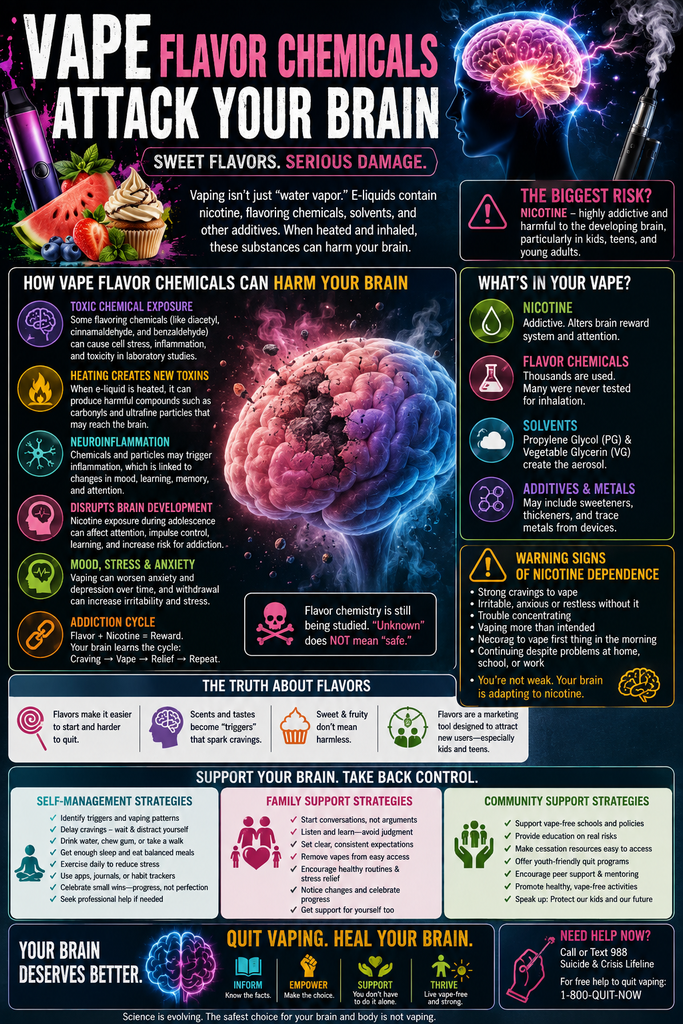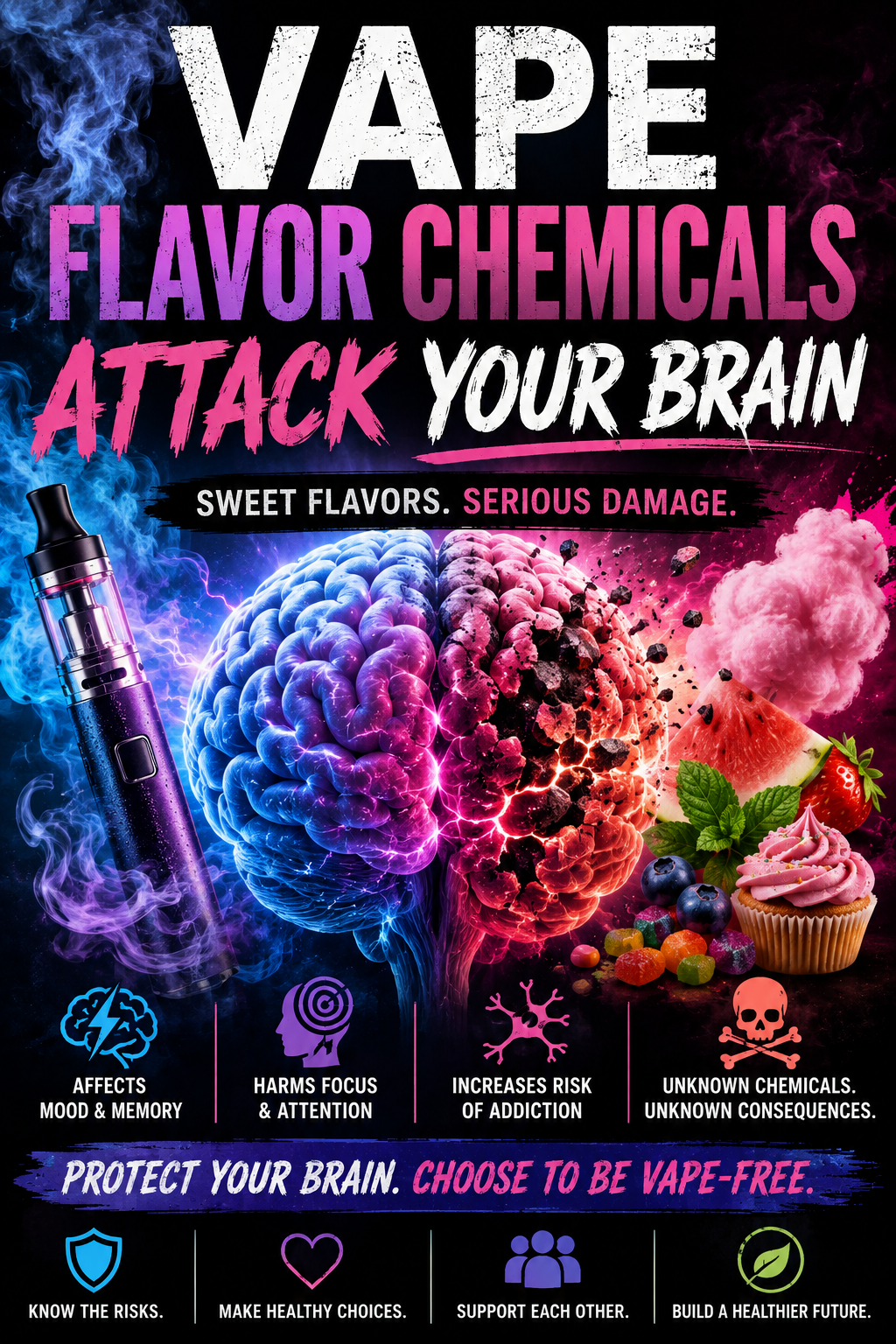
Sweet and fruity vape flavors can make vaping seem harmless, especially to young people. However, vape aerosols can contain nicotine, flavoring chemicals, solvents, metals, and compounds created during heating. Nicotine poses the clearest established risk to the developing brain by promoting dependence and affecting brain systems involved in attention, learning, and reward. Researchers are still investigating the long-term neurological effects of flavoring chemicals and other substances inhaled through vaping.
Why Vape Flavors Matter
Flavorings are particularly important because they can make vaping more appealing and easier to start. Sweet and fruity flavors may disguise the harshness of nicotine and create the impression that the product is closer to candy than an addictive substance.
This matters because repeated vaping can turn experimentation into a learned behavioral pattern:
Flavor → vaping → nicotine delivery → reward → craving → repeated vaping
Once this pattern becomes established, certain flavors, places, friends, emotions, or activities can become triggers for cravings.
Nicotine Has the Clearest Effect on the Brain
Nicotine reaches the brain rapidly and interacts with receptors involved in attention, learning, mood, and reward. Repeated exposure can produce neuroadaptations that contribute to dependence.
This is particularly concerning for adolescents because brain development continues into the mid-20s. Nicotine exposure during adolescence can affect brain systems involved in attention, learning, impulse control, and addiction vulnerability.
Signs of nicotine dependence may include:
- Strong cravings to vape
- Irritability when unable to vape
- Difficulty concentrating during withdrawal
- Feeling anxious or restless without nicotine
- Vaping immediately after waking
- Increasing the amount or frequency of vaping
- Trying unsuccessfully to stop
- Continuing despite health, financial, school, or relationship consequences
What About the Flavor Chemicals Themselves?
Food flavorings are often designed to be eaten, not repeatedly heated and inhaled deeply into the lungs.
Researchers have therefore investigated flavoring substances such as aldehydes and other compounds used to produce sweet, fruity, cinnamon, vanilla, or buttery flavors. Laboratory research suggests that some flavoring chemicals or their thermal breakdown products can contribute to cellular stress, inflammation, or toxicity under certain experimental conditions.
However, an important distinction is necessary: evidence that a chemical damages cells in a laboratory does not automatically prove that ordinary human vaping exposure causes a specific neurological disease.
The science is still developing.
Heating Can Change the Chemistry
A vape device does more than turn liquid into harmless water vapor. Heating e-liquid creates an aerosol containing tiny particles and chemicals.
Depending on the product, temperature, device, ingredients, and pattern of use, heating may generate potentially harmful compounds such as carbonyls. Metals from heating components can also enter some aerosols.
This means users may inhale substances that were not necessarily present in exactly the same form in the original liquid.
Flavors Can Strengthen the Addiction Cycle
Flavor itself can become part of nicotine dependence.
Imagine someone repeatedly using a mango-flavored vape while experiencing nicotine’s rewarding effects. Eventually, the smell or taste of mango—or simply seeing the device—may become associated with nicotine.
The brain learns:
Cue → expectation → craving → vaping → temporary relief/reward
This conditioning helps explain why quitting can be difficult even after the strongest physical withdrawal symptoms begin improving.
Vaping, Mood, and Stress
Many people say they vape because nicotine helps them relax. Nicotine can temporarily change mood and attention, but dependence creates another problem: when nicotine levels decline, withdrawal can cause irritability, anxiety, restlessness, and difficulty concentrating.
Taking another hit may relieve those withdrawal symptoms temporarily.
The person can therefore interpret vaping as treating stress when part of the discomfort may actually be nicotine withdrawal being relieved by another dose of nicotine.
This cycle can make nicotine seem emotionally necessary.
Self-Management Strategies
People who want to reduce or stop vaping can begin by understanding their own triggers and dependence patterns.
Helpful strategies include:
- Identify triggers. Track when you vape and what happened immediately beforehand.
- Delay the response. When a craving occurs, wait several minutes before acting on it and use another activity.
- Remove vaping supplies. Keeping devices, pods, chargers, and e-liquids nearby can make impulsive vaping easier.
- Change routines. Replace vaping-associated activities with walking, chewing gum, drinking water, stretching, or another activity.
- Protect sleep. Poor sleep can make irritability and cravings harder to manage.
- Practice stress-management skills. Deep breathing, mindfulness, exercise, music, hobbies, and supportive conversations can provide alternatives to nicotine.
- Prepare for withdrawal. Irritability, cravings, restlessness, sleep difficulties, and concentration problems can occur after stopping nicotine.
- Track progress rather than expecting perfection. A lapse can be examined for triggers rather than treated as proof that quitting is impossible.
- Seek professional help. Healthcare professionals can help develop an individualized cessation plan.
Family Support Strategies
Parents and family members can influence whether vaping becomes normalized or challenged.
Effective support begins with conversation rather than accusation.
Families can:
- Ask what the person likes about vaping before lecturing about its risks.
- Learn about nicotine dependence and withdrawal.
- Avoid calling the person weak or irresponsible.
- Discuss how flavors and marketing can increase product appeal.
- Establish clear household expectations regarding vaping.
- Keep nicotine products away from younger children.
- Recognize irritability or difficulty concentrating during withdrawal.
- Encourage healthy alternatives for managing stress.
- Celebrate progress toward quitting.
- Help arrange medical or behavioral support when needed.
For adolescents, punishment alone may not address nicotine dependence. A teenager who continues vaping despite consequences may be experiencing cravings and withdrawal that require support as well as boundaries.
Community Support Strategies
Preventing vaping requires more than asking individuals to make better choices. Schools, healthcare systems, families, policymakers, and community organizations can reduce exposure and improve access to cessation support.
Community strategies include:
- Providing youth-focused vaping-prevention education.
- Teaching students how nicotine affects the developing brain.
- Correcting the misconception that vape aerosol is harmless water vapor.
- Training healthcare professionals to screen for vaping.
- Offering evidence-based tobacco and nicotine cessation programs.
- Enforcing age restrictions on nicotine products.
- Supporting policies that reduce youth access and appeal.
- Educating parents about newer vaping devices and nicotine products.
- Providing confidential cessation resources for adolescents.
- Creating smoke- and vape-free schools, workplaces, and public environments.
- Supporting research into flavoring chemicals and long-term vaping exposure.
When Someone Is Ready to Quit
Quitting nicotine can be challenging because dependence involves both brain chemistry and learned behavior.
A person may need to address physical withdrawal while simultaneously changing routines, avoiding triggers, developing new stress-management skills, and learning how to respond when cravings occur.
Professional support can make this easier. In the United States, 1-800-QUIT-NOW connects callers with state tobacco-cessation services. Smokefree resources also provide tools specifically designed for people trying to quit vaping.
What the Research Teaches Us
The message should not simply be that every flavor chemical directly “attacks” the brain. The evidence supports a more precise warning:
Vaping can expose the brain to addictive nicotine while exposing the body to a mixture of flavorings, solvents, particles, metals, and compounds created during heating. Some flavor-related chemicals have demonstrated concerning biological effects in experimental research, and scientists are still determining their long-term consequences in humans.
That uncertainty is not evidence of safety.
For adolescents especially, preventing nicotine exposure remains important because the developing brain is particularly vulnerable to addiction.
Conclusion
Vape flavors may taste like fruit, candy, mint, or dessert, but flavor does not make an inhaled product harmless. Nicotine can alter the brain’s reward system and establish dependence, while flavorings can increase product appeal, reinforce learned vaping cues, and contribute to a complex aerosol whose long-term effects are still being investigated.
Protecting brain health requires more than fear-based messaging. People need accurate information, practical quitting strategies, supportive families, accessible cessation treatment, and communities that make nicotine-free choices easier.
The most useful message is therefore not simply “vape chemicals attack your brain.” It is:
Know what you’re inhaling. Understand how nicotine trains the brain to keep coming back. Recognize the role flavors can play in that cycle—and know that nicotine dependence can be treated and quitting is possible.
Frequently Asked Questions
Here are some common questions:
1. Do vape flavor chemicals really “attack” the brain?
“Attack” is an attention-grabbing term rather than a medical description. The clearest established brain risk from many vapes is nicotine, which is highly addictive and can affect the developing adolescent brain. Researchers are also studying whether flavoring chemicals and substances produced when e-liquids are heated contribute to neurological harm.
2. Are flavored vapes safer than tobacco-flavored vapes?
Not necessarily. A sweet, fruity, mint, or dessert flavor does not make a vape harmless. Flavored products can still contain nicotine and expose users to aerosols containing solvents, flavoring chemicals, particles, metals, and other substances.
3. Why are vape flavors especially concerning for teenagers?
Flavors can make vaping more appealing and easier to initiate. Adolescence is also a period of continued brain development, making nicotine exposure particularly concerning. Nicotine can reinforce the brain’s reward pathways and contribute to dependence.
4. What does nicotine do to the developing brain?
Nicotine interacts with receptors involved in reward, attention, learning, and mood. Repeated exposure can produce brain adaptations that contribute to cravings and dependence. Because brain development continues into the mid-20s, adolescents and young adults are an important risk group.
5. Can vape flavors make nicotine more addictive?
Flavor chemicals themselves do not necessarily cause nicotine addiction, but appealing tastes and smells can encourage repeated vaping. Over time, particular flavors can become conditioned cues associated with nicotine reward and trigger cravings.
6. Is vape aerosol just harmless water vapor?
No. E-cigarettes produce an aerosol, not simply water vapor. Depending on the product, it may contain nicotine, ultrafine particles, flavorings, volatile compounds, and metals originating from device components.
7. What happens to vape chemicals when they are heated?
Heating can change the chemical composition of e-liquids. Under certain conditions, heating solvents and flavoring ingredients can generate additional compounds, including carbonyl compounds such as formaldehyde, acetaldehyde, and acrolein.
8. Are food flavorings automatically safe to inhale?
No. A substance considered appropriate for use in food is not automatically proven safe when heated and repeatedly inhaled into the lungs. Eating and inhaling are different routes of exposure.
9. Do scientists know the long-term brain effects of every vape flavor chemical?
No. Thousands of possible ingredients, different devices, varying temperatures, changing formulations, and patterns of use make the question complicated. Research continues into the long-term effects of repeated exposure.
Lack of long-term evidence should not be interpreted as proof of safety.
10. Can vaping affect concentration and attention?
Nicotine dependence and withdrawal can interfere with concentration. A person may temporarily feel more focused after vaping because nicotine is relieving withdrawal symptoms, reinforcing the belief that vaping is necessary for concentration.
11. Can vaping affect anxiety and mood?
The relationship is complicated. People may vape because they believe nicotine reduces stress, but nicotine dependence can create withdrawal symptoms such as irritability, anxiety, restlessness, and difficulty concentrating. Taking another hit temporarily relieves these symptoms, reinforcing continued vaping.
12. What are signs of nicotine dependence from vaping?
Possible warning signs include:
- Strong cravings
- Vaping soon after waking
- Irritability or anxiety without vaping
- Difficulty concentrating during withdrawal
- Vaping more frequently than intended
- Needing higher nicotine exposure
- Difficulty going several hours without vaping
- Unsuccessful attempts to quit
- Continuing despite school, work, financial, relationship, or health consequences
13. Can someone become addicted even if they only vape socially?
Yes. Occasional vaping can progress to more frequent use, particularly with high-nicotine products. Dependence develops differently among individuals, so there is no guaranteed amount of nicotine exposure that prevents addiction.
14. Why do cravings occur when someone sees or smells a familiar vape flavor?
The brain learns associations. If someone repeatedly experiences strawberry flavor followed by nicotine reward, the flavor itself can eventually become a cue that produces anticipation and craving.
The cycle can become:
Flavor or situation → craving → vaping → nicotine reward/withdrawal relief → stronger association
15. What happens when someone stops vaping nicotine?
Nicotine withdrawal may cause cravings, irritability, anxiety, restlessness, difficulty concentrating, sleep disturbances, increased appetite, or low mood. Symptoms generally improve with time, although cravings associated with triggers can persist longer.
16. What self-management strategies can help someone quit?
Helpful approaches include:
- Identify vaping triggers.
- Remove devices, pods, chargers, and e-liquids.
- Develop a specific quit plan.
- Delay and distract yourself during cravings.
- Exercise or take a short walk.
- Use water or sugar-free gum as an alternative behavior.
- Protect sleep and maintain regular meals.
- Practice healthier stress-management techniques.
- Track vape-free days and money saved.
- Seek professional cessation assistance when needed.
A lapse does not have to become a complete return to regular vaping. Identifying what triggered it can strengthen the next quit attempt.
17. How can parents help a teenager who vapes?
Begin with curiosity rather than accusation. Ask what the teenager likes about vaping, how frequently they use it, whether they experience cravings, and whether they have tried to stop. Establish appropriate boundaries while recognizing that nicotine dependence may require treatment rather than punishment alone.
18. How can families support someone who is quitting?
Families can remove vaping cues from the home, avoid vaping around the person, encourage healthy activities, understand that temporary irritability may occur during withdrawal, recognize progress, and help connect the person with professional cessation resources.
19. What can schools and communities do?
Communities can provide accurate prevention education, vape-free environments, youth cessation programs, healthcare screening, parent education, peer-support programs, and enforcement of laws restricting youth access to nicotine products.
20. Where can someone get help quitting vaping?
In the United States, 1-800-QUIT-NOW (1-800-784-8669) connects people with their state’s tobacco cessation services. Healthcare professionals can also help determine an appropriate quitting strategy, particularly for people experiencing significant nicotine dependence.
21. What is the most important message about vape flavors and the brain?
The strongest message is not that every flavor chemical has been proven to directly damage the human brain. Rather, flavored vaping can expose users to addictive nicotine and a complex chemical aerosol while making vaping more appealing and reinforcing the behavioral cues that maintain nicotine dependence.
Video: