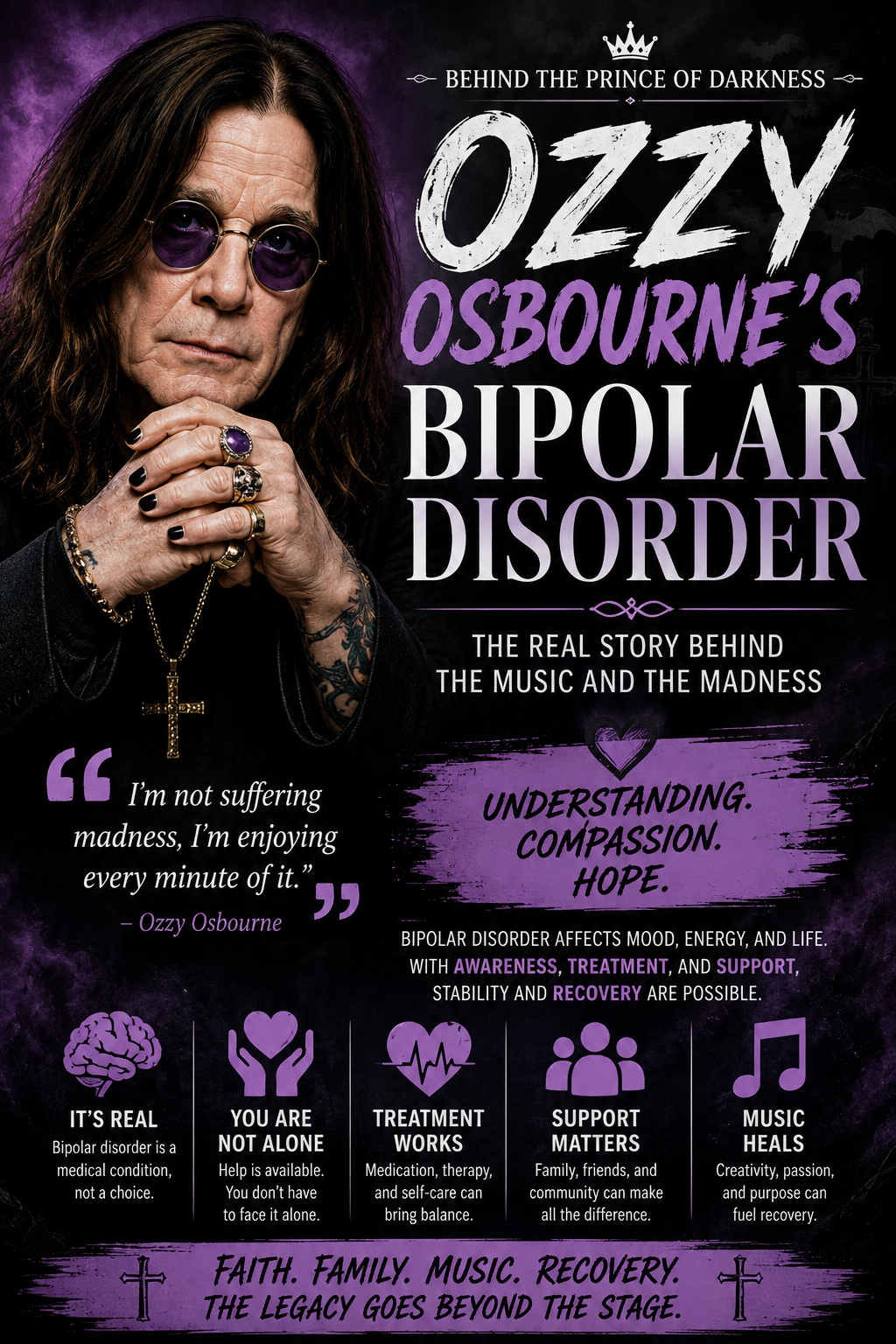
Ozzy Osbourne became one of the most recognizable figures in heavy metal as the lead singer of Black Sabbath and later through his successful solo career. Behind the theatrical image of the “Prince of Darkness,” however, Osbourne openly described decades of emotional difficulties, substance misuse, anxiety, depression, psychiatric treatment, rehabilitation, and periods when his behavior became dangerously out of control.
Although Ozzy is sometimes described online as having bipolar disorder, reliable public sources do not clearly establish that he received a formal bipolar diagnosis. What is well documented is his experience with depression, anxiety, addiction, psychiatric medications, therapy, and dramatic changes in mood and behavior that were frequently complicated by alcohol and other drugs. His journey therefore provides an opportunity to discuss bipolar disorder while emphasizing why celebrities—or anyone else—should not be diagnosed from a distance.
Understanding Bipolar Disorder
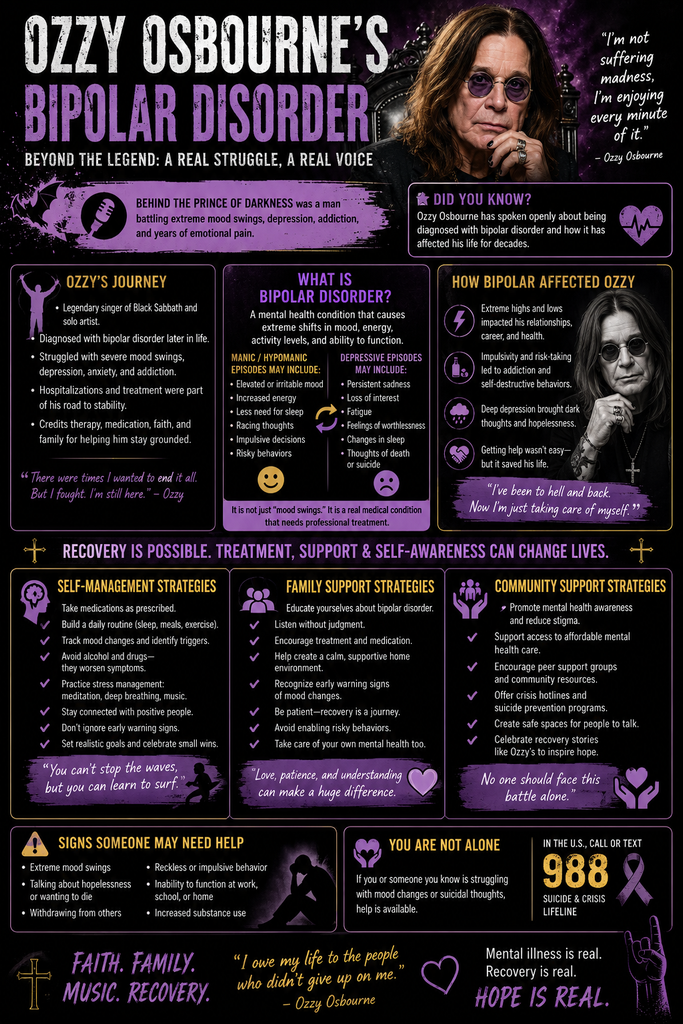
Bipolar disorder is a mental-health condition involving significant changes in mood, energy, activity, concentration, and ability to function. It is more complex than simply having ordinary “highs and lows.”
Depending on the type of bipolar disorder, symptoms may include episodes of mania or hypomania and periods of depression.
During manic or hypomanic episodes, a person may experience:
- Unusually elevated or extremely irritable mood
- Increased energy and activity
- Decreased need for sleep
- Racing thoughts
- Rapid or excessive talking
- Increased confidence
- Distractibility
- Impulsive or risky decisions
During depressive episodes, symptoms may include:
- Persistent sadness or emptiness
- Loss of pleasure or interest
- Fatigue and reduced motivation
- Changes in sleep or appetite
- Difficulty concentrating
- Feelings of worthlessness or hopelessness
- Social withdrawal
- Thoughts about death or suicide
These symptoms require professional evaluation because substance use, medications, medical illnesses, sleep deprivation, and other psychiatric conditions can sometimes produce similar behaviors.
Ozzy’s Documented Mental-Health Struggles
Osbourne spoke candidly about being an extremely nervous person, taking psychiatric medications and antidepressants, and seeing a therapist. He also described wanting to isolate himself and struggling with persistent fear and emotional distress.
His mental health became intertwined with decades of alcohol and drug misuse. Ozzy acknowledged using substances as a form of self-medication and went through rehabilitation repeatedly during his life.
This overlap matters because alcohol and other drugs can worsen depression, anxiety, impulsivity, sleep problems, and mood instability. Substance intoxication and withdrawal can also resemble symptoms associated with psychiatric disorders.
Depression During Physical Illness
Mental-health challenges became particularly important later in Ozzy’s life as he experienced serious physical problems, including Parkinson’s disease and mobility difficulties.
He described reaching an extremely low emotional point when physical limitations interfered with his ability to perform. He subsequently discussed taking antidepressants and trying to remain active.
Chronic medical conditions can affect independence, identity, relationships, employment, and quality of life. For a performer whose identity was closely connected with being onstage, losing physical abilities could create another significant psychological challenge.
Addiction and Mood
Ozzy’s long history of substance misuse provides another important lesson about mental-health diagnosis.
Alcohol and drugs may initially appear to provide relief from anxiety, depression, insomnia, or emotional discomfort. Over time, however, substance use can make these problems significantly worse.
The cycle can become:
Emotional distress → substance use → temporary relief → consequences or withdrawal → worsening distress → additional substance use.
Breaking that cycle often requires treating both mental-health symptoms and addiction rather than assuming one problem can be addressed independently.
Self-Management Strategies
People living with bipolar disorder or significant mood instability can develop strategies that support professional treatment.
Helpful approaches include:
- Follow treatment consistently. Take psychiatric medications exactly as prescribed and maintain medical and therapy appointments.
- Protect sleep. Significant changes in sleep can sometimes precede mood episodes.
- Track mood patterns. A journal or mood-tracking system can help identify changes in sleep, energy, activity, irritability, depression, and impulsivity.
- Maintain structure. Regular routines for sleeping, eating, exercise, work, and recreation can support stability.
- Avoid alcohol and recreational drugs. Substances can destabilize mood and interfere with psychiatric medications.
- Identify triggers. Stress, disrupted sleep, relationship conflict, substance use, and major life changes may contribute to worsening symptoms.
- Create an early-warning plan. Identify what should happen when significant mood changes begin.
- Stay socially connected. Isolation can make depression more difficult to recognize and manage.
- Seek help early. Contacting a clinician when symptoms begin escalating may prevent a more serious crisis.
Self-management does not mean managing bipolar disorder alone. Long-term professional treatment is often essential.
Family Support Strategies
Ozzy frequently credited his wife, Sharon, with playing an important role in his personal and professional life. Their history also illustrates how difficult addiction and severe emotional instability can be for an entire family.
Family members can help someone experiencing bipolar disorder or other significant mood difficulties by:
- Learning about the person’s diagnosis and treatment.
- Listening without immediately criticizing or arguing.
- Recognizing changes in sleep, energy, spending, speech, irritability, or social behavior.
- Encouraging treatment during both depressive and elevated mood periods.
- Helping maintain appointments when appropriate.
- Supporting medication adherence without becoming controlling.
- Avoiding alcohol and drug use around someone whose substances are a trigger.
- Establishing healthy boundaries around dangerous or abusive behavior.
- Creating a crisis plan before an emergency develops.
- Taking suicidal statements or dangerous behavior seriously.
- Obtaining their own counseling or family support when needed.
Supporting someone does not require tolerating violence, threats, or unsafe behavior. Safety should remain a priority for everyone involved.
Community Support Strategies
Mental-health recovery becomes easier when treatment and supportive communities are accessible.
Communities can help by:
- Expanding affordable psychiatric and counseling services.
- Integrating mental-health and addiction treatment.
- Providing peer-recovery and family-support groups.
- Educating communities about bipolar disorder and mood disorders.
- Teaching people how to recognize mental-health crises.
- Expanding crisis-response services.
- Providing rehabilitation and recovery programs for substance-use disorders.
- Offering workplace accommodations when appropriate.
- Challenging stereotypes that portray mental illness as dangerous, embarrassing, or a personal weakness.
- Encouraging people to seek professional help before symptoms become emergencies.
Musicians, entertainers, athletes, and other public figures who discuss mental-health struggles can also help normalize conversations that many people once felt forced to hide.
What Ozzy Osbourne’s Journey Can Teach Us
Perhaps the most important lesson from Ozzy’s experience is that dramatic behavior should not automatically be assigned a psychiatric diagnosis.
His history involved many interacting factors—addiction, depression, anxiety, sleep difficulties, medications, physical illness, extraordinary fame, relationship stress, and decades of substance exposure. Determining whether someone’s symptoms represent bipolar disorder, substance-induced mood symptoms, depression, anxiety, or another condition requires careful clinical evaluation.
His experiences also demonstrate the importance of treating addiction and mental health together. Osbourne openly acknowledged using alcohol as a way of self-medicating. Temporary emotional relief from substances can eventually create additional physical, psychological, relationship, and behavioral consequences.
Most importantly, repeated setbacks do not mean treatment has failed permanently. Recovery from addiction and management of chronic mental-health conditions can involve relapses, medication adjustments, therapy, rehabilitation, family involvement, and repeated efforts to regain stability.
Conclusion
Ozzy Osbourne’s public life contained extraordinary musical success alongside addiction, depression, anxiety, physical illness, rehabilitation, psychiatric treatment, and family struggles. Although bipolar disorder is sometimes associated with him in popular discussions, his story should not be used to claim a confirmed diagnosis without reliable evidence.
Instead, his journey provides a broader mental-health lesson. Symptoms deserve professional evaluation, substance use can complicate diagnosis and treatment, and mental-health recovery often requires persistence rather than a single intervention.
For people living with bipolar disorder or other serious mood conditions, stability may be supported through consistent treatment, medication when prescribed, healthy sleep, avoidance of alcohol and drugs, awareness of warning signs, supportive relationships, and accessible community resources.
Ozzy’s complicated journey reminds us that behind a larger-than-life public persona can be a person managing very real psychological struggles—and that seeking treatment should never be viewed as weakness.
Frequently Asked Questions
Here are some common questions:
1. Did Ozzy Osbourne have bipolar disorder?
Although Ozzy Osbourne is sometimes described online as having bipolar disorder, reliable public sources do not clearly establish a confirmed formal bipolar diagnosis. He did speak openly about depression, anxiety, psychiatric treatment, medication, therapy, and longstanding substance-use problems. For accuracy, his documented experiences should be distinguished from an unverified bipolar diagnosis.
2. Why is Ozzy Osbourne sometimes associated with bipolar disorder?
His history included dramatic behavior, emotional difficulties, addiction, depression, anxiety, and periods of instability. However, these characteristics alone cannot establish bipolar disorder. Alcohol, drugs, withdrawal, medications, sleep deprivation, depression, anxiety, and other conditions can produce symptoms that resemble mood disorders.
3. What is bipolar disorder?
Bipolar disorder is a mental-health condition involving episodes of significant changes in mood, energy, activity, and functioning. Depending on the type, a person may experience manic or hypomanic episodes as well as depressive episodes.
4. What are symptoms of mania?
Mania can involve unusually elevated or irritable mood, greatly increased energy, decreased need for sleep, racing thoughts, rapid speech, distractibility, inflated confidence, impulsivity, and potentially dangerous or risky behavior.
5. What happens during a depressive episode?
A depressive episode may involve:
- Persistent sadness or emptiness
- Loss of interest or pleasure
- Low energy
- Changes in sleep or appetite
- Difficulty concentrating
- Feelings of worthlessness or guilt
- Social withdrawal
- Hopelessness
- Thoughts of death or suicide
Severe symptoms require professional assessment and treatment.
6. Did Ozzy Osbourne experience depression?
Yes. Osbourne publicly discussed experiencing depression and periods of severe emotional difficulty. He also talked about using psychiatric medications and receiving therapy.
7. Did Ozzy Osbourne struggle with anxiety?
Yes. Osbourne described himself as extremely nervous and discussed anxiety and fear throughout his life. His experiences demonstrate that someone with an intimidating or larger-than-life public persona can experience significant anxiety privately.
8. Did Ozzy Osbourne struggle with addiction?
Yes. Osbourne publicly acknowledged decades of problematic alcohol and drug use. He underwent rehabilitation numerous times and discussed how substance use affected his health, relationships, behavior, and career.
9. Can addiction be confused with bipolar disorder?
Sometimes. Intoxication and withdrawal can cause changes in mood, sleep, energy, judgment, and behavior that resemble mania or depression. Clinicians therefore need a detailed history to determine whether symptoms result from bipolar disorder, substance use, another psychiatric disorder, or a combination of conditions.
10. Can someone have both bipolar disorder and addiction?
Yes. Bipolar disorder and substance-use disorders can occur together. When they do, integrated treatment that addresses both conditions is especially important.
11. Did Ozzy use substances to cope with emotional problems?
Osbourne has described substance use in the context of self-medication and coping with emotional difficulties. While substances may temporarily reduce distress, continued use can ultimately worsen depression, anxiety, sleep, impulsivity, and overall mental health.
12. How is bipolar disorder treated?
Treatment depends on the individual and may include mood-stabilizing medications, certain antipsychotic medications, psychotherapy, education, sleep and routine management, and treatment for co-occurring conditions. Medication decisions should be made with a qualified healthcare professional.
13. What self-management strategies can help with bipolar disorder?
Helpful strategies may include:
- Taking medications exactly as prescribed
- Maintaining consistent sleep and waking schedules
- Tracking mood, sleep, and energy changes
- Recognizing personal triggers
- Avoiding alcohol and recreational drugs
- Maintaining structured daily routines
- Managing stress
- Staying connected with supportive people
- Keeping regular psychiatric and medical appointments
- Developing a crisis and relapse-prevention plan
14. How can families support someone with bipolar disorder?
Families can learn about the condition, recognize early changes in mood or sleep, encourage continued treatment, communicate calmly, support healthy routines, and develop a crisis plan together.
Support does not mean accepting dangerous, threatening, or abusive behavior. Healthy boundaries and everyone’s safety remain important.
15. What warning signs might indicate that a mood episode is developing?
Changes may include sleeping substantially less, unusually high energy, rapid speech, increased irritability, impulsive spending, risky decisions, withdrawal, severe sadness, hopelessness, or suddenly stopping treatment. Early intervention can sometimes prevent symptoms from becoming more severe.
16. How can communities support people with bipolar disorder?
Communities can improve access to psychiatric treatment, integrate addiction and mental-health services, provide peer and family support groups, educate people about warning signs, reduce stigma, and ensure that crisis services are readily available.
17. Can someone with bipolar disorder live a successful life?
Yes. Bipolar disorder is a serious but treatable and manageable condition. Many people maintain careers, relationships, creative pursuits, and fulfilling lives with appropriate treatment, awareness of warning signs, supportive relationships, and ongoing self-management.
18. What does Ozzy Osbourne’s journey teach us about mental health?
One important lesson is that we should not diagnose someone based on their public behavior. Ozzy’s documented experiences with addiction, depression, anxiety, treatment, physical illness, and recovery demonstrate how complicated mental health can be.
19. Why is accurate language important when discussing celebrities and mental illness?
A celebrity’s unusual behavior does not prove a psychiatric diagnosis. Using verified information helps reduce misinformation and prevents mental-health conditions such as bipolar disorder from becoming stereotypes for unpredictability or extreme behavior.
20. What should someone do during a mental-health crisis?
If someone is experiencing severe mood symptoms, dangerous behavior, or suicidal thoughts, seek professional help promptly. In the United States, call or text 988 for the Suicide & Crisis Lifeline. If there is immediate danger, call 911 or go to the nearest emergency department.
Video: