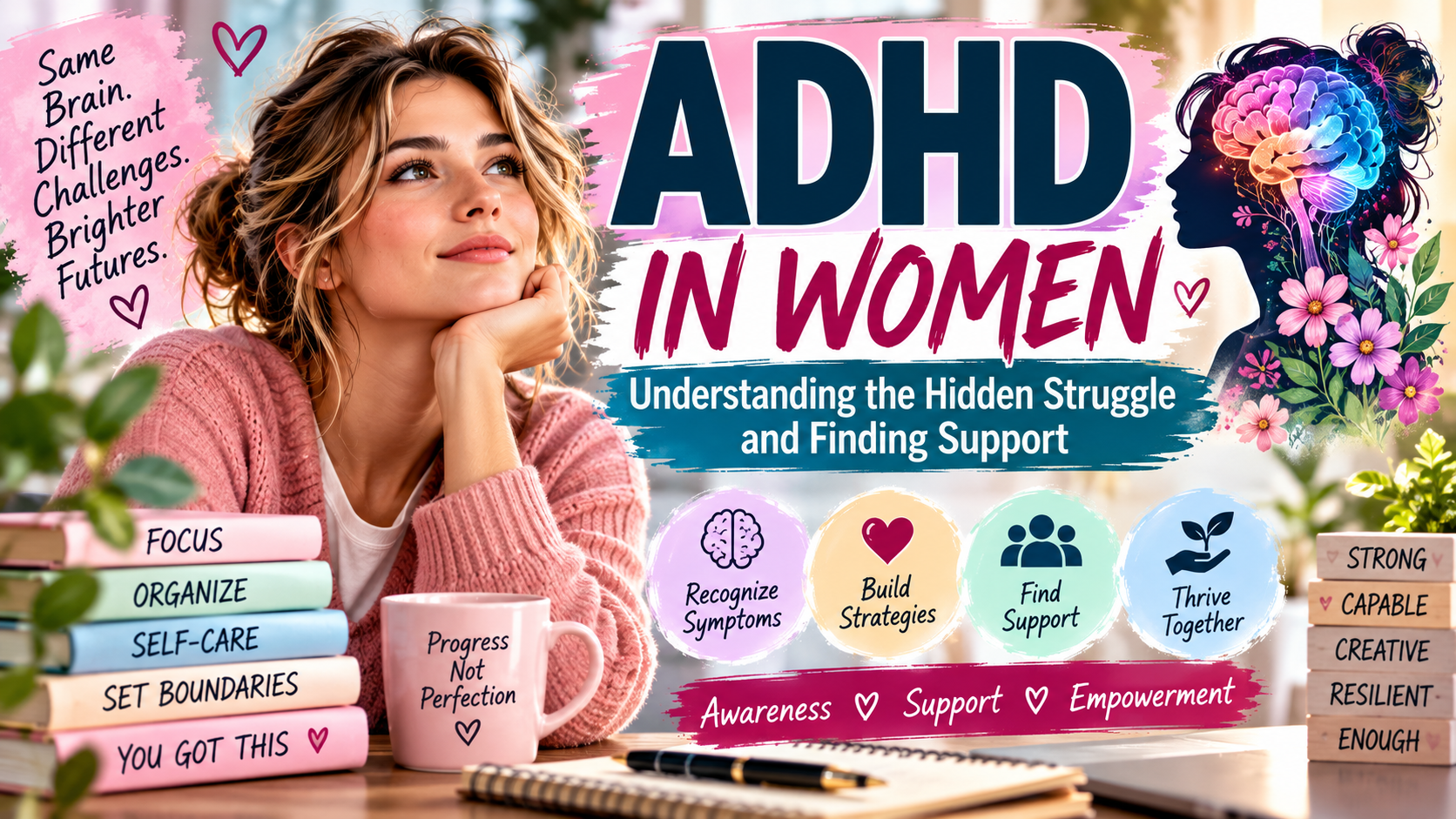
Attention-deficit/hyperactivity disorder (ADHD) is a neurodevelopmental disorder commonly associated with distractibility, impulsivity, hyperactivity, and difficulty staying organized. For many years, however, the popular image of ADHD centered heavily on hyperactive boys. That stereotype has contributed to some girls and women having their symptoms overlooked or recognized later in life.
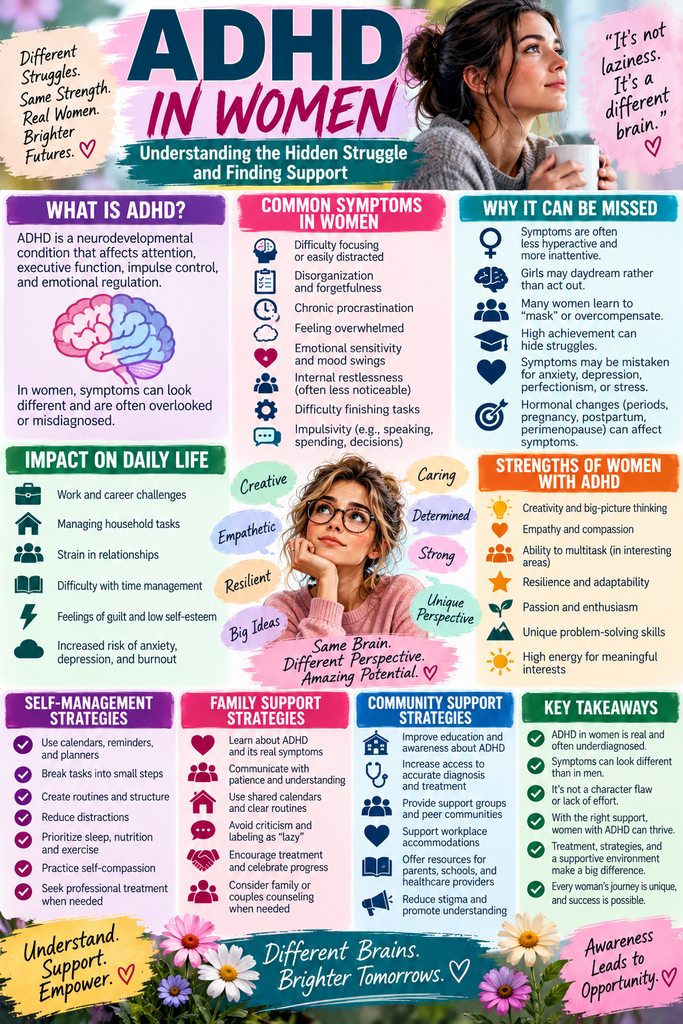
Women with ADHD may struggle with attention, organization, time management, emotional regulation, forgetfulness, procrastination, and feeling chronically overwhelmed. Some become skilled at compensating for their difficulties, making ADHD less obvious to teachers, employers, friends, and even healthcare professionals.
Understanding ADHD in women is important because receiving an accurate diagnosis can replace years of confusion and self-criticism with appropriate treatment, practical strategies, and support.
Why ADHD Can Look Different in Women
ADHD is divided into predominantly inattentive, predominantly hyperactive-impulsive, and combined presentations.
Girls and women may have symptoms that attract less attention than obvious disruptive or hyperactive behavior. A girl quietly daydreaming, forgetting assignments, struggling to organize her belongings, or taking hours to complete homework may not be recognized as having ADHD.
Possible symptoms include:
- Difficulty maintaining attention during conversations or tasks.
- Frequently losing keys, phones, paperwork, or other belongings.
- Forgetting appointments and responsibilities.
- Starting projects but struggling to finish them.
- Chronic procrastination.
- Difficulty estimating how long tasks will take.
- Feeling mentally disorganized.
- Becoming easily distracted.
- Interrupting conversations or making impulsive decisions.
- Restlessness that may feel more internal than outwardly hyperactive.
- Difficulty managing multiple responsibilities.
- Feeling overwhelmed by routine household or workplace demands.
Having some of these experiences does not automatically mean someone has ADHD. Diagnosis requires a professional assessment and evidence that symptoms meet established diagnostic criteria and cause meaningful impairment.
The Experience of Being Diagnosed Later in Life
Some women reach adulthood without realizing that ADHD may help explain difficulties they have experienced since childhood.
They may have spent years hearing statements such as:
“You’re intelligent—you just need to try harder.”
“Why are you always late?”
“You’re so disorganized.”
“Why can’t you just finish what you started?”
Repeated criticism can gradually affect self-esteem. A woman may conclude that she is lazy, irresponsible, or incapable when the underlying problem may involve executive functioning.
Receiving an ADHD diagnosis later in life can therefore produce several emotions simultaneously. There may be relief because longstanding struggles finally have an explanation, but there may also be grief or frustration about missed opportunities and support.
Masking and Overcompensating
Some women develop elaborate systems to hide their difficulties.
They may arrive extremely early because they fear being late, maintain multiple calendars, repeatedly check their work, stay up late completing tasks, or become perfectionistic because they fear making mistakes.
This is sometimes described as masking or compensating.
From the outside, the woman may appear exceptionally organized. Internally, maintaining that appearance may require enormous effort.
This distinction matters because functioning successfully does not necessarily mean functioning easily.
ADHD and Executive Function
Many everyday ADHD difficulties involve executive functions—the mental processes that help people organize and regulate goal-directed behavior.
Challenges may involve:
- Planning.
- Prioritizing.
- Working memory.
- Task initiation.
- Sustaining attention.
- Switching between activities.
- Monitoring time.
- Controlling impulses.
- Completing multistep projects.
This can explain an experience that frustrates many adults with ADHD: knowing exactly what needs to be done but still struggling to begin doing it.
The problem is not necessarily a lack of knowledge or concern.
Emotional Health and ADHD
Women with ADHD may also experience anxiety, depression, low self-esteem, sleep problems, eating disorders, or substance-related difficulties. These conditions can occur alongside ADHD and sometimes complicate diagnosis.
For example, difficulty concentrating can occur with ADHD, depression, anxiety, sleep deprivation, trauma, thyroid disorders, medication effects, and several other conditions.
This is one reason self-diagnosis based solely on social-media content can be misleading.
A comprehensive assessment helps determine whether symptoms represent ADHD, another condition, or multiple conditions occurring together.
Hormonal Changes and ADHD Symptoms
An emerging area of interest involves the relationship between ADHD symptoms and hormonal changes.
Some women report changes in attention, mood, and executive functioning around menstruation, pregnancy, the postpartum period, or perimenopause. Research in this area is still developing, and individual experiences vary considerably.
Women noticing significant symptom changes across hormonal transitions should discuss them with their healthcare professionals rather than independently changing medication.
Self-Management Strategies
Medication can be helpful for many people with ADHD, but everyday strategies remain important whether medication is used or not.
Helpful approaches include:
- Externalize reminders. Use calendars, alarms, timers, written lists, and visual reminders instead of relying entirely on memory.
- Break large tasks into smaller steps. “Clean the house” can become “clear the kitchen counter for 10 minutes.”
- Use timers for task initiation. Commit to working for five or ten minutes rather than waiting to feel motivated.
- Create designated locations. Keep frequently misplaced objects such as keys, medication, bags, and chargers in consistent places.
- Reduce environmental distractions. Silence unnecessary notifications and, when possible, create a dedicated work area.
- Prioritize sleep. Poor sleep can worsen attention, memory, and emotional regulation.
- Schedule difficult tasks strategically. Complete demanding activities during periods when concentration tends to be strongest.
- Use routines instead of relying on motivation. Repeated systems reduce the number of decisions required each day.
- Practice self-compassion. ADHD symptoms should be addressed without turning every organizational difficulty into a judgment about character.
- Seek professional treatment. Persistent symptoms interfering with work, school, relationships, finances, parenting, or everyday functioning deserve evaluation.
Family Support Strategies
ADHD affects relationships as well as individuals.
A partner may interpret forgotten chores as a lack of caring. A parent may interpret chronic lateness as irresponsibility. A woman with ADHD may feel constantly criticized despite making considerable effort.
Education can change these interactions.
Families can:
- Learn about ADHD and executive functioning.
- Discuss specific behaviors rather than attacking someone’s character.
- Establish clear household responsibilities.
- Use shared calendars and reminders.
- Avoid repeatedly labeling someone as lazy or irresponsible.
- Develop predictable household routines.
- Divide large household projects into manageable tasks.
- Recognize successful strategies and progress.
- Encourage treatment without becoming controlling.
- Consider couples or family counseling when ADHD contributes to ongoing conflict.
Understanding ADHD should not mean eliminating accountability. Instead, pair expectations with systems that make success more achievable.
ADHD, Motherhood, and the Mental Load
Parenthood can expose executive-function difficulties that were previously manageable.
Suddenly, one person may be responsible for school schedules, medical appointments, meals, laundry, transportation, extracurricular activities, household supplies, bills, work obligations, and countless unexpected interruptions.
For a mother with ADHD, this mental load can become overwhelming.
Helpful strategies may include shared digital calendars, automated bill payments, grocery delivery, recurring reminders, simplified household systems, and intentionally dividing responsibilities between adults.
Asking for practical help is a management strategy—not evidence of failure.
ADHD in the Workplace
Women with ADHD may be highly creative, energetic, and curious, with the ability to concentrate intensely on engaging subjects, while struggling with repetitive administrative responsibilities.
Workplace strategies may include:
- Written rather than exclusively verbal instructions.
- Breaking projects into intermediate deadlines.
- Calendar blocking.
- Noise-reducing headphones when appropriate.
- Regular organizational check-ins.
- Minimizing unnecessary interruptions.
- Using project-management software.
- Completing similar tasks together rather than constantly switching activities.
Some individuals with ADHD may qualify for workplace accommodations depending on their circumstances and applicable disability laws.
Community Support Strategies
Communities can improve outcomes by making ADHD assessment, education, and treatment more accessible.
Helpful approaches include:
- Training healthcare professionals to recognize ADHD across sexes and ages.
- Improving access to qualified diagnostic evaluations.
- Providing affordable mental-health and behavioral services.
- Educating schools about less obvious presentations of ADHD.
- Offering parenting and family education.
- Providing ADHD support groups and peer communities.
- Reducing stigma surrounding ADHD medication and mental-health treatment.
- Supporting workplace accommodations when appropriate.
- Improving continuity of care as adolescents transition into adult healthcare.
Community education should also challenge the idea that ADHD is simply poor discipline or lack of motivation.
Professional Treatment
ADHD treatment should be individualized.
Depending on the person, treatment may include:
- Stimulant medication.
- Non-stimulant medication.
- Cognitive behavioral therapy.
- ADHD-focused behavioral strategies.
- Organizational skills training.
- Coaching.
- Treatment of co-occurring anxiety, depression, sleep disorders, or substance use disorders.
- Couples or family therapy when relationship problems are significant.
Medication decisions should be made with an appropriately qualified healthcare professional who can consider medical history, symptoms, side effects, other medications, and potential contraindications.
ADHD Is Not a Personality Flaw
Perhaps one of the most important changes after recognizing ADHD is learning to separate symptoms from moral judgments.
Forgetting an appointment does not automatically mean someone does not care.
Difficulty starting a task does not necessarily mean laziness.
A cluttered environment does not determine someone’s intelligence.
Needing reminders does not mean someone is incapable.
At the same time, ADHD does not remove responsibility for behavior. Effective management involves recognizing genuine neurological challenges while developing strategies to reduce their impact.
The goal is understanding and accountability, not blame.
Recognizing Strengths Without Romanticizing ADHD
Discussions of ADHD sometimes swing between two extremes: portraying it entirely as a deficit or describing it as a “superpower.”
Neither description captures everyone’s experience.
Some women with ADHD describe creativity, curiosity, spontaneity, persistence, enthusiasm, unconventional problem-solving, or periods of intense focus as personal strengths. However, ADHD can also cause substantial impairment.
It is possible to appreciate someone’s strengths while recognizing that the condition may require treatment and support.
Conclusion
ADHD in women can remain unnoticed for years, particularly when symptoms are primarily inattentive, successfully masked, or mistaken for anxiety, stress, disorganization, or personality traits.
Recognition can be transformative because it changes the question from “What’s wrong with me?” to “What strategies and support will help me function better?”
Self-management strategies can provide structure through calendars, routines, reminders, task breakdown, sleep, and environmental changes. Families can replace criticism with education, communication, shared systems, and appropriate accountability. Communities can improve recognition by training healthcare professionals, educating schools, expanding access to assessment and treatment, supporting workplace accommodations, and reducing stigma.
Women do not need to become perfectly organized to manage ADHD successfully. The goal is to understand how the brain functions, develop systems that work with those patterns, obtain evidence-based treatment when needed, and create an environment where challenges can be addressed without shame.
ADHD may help explain a person’s struggles, but it does not define her intelligence, abilities, relationships, or potential.
Frequently Asked Questions
Here are some common questions:
1. What is ADHD in women?
Attention-deficit/hyperactivity disorder (ADHD) is a neurodevelopmental disorder involving persistent difficulties with attention, impulsivity, hyperactivity, or a combination of these symptoms. In women, ADHD may sometimes be less obvious because symptoms can involve internal restlessness, distractibility, forgetfulness, disorganization, and difficulty managing everyday responsibilities rather than highly visible hyperactivity.
2. Why is ADHD sometimes missed in girls and women?
Historically, ADHD was often associated with disruptive or hyperactive behavior more commonly recognized in boys. Girls with predominantly inattentive symptoms may quietly daydream, lose belongings, forget assignments, procrastinate, or struggle with organization without creating classroom disruptions. As a result, their difficulties may be attributed to personality, anxiety, or lack of effort.
3. What are common ADHD symptoms in adult women?
Symptoms vary, but common difficulties can include:
- Distractibility and difficulty sustaining attention.
- Forgetfulness and frequently losing belongings.
- Chronic procrastination.
- Difficulty beginning or completing tasks.
- Poor time management.
- Disorganization.
- Impulsive decisions or interruptions.
- Internal restlessness.
- Difficulty prioritizing responsibilities.
- Feeling overwhelmed by multiple tasks.
- Difficulty regulating emotions.
Experiencing several of these problems does not automatically mean someone has ADHD.
4. Can a woman have ADHD without being hyperactive?
Yes. ADHD has predominantly inattentive, predominantly hyperactive-impulsive, and combined presentations. Someone with predominantly inattentive ADHD may experience substantial problems with concentration and executive functioning without displaying obvious physical hyperactivity.
5. Can women be diagnosed with ADHD for the first time as adults?
Yes. Some women are not diagnosed until adulthood. However, ADHD is considered a neurodevelopmental condition, so clinicians evaluating an adult generally look for evidence that relevant symptoms were present during childhood, even if ADHD was not recognized or diagnosed at the time.
6. What is ADHD masking?
Masking generally refers to efforts to hide or compensate for ADHD-related difficulties. A woman might use multiple calendars, repeatedly check her work, arrive extremely early because she fears being late, work much longer than colleagues to accomplish the same tasks, or become highly perfectionistic to prevent others from noticing organizational difficulties.
7. Can successful women have ADHD?
Absolutely. Academic achievement, professional success, or intelligence does not rule out ADHD. Some women develop effective compensatory systems but expend considerable time and mental energy maintaining them.
8. What is executive dysfunction?
Executive functions help people plan, organize, prioritize, remember information, start tasks, regulate impulses, manage time, and achieve goals. ADHD can interfere with these processes. This helps explain why someone may understand exactly what needs to be done yet have considerable difficulty getting started.
9. Can ADHD be confused with anxiety or depression?
Yes. Concentration problems, forgetfulness, sleep difficulties, low motivation, and feeling overwhelmed can occur with several conditions. ADHD may also coexist with anxiety or depression. A comprehensive assessment is important because treatment depends on identifying the actual cause of the symptoms.
10. Can hormones affect ADHD symptoms in women?
Some women report changes in ADHD symptoms around menstruation, pregnancy, postpartum periods, and perimenopause. Research examining the relationship between hormonal fluctuations and ADHD continues to develop. Discuss significant changes with a healthcare professional, especially before changing medications.
11. Does ADHD cause emotional sensitivity?
Difficulty regulating emotions is frequently reported by adults with ADHD, although emotional dysregulation itself is not sufficient to diagnose the disorder. Some women describe becoming frustrated quickly, feeling overwhelmed, or having difficulty calming down after strong emotional reactions.
12. How is ADHD diagnosed in women?
There is no single blood test or brain scan that establishes an ADHD diagnosis. Assessment may include a detailed clinical interview, symptom questionnaires, childhood and school history when available, information about current functioning, and evaluation for other conditions that could explain similar symptoms.
13. Can social media be used to diagnose ADHD?
No. Social-media posts can increase awareness, but relatable content is not equivalent to a clinical assessment. Many ADHD-like symptoms can also occur because of stress, anxiety, depression, trauma, inadequate sleep, medical conditions, medications, or other causes.
14. What treatments are available for women with ADHD?
Treatment is individualized and may include stimulant or non-stimulant medication, behavioral strategies, cognitive behavioral therapy, organizational-skills training, coaching, and treatment of co-occurring conditions. Medication decisions should be made with an appropriately qualified healthcare professional.
15. What self-management strategies can help women with ADHD?
Helpful approaches can include:
- Using calendars, timers, alarms, and visual reminders.
- Breaking large projects into small steps.
- Creating consistent locations for important belongings.
- Developing predictable morning and evening routines.
- Reducing unnecessary environmental distractions.
- Using short work periods with planned breaks.
- Automating bills and recurring responsibilities.
- Prioritizing adequate sleep and regular physical activity.
- Scheduling demanding work during periods of better concentration.
- Seeking professional support when symptoms interfere with daily functioning.
16. How can families support a woman with ADHD?
Families can learn about ADHD, communicate without labeling someone as lazy or irresponsible, use shared calendars, establish clear expectations, divide household responsibilities realistically, and encourage treatment when appropriate. Understanding ADHD should complement—not eliminate—healthy accountability.
17. How can ADHD affect relationships?
Forgotten commitments, impulsive comments, unfinished household responsibilities, lateness, distractibility during conversations, or difficulty managing finances can create conflict. Partners may incorrectly interpret symptoms as evidence that the person does not care. Education, practical systems, communication, and couples counseling when necessary can help.
18. Why can motherhood make ADHD symptoms more noticeable?
Parenthood often dramatically increases executive-function demands. Managing children’s appointments, school activities, meals, household responsibilities, work, finances, and unexpected interruptions can overwhelm organizational systems that previously worked adequately.
19. Can women with ADHD succeed at work?
Yes. Women with ADHD can succeed in any profession. Helpful strategies can include written instructions, project-management systems, intermediate deadlines, calendar blocking, reducing distractions, and workplace accommodations when appropriate.
20. Does ADHD have strengths as well as challenges?
Some people with ADHD describe creativity, curiosity, enthusiasm, adaptability, unconventional problem-solving, or intense concentration on highly interesting activities as personal strengths. However, ADHD should not automatically be called a “superpower,” because it can also cause substantial impairment.
21. Is ADHD caused by laziness or poor discipline?
No. ADHD is a neurodevelopmental disorder, not a character flaw. Difficulty beginning a task, organizing responsibilities, or remembering an appointment can involve executive-function problems rather than lack of intelligence or caring.
22. When should a woman consider being evaluated for ADHD?
Evaluation may be appropriate when longstanding difficulties with attention, organization, impulsivity, time management, forgetfulness, or task completion consistently interfere with school, employment, relationships, parenting, finances, or everyday responsibilities.
23. What is the most important message about ADHD in women?
Women can spend years interpreting ADHD-related difficulties as personal failures. Recognizing the possibility of ADHD can shift the focus from blame to understanding and effective management.
The goal is not to use ADHD as an excuse for every difficulty. It is to identify genuine challenges and develop treatment, routines, accommodations, self-management strategies, family support, and community resources that make everyday life more manageable.
Video: What it’s really like to live with ADHD as a woman #ADHD #WomenWithADHD #MentalHealth