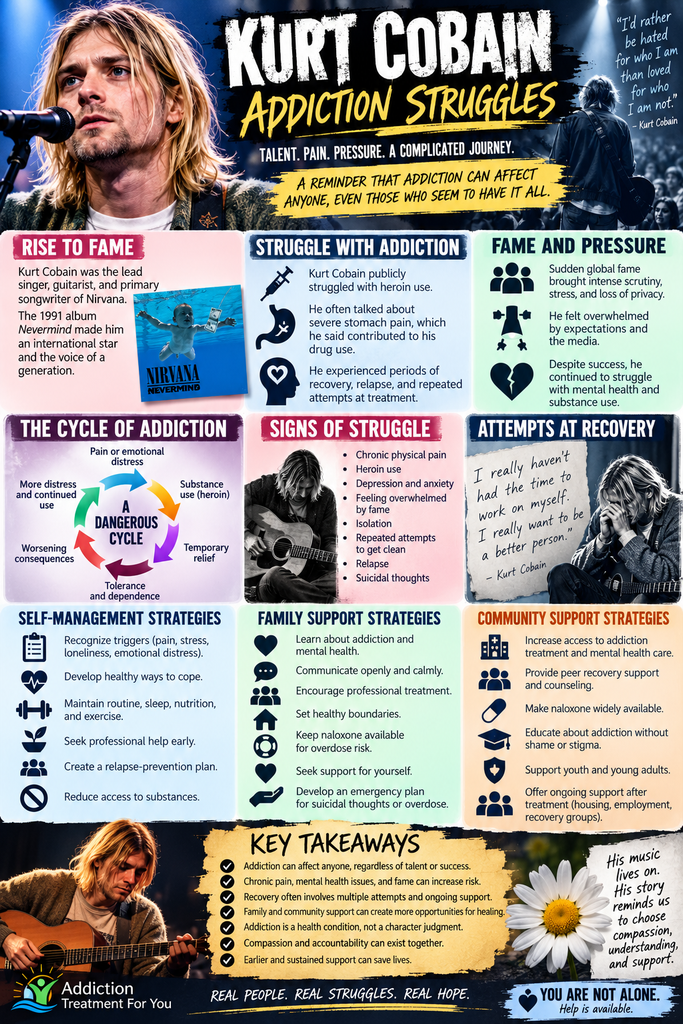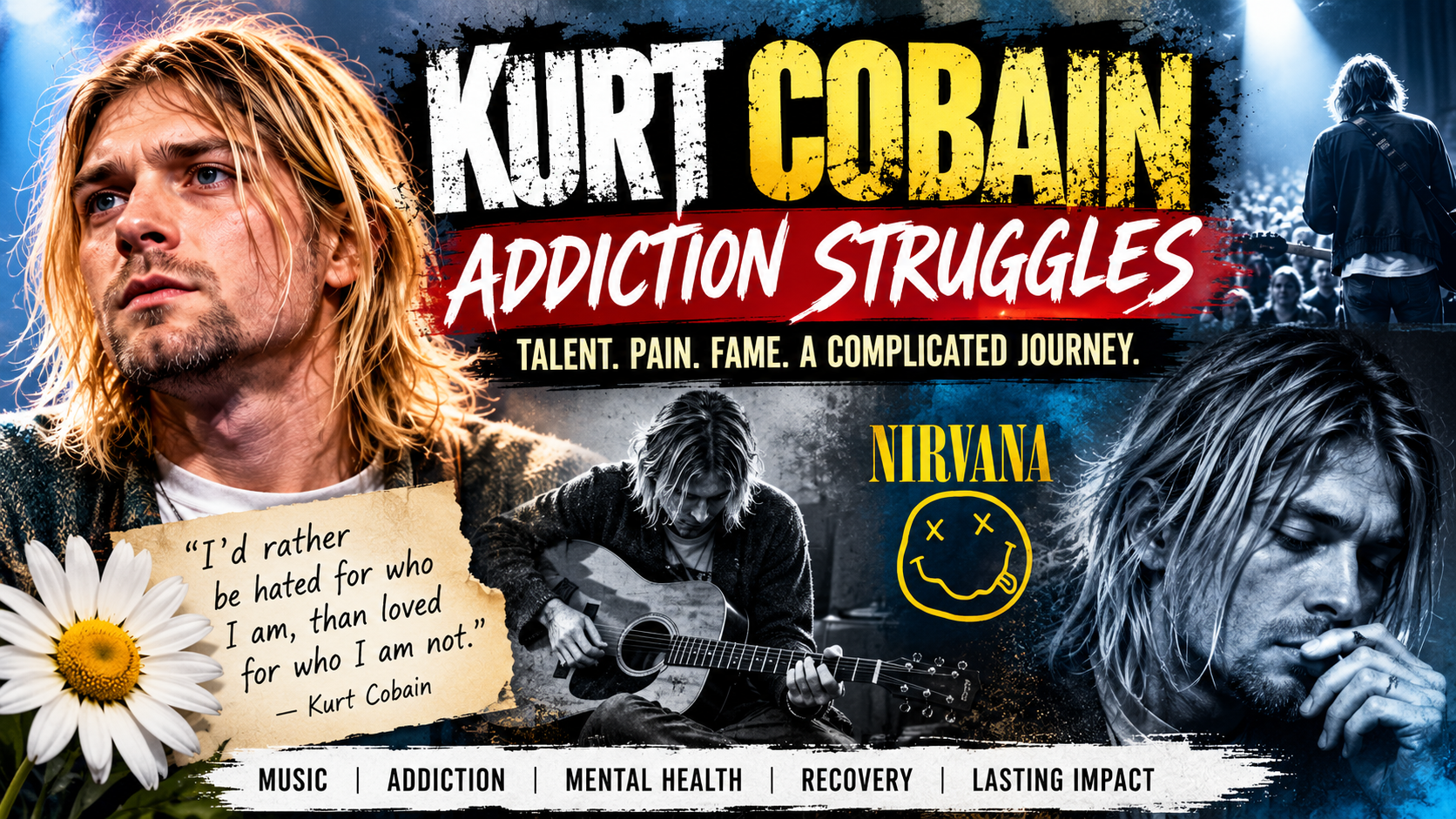
Kurt Cobain, the singer-songwriter for Nirvana, became one of the most influential musicians of his generation after Nevermind’s success. Behind his fame, he struggled with heroin use, chronic pain, emotional distress, and the pressures of celebrity.
Cobain died by suicide in 1994 at age 27. Rather than romanticizing his struggles, his story highlights how addiction, pain, and mental-health challenges can become interconnected and emphasizes the importance of compassionate treatment, family support, and ongoing recovery care.
Chronic Pain and Self-Medication
Cobain frequently discussed severe stomach problems that affected him for years. In interviews recorded in 1992 and 1993, he said that his stomach pain contributed to his decision to self-medicate with heroin.
This is an important concept in addiction education. Some people initially use alcohol or drugs because they believe the substance provides relief from physical pain, anxiety, trauma, insomnia, depression, or other distress.
Temporary relief, however, can develop into a dangerous cycle:
Pain or distress → substance use → temporary relief → tolerance and dependence → worsening consequences → more distress → continued substance use.
Understanding why someone began using a substance can be essential to treatment, but it does not make continued drug use safe.
Fame Did Not Protect Him
After Nirvana’s breakthrough, Cobain faced intense public attention. He spoke about the difficulty of adjusting to sudden fame and being portrayed as a representative of his generation.
Success can sometimes hide addiction rather than prevent it. A person may continue performing, working, earning money, caring for a family, or maintaining a public image while experiencing significant substance-related problems privately.
This is why addiction should not be measured simply by whether someone appears successful.
Attempts at Recovery
Cobain’s struggle was not simply a story of continuous drug use without attempts to change. Historical reporting describes multiple efforts at detoxification and treatment.
After a serious drug-related medical emergency in Rome in March 1994, people close to Cobain—including his wife, bandmates, and others—attempted to persuade him to obtain treatment. Later that month, he entered a recovery program in California but left after several days.
His experience illustrates a difficult reality of substance use disorders: entering treatment does not guarantee immediate or permanent recovery.
Recovery may involve repeated treatment episodes, relapse prevention, medical care, mental-health treatment, peer support, medication when appropriate, and continuing care after formal treatment ends.
Addiction and Mental Health
Cobain’s history also demonstrates why substance use cannot always be addressed in isolation.
When addiction occurs alongside depression, suicidal thoughts, trauma, anxiety, chronic pain, or another mental-health problem, treating only the substance use may leave important drivers of distress untreated.
Modern care increasingly recognizes the importance of addressing co-occurring conditions together.
A comprehensive treatment plan may therefore involve addiction medicine, psychotherapy, psychiatric evaluation, pain management, primary care, family involvement, and social support.
Self-Management Strategies
A person struggling with addiction cannot always manage the condition alone, but self-management skills can strengthen professional treatment and long-term recovery.
Helpful strategies include:
- Recognize personal triggers. Pain, stress, loneliness, conflict, exhaustion, and emotional distress may increase cravings.
- Develop alternatives to self-medication. Work with healthcare professionals to manage physical and psychological symptoms safely.
- Create a relapse-prevention plan. Identify warning signs and decide in advance whom to contact when cravings intensify.
- Reduce access to substances. Changing environments and relationships associated with drug use can support recovery.
- Maintain basic health. Sleep, nutrition, exercise, and medical care support physical and emotional stability.
- Build structure. Regular appointments, recovery meetings, work, hobbies, and healthy routines can reduce unstructured periods associated with use.
- Be honest about relapse. A return to substance use should prompt reassessment and treatment rather than secrecy or shame.
- Seek immediate help during a crisis. Suicidal thoughts, severe withdrawal, overdose, or an inability to remain safe require urgent professional intervention.
Family Support Strategies
Cobain’s final weeks demonstrate both the importance and limitations of family intervention. Historical accounts describe loved ones and associates attempting an intervention and encouraging him to enter treatment.
Families can be enormously important, but they cannot single-handedly control another person’s recovery.
Helpful family strategies include:
- Learn about substance use disorders rather than treating addiction simply as a lack of willpower.
- Communicate concerns calmly and specifically.
- Encourage professional treatment.
- Avoid supplying money or resources that knowingly support substance use.
- Establish reasonable and consistent boundaries.
- Learn how to recognize an overdose.
- Keep naloxone available when opioid use is a risk.
- Participate in family counseling or support programs.
- Develop an emergency plan for suicidal behavior or overdose.
- Obtain emotional support for themselves.
Family members also need to understand an uncomfortable truth: loving someone does not give you complete control over whether that person accepts treatment.
Support can create opportunities for recovery, but the person with the substance use disorder must ultimately participate in the treatment process.
Community Support Strategies
Addiction recovery requires more than individual determination and family involvement. Communities can make treatment easier—or harder—to obtain.
Effective community strategies include:
- Expanding access to evidence-based addiction treatment.
- Making naloxone widely available.
- Providing medications for opioid use disorder when clinically appropriate.
- Integrating addiction and mental-health treatment.
- Offering affordable counseling and psychiatric services.
- Improving chronic-pain treatment without stigmatizing patients.
- Providing peer-recovery specialists and recovery support groups.
- Offering crisis and suicide-prevention services.
- Educating schools and communities about addiction without using shame-based messages.
- Providing continuing support after detoxification or residential treatment.
The period immediately following detoxification or treatment can be especially important. Treatment should ideally connect people with continuing medical, psychological, and social support rather than assuming that completing a program means the problem has disappeared.
What Families Can Learn From Kurt Cobain’s Story
Cobain’s experience demonstrates why addiction should be taken seriously even when someone remains talented, productive, wealthy, or famous.
It also shows that warning signs should not be dismissed simply because someone previously promised to stop using drugs.
Families should pay particular attention when substance use occurs alongside:
- Increasing isolation.
- Severe depression or hopelessness.
- Previous overdose.
- Suicidal statements or behavior.
- Leaving treatment unexpectedly.
- Escalating opioid use.
- Significant chronic pain.
- Access to lethal means.
- Sudden withdrawal from family, friends, or responsibilities.
These situations warrant professional assessment rather than relying solely on reassurance from the person struggling.
Addiction Is a Health Condition, Not a Character Judgment
One of the most damaging misconceptions about addiction is that people would stop if they simply cared enough about their families.
Substance use disorders can alter motivation, decision-making, reward processing, and behavior. People may continue using substances despite knowing that their relationships, careers, health, and lives are being harmed.
Compassion does not mean ignoring dangerous behavior.
A useful approach combines empathy with accountability: recognizing the person behind the addiction while encouraging treatment, maintaining boundaries, and responding seriously to dangerous behavior.
Kurt Cobain’s Legacy and an Important Lesson
Cobain’s musical influence remains enormous, but his suffering should not become part of a romantic image of artistic creativity.
Addiction did not make Kurt Cobain talented.
His creativity, songwriting, musicianship, and artistic perspective existed alongside his struggles—not because of them.
His history reminds us that chronic pain deserves effective treatment, opioid addiction requires evidence-based care, mental-health symptoms deserve attention, and repeated relapse does not mean treatment should be abandoned.
Conclusion
Kurt Cobain’s addiction journey was complex. He described using heroin partly as an attempt to cope with severe stomach pain, experienced repeated problems with heroin, underwent attempts at detoxification and treatment, and had loved ones who tried to intervene.
His experience demonstrates why addiction treatment should address the whole person rather than focusing exclusively on stopping drug use.
Individuals benefit from learning their triggers, developing alternatives to self-medication, creating relapse plans, and remaining connected with professional treatment. Families can provide compassion, boundaries, education, and encouragement while obtaining support for themselves. Communities can make recovery more achievable through accessible addiction medicine, mental-health treatment, naloxone, peer support, chronic-pain care, and long-term recovery services.
Kurt Cobain’s life should ultimately remind us not to romanticize addiction or assume that talent and success protect someone from it. Behind addiction is a person who may be experiencing physical and emotional suffering—and earlier, sustained, evidence-based support can create more opportunities for recovery.
Frequently Asked Questions
Here are some common questions:
1. Did Kurt Cobain struggle with addiction?
Yes. Kurt Cobain struggled with heroin use during the later years of his life. His substance use became increasingly serious as Nirvana’s fame grew, and historical accounts document attempts at detoxification and treatment before his death in 1994.
2. Why did Kurt Cobain use heroin?
Cobain said in interviews that severe, persistent stomach pain contributed to his heroin use. He described using heroin partly as a way of self-medicating that pain. His experience illustrates how physical pain and emotional distress can sometimes contribute to substance misuse, although they should not be treated as the sole explanation for addiction.
3. How did chronic stomach pain affect Cobain’s addiction struggles?
Cobain repeatedly described significant stomach problems. He reported that heroin temporarily relieved his symptoms. This demonstrates one potential pathway into problematic substance use: a person experiences pain, discovers that a substance temporarily reduces it, and repeatedly returns to that substance despite increasing risks and consequences.
4. Did fame contribute to Kurt Cobain’s struggles?
Cobain frequently expressed discomfort with sudden fame and intense media attention after Nirvana became internationally successful. Fame, however, should be understood as one part of a complicated situation rather than identified as the cause of his addiction.
5. Did Kurt Cobain ever try to stop using heroin?
Yes. Historical accounts document periods of detoxification, treatment, attempts to stop using heroin, and subsequent returns to use. Shortly before his death, people close to him encouraged him to enter treatment, and he entered a recovery facility in California but left after several days.
6. Does relapse mean addiction treatment has failed?
No. Substance use disorders can have a chronic, relapsing course. A return to drug use signals that the treatment and recovery plan may need to be reassessed or intensified. It does not mean that future recovery is impossible.
7. Did Kurt Cobain’s family and friends try to help him?
Yes. Historical accounts describe an intervention involving people close to Cobain shortly before his death. They expressed concerns about his drug use and encouraged him to seek treatment. His experience also shows the limits families face: loved ones can encourage treatment and set boundaries, but they cannot fully control another person’s behavior.
8. How can families help someone struggling with opioid addiction?
Families can:
- Learn about opioid use disorder and available treatments.
- Communicate concerns without humiliation or stigmatizing language.
- Encourage professional addiction and mental-health treatment.
- Establish healthy boundaries rather than enabling continued substance use.
- Keep naloxone available when opioid overdose is possible.
- Learn how to recognize and respond to an overdose.
- Develop a crisis plan when suicidal behavior or severe psychological distress is present.
- Seek counseling or family support for themselves.
9. What self-management strategies can help someone with addiction?
Self-management works best alongside professional treatment. Helpful strategies can include recognizing triggers, avoiding environments associated with drug use, creating a relapse-prevention plan, developing healthier responses to stress and pain, maintaining sleep and nutrition, building daily structure, attending recovery support meetings, and contacting someone early when cravings or warning signs increase.
10. What treatments are available today for opioid use disorder?
Evidence-based treatment can include medications such as buprenorphine, methadone, and extended-release naltrexone, along with counseling and behavioral or psychosocial support when appropriate. Treatment should also address co-occurring medical, psychiatric, social, and pain-related concerns.
11. Why is naloxone important for families affected by opioid use?
Naloxone can rapidly reverse an opioid overdose and restore breathing while emergency assistance is obtained. Families and communities affected by opioid use can benefit from knowing where naloxone is available and how to administer it.
12. Was Kurt Cobain’s addiction the cause of his suicide?
It would be inaccurate to reduce Cobain’s suicide to one cause. Suicide is complex and can involve multiple interacting biological, psychological, social, environmental, and substance-related factors. Addiction can increase risk, but it should not be presented as a complete explanation for an individual’s suicide.
13. Why is it important not to romanticize Cobain’s addiction?
Connecting addiction with artistic genius can unintentionally make dangerous substance use appear meaningful or necessary for creativity. Cobain’s heroin use did not create his musical talent. His addiction represented a serious health problem occurring alongside his creativity and career.
14. What can communities learn from Kurt Cobain’s experience?
Communities can reduce harm by making addiction treatment easier to access, expanding naloxone availability, integrating mental-health and addiction services, improving chronic-pain care, supporting families, providing peer-recovery services, and reducing stigma surrounding treatment.
15. What is the main lesson from Kurt Cobain’s addiction journey?
His story demonstrates that talent, money, fame, and professional achievement do not protect someone from addiction. People experiencing substance use problems need compassion, but compassion should be combined with evidence-based treatment, appropriate boundaries, overdose prevention, mental-health care, and continued support.
Cobain’s life is best remembered not by romanticizing his suffering, but by recognizing both his extraordinary musical influence and the seriousness of addiction. Recovery is possible, and needing repeated or long-term treatment should never be viewed as a personal failure.
Crisis support: If someone may be experiencing an opioid overdose, call emergency services and administer naloxone if available. In the United States, anyone experiencing suicidal thoughts or a mental-health crisis can call or text 988 for the Suicide & Crisis Lifeline.
Video: Why Kurt Cobain couldn’t escape his own demons #nirvana #grunge #mentalhealth