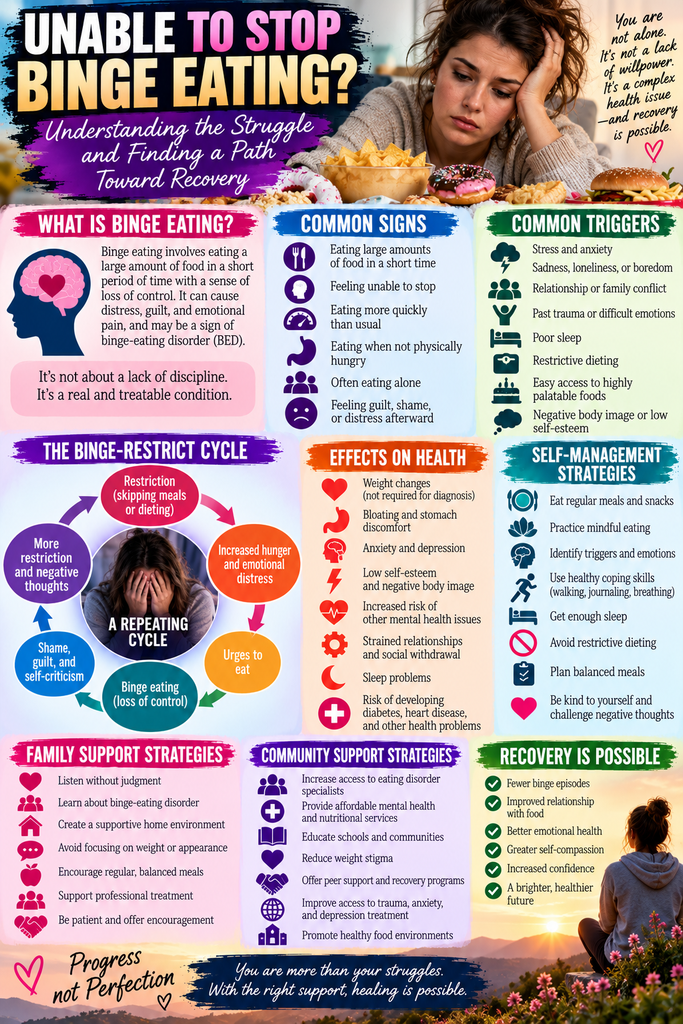
One common pattern involves alternating between attempts at strict dietary control and episodes of overeating.
The cycle may look something like this:
Restriction → Hunger or emotional distress → Urges to eat → Binge eating → Shame and guilt → More restriction → Another binge
After a binge, someone might decide:
“Tomorrow I’m barely going to eat.”
That response seems logical when someone is frightened by their eating behavior. However, severe restriction can increase physiological hunger and psychological preoccupation with food.
By evening, the person may be extremely hungry, emotionally exhausted, or both.
Another binge occurs.
The person then concludes:
“I have no self-control.”
But the restriction itself may be helping maintain the cycle.
Emotional Triggers and Binge Eating
Not every binge begins with physical hunger.
Food can temporarily change emotional experience. Eating may become a way of distracting from sadness, loneliness, boredom, anxiety, anger, rejection, trauma-related distress, or overwhelming stress.
Someone might discover that eating briefly provides comfort or emotional numbness.
For a short period, attention shifts away from painful emotions.
The problem is what happens afterward.
The original emotional problem may still be present—and now shame about binge eating has been added to it.
This creates another cycle:
Emotional distress → Binge eating → Temporary relief → Shame → Greater emotional distress → Another urge to binge
Treatment often involves learning how to interrupt this pattern without treating food itself as the enemy.
Binge Eating and the Brain
Eating behavior is influenced by interconnected systems involving hunger, reward, emotion, learning, stress, and decision-making.
Highly rewarding foods can stimulate brain pathways involved in pleasure and motivation. Stress, inadequate sleep, prolonged food restriction, and emotional distress may make urges more difficult to manage.
However, describing binge eating simply as a “food addiction” can be misleading. Binge-eating disorder is clinically classified as an eating disorder, and people cannot abstain from food in the way someone might abstain from alcohol or another substance.
Recovery therefore requires developing a healthier relationship with eating rather than eliminating food.
Binge Eating Is Not About Body Size
People with binge-eating problems come in different body shapes and sizes.
Someone does not need to have obesity to experience binge-eating disorder, and a person’s appearance cannot tell us whether they have an eating disorder.
Likewise, focusing exclusively on weight can overlook the psychological distress occurring underneath the eating behavior.
Treatment should address the whole person—not simply a number on a scale.
Self-Management Strategies
Self-management strategies can complement professional treatment and help someone begin recognizing the patterns surrounding binge episodes.
Helpful strategies include:
- Eat regularly. Consistent meals and planned snacks can reduce extreme hunger that may trigger binges.
- Avoid compensatory restriction. Skipping meals after a binge can perpetuate the binge-restrict cycle.
- Identify triggers. Keep track of emotions, situations, hunger levels, and thoughts that tend to occur before binge episodes.
- Pause before responding to an urge. Even a short delay can create space to identify what is happening emotionally and physically.
- Practice mindful eating. Slow down when possible and notice hunger, fullness, taste, and emotional responses without judgment.
- Develop alternative coping strategies. Walking, journaling, calling someone, listening to music, breathing exercises, or another meaningful activity may help manage emotional distress.
- Protect sleep. Sleep deprivation can affect appetite regulation, mood, and impulse control.
- Challenge all-or-nothing thinking. Eating one food you had not planned does not mean the entire day has been “ruined.”
- Reduce shame. Harsh self-criticism often increases distress rather than preventing another binge.
- Seek professional help. Repeated loss-of-control eating deserves appropriate assessment and treatment.
Stop Punishing Yourself After a Binge
The period immediately following a binge is important.
Someone may feel compelled to compensate by fasting, dramatically cutting calories, exercising excessively, or starting another restrictive diet.
Instead, try returning to the next normally scheduled meal.
One episode does not require punishment.
A more constructive response is curiosity:
What happened before the binge?
Were you extremely hungry? Angry? Lonely? Exhausted? Anxious? Did you skip meals? Did an argument occur? Were you trying to follow an overly restrictive diet?
Understanding the pattern provides more useful information than simply calling yourself a failure.
Professional Treatment
Binge-eating disorder is treatable.
Cognitive behavioral therapy (CBT) is commonly used and can help people recognize and change patterns of thinking and behavior that maintain binge eating.
Other approaches may focus on interpersonal difficulties, emotional regulation, body image, or related mental-health conditions.
Treatment may involve:
- Psychotherapy.
- Nutritional counseling from a clinician experienced with eating disorders.
- Regular medical monitoring.
- Treatment of depression, anxiety, trauma, or other co-occurring conditions.
- Medication when clinically appropriate.
Medication decisions should be individualized and made with a qualified healthcare professional. Treatment works best when the psychological, nutritional, behavioral, and medical aspects of the condition are considered together.
Family Support Strategies
Family members often want to help but may unintentionally increase shame by focusing on food, appearance, or weight.
Statements such as “Just stop eating so much” overlook the complexity of an eating disorder.
Families can instead:
- Learn about binge-eating disorder.
- Listen without judgment.
- Avoid criticizing weight, appearance, or food choices.
- Avoid monitoring every bite the person eats unless this is part of a professionally guided treatment plan.
- Encourage regular meals and a supportive home environment.
- Avoid labeling foods as morally “good” or “bad.”
- Encourage professional treatment.
- Ask what type of support would actually be helpful.
- Recognize signs of depression, anxiety, or severe emotional distress.
- Consider family therapy when recommended.
- Take care of their own emotional health.
Support should help the individual develop autonomy rather than creating another environment of control.
Community Support Strategies
Binge-eating disorder can remain hidden because people may feel ashamed to discuss their behavior.
Communities and healthcare systems can reduce these barriers by:
- Increasing access to eating-disorder specialists.
- Training healthcare professionals to recognize binge-eating symptoms.
- Screening for eating disorders across different body sizes.
- Providing affordable mental-health and nutritional services.
- Reducing weight stigma in healthcare settings.
- Supporting eating-disorder education in schools and communities.
- Providing peer-support and recovery programs.
- Educating families about eating disorders.
- Improving access to treatment for co-occurring depression, anxiety, trauma, and substance use.
- Promoting messages that separate personal worth from body weight.
Community education matters because someone may struggle for years without realizing that their behavior has a name—or that treatment exists.
When Should You Seek Help?
Professional evaluation is particularly important when binge eating occurs repeatedly, feels uncontrollable, produces significant distress, or interferes with physical health, relationships, work, or everyday life.
Other warning signs include:
- Frequently eating secretly.
- Feeling unable to stop once eating begins.
- Intense shame after eating.
- Repeated restrictive dieting followed by binges.
- Increasing depression or anxiety.
- Avoiding social situations involving food.
- Significant preoccupation with eating or body image.
- Using vomiting, laxatives, fasting, or excessive exercise to compensate for eating.
Compensatory behaviors may suggest another eating disorder, such as bulimia nervosa, and warrant professional assessment.
Recovery Is About More Than Stopping a Binge
It is understandable to define success as:
“I never want to binge again.”
But recovery involves something broader.
It may mean learning to eat consistently without fear. It can involve recognizing hunger without panicking, experiencing an uncomfortable emotion without immediately needing food to suppress it, and enjoying a favorite meal without deciding that you’ve “failed.”
Recovery can also mean looking at yourself after a difficult day and responding with curiosity instead of punishment.
Progress may occur gradually.
One binge becomes less intense. Episodes happen less frequently. A trigger is recognized earlier. Someone calls a friend instead of isolating. A meal that once produced guilt becomes simply a meal.
These changes matter.
Conclusion
Feeling unable to stop binge eating can be frightening and isolating, but repeated binge eating is not simply evidence of poor self-control.
Biology, restrictive dieting, stress, emotions, trauma, learned behaviors, sleep, and mental-health conditions can all influence eating patterns.
Breaking the cycle often requires more than another diet.
Self-management can help establish regular eating patterns, identify triggers, challenge restrictive thinking, and develop healthier coping strategies. Family support can reduce shame and provide encouragement without policing food or weight. Community support can make specialized eating-disorder treatment, nutritional care, mental-health services, and education more accessible.
Most importantly, recovery is not about becoming perfect around food.
It is about developing a relationship with food—and with yourself—that is increasingly guided by nourishment, awareness, flexibility, and compassion rather than restriction, shame, and fear.
Frequently Asked Questions
Here are some common questions:
1. What is binge eating?
Binge eating involves consuming an unusually large amount of food in a relatively short period while feeling a loss of control. A person may feel that they cannot stop eating or control what or how much they eat.
2. Is binge eating the same as occasionally overeating?
No. Most people occasionally eat more than intended. Binge eating is different because episodes involve loss of control and are often followed by significant emotional distress, such as guilt, shame, sadness, or disgust.
3. What is binge-eating disorder (BED)?
Binge-eating disorder is a recognized eating disorder involving recurrent binge-eating episodes that cause significant distress. Unlike bulimia nervosa, BED does not regularly involve compensatory behaviors such as self-induced vomiting, laxative misuse, fasting, or excessive exercise.
4. Why do I feel like I cannot stop eating once I start?
Binge eating can involve several interacting factors, including physical hunger, restrictive dieting, stress, emotional distress, learned behaviors, reward pathways, sleep problems, and mental-health conditions. It is usually more complicated than simply lacking self-control.
5. What commonly triggers binge eating?
Triggers vary from person to person but can include:
- Restrictive dieting or skipping meals
- Stress and anxiety
- Loneliness or boredom
- Sadness or depression
- Relationship conflict
- Trauma-related emotions
- Poor sleep
- Negative body image
- Feeling deprived of certain foods
- Difficult or overwhelming emotions
Identifying personal patterns can be an important part of treatment.
6. Can restrictive dieting actually make binge eating worse?
It can. Severe restriction may increase physical hunger and psychological preoccupation with food. Someone may restrict food after a binge because they feel guilty, become extremely hungry later, binge again, and then respond with additional restriction.
This can create a restriction → hunger/distress → binge → guilt → restriction cycle.
7. Is binge eating a food addiction?
Binge eating can sometimes feel addiction-like because of cravings and loss of control, but binge-eating disorder is clinically classified as an eating disorder. Food is also necessary for survival, so treatment generally focuses on developing a healthier relationship with eating rather than abstaining from food.
8. Can trauma contribute to binge eating?
For some people, yes. Eating may temporarily provide comfort, distraction, or emotional numbness when someone is experiencing trauma-related distress. However, trauma is not the cause of every case of binge eating, and many biological, psychological, and environmental factors may contribute.
9. Can poor sleep make binge eating more difficult to control?
Insufficient sleep can affect appetite, mood, stress regulation, and decision-making. Someone who is exhausted may also have fewer emotional resources available to manage cravings or distress. Improving sleep can therefore be one component of a broader recovery plan.
10. Can binge-eating disorder occur in someone who is not overweight?
Yes. Binge-eating disorder can occur across different body sizes. You cannot determine whether someone has an eating disorder simply by looking at their weight or appearance.
11. What should I do immediately after a binge?
Avoid punishing yourself by fasting, severely restricting food, or exercising excessively. Instead, return to your regular eating schedule and consider what happened before the episode.
Ask yourself: Was I extremely hungry? Stressed? Lonely? Angry? Exhausted? Did I skip meals? Was something emotionally difficult happening?
Curiosity generally provides more useful information than self-criticism.
12. What self-management strategies can help reduce binge eating?
Helpful strategies can include:
- Eating regular meals and planned snacks.
- Avoiding extreme food restriction.
- Identifying emotional and situational triggers.
- Practicing mindful eating.
- Developing alternative coping skills for difficult emotions.
- Maintaining adequate sleep.
- Challenging all-or-nothing thinking about food.
- Reducing self-criticism after setbacks.
- Seeking professional eating-disorder treatment when needed.
13. Should I eliminate all of my favorite foods to prevent binges?
Not necessarily. Labeling certain foods as completely forbidden can sometimes increase feelings of deprivation and preoccupation with those foods. An eating-disorder professional or registered dietitian experienced in eating disorders can help develop an individualized eating plan.
14. What treatments are available for binge-eating disorder?
Treatment may include psychotherapy, nutritional counseling, medical monitoring, and sometimes medication. Cognitive behavioral therapy (CBT) is commonly used to help identify and change thoughts and behaviors that maintain binge eating. Treatment may also address depression, anxiety, trauma, or other co-occurring conditions.
15. Are medications available for binge-eating disorder?
Yes. Medication may be appropriate for some people, but it should be selected based on the individual’s medical and psychiatric history, symptoms, potential risks, and other medications. Medication generally works best as part of a broader treatment plan rather than as the only intervention.
16. How can family members help someone who binge eats?
Families can listen without judgment, learn about eating disorders, encourage professional treatment, support regular eating patterns, and avoid criticizing the person’s weight or appearance.
Family members should also avoid policing every bite of food unless food monitoring is specifically part of a professionally supervised treatment plan.
17. What should families avoid saying?
Comments such as “Just stop eating,” “You need more willpower,” “Why don’t you go on a diet?” or jokes about weight can increase shame.
More helpful communication focuses on the person’s emotional well-being rather than their appearance.
18. How can communities help people with binge-eating disorder?
Communities can improve access to eating-disorder specialists, mental-health professionals, registered dietitians, peer-support programs, and affordable healthcare. Healthcare systems can also reduce weight stigma and screen for eating disorders among people of different body sizes.
19. When should someone seek professional help?
Consider professional evaluation when binge episodes repeatedly feel uncontrollable, cause significant distress, or interfere with relationships, work, physical health, or everyday life.
Help is particularly important when binge eating occurs alongside severe restriction, self-induced vomiting, laxative misuse, excessive exercise, depression, substance misuse, or thoughts of self-harm.
20. Is recovery from binge-eating disorder possible?
Yes. Many people improve significantly with appropriate treatment and support. Recovery may involve fewer or no binge episodes, more regular eating patterns, improved coping skills, reduced shame, and a healthier relationship with food and body image.
Video: