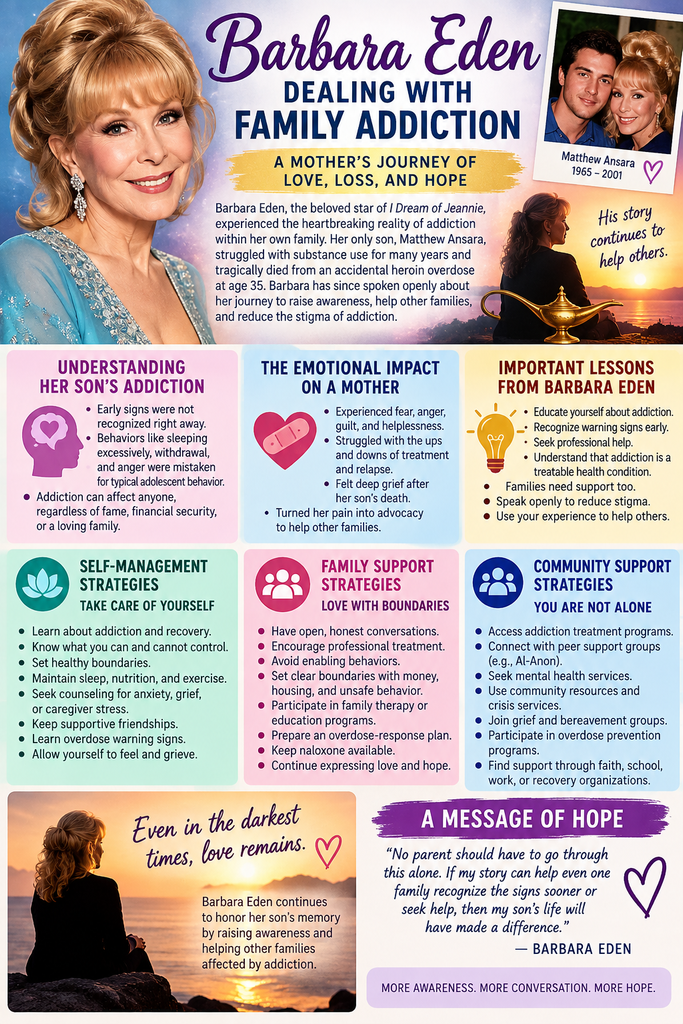
Barbara Eden, best known for her starring role in I Dream of Jeannie, experienced a devastating struggle away from Hollywood: watching her only son, Matthew Ansara, battle substance addiction for many years. Matthew went through periods of treatment and sobriety but died at age 35 from an accidental heroin overdose in June 2001. Eden later spoke publicly about her grief, guilt, and the lessons she wished she had understood earlier about addiction.
Her experience illustrates an important truth about addiction: substance use disorders affect entire families, not only the individual using drugs. Parents may experience fear, anger, guilt, confusion, exhaustion, and helplessness as they try to protect someone they love. Eden’s journey also demonstrates why education, early intervention, family support, and professional treatment are so important.
Recognizing the Addiction
Eden has said that she and Matthew’s father initially did not recognize what was happening. Behaviors such as sleeping excessively, withdrawal, and sudden anger were initially mistaken for ordinary adolescent behavior. She later encouraged parents to educate themselves about substance use and recognize warning signs early.
This is a challenge many families face. Early signs of substance misuse can resemble common adolescent or young-adult behaviors. Changes in friendships, secrecy, declining performance, unexplained financial problems, missing possessions, major mood changes, altered sleep patterns, and increasing isolation deserve attention—particularly when several changes occur together.
Recognizing warning signs does not prove that someone has an addiction. Instead, it provides a reason to begin a compassionate conversation and, when appropriate, seek professional assessment.
Years of Addiction and Recovery
Matthew’s addiction was not a short-lived problem. Eden described years of treatment, relapse, and efforts toward sobriety. In a 2002 interview, she emphasized that her son had been fighting to remain sober and that she continued believing in him. Matthew himself said that his mother maintained hope in him when he struggled to believe in himself.
This part of their story is important because recovery is not always a straight line. Substance use disorder is a treatable health condition, but some individuals experience periods of recurrence or relapse.
A return to substance use does not mean that previous treatment was meaningless. It may signal the need to reassess treatment intensity, medications when appropriate, mental health conditions, environmental triggers, recovery supports, or other factors contributing to continued substance use.
A Mother’s Guilt and Grief
After Matthew’s death, Eden described experiencing tremendous grief, guilt, anger, and periods when she felt close to tears. Like many parents who lose a child to addiction, she questioned what she could have done differently.
Parental guilt can become particularly powerful after an overdose. Parents may repeatedly ask themselves:
“Why didn’t I recognize it earlier?”
“Could I have stopped it?”
“Did I do something wrong?”
These questions are understandable, but addiction develops through a complicated interaction of biological, psychological, developmental, environmental, and social factors. Families can influence recovery and encourage treatment, but they cannot completely control another person’s substance use.
Grief counseling, bereavement groups, family therapy, and peer support can help families process these complicated emotions.
Self-Management Strategies for Families
When someone you love has an addiction, focusing entirely on that person’s behavior can cause you to neglect your own physical and emotional health. Self-management does not mean abandoning your loved one. It means staying stable enough to respond constructively rather than living in constant crisis.
Helpful strategies include:
- Learn about substance use disorders, overdose, treatment, and recovery.
- Recognize what you can and cannot control.
- Establish healthy emotional and financial boundaries.
- Maintain sleep, nutrition, exercise, medical care, and normal routines.
- Consider individual counseling for anxiety, depression, grief, or caregiver stress.
- Avoid blaming yourself for every recurrence of substance use.
- Keep supportive friendships and activities outside the addiction crisis.
- Learn overdose warning signs and emergency-response procedures.
- Keep naloxone available when opioid exposure is possible.
- Allow yourself to grieve and experience difficult emotions without shame.
Eden herself sought knowledge and connection. She has described attending Al-Anon meetings and listening to people affected by addiction, which she said helped broaden her understanding of the problem.
Family Support Strategies
Families can become powerful allies in recovery, but helping someone with addiction requires balancing compassion, boundaries, safety, and accountability.
Family members should educate themselves about addiction rather than viewing every behavior as evidence of laziness, selfishness, or lack of character. At the same time, understanding addiction as a health disorder does not require accepting dangerous or destructive behavior.
Families can:
- Talk openly about concerning behavior without humiliation or name-calling.
- Encourage professional assessment and evidence-based treatment.
- Learn the difference between supporting recovery and enabling substance use.
- Set clear boundaries regarding money, housing, transportation, and unsafe behavior.
- Participate in family therapy or addiction education when available.
- Develop an overdose-response plan.
- Keep naloxone accessible when opioids are involved.
- Recognize signs of relapse without assuming that recovery has failed.
- Encourage treatment for co-occurring mental health conditions.
- Continue expressing love while maintaining reasonable boundaries.
One of the most powerful aspects of Eden’s story was her persistence. Matthew later described his mother as someone who continued believing in him even when he struggled to believe in himself.
Families cannot force recovery, but they can communicate an important message: “I love you, I believe recovery is possible, and I will help you access treatment.”
Community Support Strategies
Addiction should not become a private family battle. Families often need outside support just as much as the person experiencing the substance use disorder.
Community resources may include:
- Addiction medicine professionals and treatment programs.
- Mental health professionals.
- Medication treatment for opioid use disorder when clinically appropriate.
- Peer recovery specialists.
- Family-support programs such as Al-Anon or similar groups.
- Naloxone education and distribution programs.
- Recovery community organizations.
- Grief and bereavement groups.
- Faith or spiritual communities when desired by the family.
- Community mental health and crisis services.
Eden has emphasized the importance of education and connecting people with those who understand addiction. After Matthew’s death, she also spoke with other parents facing similar situations.
No parent should have to become an addiction expert overnight. Community support can provide knowledge, practical assistance, emotional support, and connections to appropriate treatment.
The Importance of Early Intervention
One of Eden’s strongest messages has been that she wished she had understood more about drugs when Matthew was younger. She has encouraged parents to educate themselves and pay attention to behavioral changes rather than assuming addiction could never happen within their family.
Early intervention does not guarantee that addiction will disappear, but recognizing a developing problem sooner can create opportunities for assessment and treatment before consequences become more severe.
Parents should therefore respond to concerning changes with curiosity rather than immediate accusation:
What has changed?
What might my child be experiencing?
Could substances be involved?
Does my child need professional help?
Those questions can open the door to intervention.
Supporting Someone Without Enabling Addiction
One of the hardest challenges for families is distinguishing helping from enabling.
Support promotes health, safety, treatment, and personal responsibility.
Enabling unintentionally protects someone from the natural consequences of continued substance use or makes continued use easier.
For example, helping someone locate treatment is supportive. Continually providing money that is being used to purchase drugs is not. Driving someone to a recovery appointment can be supportive, while repeatedly covering up substance-related problems at work or school may prevent the person from experiencing consequences that could motivate change.
Boundaries should not be used as punishment. Their purpose is to protect everyone involved and create healthier conditions for recovery.
Finding Meaning After Loss
Eden could not change what happened to Matthew, but she eventually used her experience to educate other families. She has spoken about addiction publicly because she hoped her family’s experience could help someone else recognize a problem sooner.
She has also acknowledged that grief is deeply individual. There is no universal timetable or formula for recovering from the death of a child.
For some families, healing eventually includes advocacy, volunteering, overdose-prevention work, supporting other parents, or simply becoming willing to discuss addiction without shame.
Finding meaning does not erase grief. It can allow love for the person who died to continue through actions that help others.
Lessons From Barbara Eden’s Journey
Barbara Eden’s experience reminds families that addiction can affect people from every social and economic background. Fame, financial security, education, or loving parents cannot guarantee protection from a substance use disorder.
Her story also highlights the importance of knowledge over denial, treatment over punishment, boundaries over enabling, and compassion over stigma.
Perhaps most importantly, families need support too.
Parents cannot control every decision made by an adult child struggling with addiction. What they can do is educate themselves, recognize warning signs, encourage evidence-based treatment, prepare for overdose emergencies, establish healthy boundaries, and seek emotional support for themselves.
Conclusion
Barbara Eden’s journey through her son’s addiction and eventual overdose is heartbreaking, but it also carries an important message about family recovery. Addiction does not affect one person in isolation. Fear, uncertainty, relapse, treatment, hope, and grief can affect an entire family.
Self-management strategies help family members protect their own emotional and physical health. Family support strategies combine compassion with boundaries and encourage treatment without shame. Community support strategies connect families with professionals, peer groups, addiction treatment, overdose-prevention resources, and grief services.
Matthew Ansara’s story should ultimately be remembered as more than the story of an overdose. He was a son deeply loved by his family who struggled with a serious substance use disorder. Barbara Eden’s willingness to speak about that experience helps other families understand that addiction should not be hidden in shame—and that asking for help early can matter.
Frequently Asked Questions
Here are some common questions:
1. How was Barbara Eden affected by addiction in her family?
Barbara Eden experienced addiction through her only son, Matthew Ansara, who struggled with substance use for many years. His addiction affected the entire family and exposed Eden to the fear, uncertainty, hope, and emotional exhaustion that many parents experience when a child has a substance use disorder.
2. Who was Barbara Eden’s son?
Matthew Ansara was the son of Barbara Eden and actor Michael Ansara. He worked as an actor and bodybuilder and experienced a long struggle with substance use before his death in 2001 at age 35.
3. What type of addiction did Matthew Ansara struggle with?
Matthew experienced problems with drugs, including heroin. His history included periods of treatment, recovery, and recurrence of substance use.
4. How did Matthew Ansara die?
Matthew Ansara died from an accidental heroin overdose in June 2001. His death illustrates the potentially fatal consequences associated with opioid use and recurrence after periods of abstinence.
5. Did Barbara Eden recognize her son’s addiction immediately?
No. Eden has discussed how some of Matthew’s early behavioral changes were initially difficult to distinguish from typical adolescent behavior. Her experience later led her to emphasize the importance of parents educating themselves about substance use and recognizing warning signs.
6. What warning signs should families watch for?
Possible warning signs include major changes in mood, sleep, friendships, or appearance; increasing secrecy or isolation; declining school or work performance; unexplained financial problems; missing possessions; and noticeable changes in behavior. No single symptom proves addiction, but several significant changes may warrant a professional assessment.
7. Did Barbara Eden blame herself for her son’s addiction?
Eden has spoken about experiencing guilt and questioning whether she could have done something differently. Such feelings are common among parents affected by a child’s addiction. However, substance use disorders develop through complex interactions among biological, psychological, environmental, developmental, and social factors.
8. How did Barbara Eden cope with her son’s addiction?
Eden continued supporting her son while trying to understand addiction and recovery. She has also discussed seeking information and attending support meetings such as Al-Anon. After Matthew’s death, speaking publicly about her experience became one way of helping other families understand addiction.
9. What can parents do when an adult child has an addiction?
Parents can educate themselves about substance use disorders, encourage professional treatment, communicate without humiliation, establish healthy boundaries, learn about overdose prevention, and seek counseling or peer support for themselves.
10. What is the difference between supporting and enabling someone with addiction?
Supporting someone means encouraging behaviors that promote recovery, safety, and responsibility. Enabling occurs when well-intentioned actions unintentionally make continued substance use easier or repeatedly protect the person from its consequences.
For example, driving someone to treatment is supportive. Continually giving money that is being used to purchase drugs may enable continued substance use.
11. Should parents set boundaries with a child who has an addiction?
Yes. Healthy boundaries can protect both the family and the person struggling with addiction. Boundaries might address money, housing, substance use in the home, threatening behavior, or other safety concerns. Boundaries are most effective when they are clear, realistic, consistent, and focused on safety rather than punishment.
12. How can families take care of themselves?
Family members need recovery support too. Helpful self-management strategies include maintaining normal routines, getting adequate sleep, continuing friendships and enjoyable activities, attending counseling or family-support groups, and recognizing that they cannot control another person’s recovery.
13. How can communities support families affected by addiction?
Communities can provide addiction treatment, mental health services, peer recovery programs, family-support groups, grief counseling, naloxone education, overdose-prevention programs, and recovery-oriented organizations. Reducing stigma can also make families more willing to seek assistance earlier.
14. Why is naloxone important for families affected by opioid addiction?
Naloxone is a medication that can rapidly reverse an opioid overdose. Families and others who may encounter someone at risk of opioid overdose can learn how to recognize an overdose, administer naloxone, and obtain emergency medical assistance.
15. Can relapse happen after someone appears to be doing well?
Yes. A recurrence of substance use can happen even after significant periods of recovery. Importantly, opioid tolerance may decrease during abstinence, which can increase overdose risk if someone returns to a previously used dose. A recurrence should prompt reassessment and renewed treatment rather than being viewed simply as a moral failure.
16. How should families respond when treatment does not seem to be working?
Treatment may need to be adjusted. Families can encourage reassessment by an addiction professional to determine whether the individual needs a different level of care, medication treatment, mental health treatment, stronger recovery supports, or intervention for other factors contributing to substance use.
17. How can parents cope after losing a child to addiction or overdose?
Grieving an overdose death can involve sadness, anger, guilt, shame, and unanswered questions. Individual counseling, grief groups, overdose-loss support groups, trusted family and friends, and spiritual support when desired can help. There is no required timetable for grief.
18. What is the most important lesson from Barbara Eden’s experience?
Her story demonstrates that addiction can affect any family and should not be treated as a source of shame. Families cannot control every decision a loved one makes, but they can educate themselves, recognize warning signs, encourage evidence-based treatment, maintain healthy boundaries, prepare for emergencies, and seek support for themselves.
Video: