We often hear inspiring stories about people who experienced abuse, poverty, addiction in the family, violence, neglect, loss, or other serious adversity and later became remarkably successful. Can these stories create an appealing idea: Does trauma actually make people more successful?
The answer is more complicated than a simple yes or no.
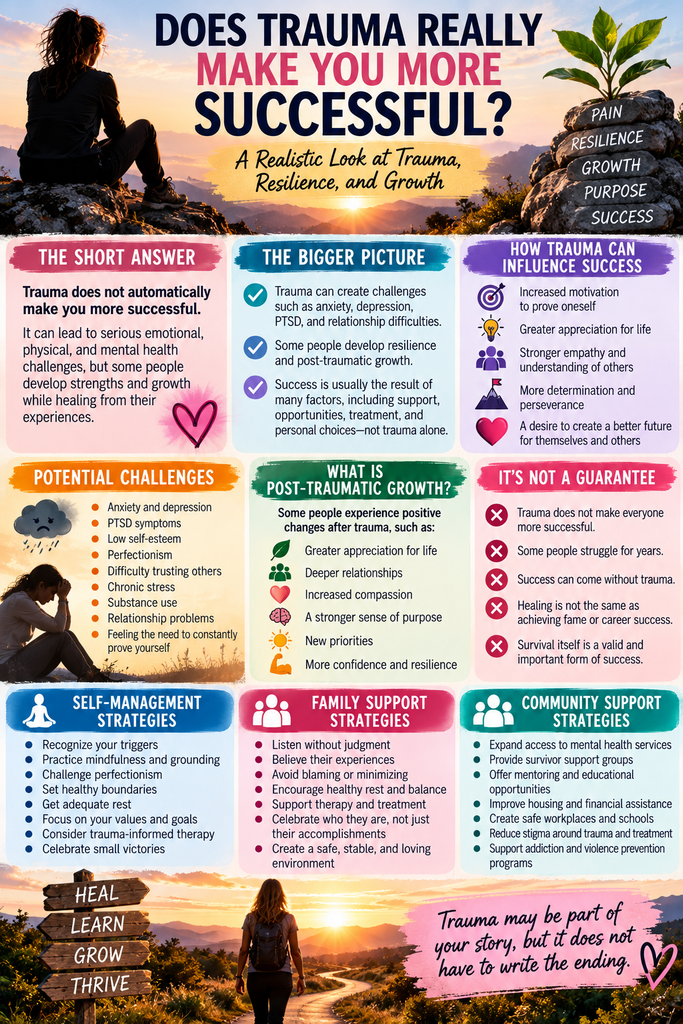
Trauma itself is not a recipe for success. It can contribute to depression, anxiety, post-traumatic stress disorder (PTSD), substance use, relationship difficulties, chronic stress, and physical health problems. However, some people develop significant strengths as they adapt to difficult circumstances. Others experience post-traumatic growth, meaning they develop new perspectives, priorities, relationships, or a stronger sense of purpose while working through what happened.
The important distinction is this: trauma does not automatically create success. What people develop while surviving, processing, and recovering from trauma sometimes contributes to later growth.
Why Trauma Can Change a Person
Trauma occurs when an experience overwhelms a person’s ability to cope effectively. Childhood abuse, domestic violence, sexual assault, serious accidents, war, sudden loss, community violence, and other threatening experiences can disrupt a person’s sense of safety and control.
The brain and body adapt to survive threatening environments.
For example, someone raised in an unpredictable household may become exceptionally sensitive to changes in other people’s moods. Another person may become fiercely independent because depending on others once felt unsafe. Someone else may become highly achievement-oriented because accomplishment provides a sense of control or validation.
These adaptations may help someone survive difficult circumstances, but they can come at a cost.
Hypervigilance might later look like extraordinary attention to detail—but it can also produce exhaustion and anxiety.
Independence may help someone become a strong leader—but it may also make asking for help extremely difficult.
Perfectionism may contribute to professional accomplishments—but it can also create chronic stress and the feeling that nothing is ever good enough.
This is why apparent strength should not automatically be interpreted as healing.
The “I’ll Prove Everyone Wrong” Response
Some trauma survivors become intensely driven.
A person who grew up feeling powerless may promise themselves that they will someday become financially independent. Someone repeatedly criticized as a child may become determined to prove their worth through education or career achievement.
That motivation can produce impressive accomplishments.
However, success driven primarily by fear can become psychologically expensive. A person may continually chase the next degree, promotion, business milestone, award, or financial goal without ever feeling genuinely successful.
The underlying belief may remain:
“If I accomplish enough, then I will finally be worthy.”
Healing involves separating personal worth from performance.
You can be ambitious because you value your goals—not because you must constantly prove that you deserve respect.
Trauma and Resilience
Resilience is the ability to adapt and continue functioning despite adversity. It does not mean that someone was unaffected by what happened.
A resilient survivor may still experience grief, anxiety, triggers, or difficult memories.
Resilience can develop through:
- Supportive relationships
- Effective coping skills
- Problem-solving abilities
- Access to education and opportunities
- Therapy and mental health treatment
- Spirituality or personal values
- Safe and stable environments
- Community resources
- A growing sense of personal control
Resilience should therefore not be described simply as something trauma “gave” a person. Often, resilience develops because people found resources and relationships that helped them survive what trauma took from them.
What Is Post-Traumatic Growth?
Some people report positive psychological changes after struggling with traumatic experiences. Researchers describe this as post-traumatic growth.
A survivor might develop:
- Greater appreciation for life
- Deeper relationships
- Increased compassion for others
- New priorities
- Greater confidence in handling difficulties
- Spiritual or philosophical growth
- A stronger sense of purpose
- Motivation to help others
Importantly, post-traumatic growth does not mean someone is grateful that the trauma occurred.
A person can say:
“I became stronger while recovering from what happened.”
without saying:
“I needed the trauma to become strong.”
Both emotional pain and personal growth can exist at the same time.
When Success Becomes a Trauma Response
High achievement can sometimes hide unresolved emotional pain.
A person may appear extraordinarily successful while privately struggling with anxiety, loneliness, insomnia, substance use, perfectionism, or an inability to slow down.
Warning signs that achievement may partly function as a coping mechanism include:
- Feeling guilty whenever you rest
- Believing your value depends on productivity
- Becoming extremely distressed by mistakes
- Constantly comparing yourself with others
- Working excessively to avoid difficult emotions
- Feeling uncomfortable when life becomes calm
- Being unable to celebrate accomplishments
- Immediately chasing another goal after reaching one
- Feeling like a failure despite significant achievements
This does not mean ambition is unhealthy. The goal is to understand what is driving the ambition.
Self-Management Strategies
Trauma recovery involves developing healthier ways of managing emotions, stress, relationships, and achievement.
Helpful self-management strategies include:
- Recognize your triggers. Notice situations that activate fear, anger, shame, or the need to prove yourself.
- Examine perfectionism. Ask whether your standards help you grow or keep you from feeling satisfied.
- Practice intentional rest. Rest is a biological need, not something you must earn.
- Develop grounding skills. Mindfulness, breathing exercises, exercise, journaling, and sensory grounding can reduce emotional overwhelm.
- Separate worth from productivity. Accomplishments are things you achieve; they are not measurements of your value as a human being.
- Set realistic goals. Sustainable progress is often healthier than constant pressure.
- Celebrate small victories. Recognizing progress teaches the brain that accomplishment can be experienced rather than immediately dismissed.
- Consider trauma-informed therapy. Professional treatment can help identify connections between earlier experiences and present-day behaviors.
The goal is not to eliminate ambition. The goal is to ensure ambition belongs to you, rather than allowing fear to control it.
Family Support Strategies
Families can significantly influence recovery after trauma. A safe family environment can help survivors experience what trauma may have disrupted: predictable, trustworthy relationships.
Families can help by:
- Listening without judgment.
- Believing a survivor’s experiences.
- Avoiding statements such as “everything happens for a reason.”
- Not expecting survivors to “get over it.”
- Respecting emotional and physical boundaries.
- Encouraging healthy rest rather than constant productivity.
- Celebrating the person, not only their accomplishments.
- Supporting professional treatment when appropriate.
- Learning about trauma responses.
- Creating predictable and emotionally safe environments.
One particularly important message families can communicate is:
“You don’t have to achieve something for us to value you.”
For someone whose self-worth became connected with survival or performance, hearing and experiencing that message consistently can be powerful.
Community Support Strategies
Individual resilience is important, but people should not have to overcome trauma entirely on their own.
Communities can promote recovery by:
- Expanding affordable trauma-informed mental health services.
- Providing survivor support groups.
- Developing mentoring programs for young people.
- Supporting domestic violence and sexual assault services.
- Creating safe school and workplace environments.
- Improving access to housing and financial assistance.
- Teaching healthy coping and emotional regulation skills.
- Reducing stigma surrounding therapy and mental illness.
- Supporting addiction prevention and treatment programs.
- Training healthcare professionals, educators, and community leaders in trauma-informed practices.
Community support matters because recovery is easier when people have access to safety, healthcare, education, housing, supportive relationships, and meaningful opportunities.
Success Does Not Prove Someone Has Healed
One of the biggest misconceptions about trauma is that professional success proves emotional recovery.
Someone can become a physician, entrepreneur, celebrity, executive, teacher, athlete, or successful parent while still carrying significant emotional pain.
Achievements cannot tell us what happens inside someone’s mind.
Likewise, survivors who struggle professionally should never be considered less resilient than survivors who become extraordinarily successful.
Sometimes survival itself represents enormous strength.
For one survivor, success may mean building a multimillion-dollar company.
For another, success may mean completing therapy, maintaining sobriety, leaving an abusive relationship, returning to school, rebuilding relationships, sleeping peacefully, or getting through the day without being controlled by traumatic memories.
Both forms of progress matter.
Trauma Is Not a Requirement for Greatness
Society sometimes romanticizes suffering with statements such as:
“What doesn’t kill you makes you stronger.”
There may be truth in the idea that people can develop strength through adversity, but the statement can also minimize suffering.
Some experiences hurt people profoundly.
The better question is not:
“Did trauma make this person successful?”
Instead, ask:
“What helped this person grow despite what happened?”
The answers are usually much more meaningful: supportive relationships, opportunity, therapy, education, determination, spirituality, mentors, healthy coping skills, community resources, and personal choices.
Redefining Success After Trauma
Trauma survivors sometimes need to redefine success.
Success does not always mean achieving more.
Sometimes success means:
- Feeling safe.
- Setting a boundary.
- Asking for help.
- Ending an unhealthy relationship.
- Maintaining recovery.
- Taking a day off without guilt.
- Trusting someone again.
- Becoming financially independent.
- Learning to manage triggers.
- Building a peaceful home.
- Discovering an identity beyond trauma.
These accomplishments may never appear on a résumé, but they can represent profound psychological growth.
Conclusion: Trauma Doesn’t Create Success—Healing Can Create Growth
So, does trauma really make you more successful?
Not necessarily.
Trauma can cause significant psychological and physical harm, and there is no guarantee that adversity will produce resilience or achievement. We should never romanticize abuse, violence, neglect, loss, or other traumatic experiences as necessary ingredients for success.
However, people can develop extraordinary strengths while recovering from trauma.
Through self-management, survivors can understand their triggers and develop healthier coping strategies. With family support, they can experience acceptance, stability, and relationships not based on performance. With community support, they can access treatment, education, mentoring, housing, and other resources that make recovery more achievable.
The most powerful message is not that trauma creates successful people.
It is that people can experience terrible things, receive the right support, work toward healing, and still build meaningful lives.
Trauma may be part of someone’s story.
It does not have to write the ending.
Frequently Asked Questions and Answers
1. Does trauma really make a person more successful?
Not necessarily. Trauma does not automatically produce success, resilience, or motivation. It can cause significant emotional and physical difficulties. Some people, however, develop strengths while recovering from traumatic experiences that later contribute to personal or professional growth.
2. Why do some trauma survivors become highly successful?
Some survivors develop determination, independence, problem-solving skills, empathy, adaptability, or a strong desire to create a different future. These qualities may contribute to achievement, but they develop through adaptation and recovery—not because trauma itself is beneficial.
3. What is post-traumatic growth?
Post-traumatic growth refers to positive psychological changes that some people experience while coping with major adversity. These may include greater appreciation for life, stronger relationships, increased personal strength, new priorities, spiritual growth, or a stronger sense of purpose.
4. Does post-traumatic growth mean someone is completely healed?
No. Growth and emotional distress can exist simultaneously. Someone may discover new purpose after trauma while continuing to experience anxiety, grief, triggers, or PTSD symptoms.
5. Can trauma make someone more ambitious?
Sometimes. A person who experienced poverty, rejection, abuse, instability, or feeling powerless may become strongly motivated to achieve independence or prove themselves. However, ambition driven primarily by fear or low self-worth can eventually contribute to stress, burnout, and perfectionism.
6. Can being a high achiever actually be a trauma response?
In some cases, yes. Excessive work, perfectionism, people-pleasing, or constantly pursuing achievements can become ways of coping with insecurity or uncomfortable emotions. High achievement alone, however, does not indicate that someone has experienced trauma.
7. What are signs that achievement may be connected to unresolved trauma?
Possible signs include feeling guilty while resting, being extremely afraid of failure, constantly needing approval, never feeling satisfied after reaching goals, tying self-worth to productivity, and using work to avoid uncomfortable emotions.
8. Does trauma always make people stronger?
No. The popular statement that adversity automatically makes people stronger oversimplifies trauma. Some people develop resilience, while others experience significant and persistent psychological difficulties. Neither response represents a personal failure.
9. Why shouldn’t we romanticize trauma?
Romanticizing trauma can make suffering appear necessary for personal development. People can become resilient, compassionate, ambitious, and successful without experiencing abuse, violence, neglect, or other traumatic events.
10. What factors help someone become resilient after trauma?
Protective factors can include safe relationships, stable housing, supportive families, therapy, education, financial security, mentors, spirituality, healthy coping strategies, community resources, and opportunities to regain control over one’s life.
11. Can trauma affect someone’s definition of success?
Yes. After trauma, success may become less about money, status, or recognition and more about safety, healthy relationships, independence, peace, recovery, meaningful work, or having control over one’s decisions.
12. What self-management strategies can support trauma recovery?
Helpful approaches can include recognizing triggers, practicing grounding and mindfulness, establishing boundaries, getting adequate sleep, exercising, challenging perfectionism, maintaining supportive relationships, and seeking trauma-informed professional care when appropriate.
13. How can families support someone recovering from trauma?
Families can listen without judgment, respect boundaries, avoid minimizing the experience, encourage healthy rest, support treatment when appropriate, and remind the person that their value does not depend on productivity or accomplishments.
14. How can communities help trauma survivors succeed?
Communities can improve access to affordable mental healthcare, survivor support groups, safe housing, education, employment opportunities, addiction treatment, mentoring, crisis services, and trauma-informed schools and workplaces.
15. Does professional success prove someone has healed from trauma?
No. Someone can have a successful career while privately experiencing anxiety, depression, PTSD symptoms, relationship difficulties, substance misuse, or emotional exhaustion. External achievement and psychological recovery are different things.
16. Can someone recover from trauma without becoming exceptionally successful?
Absolutely. Recovery should not be measured by wealth, fame, career status, or extraordinary accomplishments. Feeling safe, maintaining recovery, establishing boundaries, developing healthy relationships, or simply enjoying everyday life can represent tremendous progress.
17. Can trauma lead to addiction or unhealthy coping behaviors?
Traumatic experiences can increase vulnerability to substance use and other unhealthy coping strategies in some people. Alcohol or drugs may temporarily numb distress but can create additional problems. Trauma-informed addiction treatment can address both substance use and underlying emotional experiences.
18. Can therapy help someone turn survival skills into healthier strengths?
Yes. Trauma-informed therapy can help people recognize which behaviors once helped them survive but may no longer be helpful. For example, hypervigilance can be replaced with healthier awareness, perfectionism with realistic standards, and extreme independence with the ability to accept appropriate support.
19. What is a healthier way to think about trauma and success?
Instead of saying, “Trauma made me successful,” it may be more accurate to say, “I developed strengths while surviving and healing from experiences that should never have happened.” This recognizes resilience without suggesting that trauma itself was beneficial.
20. What is the most important message about trauma and success?
Trauma is not a requirement for greatness. Some people experience meaningful growth after adversity, while others need significant support simply to regain stability—and both experiences are valid.
Video: