Tina Turner became one of the most celebrated performers in music history, but behind her energetic performances and public success was a prolonged experience of domestic violence. Turner publicly described years of physical, emotional, sexual, and psychological abuse during her marriage and professional partnership with Ike Turner. In 1976, she finally escaped the relationship and later rebuilt both her personal life and career. Her story illustrates the complicated realities of domestic violence and the importance of self-management, supportive relationships, and community resources in helping survivors establish safety and independence.
Behind the Success Was an Abusive Relationship
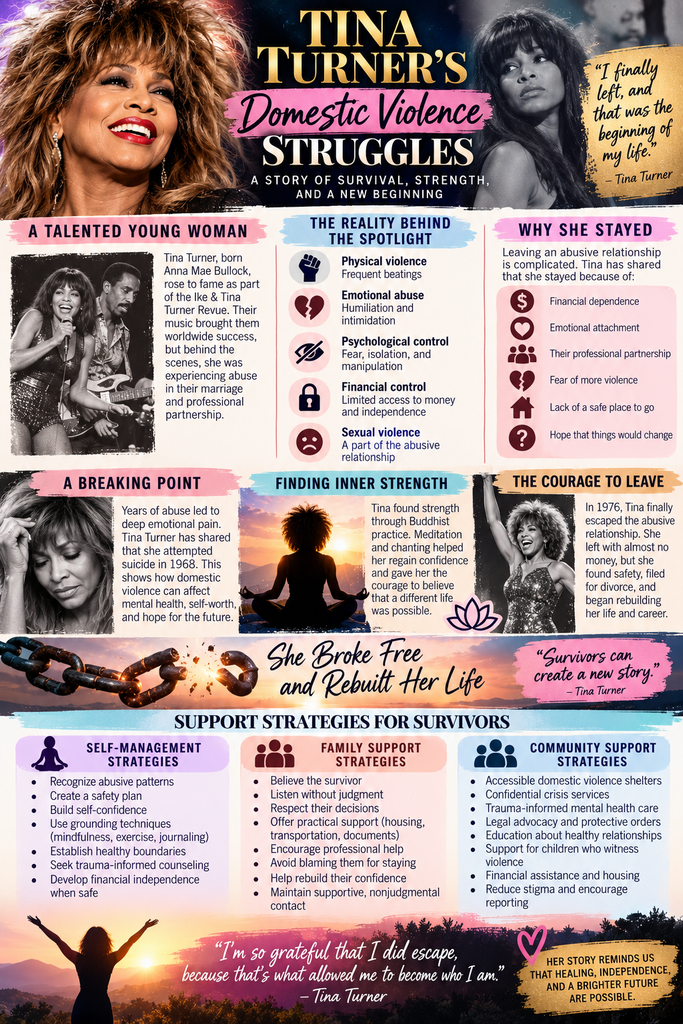
Tina Turner, born Anna Mae Bullock, began performing with Ike Turner while she was still young. Together they eventually became the successful Ike & Tina Turner Revue. Their professional success, however, concealed what Turner later described as a frightening and controlling relationship. The Smithsonian’s National Museum of African American History and Culture notes that she maintained a polished public image while privately experiencing an abusive marriage.
Turner later described physical assaults, psychological intimidation, coercive control, and sexual violence. Ike Turner subsequently disputed portions of her account while acknowledging that he had hit her. Turner also described feeling trapped by fear, loyalty, their professional partnership, and concerns about whether she could succeed without him.
Her experience demonstrates an important reality about domestic violence: leaving is often a process rather than a single decision.
Why Survivors May Stay
People sometimes ask why someone experiencing domestic violence does not simply leave. That question can underestimate the control an abusive partner may have over the survivor.
A survivor may remain because of:
- Fear that violence will escalate if they attempt to leave
- Financial dependence
- Threats or intimidation
- Concern for children or other family members
- Social isolation
- Emotional attachment or loyalty
- Damage to self-confidence
- Religious or cultural pressures
- Professional or financial connections to the abusive partner
- Hope that the abusive person will change
- Lack of a safe place to go
Turner herself later explained that she felt afraid and obligated to stay. Her experience shows why the responsibility for abuse should remain with the person committing it rather than being shifted onto the survivor for not leaving sooner.
Reaching an Emotional Breaking Point
Years of violence had severe consequences. Turner wrote about reaching such profound hopelessness that she attempted suicide in 1968. This period illustrates how prolonged domestic violence can affect far more than physical safety; it can profoundly affect self-worth, emotional health, hope, and a person’s sense of control over life.
Survivors of prolonged abuse may experience depression, anxiety, post-traumatic stress symptoms, sleep problems, hypervigilance, shame, social withdrawal, or difficulty trusting others.
These reactions should not be interpreted as personal weakness. They can develop after repeatedly living in an environment where safety is unpredictable.
Spirituality and Rebuilding Inner Strength
One of the most important self-management strategies Turner identified was her Buddhist practice. She began practicing Nichiren Buddhism and chanting during the 1970s. Turner later credited Buddhism with helping her develop the confidence and courage necessary to change her circumstances.
She explained that the process was gradual. As her confidence increased, she became less afraid of Ike and increasingly recognized that her life needed to change.
Spirituality will not be the right approach for every survivor, and spiritual practice should never replace safety planning or professional assistance. For Turner, however, it became an important source of psychological strength.
The Decision to Leave
In July 1976, after another violent confrontation while traveling in Dallas, Turner escaped from Ike. She fled their hotel and reached another hotel where she asked for assistance despite having almost no money. People provided temporary safety, and supportive contacts later helped her separate from Ike.
The divorce was finalized in 1978. Turner relinquished most of the couple’s assets but fought to retain the professional name Tina Turner, which became essential to rebuilding her career.
Her departure was not immediately followed by extraordinary success. She faced financial and professional difficulties and spent years rebuilding before the enormous success of Private Dancer in 1984.
This part of her journey is particularly important: escaping abuse and recovering from abuse are not the same event.
Self-Management Strategies for Survivors
Turner’s story provides a framework for discussing self-management, although every survivor’s circumstances are different. Personal strategies should always prioritize safety.
- Recognize abusive patterns. Physical violence is only one form of abuse. Threats, humiliation, sexual coercion, financial control, intimidation, and isolation are also serious.
- Develop a personalized safety plan. Consider safe places, important documents, emergency contacts, transportation, medications, and financial resources.
- Rebuild self-confidence gradually. Abuse can damage self-worth. Counseling, supportive relationships, spirituality, creative expression, or meaningful activities can help restore a sense of identity.
- Use grounding and stress-management skills. Breathing exercises, mindfulness, exercise, journaling, music, and meditation may help manage trauma responses.
- Establish boundaries. Recovery may require limiting or ending contact with abusive individuals.
- Seek trauma-informed counseling. Professional support can help survivors process fear, shame, grief, and traumatic memories.
- Develop financial independence when safely possible. Access to money, employment, housing, and transportation can significantly affect a person’s ability to remain independent.
Importantly, leaving an abusive partner can sometimes increase immediate danger. Safety planning should therefore be individualized rather than based on a simple instruction to “just leave.”
Family Support Strategies
Family members and friends can become critical sources of support, but their response matters.
Helpful strategies include believing the survivor, listening without judgment, respecting confidentiality when safety permits, and avoiding criticism about why the person stayed.
Family and friends can also:
- Help identify safe housing and transportation.
- Store important documents or emergency belongings when appropriate.
- Offer practical assistance without attempting to control the survivor’s decisions.
- Learn about domestic violence and coercive control.
- Encourage professional counseling without demanding it.
- Avoid confronting the abusive partner unless advised as part of a safety plan.
- Maintain supportive contact when isolation is occurring.
- Help survivors reconnect with their interests and personal identity.
Turner’s escape also demonstrates the importance of seemingly small acts of assistance. After she fled Ike, the manager gave her a safe room despite her inability to pay. Others later helped her find temporary places to stay.
Sometimes community support begins with one person choosing to believe and help someone asking for safety.
Community Support Strategies
Domestic violence cannot be addressed solely by asking survivors to protect themselves. Communities also have responsibilities.
Effective community strategies include:
- Maintaining accessible domestic violence shelters and crisis programs.
- Providing confidential safety planning.
- Expanding affordable trauma-informed mental health treatment.
- Providing legal advocacy and assistance with protective orders when appropriate.
- Helping survivors obtain emergency housing and financial assistance.
- Training healthcare professionals to recognize signs of domestic violence.
- Educating young people about healthy relationships and coercive control.
- Providing culturally responsive survivor services.
- Supporting children who have witnessed domestic violence.
- Challenging stigma that prevents survivors from seeking assistance.
Community programs should focus on restoring survivors’ choices rather than replacing one form of control with another.
Speaking Publicly About Domestic Violence
Turner eventually made another significant decision: she talked openly about what happened.
Her 1981 disclosure about domestic violence was particularly notable at a time when the subject was much less openly discussed. She later described her experiences in her memoir I, Tina, and her story became widely known through the film What’s Love Got to Do with It. Advocates have credited her openness with helping other survivors feel less alone and bringing domestic violence into public conversation.
However, Turner also acknowledged that repeatedly discussing the abuse could be painful. Her experience reminds us that survivors should not be expected to continually retell traumatic experiences simply because their stories might help others.
Reclaiming an Identity Beyond Abuse
Perhaps one of the strongest lessons from Turner’s journey is the importance of identity.
For years, her personal life, career, finances, and public identity were closely tied to Ike. Leaving required more than ending a marriage. She had to establish who Tina Turner was on her own.
Her later solo career provided a powerful answer.
The enormous success she eventually achieved did not erase her trauma. Instead, it demonstrated that the person she had been told she could not become without Ike already existed within her.
Recovery for other survivors does not need to look like Turner’s remarkable career comeback. Success might mean obtaining safe housing, returning to school, finding employment, rebuilding relationships, attending counseling, sleeping without fear, or simply making independent decisions again.
Understanding Tina Turner’s Journey
Tina Turner’s story should not be reduced to a simple narrative that says suffering automatically produces strength. Domestic violence caused her serious harm, and she should never have had to endure it.
The more meaningful lesson is that abuse did not have the final word.
Her journey demonstrates how internal coping strategies, spirituality, supportive individuals, community assistance, economic independence, and opportunities to rebuild identity can work together in recovery. Turner ultimately described developing the confidence to leave an unhealthy environment “on my own terms.”
Conclusion
Tina Turner’s journey from domestic violence to independence illustrates both the devastating effects of abuse and the complicated process of rebuilding afterward. She experienced years of violence and control, escaped in 1976 with few resources, rebuilt her career from the ground up, and eventually spoke publicly about experiences that many survivors were still expected to keep hidden.
Her experience offers three important lessons. Self-management can help survivors rebuild confidence and emotional stability. Family and trusted relationships can provide validation and practical assistance. Community support can provide the shelter, healthcare, legal resources, counseling, and financial assistance necessary to turn the possibility of leaving into sustainable safety.
Most importantly, domestic violence is never the survivor’s responsibility. Recovery should not be measured by fame, professional success, or how quickly someone moves forward. Sometimes recovery begins with something much simpler: finding safety, reclaiming personal choices, and realizing that life can belong to you again.
Frequently Asked Questions and Answers
1. Did Tina Turner experience domestic violence?
Yes. Tina Turner publicly described experiencing years of physical, emotional, psychological, and sexual abuse during her marriage and professional partnership with Ike Turner. She later discussed these experiences in interviews and memoirs, helping bring greater public attention to domestic violence.
2. Who was Tina Turner’s abusive partner?
Tina identified her former husband and musical partner, Ike Turner, as her abuser. The two performed together as the Ike & Tina Turner Revue before Tina eventually left the relationship.
3. Why did Tina Turner stay in the abusive relationship for so long?
Tina described fear, emotional attachment, financial and professional dependence, and a sense of responsibility toward Ike as factors that made leaving difficult. These barriers are common in abusive relationships. Asking why a survivor stayed can overlook the coercion, fear, and practical obstacles that may restrict their choices.
4. Did Ike Turner acknowledge abusing Tina Turner?
Ike Turner disputed some aspects of Tina’s accounts but acknowledged in his autobiography that he had hit her. Tina consistently maintained that she experienced serious and repeated abuse throughout their relationship.
5. How did domestic violence affect Tina Turner’s mental health?
Tina described experiencing severe emotional distress and hopelessness during the abusive relationship. She disclosed that she attempted suicide in 1968. Her experience illustrates how prolonged domestic violence can profoundly affect self-esteem, emotional health, and a person’s sense of hope.
6. When did Tina Turner finally leave Ike Turner?
Tina left Ike in 1976 following a violent confrontation in Dallas. She escaped their hotel and sought safety elsewhere. Their divorce was finalized in 1978.
7. Did Tina Turner have money when she escaped?
She described escaping with very little money and relying on others’ kindness for immediate assistance. Her experience demonstrates why access to emergency housing, transportation, finances, and supportive individuals can be critical when someone leaves an abusive relationship.
8. What role did spirituality play in Tina Turner’s recovery?
Tina practiced Nichiren Buddhism and regularly chanted. She credited her Buddhist practice with helping her develop greater inner strength, confidence, and hope. Spirituality can be meaningful for some survivors, but it should complement, not replace, safety planning and professional care when needed.
9. How did Tina Turner rebuild her life after leaving?
Rebuilding took time. She faced financial and professional difficulties before reestablishing herself as a solo performer. Her breakthrough album, Private Dancer (1984), helped establish her as an internationally successful solo artist.
10. Did Tina Turner speak publicly about domestic violence?
Yes. Tina became one of the most prominent celebrities of her era to discuss domestic violence openly. Her memoir I, Tina provided further details about her experiences, and her life story later inspired the film What’s Love Got to Do with It.
11. What self-management strategies can help domestic violence survivors?
Helpful strategies may include recognizing abusive patterns, creating an individualized safety plan, identifying trusted people, establishing boundaries, practicing grounding techniques, rebuilding financial independence when safely possible, and obtaining trauma-informed counseling. Leaving can sometimes increase danger, so safety planning is especially important.
12. How can family members support someone experiencing domestic violence?
Family members can believe the survivor, listen without judgment, avoid blaming them for staying, respect their decisions, help locate professional resources, and provide practical assistance such as transportation, temporary housing, childcare, or document storage when appropriate.
13. Should family members confront the abusive partner?
Usually, directly confronting an abusive person without a safety plan can increase risk. Family members should prioritize the survivor’s safety and consider obtaining guidance from a domestic violence professional before taking actions that could escalate the situation.
14. How can communities better support domestic violence survivors?
Communities can provide confidential shelters, crisis services, affordable housing, legal advocacy, financial assistance, trauma-informed healthcare, counseling, childcare, and education about healthy relationships. Schools and healthcare professionals can also be trained to recognize warning signs and connect people with appropriate resources.
15. Why is it difficult for some survivors to leave abusive relationships?
Leaving may involve threats, financial dependence, children, housing insecurity, isolation, fear of retaliation, immigration concerns, emotional attachment, or uncertainty about where to go. Abuse can also progressively damage a person’s confidence and independence.
16. Does leaving an abusive relationship immediately end the trauma?
No. Physical separation may establish safety, but emotional recovery can take considerably longer. Survivors may continue experiencing anxiety, depression, nightmares, hypervigilance, grief, difficulty trusting others, or post-traumatic stress symptoms.
17. What does Tina Turner’s story teach us about recovery?
Her journey demonstrates that leaving abuse and recovering from it are different processes. After leaving, Tina had to rebuild her finances, career, identity, confidence, and personal life. Recovery may involve many small steps rather than one dramatic transformation.
18. What is the most important message from Tina Turner’s experience?
Domestic violence is never the survivor’s fault. Tina Turner’s story shows why survivors need safety rather than judgment, resources rather than pressure, and support rather than blame. A history of abuse can profoundly affect someone’s life without having to define their future.
Video: