Smoking rates in the United States have declined dramatically over the past several decades, representing one of the country’s most important public health achievements. However, millions of Americans continue to smoke cigarettes, and tobacco-related diseases remain a major cause of preventable illness and death.
Despite growing awareness of smoking’s dangers, nicotine addiction, stress, mental health challenges, social influences, and unequal access to healthcare continue to make quitting difficult for many people.
Understanding the truth about U.S. smoking rates requires looking beyond national statistics. It means examining who continues to smoke, why nicotine dependence develops, how tobacco affects health, and what individuals, families, and communities can do to support lasting recovery.
Smoking cessation is not simply about willpower. It involves addressing physical nicotine dependence, learned behaviors, emotional triggers, and environmental influences.
The latest U.S. smoking statistics
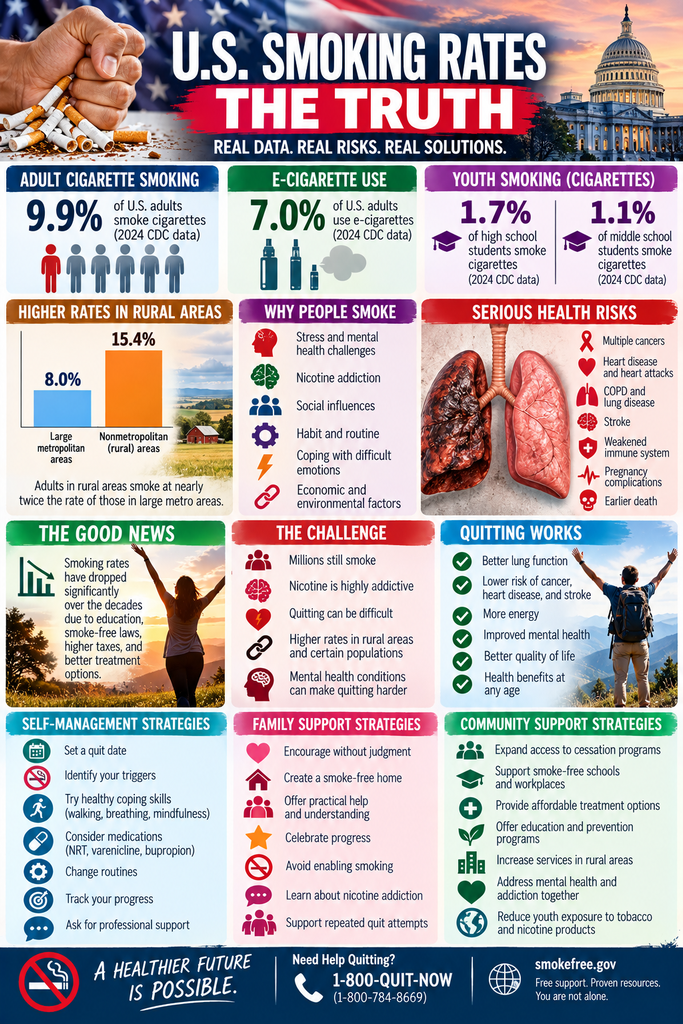
CDC National Health Interview Survey, 2024 data; published March 2026
9.9%
U.S. adults who smoke cigarettes
7.0%
U.S. adults who use e-cigarettes
Adult cigarette smoking by location
Percentage of adults, 2024
0%5%10%15%20%Large metropolitanNonmetropolitan
Adults in nonmetropolitan counties had nearly twice the cigarette-smoking prevalence of adults in large metropolitan counties.
The Truth Behind Declining Smoking Rates
The latest verified CDC figures show that 9.9% of American adults smoked cigarettes in 2024. This represents major progress compared with previous decades, when cigarette smoking was far more common.
However, declining cigarette smoking does not mean nicotine dependence has disappeared. Electronic cigarettes, nicotine pouches, and other nicotine products have changed the tobacco landscape.
The CDC also reported that 7.0% of adults used e-cigarettes in 2024. These figures should not be added together because some people use both cigarettes and e-cigarettes.
Why Smoking Rates Have Declined
Several public health developments have contributed to declining cigarette use:
- Increased awareness of smoking-related cancers and cardiovascular disease.
- Smoke-free workplace and public-space policies.
- Higher tobacco prices and taxes.
- Public education and anti-smoking campaigns.
- Improved access to nicotine replacement therapy and cessation medications.
- Greater availability of counseling and smoking cessation programs.
- Changing social attitudes toward cigarette smoking.
These improvements demonstrate that tobacco prevention and treatment can work. Nevertheless, the remaining burden of smoking is not distributed equally.
Who Is Still Smoking in America?
Smoking rates differ across geographic, socioeconomic, and health-related groups.
CDC research has identified higher cigarette-smoking prevalence among adults living in rural communities, people with certain disabilities, and individuals experiencing significant mental health symptoms. These differences reflect overlapping influences, including tobacco marketing, economic disadvantage, chronic stress, access to healthcare, and social environments.
People who smoke should not be stereotyped as lacking motivation or discipline. Nicotine dependence is a treatable condition, and some individuals face more barriers to quitting than others.
Are Teenagers Still Smoking?
Traditional cigarette smoking among adolescents has become much less common, but nicotine exposure remains a concern.
According to the CDC’s 2024 National Youth Tobacco Survey:
- 1.7% of high school students reported cigarette smoking within the previous 30 days.
- 1.1% of middle school students reported cigarette smoking within the previous 30 days.
- 5.9% of middle and high school students combined reported current e-cigarette use.
- Flavored nicotine products remained especially common among youth who used e-cigarettes.
These findings show that the products young people use are changing, even as conventional cigarette smoking declines.
Nicotine exposure during adolescence can affect brain development and increase the risk of dependence.
Why Nicotine Addiction Is So Difficult to Overcome
Nicotine activates nicotinic acetylcholine receptors in the brain and influences dopamine signaling involved in reinforcement and reward.
Repeated nicotine exposure can produce neuroadaptations that contribute to dependence. When nicotine levels fall, withdrawal symptoms may develop.
Common symptoms include:
- Irritability and frustration.
- Anxiety or restlessness.
- Difficulty concentrating.
- Increased appetite.
- Sleep disturbances.
- Strong cravings.
- Depressed mood.
Smoking also becomes associated with everyday routines. A cigarette after coffee, during a work break, or following a stressful interaction can become a learned behavioral pattern.
Successful treatment often addresses both physiological withdrawal and the habits associated with smoking.
Health Consequences of Cigarette Smoking
Although fewer Americans smoke, cigarettes remain a major preventable cause of illness.
Smoking increases the risk of:
- Lung cancer and multiple other cancers.
- Chronic obstructive pulmonary disease (COPD).
- Coronary artery disease and heart attacks.
- Stroke and peripheral arterial disease.
- Respiratory infections and impaired lung function.
- Pregnancy complications.
- Poor wound healing and other health problems.
Secondhand smoke also exposes nonsmokers to harmful chemicals, increasing the risks of cardiovascular and respiratory disease.
Quitting smoking offers meaningful health benefits at any age, including for individuals who have smoked for decades.
Self-Management Strategies for Smoking Cessation
Quitting is often more successful when individuals combine behavioral strategies with evidence-based treatment.
Develop a Personal Quit Plan
- Identify smoking triggers. Recognize emotional, environmental, and social situations associated with smoking.
- Choose a quit date. Establish a realistic date and prepare for situations that may trigger cravings.
- Consider cessation medications. Nicotine patches, gum, lozenges, varenicline, and bupropion can reduce withdrawal symptoms and cravings.
- Practice coping skills. Walking, breathing exercises, mindfulness, and other activities can help manage urges.
- Change established routines. Replace smoking-associated habits with healthier alternatives.
- Monitor progress. Track smoke-free days, money saved, and improvements in physical health.
- Prepare for setbacks. A return to smoking does not erase previous progress. Review triggers and adjust the treatment plan.
The CDC reports that combining behavioral counseling with cessation medication can more than double the chances of successfully quitting compared with attempting cessation without these treatments.
When selecting medication, consider medical history, contraindications, pregnancy status, and individual preferences.
Family Support Strategies
Family support can make an important difference during nicotine withdrawal and long-term recovery.
Family members may not fully understand why someone continues smoking despite knowing the risks. Education about nicotine dependence can reduce blame and improve communication.
Helpful family strategies include:
- Encourage without criticizing. Avoid shaming, threats, or repeated lectures.
- Recognize withdrawal symptoms. Irritability and mood changes may occur temporarily during cessation.
- Create a smoke-free home. Reduce secondhand smoke exposure and environmental triggers.
- Offer practical assistance. Help arrange appointments, transportation, or access to cessation resources.
- Celebrate progress. Recognize milestones without setting unrealistic expectations.
- Support healthy activities. Encourage walking, hobbies, stress management, and social connection.
- Avoid enabling smoking. Do not routinely purchase cigarettes or encourage smoking during stressful situations.
- Support repeated quit attempts. Encourage renewed treatment rather than treating a setback as failure.
Families should understand that quitting is a process, not simply a test of determination.
Community Support Strategies
Reducing smoking rates requires more than individual motivation. Communities must make prevention and treatment accessible.
Effective community strategies include:
- Expanding affordable tobacco cessation counseling.
- Improving insurance coverage for FDA-approved cessation medications.
- Providing free or low-cost nicotine replacement therapy where available.
- Supporting smoke-free schools, workplaces, and public spaces.
- Offering educational programs about nicotine dependence.
- Increasing access to treatment in rural and underserved communities.
- Integrating smoking cessation into mental health and addiction treatment.
- Supporting youth tobacco prevention programs.
- Providing culturally and linguistically appropriate cessation services.
- Developing public health campaigns that address nicotine addiction without stigmatizing people who smoke.
Healthcare professionals can routinely assess tobacco use, offer treatment, and connect patients with cessation resources.
The CDC recommends ongoing support, including follow-up appointments and treatment adjustments when previous attempts have not been successful.
The Connection Between Smoking, Stress, and Mental Health
Many people describe smoking as a way to relieve stress. Nicotine can temporarily reduce withdrawal discomfort, creating the impression that smoking is calming.
However, this relief may reinforce dependence because nicotine withdrawal itself can contribute to irritability and anxiety.
People experiencing depression, anxiety, PTSD, or substance use disorders may face additional challenges when quitting. Treatment should address these concerns rather than assuming that smoking cessation must wait until every other condition has resolved.
Integrated behavioral healthcare can support nicotine cessation while continuing appropriate mental health or addiction treatment.
The Truth About Vaping as an Alternative
E-cigarettes generally expose users to fewer combustion-related toxicants than conventional cigarettes when they switch completely, but vaping is not harmless.
E-cigarettes can maintain nicotine dependence, expose users to potentially harmful substances, and create additional concerns for adolescents and pregnant individuals.
For adults who smoke, completely switching away from combustible cigarettes may reduce exposure to certain harmful chemicals, but dual use does not eliminate smoking-related risks.
In the United States, e-cigarettes are not FDA-approved smoking cessation medications. FDA-approved medications and behavioral counseling remain established treatment options.
What the Future of U.S. Smoking Rates May Look Like
Continued progress will depend on preventing nicotine initiation, helping current smokers quit, and addressing disparities in treatment access.
Future public health efforts should focus on:
- Reducing cigarette smoking among populations with persistently high prevalence.
- Preventing youth nicotine dependence.
- Expanding access to cessation treatment.
- Supporting people with co-occurring mental health and substance use conditions.
- Addressing tobacco-related health disparities.
- Monitoring emerging nicotine products and their health effects.
The goal should not simply be to achieve lower smoking statistics. It should be to reduce preventable illness, improve quality of life, and make effective treatment available to everyone who wants to quit.
Conclusion: The Real Story Behind U.S. Smoking Rates
The United States has made substantial progress in reducing cigarette smoking. With adult cigarette use at 9.9% in 2024, the country has moved far beyond the era when smoking was widespread and socially normalized.
Nevertheless, nicotine dependence remains a serious public health challenge, especially in communities where economic hardship, mental health concerns, tobacco exposure, and limited healthcare access create additional barriers.
Self-management helps individuals recognize triggers, manage withdrawal, and build healthier routines. Family support provides encouragement, understanding, and smoke-free environments. Community support makes evidence-based treatment, education, and prevention resources more accessible.
The most important truth is that declining smoking rates do not mean the work is finished.
Every person who successfully quits smoking represents more than a statistic. They represent an opportunity for better health, greater independence from nicotine, and a healthier future.
Smoking rates are falling, but lasting progress requires compassion, prevention, treatment, and continued support.
Smoking Cessation Resources
The following resources provide free or confidential help:
- National Quitline: 1-800-QUIT-NOW (1-800-784-8669).
- CDC: How to Quit Smoking.
- National Cancer Institute: Smokefree.gov.
- Text support: Text QUITNOW to 333888 for cessation resources.
Frequently Asked Questions and Answers
1. What percentage of Americans smoke cigarettes?
According to the CDC’s 2024 National Health Interview Survey, approximately 9.9% of U.S. adults smoked cigarettes. Although this represents a substantial decline compared with previous decades, millions of Americans continue to experience nicotine dependence and smoking-related health risks.
2. Are smoking rates declining in the United States?
Yes. Cigarette smoking has declined significantly over the past several decades. Public education, tobacco taxes, smoke-free policies, improved awareness of health risks, and smoking cessation treatments have contributed to this progress. However, nicotine dependence remains a public health concern.
3. Why are fewer Americans smoking cigarettes?
Several factors have contributed to declining smoking rates:
- Greater awareness of smoking-related diseases.
- Increased cigarette prices and tobacco taxes.
- Smoke-free workplaces and public spaces.
- Access to smoking cessation medications.
- Public health education and prevention campaigns.
- Changing social attitudes toward cigarette smoking.
These efforts have helped many Americans avoid starting smoking or successfully quit.
4. Which populations have higher smoking rates?
Smoking prevalence varies by geographic location, income, education, disability status, and other factors. Rural communities and some populations experiencing mental health challenges have historically reported higher smoking rates.
These differences are influenced by tobacco marketing, chronic stress, social environments, and unequal access to healthcare and cessation resources.
5. Why are smoking rates higher in rural communities?
Rural communities may experience higher smoking rates because of limited healthcare access, economic challenges, tobacco-related social norms, and fewer smoking cessation programs.
In 2024, approximately 15.4% of adults in nonmetropolitan areas smoked cigarettes, compared with 8.0% in large metropolitan areas.
Expanding affordable cessation services can help address these disparities.
6. Are teenagers still smoking cigarettes?
Yes, although traditional cigarette smoking among teenagers has declined considerably.
According to the CDC’s 2024 National Youth Tobacco Survey, approximately 1.7% of high school students and 1.1% of middle school students reported smoking cigarettes within the previous 30 days.
However, vaping and other nicotine products remain important concerns among young people.
7. Is vaping replacing cigarette smoking?
Electronic cigarettes have become an alternative nicotine product for some adults and adolescents.
In 2024, approximately 7.0% of U.S. adults reported e-cigarette use. Some individuals use e-cigarettes exclusively, while others use both vaping products and conventional cigarettes.
Although vaping generally exposes users to fewer combustion-related toxicants than smoking cigarettes, it is not risk-free and can maintain nicotine dependence.
8. Why is nicotine so addictive?
Nicotine affects brain receptors and stimulates dopamine and reward pathways.
Repeated exposure can lead to physical dependence. When nicotine levels decrease, withdrawal symptoms may include:
- Irritability and anxiety.
- Difficulty concentrating.
- Strong nicotine cravings.
- Restlessness.
- Sleep disturbances.
- Increased appetite.
These symptoms help explain why quitting smoking can be challenging even when someone understands the health risks.
9. What are the most serious health risks associated with smoking?
Cigarette smoking increases the risk of several serious medical conditions, including:
- Lung cancer and other cancers.
- Chronic obstructive pulmonary disease (COPD).
- Heart disease and heart attacks.
- Stroke.
- Peripheral arterial disease.
- Respiratory infections.
- Pregnancy complications.
Smoking also damages blood vessels and contributes to chronic inflammation. Long-term exposure can significantly reduce life expectancy.
10. Can someone recover from years of smoking?
Yes. Quitting smoking provides meaningful health benefits regardless of age or smoking history.
After quitting, circulation and lung function may improve, and the risks of cardiovascular disease, cancer, and other smoking-related illnesses decrease over time.
Although some damage may be permanent, stopping smoking can slow disease progression and improve quality of life.
11. What is the most effective way to quit smoking?
Evidence-based smoking cessation treatment typically combines behavioral counseling with medication when appropriate.
Effective options include nicotine replacement therapy, varenicline, and bupropion.
Additional strategies include identifying triggers, developing coping skills, establishing a quit date, and participating in counseling or support programs.
Combining counseling and medication generally produces better quit outcomes than either approach alone.
12. What self-management strategies help people quit smoking?
Self-management involves recognizing nicotine dependence and developing healthier responses to cravings.
Helpful strategies include:
- Setting a realistic quit date.
- Identifying emotional and environmental triggers.
- Practicing mindfulness and relaxation techniques.
- Exercising regularly.
- Establishing consistent sleep routines.
- Using cessation medications when appropriate.
- Tracking progress and celebrating milestones.
- Seeking professional help when cravings become difficult to manage.
A structured quit plan can improve confidence and support long-term recovery.
13. How can family members support someone trying to quit smoking?
Family members can provide encouragement, understanding, and practical assistance.
Helpful approaches include:
- Avoiding criticism, blame, or shame.
- Creating a smoke-free home.
- Understanding nicotine withdrawal symptoms.
- Encouraging professional treatment.
- Participating in healthy activities together.
- Celebrating progress.
- Supporting renewed quit attempts after setbacks.
Positive communication and patience can help individuals remain motivated throughout the cessation process.
14. What role do communities play in reducing smoking rates?
Communities can reduce tobacco-related harm by improving prevention, education, and treatment access.
Important strategies include:
- Providing affordable cessation programs.
- Supporting smoke-free environments.
- Offering tobacco prevention education in schools.
- Expanding mental health and addiction treatment services.
- Increasing access to nicotine replacement therapy.
- Supporting rural and underserved populations.
- Promoting public awareness of smoking-related diseases.
Community support is especially important for individuals who face financial or healthcare barriers.
15. Is smoking connected to anxiety, depression, and stress?
Yes. Smoking and mental health concerns frequently occur together.
Some individuals smoke because they believe nicotine reduces stress or anxiety. However, nicotine withdrawal can itself produce irritability and anxiety, creating a cycle in which smoking temporarily relieves withdrawal symptoms.
Integrated treatment that addresses both nicotine dependence and mental health can improve recovery outcomes.
16. Does quitting smoking improve mental health?
For many individuals, successful smoking cessation is associated with improvements in anxiety, depression, stress, and overall psychological well-being.
Withdrawal symptoms may temporarily affect mood, but these effects usually improve.
People with existing mental health conditions should receive appropriate support and continue their prescribed treatment during smoking cessation.
17. What happens if someone starts smoking again after quitting?
Returning to smoking does not mean treatment has failed permanently.
Nicotine dependence is often difficult to overcome, and some individuals require multiple quit attempts.
After a setback, individuals can identify what triggered smoking, strengthen coping strategies, and consider additional counseling or medication.
The goal is to learn from the experience and continue working toward cessation rather than responding with shame or discouragement.
18. Is secondhand smoke dangerous?
Yes. Secondhand smoke contains toxic substances that can harm people who do not smoke.
Exposure increases the risk of heart disease, stroke, and lung cancer in adults. Children exposed to secondhand smoke may experience increased respiratory infections, asthma attacks, and ear infections.
Maintaining smoke-free homes and vehicles helps protect family members and others from exposure.
19. Will cigarette smoking eventually disappear in the United States?
Smoking rates may continue to decline, but eliminating cigarette smoking remains a complex public health challenge.
Nicotine dependence, economic disparities, mental health conditions, tobacco marketing, and limited treatment access can slow progress.
Continued investment in prevention, cessation treatment, and public education will be important for reducing tobacco-related illness and death.
20. Where can Americans find free help to quit smoking?
Several organizations provide free smoking cessation information and support.
- National Quitline: 1-800-QUIT-NOW (1-800-784-8669).
- Smokefree.gov: www.smokefree.gov
- CDC: How to Quit Smoking
- American Lung Association: www.lung.org
These resources offer quit plans, educational materials, counseling referrals, and information about evidence-based treatments.
Video: