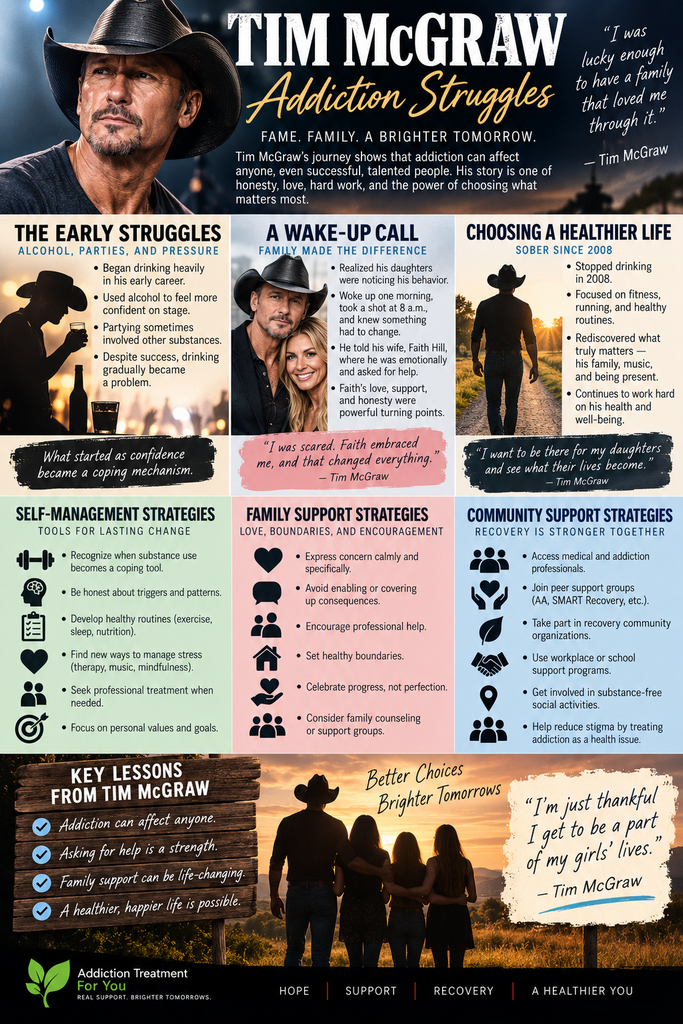
Country music superstar Tim McGraw built a career around hit songs, sold-out concerts, and a public image of confidence. Behind that success, however, McGraw has openly discussed a period when excessive drinking and partying were affecting his life and relationships. His journey toward sobriety demonstrates how addiction can develop even while someone remains professionally successful—and how self-management, family support, and a healthier environment can contribute to lasting change.
When Drinking Became a Problem
McGraw has described drinking heavily during his career and has acknowledged that his partying also involved other substances, although he has generally avoided publicly identifying them. Early in his career, he sometimes relied on alcohol before performing because he was shy and found that drinking made him feel more confident onstage. Over time, that behavior became a pattern.
This progression illustrates an important feature of problematic substance use: something that initially appears to help with anxiety, confidence, stress, or social situations can gradually become a coping mechanism that is difficult to control.
McGraw eventually recognized that his drinking was adversely affecting his life. He has said that people around him were worried, but an especially important realization came when he recognized that his daughters were old enough to notice his behavior.
The Moment He Knew Something Had to Change
One of McGraw’s most revealing descriptions of his alcohol problem came years after becoming sober. He recalled waking one morning, taking a shot of alcohol around 8 a.m., and realizing that he still had to wake his children.
Instead of continuing to conceal what was happening, McGraw went to his wife, fellow country music star Faith Hill, and admitted where he was emotionally and behaviorally. He recalled being frightened and described how Hill embraced and supported him at that moment.
That admission represents a critical recovery principle: asking for help can interrupt the secrecy and isolation that often allow addiction to continue.
Faith Hill and the Importance of Family Support
McGraw has repeatedly credited Hill with playing an important role in his decision to change. He has recalled her making it clear that his partying had gone too far and has said he feared losing what mattered most—not his money or career, but his family.
Their three daughters also became a powerful source of motivation. McGraw wanted to be present as they grew up and to see what their lives became.
Family support, however, should not be interpreted as meaning that a spouse or children are responsible for “saving” someone from addiction. Recovery ultimately requires the individual’s participation. Loved ones can encourage treatment, establish boundaries, provide emotional support, and reinforce healthier decisions, but they cannot control another person’s recovery.
Sobriety and Building a Different Routine
McGraw stopped drinking in 2008. Fitness subsequently became a major component of his lifestyle. Rather than organizing his days around alcohol and partying, he incorporated running, structured exercise, and healthier routines.
Exercise can be a valuable component of recovery because it may provide structure, stress management, social connection, and a healthy activity during times previously associated with substance use. However, exercise alone is not a universal treatment for addiction, and excessive exercise can create problems of its own.
For people with substance use disorders, an individualized recovery plan may also involve medical care, counseling, medications when appropriate, behavioral therapy, peer recovery support, and treatment for co-occurring mental health conditions.
Self-Management Strategies Inspired by McGraw’s Journey
McGraw’s experience offers several practical lessons about changing behaviors and developing a healthier lifestyle:
- Recognize patterns early. Pay attention when alcohol or another substance becomes necessary for confidence, relaxation, sleep, or coping.
- Be honest with yourself. Ask whether substance use is interfering with relationships, responsibilities, health, or personal goals.
- Tell someone you trust. Secrecy can reinforce addiction, while disclosure can open the door to support.
- Develop healthy routines. Exercise, adequate sleep, nutritious meals, hobbies, and structured schedules can support recovery.
- Identify triggers. Stress, performances, social events, loneliness, anxiety, and certain environments may increase cravings.
- Create alternative coping strategies. Breathing exercises, counseling, physical activity, music, journaling, or peer support can replace substance-centered coping.
- Seek professional treatment when needed. Recovery does not have to depend on willpower alone.
- Reconnect with personal values. Family, health, career, spirituality, creativity, and future goals can provide powerful reasons for change.
Family Support Strategies
McGraw’s relationship with Hill demonstrates how honest communication can become an important turning point. Families can support recovery while still protecting their own emotional health.
Helpful approaches include:
- Express concern calmly and specifically.
- Avoid humiliating or labeling the person.
- Encourage professional addiction assessment and treatment.
- Establish boundaries around unacceptable behaviors.
- Avoid repeatedly covering up substance-related consequences.
- Recognize and encourage healthy changes.
- Learn about addiction and relapse.
- Consider family counseling or support groups.
- Maintain personal self-care and emotional support.
A family member can be loving while still saying, “This behavior cannot continue.” Boundaries and compassion are not opposites.
Community Support Strategies
Long-term recovery becomes easier when people have supportive environments rather than trying to change in isolation. Community resources may include:
- Primary care and addiction medicine professionals.
- Mental health counselors and therapists.
- Outpatient or residential treatment programs when appropriate.
- Alcoholics Anonymous and other mutual-help organizations.
- SMART Recovery and other secular peer-support options.
- Recovery community organizations.
- Family support programs such as Al-Anon.
- Workplace employee assistance programs.
- Substance-free recreational and social activities.
Communities can also help by treating addiction as a health issue rather than a moral failure. Stigma can make people afraid to disclose substance problems or seek treatment.
Success Does Not Protect Someone From Addiction
One of the most valuable lessons from McGraw’s experience is that external success does not necessarily reflect what is happening internally. During his struggles, he was still a famous musician, husband, father, and performer.
He has explained that alcohol could initially make him feel more confident and powerful onstage. But something that appeared to help him perform eventually became a habit that threatened the relationships he valued most.
That distinction is important for families. Instead of asking only, “Is this person still functioning?” it may be more useful to ask, “What is this substance costing them?”
Turning Recovery Into a New Lifestyle
McGraw’s story is not simply about stopping alcohol. It is also about replacing an unhealthy pattern with a different way of living. Exercise, family, fatherhood, career goals, and greater attention to his health became important parts of that transformation.
Years later, McGraw has continued to credit Hill and his family with helping change the direction of his life. In more recent reflections, he has said that meeting Hill profoundly affected both his personal life and career.
Recovery does not mean every difficulty disappears. McGraw himself has described the process as not necessarily linear, acknowledging that life includes setbacks as well as progress.
Conclusion: Choosing What Matters Most
Tim McGraw’s addiction struggles demonstrate how alcohol can gradually move from something used for confidence or recreation into something that damages relationships and threatens the life a person has built. His decision to acknowledge the problem, accept support from Faith Hill, focus on his daughters, stop drinking, and develop healthier routines changed the direction of his life.
His experience also carries an important message for families: you can support someone without ignoring destructive behavior. Honest conversations, healthy boundaries, professional treatment, peer support, and community resources can work together to create an environment where recovery is possible.
Most importantly, addiction does not have to define the remainder of someone’s story. Recognizing the problem can be the beginning of change—and asking for help can be an act of strength rather than failure.
Frequently Asked Questions
Here are some common questions:
1. Did Tim McGraw struggle with addiction?
Tim McGraw has publicly discussed a period of heavy drinking and partying that became unhealthy and began affecting his personal life. He eventually recognized that he needed to change and stopped drinking in 2008.
2. What substance did Tim McGraw struggle with?
McGraw has spoken most openly about alcohol. He has also referred generally to partying and drugs during an earlier period of his career, but it is important not to speculate beyond what he has personally disclosed.
3. Why did Tim McGraw drink before performing?
McGraw has explained that he was naturally shy and initially used alcohol to feel more confident before going onstage. Over time, drinking became increasingly connected with performing and his lifestyle.
4. When did Tim McGraw realize his drinking was becoming a serious problem?
One particularly important moment occurred when McGraw realized he was drinking early in the morning while also needing to take care of his children. He has described going to his wife, Faith Hill, and admitting that he was frightened and needed help.
5. When did Tim McGraw stop drinking?
McGraw has said that he stopped drinking in 2008. In subsequent interviews, he has continued to discuss the importance of sobriety, family, fitness, and healthier living.
6. How did Faith Hill help Tim McGraw?
McGraw has repeatedly credited his wife, country singer Faith Hill, with providing important love and support. He has described turning to her during a vulnerable moment when he recognized how serious his drinking had become.
7. Did his daughters influence his decision to become sober?
Yes. McGraw has explained that recognizing his daughters were becoming old enough to notice his behavior was an important motivation for change. Being present for his family became more important than continuing his unhealthy lifestyle.
8. Did Tim McGraw go to rehabilitation?
McGraw’s public accounts have focused primarily on his decision to quit drinking, his family’s influence, and the lifestyle changes he made afterward. Details about someone’s private medical treatment should not be assumed unless that person has publicly confirmed them.
9. How did Tim McGraw replace drinking in his daily life?
Physical fitness became an important part of McGraw’s healthier lifestyle. He incorporated activities such as running and structured workouts while paying greater attention to his overall health.
Exercise can support recovery, but it should not be considered a replacement for professional addiction treatment when treatment is needed.
10. How did sobriety affect Tim McGraw’s career?
McGraw continued recording, touring, acting, and performing after stopping alcohol. His experience challenges the idea that alcohol or drugs are necessary for confidence, creativity, or success.
11. What self-management strategies can be learned from Tim McGraw’s journey?
Useful recovery strategies may include:
- Recognizing unhealthy substance-use patterns.
- Identifying emotional and environmental triggers.
- Being honest with trusted people.
- Developing structured daily routines.
- Using healthier methods of managing stress.
- Exercising and maintaining healthy sleep habits.
- Avoiding environments strongly associated with substance use.
- Seeking professional treatment when necessary.
- Staying connected with supportive people.
- Remembering personal reasons for choosing recovery.
12. What can families learn from Faith Hill’s role in his journey?
Families can provide encouragement without accepting destructive behavior. Loved ones can communicate concerns, establish healthy boundaries, encourage treatment, and remain supportive when someone chooses recovery.
However, spouses and children should never be made responsible for keeping another person sober.
13. How can families support someone struggling with alcohol?
Families can educate themselves about alcohol use disorder, encourage professional assessment, communicate without humiliation, establish boundaries, avoid covering up serious consequences, and seek counseling or family support for themselves.
14. What community resources can help someone struggling with alcohol?
Community support may include addiction medicine professionals, primary care providers, therapists, outpatient or residential programs, Alcoholics Anonymous, SMART Recovery, recovery community organizations, and family-support programs such as Al-Anon.
15. Is exercise enough to overcome alcohol addiction?
Not necessarily. Exercise can provide structure, improve well-being, reduce stress, and create a healthy alternative activity, but alcohol use disorder is a medical condition that may require professional treatment. Counseling, behavioral therapies, peer support, and FDA-approved medications can also be appropriate.
16. What does Tim McGraw’s experience teach about high-functioning addiction?
Someone can appear professionally successful while experiencing serious problems with alcohol or drugs. Career achievement does not necessarily mean substance use is controlled. Families should consider changes in behavior, health, relationships, responsibilities, and ability to control consumption rather than judging the problem solely by outward success.
17. Why is asking for help important in recovery?
Addiction often thrives in secrecy. Telling a spouse, family member, physician, counselor, or other trusted person can create an opportunity for treatment and accountability. McGraw’s decision to tell Faith Hill what was happening illustrates the importance of honest communication.
18. Can family support prevent relapse?
Family support can strengthen recovery, but no family member can guarantee that another person will remain sober. Recovery belongs to the individual. Families can provide encouragement, maintain boundaries, recognize warning signs, and help connect the person with professional resources.
19. What is the biggest lesson from Tim McGraw’s sobriety journey?
One important lesson is that recognizing what substance use is costing you can become a powerful motivation for change. For McGraw, family, fatherhood, health, and being present for his daughters became stronger priorities than continuing his previous lifestyle.
20. What should someone do if Tim McGraw’s story reminds them of their own drinking?
Consider talking honestly with a healthcare professional or addiction specialist. Help does not have to wait until someone’s career, marriage, finances, or health completely collapse. Earlier intervention can reduce harm and provide more opportunities for recovery.
Video: Why Tim McGraw Had To Stop Drinking To Save His Family #motivation #timmcgraw